This morning, many people woke up concerned as they heard challenging news. In a closed door meeting last night, the House Republican Conference voted to greatly diminish the powers of the Office of Congressional Ethics.
Created in 2008, the Office of Congressional Ethics is an independent body that investigates ethics within the House of Representatives. After last night’s vote, ethics complaints and investigations will fall exclusively under the authority of the House Ethics Committee. In other words, congressional leaders in the House will be responsible for investigating themselves.
Democrats, other Republicans, and ethics watchdog organizations are speaking out today in concern. And this should concern us. This move shifts deterrents in harmful ways.
Until this shift, the Office of Congressional Ethics has worked in this way: A six-member outside board has overseen the office with a staff of investigators. When they receive a complaint, including an anonymous complaint, these investigators conduct confidential interviews and collect documents. They pass these onto the OCE board as evidence, and if the board concludes that there may be a potential violation of federal rules or laws, they refer the matter to the House Ethics Committee, which conducts its own review.
The House Ethics Committee may move forward with the concern or dismiss it, but either way, the Office of Congressional Ethics releases its report. This brings the complaint and the process out into the open after it has been investigated by an independent body.
It serves as a deterrent against poor ethics.
Without this in place, the public cannot have access to such information. The public may never learn about specific complaints which come to the House Ethics Committee. The public may never know if the House Ethics Committee chose to investigate or why that decision was made. Most importantly, it sets up a conflict of interest as congressional leaders are tasked with investigating themselves — and most of it, out of view.
When the House Republican Conference voted upon this shift last night, they said the decision was made in order to strengthen due process for representatives who are accused and to avoid anonymous complaints.
But without the ability to make anonymous complaints, whistleblowers are at risk.
The decision to gut the Office of Congressional Ethics removes the deterrent of a public report. Instead, it places a deterrent upon whistleblowers who cannot risk naming themselves.
When it comes to public morality and leadership, ethics matter. So do the right deterrents. These shifts in deterrents diminish the truth.
My partner is an astronomer, and a couple of years ago, I asked him a question I had never really thought about before. “Is there any reason that our calendar year starts on January 1? I mean, isn’t that date rather arbitrary?”
Our 365 day year is based on the earth’s revolution around the sun, but astronomically speaking, the year could start at any point on that revolution journey. It turns out that January 1 is a rather arbitrary date to reset our calendar.
I think about this every year when we cross over from December 31 to January 1. But I don’t find the arbitrary nature of the shift to be deflating. I actually find it to be heartening. As people agree upon a collective marker to honor change, the collective energy results in actual change.
We know that New Year’s resolutions don’t usually result in permanent shifts in our individual lives. That may be true, but an arbitrary marker does actually change things. Around the world, we have playful rituals to honor New Year’s Eve and the shift from one year to the next. The customs vary, but this arbitrary date does manage to connect the world. That certainly changes things.
But I recognize this too: When we observe this date together and put our collective energy toward rituals and purposeful reflection, we end up refreshing our hopes as well.
In many cases, challenges from our previous year remain firmly intact, but as we cross over a completely arbitrary marker, we somehow manage to reevaluate our relationship to those very challenges. We hope for new visions, and we resolve to work toward them.
So hats off to our arbitrary, agreed upon date and time. It makes me wonder what else we could shift if we continued to observe hope in collective ways.
This sermon was preached at Southminster Presbyterian Church in Taylor, Michigan and was focused upon Matthew 2:13-23. The audio recording is above and a written manuscript is below.
The Gospel According to Matthew begins with this statement: “An account of the genealogy of Jesus the Messiah, the Son of David, the Son of Abraham.” These are the very first words of Matthew’s Gospel. They usher in a long genealogy of the ancestors of Jesus, but they do much more than that. These words make great claims about Jesus of Nazareth.
These words name Jesus as the Messiah, the long awaited servant leader of the people. These words name Jesus as the the Son of David, the very one who will restore the lost Kingdom of David, though this Kingdom will be unlike any other. These words name Jesus as the Son of Abraham, one of us and one among us, for we are all children of Abraham.
That’s what these opening words say: “An account of the genealogy of Jesus the Messiah, the Son of David, the Son of Abraham. . . .” We might think of these opening words as a prologue for all that will follow, a grand narrative arc that will reveal who Jesus is and how Jesus lives.
Today, as we consider new beginnings on the first day of a new year, we can consider the beginning of this Gospel as well. We can consider the foundational claims it invites into our lives.
Jesus, the Messiah, the son of David, the son of Abraham.
These are indeed great words.
But this morning, I also find myself wondering. . . what if these were the only words we knew about Jesus? What if we only knew these titles, and that’s it? What if someone started this opening phrase for us, then handed us the pen and invited us to finish the story? How would we write it?
I imagine that with our human limitations, if we knew absolutely nothing of what comes next, we might write a very different story than the one Matthew wrote for us thousands of years ago. We might hear words like ‘Messiah’ and ‘Son of David’ and depict a king in the image of so many kings we have known throughout history. Perhaps like them, we would depict Jesus as king who chases after wealth and power. . . a king who wages war. . . a king who rules with an iron fist. . . and a king who exacts rage and revenge if anyone threatens his power and control.
We might make these assumptions about Jesus if we heard he was the Son of David, the ancestor of an ancient king, and knew absolutely nothing else. But if we depicted Jesus in this way, we would greatly mistaken. Instead, we would be describing someone much more like King Herod, a king who had a great impact upon Jesus in his early life.
Today, as we ponder the beginning of the Gospel of Matthew and ponder the beginning of a new year, we are also invited to ponder the beginnings of Jesus’ life among us. Our scripture text speaks to those beginnings and gives us a fuller picture of who Jesus is and how Jesus lives. It reveals what kind of Messiah, Son of David, and Son of Abraham Jesus will be.
Jesus was born among us, never found in luxury or fine clothes. He was born to young, impoverished, unmarried parents. On his first night of life, those parents laid him in a manger to sleep, a dirty feeding troth for animals, because there was no room at the inn where they hoped to stay. Newly born into the world, Jesus was deeply loved, but he was born that night as an outsider without sufficient shelter. Jesus did not have refuge.
Perhaps this birth would have gone completely unnoticed, but other outsiders received it as life-changing news. Shepherds, filthy from the fields, came to see him and rejoiced. And as Jesus grew just a bit more, mysterious magi from a foreign land arrived in Bethlehem to bring him gifts and pay him homage.
His birth might have gone unnoticed, but it was heralded as good news, most readily by the people who were frequently forgotten and relegated to the margins. A great shift was underway, and the young Jesus was the harbinger of its hope.
But it didn’t take long for this news to find its way into the halls of power as well, for Jesus was born in a region governed by a king determined to hold onto power at all costs. Herod was a client king of Rome, and he ruled on behalf of Rome, one of the largest empires the world has ever known. Jesus was born in Bethlehem of Judea, a land occupied by this empire. Jesus did not have refuge.
Having observed a great star, an intriguing sign in the sky, those wise magi from the East traveled first to King Herod with a question that caused him to shake in his bones. They entered the halls of wealth and power, and asked Herod directly, “Where is the child who has been born King of the Jews? For we observed his star at its rising, and we have come to pay him homage.”
This question ignited great fear and insecurity in Herod. Frantically, he called together all the chief priests and scribes of the people and inquired of them of where the Messiah was to be born. They read scriptures to him and said that the Messiah would be born in Bethlehem of Judea.
That is precisely what Herod wanted to hear, though his heart was set on destruction rather than celebration. He called those wise magi to him and asked when they first observed the star. Then he sent them to search diligently for the child and to report back to him, indicating that he also wanted to pay him homage. But instead, with fear in his heart, Herod sought to destroy Jesus and anyone who stood in his way. Jesus did not have refuge.
Those wise magi found the young child, and they did pay him homage. They offered him gifts of great significance – gold, frankincense, and myrrh. But they did not return to Herod as he had demanded. Instead, they were warned in a dream not to return. They left for their own country by another road.
But they were not alone in this dream. Asleep, Joseph also had a dream which awoke him to the danger of Herod’s intentions. Joseph heard these words, “Get up, take the child and his mother, and flee to Egypt, and remain there until I tell you; for Herod is about to search for the child to destroy him.”
Can we imagine how upsetting this warning must have been? Joseph had recently watched the wise magi give gifts to the young Jesus. But now, the life of the child, the greatest gift of all, was in grave danger. Though he was born the Messiah, the Son of David, and the Son of Abraham, there was suddenly no place of refuge for Jesus in the land of his birth. Joseph, Mary, and Jesus were now refugees on the run, fleeing for their lives.
They moved in great haste to Egypt, a land associated with Israelite slavery and the Exodus. They sought safety there as God had called them to do, though this sudden move must have disrupted nearly every aspect of their lives.
Then, in one of the most challenging portions of scripture, we learn that Herod continued to exact his rage and revenge upon other families as well. When he learned that he had been tricked by the wise magi, he was infuriated. In a horrifying set of actions, he killed all the children in and around Bethlehem who were two years old and younger, grieving their families who wailed and would not be comforted.
The birth of Jesus brought great joy to those who could receive it as good news, but Jesus was also born into a world where greed and power lie in waiting. Truly, this Jesus, without refuge for much of his life, was revealed to be one of us and one among us. He is the Son of Abraham who knows the terror and grief of the world. This Jesus, cast out from his homeland as a child, was revealed to be a refugee. Yet he is also the Son of David, a king who serves the people rather than the terror of empire. This Jesus, scorned and marginalized throughout most of his life, is revealed to be God with us. He is the Messiah, the one we’ve been waiting for.
This is who Jesus is, and this is how Jesus lives.
And when we ponder this — who Jesus is and how Jesus lives — a question arises for us: In light of this revelation, Whose will we be, and how will we live?
We are called, not only to recognize who Jesus is, but to follow him and his way. We always have choices before us. We too can chase after greed and a firm grip of power over others, or we can love our neighbors who are suffering. We can choose to walk alongside others and work together to end that suffering, and we can participate in the Kingdom of God where people and places continually shelter one another in refuge. Today I wonder, will the Church be a community of refuge?
As we enter the beginning of a new year, these foundational claims of the life of Jesus can be invited into our lives in new and richer ways. And so we close, not with an ending but with a beginning.
“Our own planet is only a tiny part of the vast cosmic tapestry — a starry fabric of worlds yet untold. Those worlds in space are as countless as all the grains of sand on all the beaches of the Earth. Each of those worlds is as real as ours. In every one of them, there is a succession of incidents, events, occurrences, which influence its future: Countless worlds; numberless moments; an immensity of space and time.
“On our small planet, at this moment, here we face a critical branch point in history. What we do with our world right now will propagate down through the centuries and powerfully effect the destiny of our descendants. It is well within our power to destroy our civilization and perhaps our species as well. If we capitulate to superstition or greed or stupidity, we can plunge our world into darkness deeper than the time between the collapse of classical civilization and the Italian Renaissance. But we are also capable of using our compassion and our intelligence, our technology and our wealth, to make an abundant and meaningful life for every inhabitant of this planet; to enhance enormously our understanding of the universe and to carry us to the stars.”
– Carl Sagan from Carl Sagan’s Message to Humanity
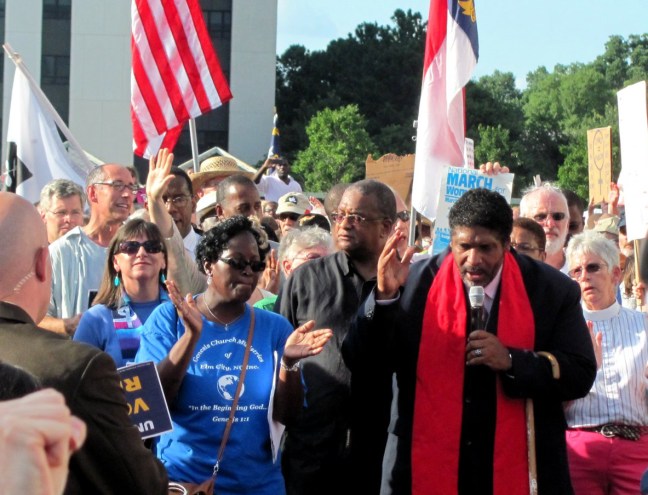
[The Rev. Dr. William Barber II addresses people at a Moral Monday rally. Wikimedia Commons]
Yesterday, I spent some time reading about the Moral Monday movement in North Carolina. Do you know about it?
Starting in 2013, a broad coalition of residents in North Carolina began public demonstrations to speak against a number of state legislative actions which were harming human lives and curtailing democracy. These demonstrations called state government officials and residents to greater moral commitment and decisive, collective action.
The demonstrations were part testimonial as people shared how they have been impacted personally by the loss of voting rights and access, the defunding of public education, harmful changes in labor laws, and unjust realities in the criminal justice system.
The demonstrations also included direct actions. Over the course of several weeks, about a thousand people volunteered themselves for arrest as they entered the legislative building, a location where they were not permitted to protest. These actions gained a great deal of attention from the press and moved hearts and minds, at times, cutting across historically entrenched lines of race, class, religion, and partisanship.
While I am only beginning to learn about this movement in greater detail, I am curious to know more. I imagine there are various pieces to celebrate, consider, and critique, but I wonder if the Moral Monday movement might offer some important visions and lessons for us as we consider this question:
How do we change public discourse about morality and values, so that we honor justice and equity for our neighbors through tangible, collective actions?
Here are some links for your consideration. I’d like to hear from you too. What do you think?
Rev. Dr. William Barber, one of the primary leaders of the Moral Mondays movement, also gave a powerful speech this summer at the DNC Convention. “I don’t come tonight representing any organization,” he started, “but I come to you about faith and morality.” He certainly brought that message home as he talked about justice and reviving “the heart of democracy.” Have a watch and listen:
I am grateful to invite the Rev. Karin Wright to share with us as a guest blogger on Smuggling Grace today. Her story below is quite powerful and sweet.
A Story in Honor of Matthew 1:18-25
19 Joseph her husband was a righteous man. Because he didn’t want to humiliate her, he decided to call off their engagement quietly.20 As he was thinking about this, an angel from the Lord appeared to him in a dream and said, “Joseph son of David, don’t be afraid to take Mary as your wife, because the child she carries was conceived by the Holy Spirit.21 She will give birth to a son, and you will call him Jesus, because he will save his people from their sins.” … When Joseph woke up, he did just as an angel from God commanded and took Mary as his wife.(Matt 1:19-21, 24)
We have about 70 head of sheep. We normally lamb (have babies born) in April which often makes Easter very hectic. My husband is extremely practical and forcibly unsentimental about the adorably cute lambs. He believes they should have as little intervention as possible from us. They are employees not pets. They earn their keep by grazing and lambing in the fields.
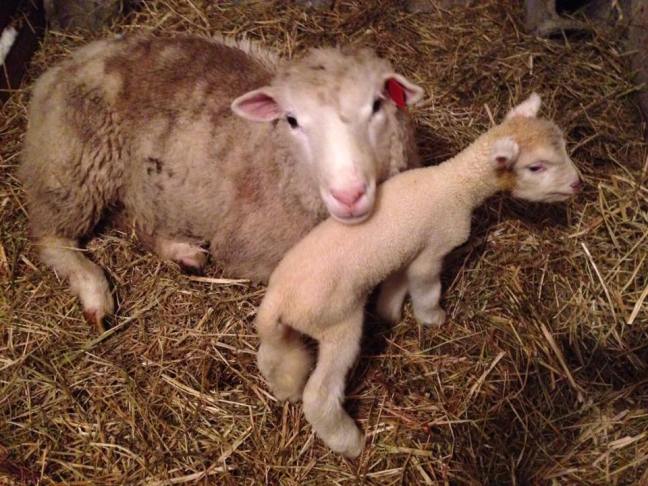
Last week, we had a December lamb. In the middle of a snowstorm (well, during a lull between two squalls – same difference). It was bitterly cold and we were expecting worse weather later on. He went out later in the day than he wanted to check on the sheep with his mother, my informant. He noticed one of the ewes looked like it had a lamb but had not passed the afterbirth yet. So a recent birth! The first time mother is wandering around with the flock towards the barn, but the shepherd sees no baby. They start methodically searching the pasture, my mother in law taking the tree line and my husband taking the opposite edge. Suddenly, she notices her son jump the fence and run through the pasture towards a lump taking off his coat and his sweatshirt as he goes. Quickly he wraps the new lamb up in the shirt that was closest to his body and therefore warmest.
They took the lamb into the barn and my husband – a fairly likable, easy-going man – began barking orders to his mother for a bucket of very hot water to be brought to him. The first bucket wasn’t warm enough. She balked, not wanting to scald the lamb, but my husband was resolute demanding it be very hot, saying the mother ewe’s body would have been 102 degrees. He kept checking the lamb’s throat to feel for any warmth or signs of life. This lamb was very close to death. With the right temperature in the bucket, the lamb was submerged and rubbed over and over. The shepherd went to fetch the mother while my mother-in-law kept rubbing the lamb for what felt like ages but was really just a few minutes. Soon, the lamb started to rouse and move around. The mother was brought into the stall and began to call for its baby. The lamb responded! It tottled over to its mother and began to nurse!
I would like to be doe-eyed and tell you how heroic, decisive, and wonderful my husband is and how I fell a little more in love with him because of the person he is – which would be true – but I didn’t hear this story from him. He only said to me, “We had a lamb! We named her December.” My humble, unsentimental husband named the lamb. Sometimes, we don’t expect new life. Still, we have to find a way to respond to the arrival of newness in faith. New life can seem so fragile and be quite time sensitive, even requiring extensive work. Yet, life is resilient and we can sometimes find hope in the smallest of successes – like a lamb surviving its first 6 hours of life.
Like the story of scripture above, my husband’s name is Joseph. I found that very fitting this week.
Rev. Karin A. Wright is an Interim Pastor in Northeast Ohio where she lives with her husband, Joe, and their four sons. As a general reminder to pastors, we are sheepdogs for the Shepherd. Go where you are sent.
Photos by Joe Wright — The first is of December and her Mom. The second is of Lynn Wright, Joe’s father and Karin’s father-in-law.
While reading yesterday, I stumbled upon a powerful poem that I have never encountered before. This poem is by Alejandro Romualdo, a Peruvian poet. He says,
Pray, Christian, pray. But let your God
not starve my comrade to death.
But let your God
restore the land to those who work it.
But let your God
not bury forever in hell
those whose hearts are full of hatred
because they love.
Pray, Christian, pray.
O, if only the fire of your hell might warm
the dreams of the poor!
And if you see my comrade
dead of rage against the earth,
and if you see him, night and day,
dead of cold under the sky,
and if you know that on the morrow
he will be persecuted
and kicked
and put against a wall and shot
at dawn,
do not pray, Christian, do not pray,
for words accomplish nothing.
-Alejandro Romualdo
“Reza, cristiano, reza” in Poesia integra (Lima: Viva Voz, 1986), 112.
Today, we are seeing videos and tweets from civilians in Syria who are sharing their last words as the violence of death comes to them and their children. For years, we have seen this genocide coming from Syrian and Russian state powers but have largely done nothing.
And immigrants and refugees in this nation, including Syrian refugees, are fearful that they will face violence on our shores as well.
Our prayers matter, but our humanity requires us to be a part of the very prayers we make. Our prayers may be the vehicle by which we are called to action.
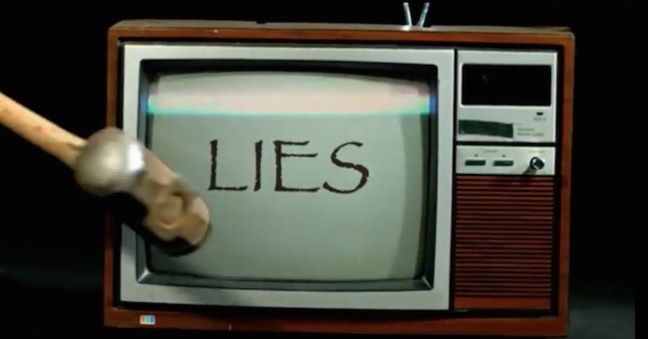
After incendiary titles and divisive headlines have grabbed our social media newsfeeds for months, fake news has become a topic in the news itself. A number of sites have begun to make a great deal of money “reporting” stories that are completely false, and they continue to spread across social media sites like wildfire. These headlines move beyond traditional political spin; instead, they put wild conspiracy theories and complete falsehoods into the world under the banner of news.
I think we need to call these stories what they really are – propaganda. Behind the people who believe and share these stories are authors and social architects who lie quite purposefully in order to ignite particular forms of action from us. Most frequently, they capture our beliefs in order to gain power for themselves, and often, they do so by turning groups against each other. We need to pay attention, and we need to check facts. These stories can have dangerous results.
We need only look as far as Pizzagate.
As you may know, a man brought a semi-automatic assault rifle into Comet Ping Pong last week, a pizza establishment which is popular with many families in Washington D.C. He said he was there to personally investigate the claims of a story. The conspiracy theory behind this story, wild as it was, had gained a remarkable level of traction and became propaganda through fake news.
Pizzagate does not get its name from the horrific incident last week in the pizza restaurant. Instead, many months before, #Pizzagate became hashtag after community of people on Reddit concluded that Hillary Clinton, staffers from her campaign, and other high profile politicians were involved in a child sex trafficking ring at Comet Ping Pong. They came to these conclusions after combing through the hacked emails of John Podesta, Hillary Clinton’s presidential campaign manager, and reading a remarkable amount into the details. The conspiracy theory took on a life of its own and was “reported” through fake news sites. These were shared by a large number of people, and perhaps most concerning, tweeted by Michael Flynn, President Elect Trump’s new appointee for Secretary of Defense.
This story is obviously false. After firing his assault rifle in the restaurant, the man only left with police after he was convinced it was not true. Thankfully, no one was hurt physically, but this was quite frightening for people who were present. It is still troubling for families who frequent the restaurant.
After it happened, my friend and colleague Eric Peltz wrote this comment on Facebook. I share it with his permission:
“Friends, the election of Trump (and most importantly, the validation of his rhetoric) has led to a gunman walking into a restaurant my family and my congregants frequent. If the safety of my children won’t urge you to take the time to diversify your news sources so you’re seeing reports of the hundreds of hate and conspiracy-induced crimes that are happening, it’s hard to believe that you care about me or my children in any real way. How will you stand up against violence and keep my family safe?”
We need to pay attention. We need to check facts. We need to speak out.
We must realize that some social architects will continue to use these kinds of stories as propaganda to solidify power and ignite action from us. We have to see it and name it as what it is.
Last week, Reply All, a podcast hosted by Alex Goldman and P.J. Vogt, released a tremendous episode which reports how Pizzagate moved from rumor, to news, to an entire online community, to action. Check it out the link and give it a listen.
There is enough. There is enough. There is enough.
In a time of profound anxiety, ignited by tangible threats to wellbeing, I find myself pondering the need for these words. Most of the time, the largest part of me actually believes them. By those words, I mean this:
There are truly enough resources — money, time, passion, compassion, power, skills, drive, ingenuity, creativity, nimbleness, intelligence, relationships, vision, and courage — to look straight at injustices, dismantle their power, and create justice toward lasting forms of change.
There is enough.
But is there will?
As we know, some benefit socially and economically from the very injustices that marginalize, imprison, and kill others. We are up against entrenched systems of power that many will not want to break.
But if the will is there — if there is enough desire to dismantle such systems and build forms of justice — we will have to use every fiber of our being to organize our resources. Journalist Shaun King says it this way: The level of our organization will have to rise to the level of our outrage.
That tiny thing you’re great at. . . is a big deal. Really. When shared with others purposefully and resourcefully, it catalyzes change. So what is it?
– Do you have an ability that seems tiny only because it comes so naturally to you?
– Do you engage with it regularly to the point that it doesn’t seem like a real gift?
– Do you forget to marvel at it because it seems so routine or easy?
Well, that’s a gift you need to put into the world. Purposefully.
That’s a gift that seeks greater expression in your community, neighborhood, nation, and world.
These days, when we see the great needs and concerns around us, and when we ponder our fears about needs and concerns to come, we can become absolutely overwhelmed. Our meager work and purposeful sharing can seem. . . well, tiny. It may feel that way, but. . .
That tiny thing? Do not underestimate what it can do.
– When placed strategically with the gifts of others, it can become organized change. It can become organized resistance. What resources can you bring uniquely — money, connections, abilities? Some of which come so naturally to you? Do all you can to make those things fit with the leadership and commitment of others. Look purposefully for where they can be placed alongside the great work that is already happening. Your tiny gift will easily multiply.
That tiny thing? Do not underestimate what it can do.
– When launched into the world with intention, that tiny thing may add a level of care that increases relational safety. Even if only for a moment, it matters. In this current climate, people are reasonably fearful and discouraged. Your tiny thing in a tiny moment may serve as a reminder of human worth and connection. It may provide a needed boost which encourages others to put their gifts into the world too.