
Here is a re-post of a humorous story I shared in 2018 — remember those before times? — back when X was still Twitter and had the capacity to save the day. Enjoy.
Never Step Into a “Staff Only” Elevator
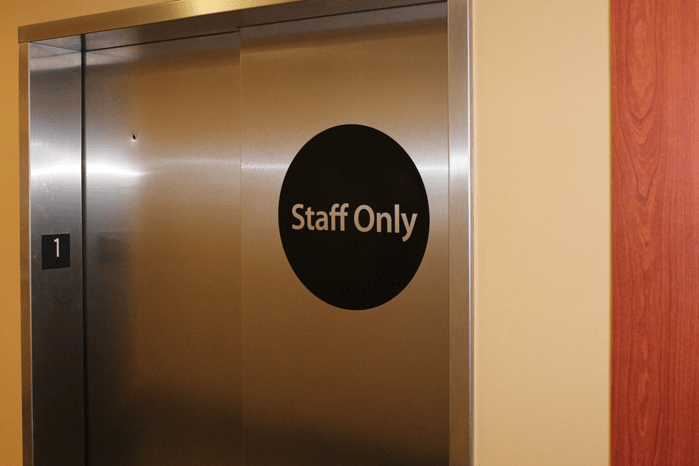
Have you ever left a City Council meeting, walked toward an elevator, read a sign that said “Staff Only,” pushed the button anyway, walked inside, watched the doors close, traveled down, then realized you’re completely stuck, then Tweeted your way out of it?
I have.
Move over, POTUS. I too can use Twitter for purposes for which it was never designed.
Yes, this really happened to me! Yes, it was embarrassing. And it has turned into a good story. (If you know me, surprise. I like that part).
Last month in Ann Arbor, I attended a very important City Council meeting. Despite some frustrating moments and comments, overall, the meeting moved in the direction we desired. This was certainly good news.
When that portion was over, I decided to leave. The meeting was still in session, and the City Council members had moved onto other business. So I decided to take the elevator down and walk back to my car. Now. . . which way did I come into the chambers. . .?
Here is a unique factoid about me: It’s mostly endearing, but on rare occasions, it can get in my way. That is, if I have things on my mind — especially if I’m anxious, but also, simply, if I’m pondering possibilities, as I was when I entered this City Council meeting — I don’t adequately pay attention to my surroundings.
In other words, when it was time to leave, I didn’t remember how I had come into the chambers. But never fear, here is an elevator! I remember coming up on an elevator!
It says, “Staff Only Elevator.”
“Surely, that means only during work hours,” I fatefully assume. “I mean, I came up on an elevator.”
I push the button, step inside, and choose the first floor.
I go down, and the doors swing open just as they should. But. . . I immediately recognize this isn’t where I’m supposed to be. Hmm. . . I suppose this was the wrong elevator after all. . . So I push the button, requesting that the doors close again so I can head back upstairs and try a different way.
The doors close.
And NOTHING.
That is, NOTHING HAPPENS. Because the doors are now irrevocably shut on the first floor, and no buttons are working. “Oh my goodness,” I realize, “This requires a badge.”
This just in: I have no badge.
I am the doof who stepped into a “Staff Only Elevator.”
I keep trying to push floor buttons to no avail. I see the red, EMERGENCY ONLY button, and with utter embarrassment, I begin to ponder what will happen if I push that. Will there be an alarm? Will I disrupt the City Council meeting that is still underway? Will emergency vehicles come? Will tomorrow’s news talk about this very important vote, then mention that the rest of the business was cut short when a firetruck arrived to save a person who took the wrong elevator?
I imagine people saying to me compassionately, “Oh, you must not have seen the sign that said ‘Staff only.’” And I ponder the truth, wondering if I would ever dare to say it aloud:
“Well, actually, I did see it, but due to my very poor spacial reasoning skills, I didn’t adequately remember the direction from which I entered the chamber. I only remembered coming up on an elevator, and here was an elevator, so. . .”
All of this felt mortifying to me.
But!
That’s when I remembered Twitter.
You see, friends, this very foolish error aside, I have a strong skill. I am an outside-the-box thinker! I remember, there is an entire community of people that uses a Twitter hashtag to hash out City Council meetings. #A2CityCouncil will be my saving day!
So I dare to craft an embarrassing, necessary tweet. I say,
“Okay, so this is verrrry embarrassing because I took an elevator that was for employees only, and now I’m on the first floor with an elevator door that won’t open. Can someone go push the elevator button on floor two so it sends me back up? #A2council”
And yes, to my further embarrassment, but even more to the necessity, people start retweeting this foolishness. And it works. The community makes a plan to collectively save me from my error (and just a little less dramatically than an emergency button) . In fact, a particular human was chosen by the community-at-large to push that button and send me back to the land of the living.
He was on his way when. . . oh, my goodness, I hear someone! An employee (you know, actual staff) was cleaning and talking on her phone right where I was. I started pounding on the elevator doors in an attempt to be just loud enough without scaring her. And that worked too.
She pushes the button to open the door, and as soon as I tell her what happened, she laughs and laughs.
I tweet again that I am free.
I walk out of that place, quite aware that I will never take a “Staff Only Elevator” again. And I tell you this tale, so that you will never follow in my not-able-to-go-anywhere footsteps.
We have a City Council meeting tonight. And God bless it it all, I’m going to pay attention to my entry point.












 Smuggling Grace