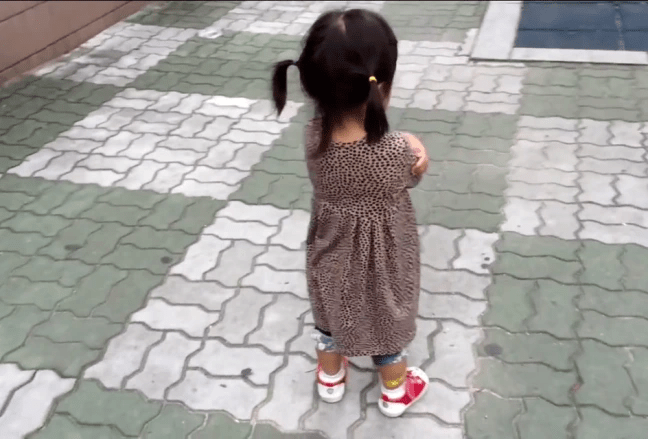
A toddler has her back to us with her arms crossed. She has brown hair in pigtails and is wearing a dress and red shoes. We will soon learn that these shoes are very squeaky.
Are you carrying stress today?
Perhaps, you didn’t sleep well, or you have a looming deadline, or you’re juggling a heavy load of responsibilities, or you’re troubled by the news, or you’re at wits end with your teenager, or you’re in a conflict with someone you love, or multiple expressions of these, or something else altogether.
Whatever it may be, you are worth wellness, space, grace, peace, insight, and connection.
And a moment of play serves as a reminder. Play reorients and grounds us in what is most true: We are loved and living in a world with lovely gifts, even as it contains real challenges.
Play changes our brains. It calms us and helps us feel more connected. It also shifts us away from our anxious reactivity, allowing us to use the higher levels of our brain functioning to solve problems.
So find a way to play a bit today, even if it’s just for a moment.
Today, I take my cue from a hilarious, adorable toddler. She has a really hard time continuing to sulk in that tantrum once she starts to delight in squeaky, red shoes. Enjoy this video:
This is a tough time to be in transition—any kind of transition. Whether you’re coming of age and looking for your first job, considering new educational opportunities, moving, dealing with needs of aging parents, contemplating a career change, watching your kids leave the house, making a big purchase, or navigating something else altogether, it’s simply a challenging time. It’s not insurmountable, but it’s difficult.
Why?
So much is changing in our nation, and much of it feels uncertain. That doesn’t mean everything is dire, though some things may certainly feel that way. Some of it is just in flux. From “I’m not sure what’s going to happen exactly” to “I’m seriously worried about _____,” everyone in transition is carrying more stress than usual.
I overheard someone say, “In the midst of this, I feel like I always sound so woe-is-me!” And I thought, “No… it’s woe is us.” This is a difficult time.
But we are also the people who can help one another. There is a we that is stronger and more present than woe. So if you’re in transition and aren’t sure where to place your weight, let your relationships uphold you.
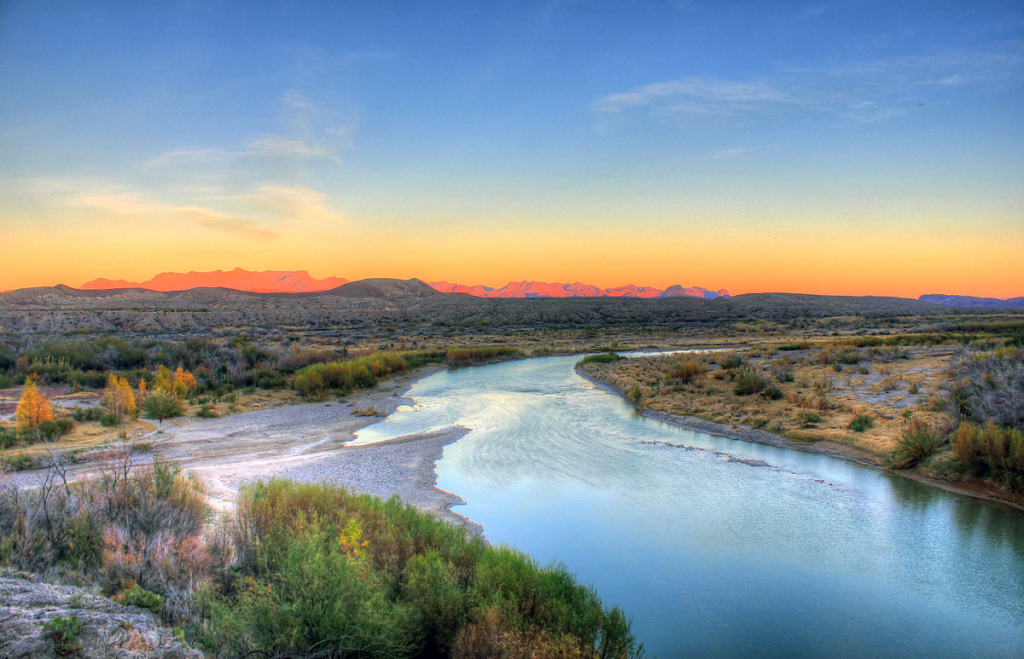
Rio Grande and the surrounding landscape; Wikimedia Commons
I was in a car near El Paso, Texas, when I saw another city nearby. At first, I wasn’t sure what it was, but then I realized it was Juárez, Mexico. The city buildings were grouped in two areas, but the landscape between them was exactly the same. It made me think about how arbitrary borders are. One area flowed naturally into the other, but the conditions on the ground in each city were vastly different.
I also spent some time at Big Bend National Park, where the Rio Grande flows, marking the border between Mexico and the United States. There was no visible difference in the terrain. The view I saw was one continuous landscape; there was no divide to mark one side as fundamentally different from the other.
We often think about nationality as a fixed category, as though borders are a natural part of our lives. But in reality, they’re entirely man-made—arbitrary lines drawn by people.
Of course, these borders function in very real ways with real consequences. We’ve decided that some people belong based on where they were born, while others are excluded. Some have determined that human rights and constitutional rights apply only to those born on one side of an arbitrary line, not to those born just across the border, even if it’s relatively nearby.
A friend’s cousin is currently facing a deportation order. He was brought to the U.S. when he was just six months old, and this is the only country he has ever known. He’s a Dreamer and has worked previously as an organizer to create pathways to residency and citizenship for people brought to the U.S. as children. All his family members are citizens or legal residents. But just a week ago, he was with his girlfriend and two children when ICE surrounded him and detained him. My friend and their family are raising funds for his legal fees. Would you consider contributing?
Why is it seen as more egregious for someone to exist on one side of an arbitrary line we’ve created, yet not egregious to deprive children of their father? Why is it considered a moral violation to live in a particular geographical location, yet not to banish someone forever from the only home they’ve ever known? Where does the moral harm lie?
Pictured Rocks National Lakeshore, Photo: Renee Roederer
Last summer, I had the pleasure of visiting Pictured Rocks National Lakeshore with one of my very favorite people. This stunning national park is located in the Upper Peninsula, near Munising, Michigan. There are many ways to experience the beauty of these rock formations, but the best views come by boat from Lake Superior.
We were on a sunset cruise, and it was gorgeous. After boarding the boat, we heard an announcement over the loudspeaker:
“Hello, my name is Braden, and I’ll be your captain on our sunset cruise tonight.”
My friend leaned over and whispered, “We’re old enough… to be captained… by a person named Braden.“
The Bradens are coming of age, and it’s a reminder of our own age.
I recently heard a perspective from a Dad of a Trans son that resonated with me. He said that too often, we make Donald Trump the main character of all that is unfolding.
This wasn’t an argument to minimize what’s happening—not at all. But it does highlight the ways we frame what is taking place. We all know how much the news focuses on Donald Trump, and I can’t help but see it constantly in my own life. Even when I’m at work, I glance at the bottom of my laptop screen, and there it is—“The Trump Administration” as a teaser, trying to get me to hover over those words and receive some “Breaking News.” But this Dad, who loves his son deeply and wants to keep Trans youth alive, as should we all, pointed out that it’s an extra wound to make Trump the main character of the harm he’s causing his son. His son should be the main character in his own story, and so should so many others who are deeply impacted by these words and policies.
The harm caused by Trump’s rhetoric, especially to marginalized communities, is undeniable. But by consistently centering him as the protagonist in this story, we diminish the actual people who are suffering. His son, in this case, deserves to be the main character in his own narrative, thriving and living fully.
This is also true when it comes to immigration, detention, and deportation. We need to center the stories of people like Kilmar Abrego Garcia, Mahmoud Khalil, and countless others whose lives have been upended by policies that target them. Just last week, a mother was deported to Honduras with her children, who are U.S. citizens. One of those children, facing stage 4 cancer, was sent away without needed medication. This is cruel and heartbreaking. These are the people who deserve to be the main characters in this story. Their stories—their struggles, their humanity—should be our focus as we tell these stories.
And let’s not forget about past moments, too. People were rightly outraged when then-candidate Trump made fun of a disabled reporter on the campaign trail. But how often did you hear that disabled reporter’s name—if ever? His name is Serge F. Kovaleski.
The media should be lifting up the voices of those who are being harmed as well as those who are working to uphold individuals and communities during times of crisis. These are the main characters of this moment in history. We certainly don’t look away. This isn’t about minimizing harm. But who are we centering? Let’s make space for the people who truly deserve to be the focus. Keep the main characters the main characters.
I was inside an arena during a university commencement ceremony. Since sportsball is also played here, there’s a central jumbotron, which allowed those of us in the “eagle’s nest” (the nosebleed seats, aptly named for the university’s Eagle mascot) to catch close-ups of students walking across the stage to celebrate the completion of their degrees.
More than once, the camera zoomed in on a student with a long, full red beard, not unlike one you might see in a ZZ Top concert. The first time I saw him, I thought, “That’s impressive.” Each time he appeared on screen, he’d make a “rock on!” gesture, and the crowd would cheer. I loved that this became a little routine throughout the ceremony. Then, at one point, he flipped his beard with a dramatic motion, much like someone tossing their hair over their shoulder. The applause grew even louder.
A plant grows in one direction, toward its lightsource. Public domain.
I sat facing the congregation, wearing a stole, listening to the organ prelude. Worship was about to begin.
As I approach my seventh year working in public health within a nonprofit, I can honestly say I love the path I’m on. It’s exactly where I want to be. Though it’s been a long time since I served as a pastor, I still lead pulpit supply frequently, filling in for colleagues when they’re away. I’ve also led several church retreats over the past year. While this is no longer where I spend most of my time, it remains an integral part of my upbringing and my sense of belonging.
As I listened to the organ prelude, my mind wandered to some of the most formative people in my life. They’ve been on my mind as I chart a new course, one added to the others. Though I’ve been writing daily for many years, I’m now working on my first book. I recently finished a chapter reflecting on my upbringing in a Presbyterian church.
Here’s a paragraph from that chapter:
I was raised by a Christian congregation, and that community became a chosen family and home in my life. When I share this, I don’t simply mean that I grew up attending worship services. For me, this was far more than a weekly routine. I was raised intentionally by St. John United Presbyterian Church in New Albany, Indiana. In that congregation, a whole circle of people decided to love me and treat me as if I were their very own daughter. It transformed the direction of my life.
As worship began yesterday, I thought about how there’s no way I’d be sitting here, about to lead this service, if it weren’t for those people. This role I’m in emerged simply and powerfully because I received so much love there.
I was thinking about how plants grow toward the sun. We can see them stretch in that direction. Could it be that we, too, grow in the places where love is shown to us?
Had I been surrounded by a different group of people, might I have developed roles I couldn’t have anticipated? And isn’t that why I also work in public health and nonprofit now? Because love found me there, too?
I enjoyed reflecting on these questions yesterday morning.
So, where is love showing up for you? And how are you growing and stretching toward it?