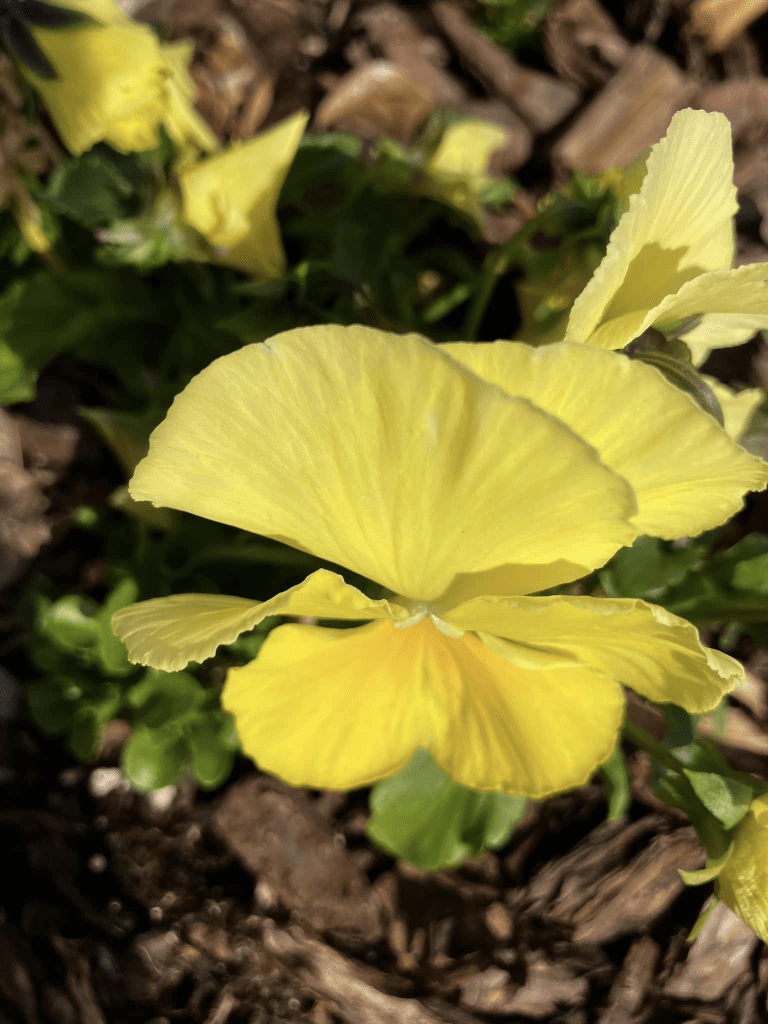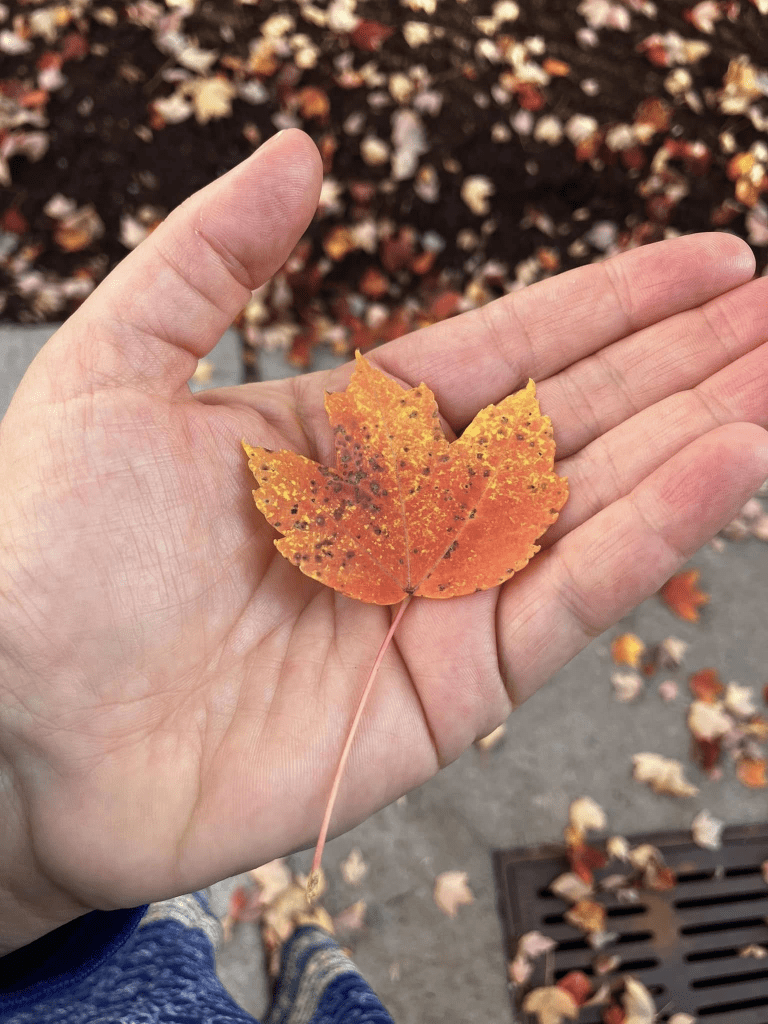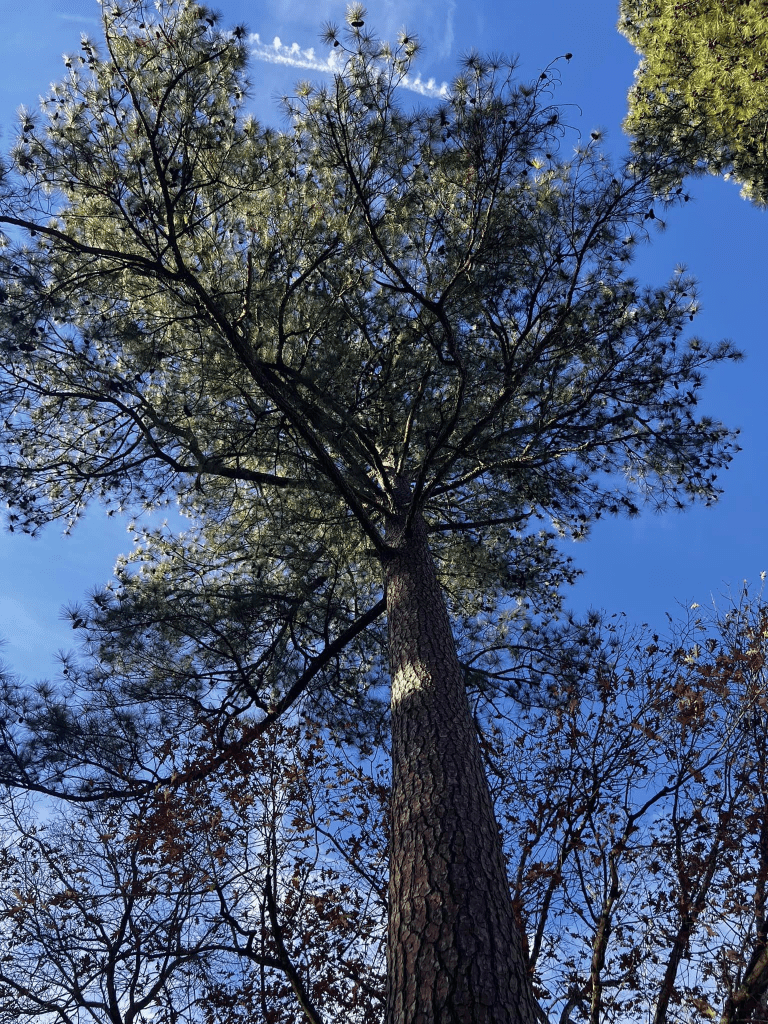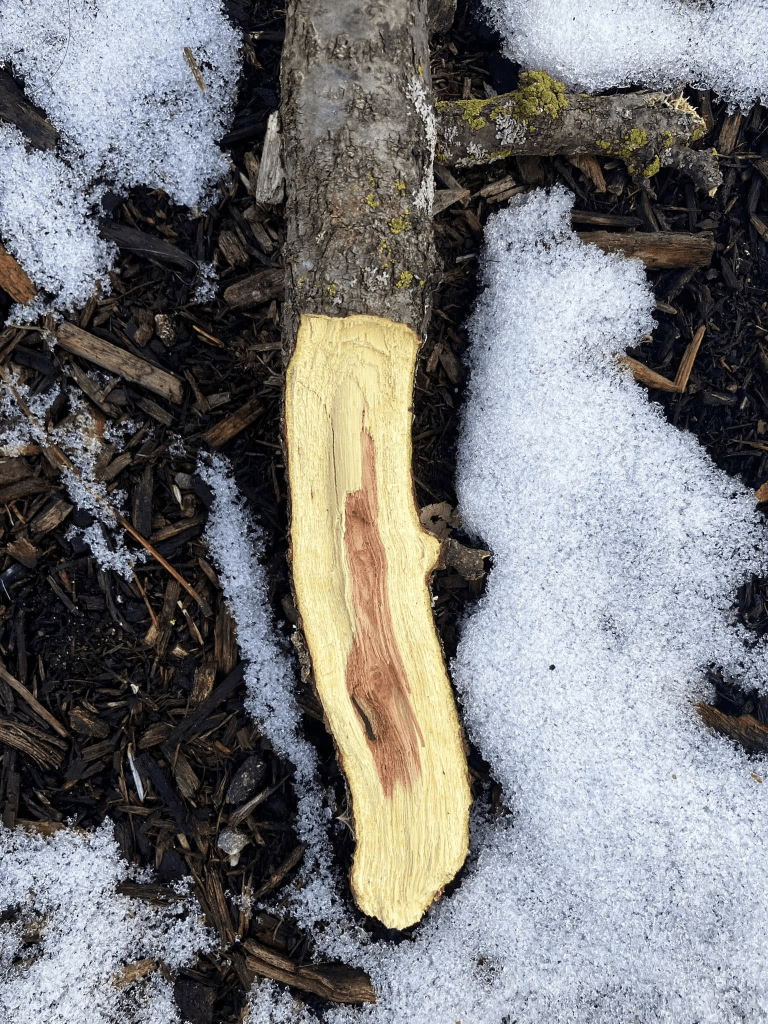







— Photos by Renee Roederer

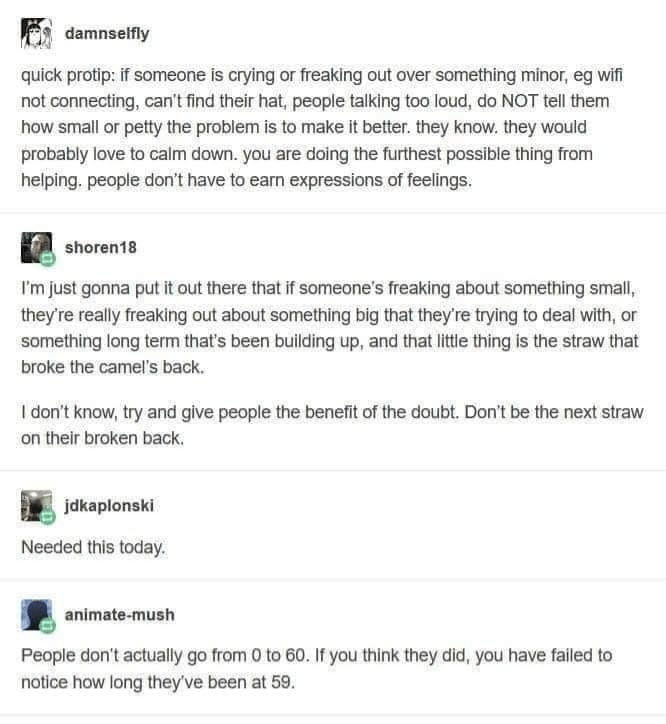
Image Text:
damnselfly
quick protip: if someone is crying or freaking out over something minor, eg wifi not connecting, can’t find their hat, people talking too loud, do NOT tell them how small or petty the problem is to make it better. they know. they would probably love to calm down. you are doing the furthest possible thing from helping. people don’t have to earn expressions of feelings.
shoren18
I’m just gonna put it out there that if someone’s freaking about something small, they’re really freaking out about something big that they’re trying to deal with, or something long term that’s been building up, and that little thing is the straw that broke the camel’s back.
I don’t know, try and give people the benefit of the doubt. Don’t be the next straw on their broken back.
jdkaplonski
Needed this today.
animate-mush
People don’t actually go from 0 to 60. If you think they did, you have failed to notice how long they’ve been at 59.

Here’s something that made me giggle.
I frequently fall asleep while listening to podcasts. Yesterday, Spotify dropped its annual Spotify Wrapped, where you get stats about how much you listened over the last year, and which are your top artists, songs, and podcasts.
I looked at my top five podcasts, and… there were some surprises. Right on top were three I listen to delightfully, deliberately, and consciously:
Stuff You Should Know
Radiolab
The Rest is History
But beneath those were
Smosh Reads Reddit Stories
Sherlock & Co
Not only do I have no recollection of hearing those. I’ve never even heard of them!
Clearly these come on while I’m sleeping.
— Renee Roederer

I wonder if you’ve ever had these feelings that I’m about to describe. If not, I hope that you will have them one day.
There is this palpable feeling in a relationship or set of relationships that have been reconciled after a difficult conflict or chapter of painful history. As that relationship moves forward, there are two distinct moments that bring an incredible sense of awe.
The first moment and first sense of awe is when you realize you’ve truly moved beyond the conflict. As you engage with one another, it becomes clear that the old story is no longer active. It’s not that the past wasn’t significant—it absolutely was — and it’s not that anyone has forgotten it. But now, the pain is no longer active. You’ve reached a point where there’s a completely new normal. And you think, “Wow, that place of pain we once had just isn’t here anymore. We’re in a new time.” You’re writing a different chapter now, and it’s obvious. This moment invites a deep sense of gratitude and awe.
The second moment and second sense of awe comes after even more time has passed. When you’re in each other’s presence, there’s a shared, unspoken awareness that things didn’t have to turn out this way, and it’s miracle that they did. This relationship is what it is now because everyone put in the work to make change and transformation possible. This invites gratitude and awe too. But that’s not all. Here’s what I want you to know if you’ve never felt this before: It feels wildly subversive, as if you are aware in each other’s presence of the gift of one another and how rare this is. And not only that. It’s this feeling that all of the pain, conflict, and trauma could not, in the end, keep you from loving one another. And you know, within your relationship or set of relationships, you are a subversive example to anyone who can see it.
It didn’t have to end up this way. Sadly, sometimes it doesn’t. Sometimes, pain remains.
But when it does end up like this, it’s one of the best feelings in the world. In my life, I can think of four different experiences of relational transformation like this. These weren’t small things, either; these are relationships that emerged from the other side of conflict, trauma, and estrangement, and all that comes with it. I realize that having four reconciling experiences of this magnitude may be more than most people experience in their lifetimes.
I would prefer not to have experienced the conflict, trauma, or estrangement, of course. But on the other side, the feeling is sacred and profound. It’s quite literally one of the best feelings I know.
And if you’re not there yet, please know that these moments can sometimes surprise you. If you’re not there, or can’t even imagine getting there (I wasn’t able to imagine it easily either) but still wish for it, know that even the desire to be reconciled is born of love. That desire is love at work. And when you put that love into the world—even if you can’t send it in the relational direction you wish you could — you place it somewhere and allow it to be active. That love is still real, and good things can come from it, for you and for others.
— Renee Roederer

I recently had the chance to join a church community in decorating a Chrismon tree. You may wonder how that differs from a Christmas tree. It’s quite similar, except all the ornaments — i.e. Chrismons — are Christian symbols. Members of the community chose a Chrismon from a bowl and then came to the tree one by one to hang their symbol.
While we were doing this, I invited everyone to reflect in one of two directions:
As we placed our Chrismons on the tree, these were the questions we held. This feels like an important time to think about hope, especially when hope it can feel so elusive.
I was reminded of an article by Dr. Dave Jensen, a theologian at Austin Presbyterian Theological Seminary, recently published in Windows. He wrote that hope isn’t the same as optimism. It “fosters attention to places that hurt: right here, right now.” Nor is hope simply realism. “It’s not the seasoned wisdom of checking our ambitions, modifying our dreams, or settling for what is ‘possible’ giving current realities. There is much in our culture that encourages truncated hope… Nothing new will emerge; accept things as they are.” He shares that “hope, instead, encourages us to see the present world differently.”
Sometimes that’s hard work. Sometimes it’s painful. And sometimes it’s beyond us. But maybe that’s when we lean into the hopes of others and know that their hope can carry us, too.
With all this in mind, how might you reflect on those questions today?
— Renee Roederer
Dr. David H. Jensen’s article is entitled, Living Hope, and is published in Austin Presbyterian Theological Seminary’s publication, Windows, Fall 2024.

There are times when we have to say no to what is being asked of us, even if it’s good and important, in order to say yes to the most central value we have.
We have to protect it, not only because it’s important to us, but because it might be the most important role we play in community.
We can’t say yes to everything. We are limited people.
Sometimes, we have to say no so we can keep saying yes.