There’s a moment before healing begins when all you can do is name the thing. Not fix it, not dress it up—just name it.
Sometimes, that’s the hardest part. Because when we name the grief, the loss, or the fear, we make it real. But we also take away its shadowy power. We begin to see it for what it is, and in that seeing, we create room for something new.
Whatever you’re facing, I hope you have the courage to name it. That’s where healing begins.
Once a month, I have the privilege of leading a spiritual service called Parables. Parables is a space designed especially for, with, and by people who have disabilities or are neurodivergent, and everyone is welcome. Each time we gather, there is a persistent reminder that we belong, and not because of what we do, but simply because of who we are.
Recently during the service, one of our community members brought a gift wrapped neatly in red paper with a bow. He placed it next to the nativity scene and said he’d think through the service about who he wanted to give it to. His grandparents had prepared it for him so he could share it with a friend.
When the time felt right, he made his choice. He handed it to me.
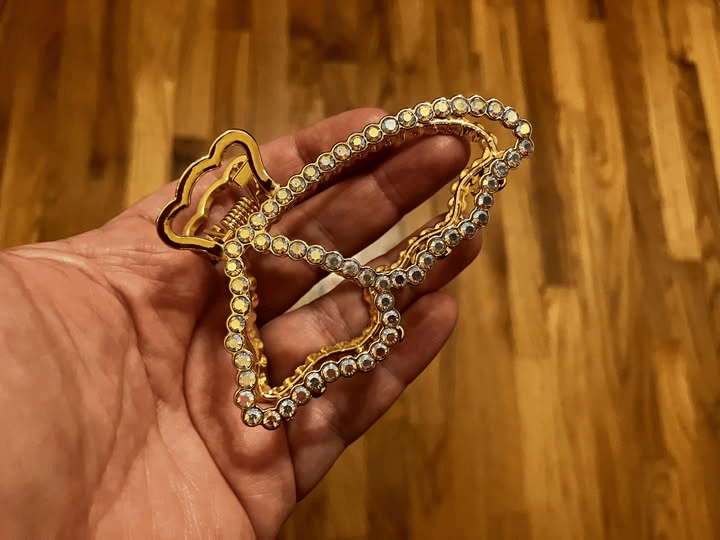
After the service, I unwrapped the gift to find a bejeweled butterfly clip for my hair. Very sweet.
Moments like these with all their small acts of care and connection remind me of what Parables offers each time we gather. It’s a space where belonging is on display and deeply felt.
A bejeweled butterfly clip. A reminder that I belong.
As we near the end of this calendar year, I find myself returning to the guiding question I set for 2024:
How expansive can a sense of home be?
I’ve explored this question in terms of place, but I’ve especially turned it toward people. Throughout 2024, I visited loved ones frequently, and I allowed certain places and certain people to stretch and deepen my internal sense of home. That experience of home is now both wider and richer.
But as this year comes to a close, I find a new question emerging:
Can home be… a time?
With this question, we might imagine ourselves in a past era when we felt especially at home or recall a chapter of our lives when we felt most fully ourselves. Those directions make sense for this question.
But I’m wondering about something else: Can home be a time when certain narratives have shifted—when they are no longer active, no longer tripping us up, no longer showing up in our thoughts, our bodies, or our actions?
Are we more at home when these narratives are firmly in the past?
“I’m not wanted.” “I’m not capable.” “That’s impossible.” “That’s foolish.” “My needs don’t matter.” “My needs can’t be spoken.” “I still feel guilty.” “I still feel ashamed.”
And more…
Certainly, these thoughts might bubble up from time to time. But if we can move into a new era, one where old childhood messages or operating narratives from relational trauma or conflict no longer dominate, do we feel more at home in ourselves?
Can home be a time when these narratives are no longer active?
Please note that the word snow contains the word no.
I’m kind of over winter.
And this is really bad because, astronomically speaking, it hasn’t even started yet.
Right now, I’m in my defiance phase. I go through this every year when the cold weather sets in. At first, I called it my denial phase, but that’s not quite right. I fully acknowledge it’s cold. I know the temperature will slap me in the face the moment I step outside. But I still refuse to wear a coat.
Why? Honestly, I don’t want to. I don’t want to bundle up. Maybe it’s my way of resisting the season itself—like I’m refusing to fully surrender to winter’s demands.
Of course, this changes nothing except my own comfort. And yet, I persist. I tell myself it’s because I’m only walking to the car or popping into the grocery store. The walks are short, I say. No need for all that effort. What a thoroughly Midwestern excuse.
But here’s the kicker: my fellow Midwesterners? They’ve succumbed. And it’s to their benefit. They’ve embraced their coats, their scarves, their gloves. Meanwhile, I’m still out here in my little rebellion, shivering on principle.
Why do I insist on having this winter defiance phase every year? I don’t know. But I do know it won’t last. Eventually, I’ll pull out my coat like a sensible person, zip it up, and brave the season the way I’m meant to.
Until then, I’ll keep marching through this odd ritual of resistance.
What about you? Do you have any little rebellions like this? A defiance phase of your own? Let me know. I’d love to hear it.
Would you consider finding some near you, creating a list, and sharing their websites with others so that people can donate, join their newsletters, or volunteer?
This language below comes from Google’s AI Overview:
Trauma bonding refers to a strong emotional attachment that develops between a victim and their abuser, often characterized by a cycle of abuse interspersed with moments of kindness, leading to a sense of loyalty and dependence on the abuser despite the harmful nature of the relationship.
Key points about trauma bonding:
Cycle of abuse:The abuser utilizes a pattern of alternating abusive behavior with brief periods of positive treatment, creating a confusing and addictive dynamic for the victim.
Fear and manipulation:The victim may feel fear, intimidation, and manipulation from the abuser, contributing to the bond.
Isolation:Abusers often isolate their victims from friends and family, further strengthening the dependence on them.
False hope:The victim may cling to the hope that the abuser will change and return to the positive moments, preventing them from leaving the relationship.
Where trauma bonding can occur:
Romantic relationships: This is the most commonly discussed scenario, where a partner is abusive towards the other.
Family dynamics: Children can experience trauma bonding with abusive parents.
Cult situations: Individuals within a controlling cult may develop a trauma bond with the leader. _________
Trauma bonding is a hallmark impact of narcissistic abuse. If you or loved ones are experiencing these kinds of dynamics, there are forms of help and healing. And those harmed are worth all the love and care they can receive.
Here’s a great video from Christina, a coach at @commonego on YouTube. She demonstrates how trauma bonding functions like an addiction, and how such a bond tends to form over time.