Over the last year, I’ve had the pleasure of supporting and cheerleading a movie that is about to go into production. It’s called “Under the Lights.” It’s directed by Miles Levin and has a star- studded cast.
A couple of years ago, Miles Levin directed and released a 12 minute long, award-winning short film with the same name. Sam, a teenager with epilepsy, is desperate to be just like any other kid, and he decides to go to prom, knowing that the lights will likely make him have a seizure.
Director Miles Levin is also a person with epilepsy, and years after the creation of the short film, this full-feature movie is going in production, having secured a talented cast and raised a great deal of money to make it happen. Miles Levin, the Epilepsy Foundation, and many others in our larger community are thrilled to support a film that will build epilepsy awareness with empathy.
Oh, and per my title, my name really is going to be in the credits. And I’m going to get to go to the premiere. (I’m really excited about this!) I’m proud of Miles and our wider community.
I’d love to show you the 12 minute short film: Here’s Under the Lights! Stay tuned for a longer movie in theatres in 2025.
A cup of McDonald’s coffee. Flickr/Westy48/Public domain.
When I was 7 years old, while my parents were at work, I spent each day of the summer with my Grandfather. And many days of that summer, he and I went to McDonald’s or Hardee’s so he could get coffee and I could get a kid’s meal. Inevitably, I would be excited, because what 7 year old doesn’t want a Happy Meal?
But once we were there, eventually things would take a turn for me. I would get so bored. After I ate that hamburger and fries, and probably got a toy, well beyond the time of excitement, my Papaw would still be drinking coffee. He was such a slow coffee drinker.
The cute thing about this — well, cute to me now, torturous when I was 7 — is that he was pretty playful about telling me he was “almost done.” That man was almost never almost done. I’d ask, “Can we go?” and he’d say, “I’m almost done. I have just a little bit more,” and the cup was 3/4 full.
If you’re a GenXer or Elder Millennial, you might remember that when we were little and at McDonald’s, you could turn in the seats and allllmost go a full circle. I’d turn that chair to the right 180 — snap — and turn that chair to the left 180 — snap — back and forth, making a toy of my seat, while this man sipped a cup of Joe, and a glacier may as well have moved outside. Of course, all these years later, I treasure the memory of my boring summer meals with Papaw.
One of my favorite aspects about my life is that I have a lot of families around the country that I like to visit. They each make up a big chosen family for me, and each of their houses feels like a home away from home.
A few years ago, one of the people said to me, “Don’t you drink like 5 cups of coffee a day?” I love the Keurig maker in their house and that glorious San Antonio brand of coffee they have. I realized this questioner was serious. “No, definitely no more than two,” I said.
Then it dawned on me that the confusion lies in how many times a day I warm up my coffee in the microwave. Oh my gosh, I am Papaw, I thought. I, too, drink it slowly. This person thought I was drinking forever, five cups a day. The glaciers are also moving through Texas.
Then last week, in a different location, I heard a little voice say, “Will you play with me?” and unthinkingly, I said, “Well, first, I want to finish my coffee. I’m almost done.” (Except I actually was almost done). And once more, I was Papaw’s double.
Life has an interesting way of making a throughline.
A blurry photo of the U.S. Capitol at night. Traffic is facing away from the building and coming in the direction of the viewer. Photo, Renee Roederer.
After finishing dinner, I crossed the street to get on the D.C. Metro, and as I walked along the crosswalk, the U.S. Capitol suddenly came into view. Since I’m not as familiar with the area, I didn’t expect that emergence, I smiled at the discovery and took a photograph.
But then, it suddenly in dawned on me that I was standing on a street corner on the very route that people took to march to the Capitol — that arrival that soon after, became an insurrection on January 6. It gave me pause. I was able to picture all of that in a new way, and it felt very real.
Last week, a friend sent one of my community groups a podcast recommendation. It’s the story of white supremacist race riot that took place in Wilmington, North Carolina in 1898, which then ended in a coup of the state government through rigged election. After that happened, these very legislators in North Carolina began to codify a series of laws that eventually came to be known as Jim Crow. The podcast is about how media was complicit in willingly distorting and then completely burying the story of what happened in Wilmington. People didn’t come to know about it again until recent years, because thankfully, Black writers left breadcrumbs of information for people to discover later.
Additionally, I’ve been noticing something taking place on my Facebook feed. I’m finding that there are a lot of beautiful and cute images showing up from accounts I’ve never followed — some look real, some look AI generated. Typically, they’re nature images. What’s the harm in sharing images like these?
To give one example, there was a beautiful photo (maybe real, I don’t know) from a group that called something like, Michigan Beauty. It showed up on my feed. I had never followed it, but there it was. I loved the image and thought, “Oh, that’s a group I would actually join.” So I went to join, and there were membership questions, including, “Do you live in Michigan?” and “What is your zip code?”
And I thought… Maybe this is getting us primed for the election, because I live in a possible swing state. Where do you live, so later, we can show you, not nature photos, but other media and alternative facts? Not necessarily on the page of “Michigan Beauty” but so you can be targeted with ads and the like?
No, thank you.
I probably wouldn’t have had that thought in the slightest, if I wasn’t also aware that I had never followed this group, yet it had emerged on my feed. (Did a FB friend like it? Was it paid for, like an ad? Some other way? Why is it on my feed?)
I’m not a conspiracy theorist. But I’m a realist. And I’m also still realistically hopeful at what we can create together, while being diligent. I think we need to be hopeful, but diligent.
I had the pleasure of spending the weekend with a precious six year old who is sweet, funny, cuddly, and so very playful. From the moment she wakes up to the moment she goes to bed, she is constantly engaging herself and others in pretend play. “Let’s play snake!” (with a jump rope). “Let’s play campsite!” (gets out the sleeping bag). And my favorite of the weekend, “Let’s play roommates with these paper dolls! This is the bed, this is the kitchen, and this is the bathroom. Pretend that every time you go into a room, I surprise you because I’m already there.” Each surprise scenario led to so many giggles.
This had me wondering — and I giggled myself about this — what if people my age had the exact same mindset and way of being in the world, but with this-age things?
Pretend you’re having a midlife crisis!
Act like you’re about to sign for a mortgage, but the previous owners back out of the deal!
Okay, you’re about to make dinner, but you realize you don’t have enough energy, so you just go to Chipotle.
Maybe that wouldn’t quite work. But her way of being is inviting. I think we could do with more imagination, possibility-thinking, and believing that things could turn out beautifully, even magically. We just have to be open to them, try them out, engage in the right kind of scenarios, and together, make them so.
A couple weeks ago, we initiated a series on attachment styles. If you missed the introductory post, you can go there, and then you can learn more about the core wounds of each insecure attachment style. From these, we can consider what our attachment styles are, as well as how these impact our internal feelings and relationships.
To recap a little, there are four primary attachment styles. There is the secure attachment style, and three insecure attachment styles — 1) anxious preoccupied, 2) fearful avoidant (also sometimes called disorganized or anxious-avoidant), and 3) dismissive avoidant. There is a great deal of psychological research around these, first championed by John Bowlby and Mary Ainsworth, and a lot of interest in recent years.
Attachment styles develop very early in life, though we can work to heal these patterns. From these patterns, we often build narratives around the scaffolding of our own fears, and they can cause friction in our relationships.
Today, I’ll invite us to learn again from Thais Gibson, a therapist who has done tremendous work in these areas. These videos are about protest behaviors. What are these? They care coping mechanisms, triggers, and behaviors we take to the manage closeness and space in relationships, particularly during times of stress and conflict.
I chose today’s direction because I had a chance to learn more about this star cluster at the Smithsonian Natural History Museum (one of my favorite places!) This video shares similar star stories across cultures. Beyond these two featured, additional cultures thought of the Pleiades as sisters in the sky.
This time last year, after the loss of two dear people, just five days apart, I encountered the poem, “Adrift,” by Mark Nepo. It’s a touching expression of what it feels like to live with feelings of grief and gratitude, both together. I’d love to share it today.
Adrift by Mark Nepo
Everything is beautiful and I am so sad. This is how the heart makes a duet of wonder and grief. The light spraying through the lace of the fern is as delicate as the fibers of memory forming their web around the knot in my throat. The breeze makes the birds move from branch to branch as this ache makes me look for those I’ve lost in the next room, in the next song, in the laugh of the next stranger. In the very center, under it all, what we have that no one can take away and all that we’ve lost face each other. It is there that I’m adrift, feeling punctured by a holiness that exists inside everything. I am so sad and everything is beautiful.
Is there a word, phrase, or image that stands out to you?
A paper calendar image of February (wrong year though — it’s not Sunday!) Public domain.
Eh, forget New Year’s Resolutions. This is a whole different month than that first one.
But let’s think again…
Is there something you want to learn about?
Is there something you want to explore in self-growth?
Is there something you want to try?
Is there something you want to let go of?
Is there a way to be kinder to yourself?
Is there a practice you want to pick up?
Is there a large goal that you might move forward in small increments — maybe 5, 10, or 15 minutes a day?
Today is a good day to start any of these. We just have to set an intention and commit (and be kind to ourselves if we miss a day here or there, or if these come and go).
Duolingo’s logo, with its cute, green owl named Duo
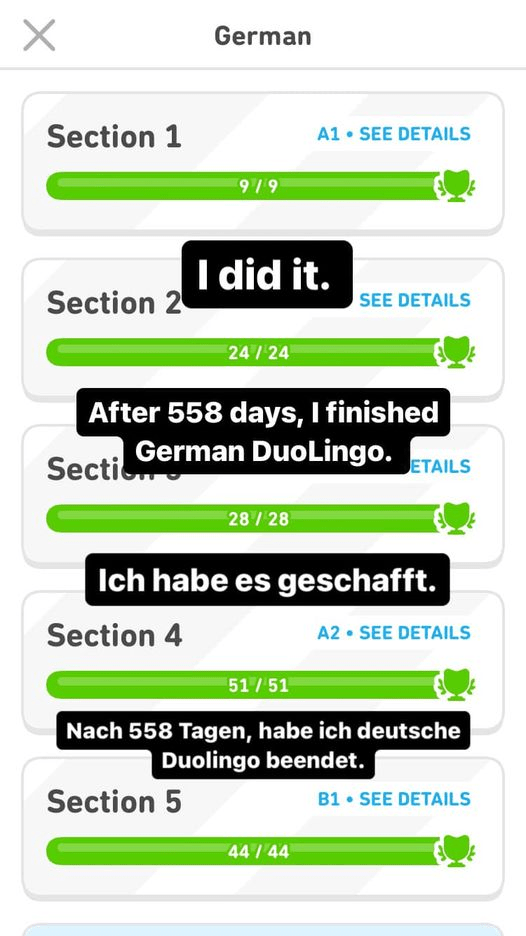
For more than a year, my most consistent, deeply practiced hobby has been learning German. I’m proud to say that in a couple of months, I’m going to finish German Duolingo, which has taken me solidly into B1 proficiency. There is still so much to learn, of course. C1 and C2 are considered to be fluency, but B1 is considered “independent usage,” meaning that I’ve met the minimal requirements to be hired for a job (no plans to do that!) and my travel German is now chef’s kiss.
I was reflecting on one aspect about this this week that feels particularly interesting and satisfying. I’ve felt a shift take place in my brain. When I practice these Duolingo exercises, in my hearing and speaking of the German I know, I’m not doing any internal translating. That is, I’m not hearing German and reminding myself what it means in English in order to respond. Of course, when you’re first learning, you take time to do this, word by word and phrase by phrase. Over time, that process becomes shorter and shorter, but now, most German words I know just have meaning to them, not translation to them.
What I mean is that a given word or phrase simply means what it means. The German word or phrase doesn’t mean the English word or phrase to me. The German word or phrase carries meaning itself in my mind without that step. I can hear, for instance — pulling open Duolingo now for it to give me a random sentence —
Das Handtuch aus Baumwolle ist ganz weich,
and I am picturing a soft, cotton towel. I am not saying internally to myself, “The hand towel made of cotton is very soft,” which is how that translates word for word.
The German carries meaning itself without translation.
And this has me thinking… outside of language learning, can we develop proficiency in other aspects of life so that they naturally begin to carry meaning? For instance, sometimes you know a person well enough to read their body language without speaking a word. That carries meaning without translation. Or perhaps listening to your intuition… those moments when you simply know something, somewhat unexplainably? That’s also an example. Or what else? Having a dream and instantly knowing what it means to you? Or getting into a flow with work or a hobby, and it feels like energy is moving through you rather than words?