Dahlia Dottie

A photo of me, holding a yellow dahlia.

I’d love to tell you about the sweetest part of yesterday.

Though she isn’t pictured, I want to tell you about Dahlia Dottie. That’s not her real name, but hers is alliterative in the same way.

I was riding my bike today through my local park, and I stopped where these gorgeous dahlias were. Dottie was there, and she told me that her sister is the gardener of these beautiful flowers. I asked if I could take a few photos of them.

Then she asked, “Can I take a photo of you with them?”

“Sure,” I said. I thought it was going to be one photo.

And what followed was a ten minute photo shoot of poses she wanted me to take with the flowers. I think I have 14 pictures of me on my phone with these dahlias.

“Look over your shoulder like this.”

“Ooh, let’s get one with your bike.”

“Let’s get rid of that yellow flower for a second. Get in close to these red ones. Wouldn’t that be a great photo to send at Christmas?”

Obviously, I expected none of this, and the whole interaction was so delightful. I’m only posting a few pictures from my Dahlia photo shoot, but I’m really grateful for the ways Dahlia Dottie uplifted my day.

Anything for Bear

Bear, the beloved Golden Doodle, lying on my foot.

This is Bear. We adore each other.

We really do. Any time I head over to the house where he typically is, he has such a visceral, full-bodied display of joy upon seeing me and greeting me. Full of smiles externally, and full of oxytocin internally, I am also full of pets and boops for this sweet boy.

Last night, I was standing near a table in conversation with people in my community, when I noticed this furry muppet come near and place himself on my foot. Sometimes, he just wants to touch me while snoozing.

My foot fell asleep and it was the best my-foot-is-asleep possible. I just let this happen, of course.

Anything for Bear.

Renee Roederer

You Will Find Me Giggling Around Town on a Bike

I bought an e-bike on clearance, and I am obsessed with it.

It’s only been one week, but my daily bike rides have been the highlight of each day. It feels wonderful to go exploring, and hills are now much easier. 🙂 I don’t turn the booster up high. It’s usually just the first setting, and there is still a full amount of peddling involved (which I enjoy). But that setting actually does make the big hills much less daunting.

I enjoy that very free feeling I get while zooming along. Alongside that, I’ve enjoyed seeing my town with a new perspective. As I mentioned in a recent post, I’ve lived in my town for a whole decade. I wouldn’t say I’m bored, but I have felt a need for novelty. My bike rides are giving me this. Even though I’m zipping through, I’m slower than driving, and I notice new things. I’m also learning in new ways which streets are connected to other streets, as well as best pathways to move well through them. This is fun.

So you’ll find me giggling through town on a bike. I am truly delighted with it.

Renee Roederer

Do Bees Remember… Collectively?

A honey bee on a New England Aster wildflower.

I’m a fan of curiosity questions — the kinds of questions we might ask and never answer fully. These are the same the kinds of questions that take us on fun information quests.

I was biking around town yesterday when I saw a bunch of bees flying around and landing upon some wildflowers. That’s a sight I see often while exploring my town. I wondered, “Do bees remember routes?” and “If many of these wildflowers are perennials, returning each year to this very spot, do they have some way of sharing that memory across their generations — after all, they have rather short lives — so that wildflower locations don’t have to be rediscovered each year?”

I’m grateful to live in an era of Google and YouTube.

And like a good curiosity question, I haven’t yet answered this fully. But I’ve learned some neato things.

— I already knew about the waggle dance (it blows my mind that this works). Watch a video about how bees share the locations of food sources with one another.

— I also learned about bee cultures, and how they teach one another. Here’s a Wikipedia article about that.

Nature is fascinating, and it’s fun to explore these questions.

Renee Roederer

Interest (Part 2) — Consider One Financial Emergency

Unbalanced scales, Wikimedia commons.

A word about inequity:

— According to the 2023 Getting Paid in America Survey, 78% of Americans are living paycheck to paycheck and shared that they would struggle to meet their financial obligations and indebtedness if their paychecks were delayed by one week. [1]

— More than one-third of Americans say that they can not afford to cover a $400 emergency, according to the Federal Reserve’s Economic Well-Being of U.S. Households in 2022 report. In the same report, two-thirds of renters share that they rent because they cannot afford a downpayment on a house, and 17% reported that they had been behind on rent payments at some point during that year. [2]

— Adults who receive disability benefits through SSI (Supplemental Security Income) are permitted to have a maximum of $2,000 in assets. This is not limited to financial savings that a person might have in a bank account. This refers to assets of any kind.

— Meanwhile, disabled adults who receive SSDI (Social Security Disability Insurance) have caps on how much they can earn on top of their benefits. In my state of Michigan, the average SSDI benefit is only $1,384.77 per month. Though people can work to earn more on top of this, the absolute maximum is $2,460 a month before losing benefits. Of course, some people with disabilities do not have the ability or stamina to work part-time, and those who can often face discriminatory barriers to finding employment.

The majority of Americans have economic struggles, and our policies require people with disabilities to live within or at risk of poverty. Most people cannot afford an emergency of any kind, especially an expensive medical emergency.

One example:

When you consider these statistics together, it is not surprising that in my work at the Epilepsy Foundation of Michigan, we frequently receive calls from people who have had at least one seizure recently (often, this includes people who have gone many years without a seizure, only to have an unexpected breakthrough seizure) who now find themselves in a serious bind. Most of these people are employed, but suddenly, they have a driving restriction. In Michigan, a person must be seizure-free for at least 6 months to drive legally.

If these individuals live in an area without robust public transportation options (most counties in Michigan), how are they going to get to their place of employment daily? With most living paycheck to paycheck, they cannot afford to lose that job. In an transient era when many people live far away from their family members, they may not have family members or friends who can drive them daily. Certainly, they can’t afford to take Uber and Lyft every day.

Are they then to apply for SSDI benefits?

Unfortunately, that is not a possibility for most people with epilepsy who have previously been well enough to work. They don’t have seizures frequently enough to qualify for those benefits.

And so we see that even a single seizure can create serious economic downturn if people cannot find transportation resources to get to work. With most unable to afford a $400 emergency and most unable to delay a paycheck by even one week, they cannot afford to lose that job. In the social model of disability, we consider that a medical diagnosis does not always functionally disable a person, but rather, social barriers, systemic failings, and a lack of access. In this case, a lack of transportation options are potentially upending a person’s ability to work and earn money to care for themselves and others.

There is a great deal of collective work to do here. It can feel disheartening. But if most — 78% at least — are struggling financially, or are close to it should one thing disrupt their lives, imagine what would be possible if this vast majority organized in better directions and held those in power to accountability for real, viable solutions?

Renee Roederer

[1] 38,600 people were surveyed through the 2023 Getting Paid in America Survey. I found information about this survey at Investopedia: Most Americans Living Paycheck to Paycheck This Year.

[2] I found this information within the Economic Well-Being of U.S. Households in 2022 Fact Sheet.

Interest (Part 1)

Unbalanced scales, Wikimedia commons


There is a vested interest among some to keep large amounts of people in a perpetual state of indebtedness and poverty. After all, there is money to be made from that state of being, and there is power to be extracted from that state of being.

Earlier this week at a reading group, I sat around a table and considered an essay from David Bentley Hart, entitled, “A Prayer for the Poor.” He writes,

“… in many ways, the difference between the poor and the rich is simply the difference between debtors and creditors, and that systems of credit are, for the most part, designed to exploit this difference… one man’s poverty is another’s source of wealth…”

and

“… all at once, the poverty of the unfortunate becomes a wellspring of revenues for the wealthy. Especially profitable for such creditors are the catastrophic medical emergencies that so frequently reduce the poor to virtual slavery, and that the American system especially — with a Darwinian prudence almost majestic in its stern, barbaric indifference to the appeals of pity or morality alike — refuses to alleviate… the poor too — like everything else — can become a commodity.”

Important truth-telling.

Renee Roederer

Trust

The Cathedral in Strasbourg, France

“Suddenly, all my ancestors are behind me.
‘Be still,’ they say.
‘Watch and listen.
You are the result of the love of thousands.’”

-Linda Hogan, Author

You can see the spire from anywhere in the city, but when you approach the central square, the Cathedrale Notre-Dame-de-Strasbourg takes up your whole vision. The Cathedral is a massive, gorgeous masterpiece of Gothic architecture. It is at once, ancient and fully present, and its facade is carved in incredible detail. Every square inch seems to include a design choice — a statue, a figurine, a story being told.

Construction began in 1015 CE, and at least 10 generations of people helped build the Cathedral, concluding its construction 1439 CE. I wonder what it would have been like to see it completed after 424 years of labor, detail, and creative artwork… I wonder how that generation of people must have felt deeply connected to those who came before them.

At the same time, I also wonder what it would have been like to initiate such a grand vision, knowing you would never see it to completion and that you would have to trust the generations behind you to finish it. This takes a great deal of trust… I wonder how that first generation of people must have felt deeply connected to those who came after them.

When people build a structure collectively, there is an obvious, shared focus of the work. Our collective work and vision may feel more intangible. Nevertheless, there is a through-line there as well. We are receiving the work of others, and we building upon the work of others. This is highly connectional and trust-filled.

Renee Roederer

Last Week in Europe

I recently returned from a Rhine Cruise, beginning in Amsterdam, traveling through Germany, and dipping into France in Strasbourg. I saw many beautiful sights, and I thought I would pass some along.

Amsterdam

The front door to the Anne Frank House. It felt important to stand here and remember her.

Amsterdam

Amsterdam — the city of bicycles. Our tour guide told us there are three bicycles for every person. Literally!

One of the most beautiful parts of the trip was simply traveling down the Rhine River.

From the Rhine, we saw some beautiful sunsets as well.

Sunset from the Rhine.

Heidelberg, one of my very favorite cities.

I was very pleased with an interaction in Heidelberg where I had conversation fully in German while ordering coffee, without staff once shifting to English. Hurrah!

The Strasbourg Cathedral — a masterpiece of Gothic architecture. Construction began in 1015 and was completed in 1439!

I climbed to the top of the cathedral and saw a view of Strasbourg from there.

Strasbourg.

These buildings are from 1572! Through conquests and occupations, many times, Strasbourg has gone back and forth between being a part of Germany and being a part of France. Both styles of architecture are present.

The same buildings reflected in the water.

On the last day of my trip, I rented an e-bike and rode around solo through the German countryside around Breisach. I also stopped in another little town with my bike and ordered a German beer — once more, all interactions in German. Felt great!

I loved this experience so much that… since returning, I bought an e-bike on clearance. More adventures to come at home!

— Photos by Renee Roederer

10 Years

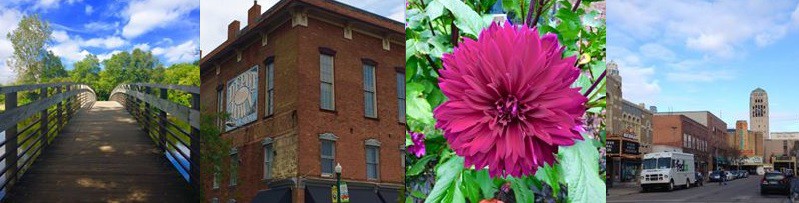
This is an artistic rendition of the Michigan Theatre, a street downtown, and the University of Michigan Tower, created from I photo I took through an app called Prisma.

Tomorrow is my Ann Arboriversary, the annual marker of the date I moved to town. I think of this each year, but this time, if feels like an especially important occasion. I begin a new year tomorrow, meaning that I close another one out today. And this time, I hit ten years. As of today, I’ve lived here for an entire decade.

That is a lovely gift. These days, I think a lot about place — what it means to witness land and nature, what it means to have a place to explore, and most of all, what it means to be embedded in relationships with friends, neighbors, and coworkers. I’m grateful to have lived here ten years.

Additionally, I have beloved people who live all over the country, and more than ever, I find myself wanting to be with them as often as I can — still rooted here, but adventuring in a number of “theres” every time I can make it happen. I want the roots; I want to prioritize the connections.

I want an expansive vision of home.

This theme has been on my mind and heart all year. Home is place. Home is land. Home is rhythms. Home is a spiritual state of mind. Home is, above all, in my experience, people.

So Ann Arbor, thanks for being a part of that vision. I’m grateful to be rooted in a place and to continue to reflect on what home means.

Renee Roederer

Dear Subscribing Readers, after submitting this post, I am going to take a two-week break from writing on Smuggling Grace, but I will be back mid-September. As always, thanks for reading along!