Mental Health Monday: Fight, Flight, Freeze, and Fawn

Image Description: This image shares the four primary nervous system responses to trauma — fight, flight, freeze, and fawn — as well as symptoms for each and ways they are commonly mislabeled. I am sharing the image text throughout the blog post below. I found this image on @SELSpace on Facebook.

Over the last few years in this era of a pandemic, we’ve moved through a number of experiences that have been traumatic collectively. This may be important time to learn about trauma and the responses that our nervous systems often take in response. When we’re feeling overwhelmed, we can move into states of fight, flight, freeze, or fawn. We might also vacillate between a couple of these.

In addition to these becoming activated due to present circumstances,

— some people have endured past traumas as well, and these can become reactivated in our nervous systems in these ways,

and/or

— some people have lived with dysregulated nervous systems throughout much their lives, not necessarily remembering large, traumatic events in childhood, but rather, growing up in households that felt stressful and overwhelming in a generalized way. In these households, it was difficult to have needs cared for and nurtured, or caregivers may have also had dysregulated nervous systems, making it difficult to co-regulate alongside them.

In both of these instances, people may live with symptoms of PTSD or CPTSD (the C stands for complex and means that the traumatic events or environment was long-lasting).

In a moment, I’m going to list symptoms of the 4F pathways of trauma. You may recognize some of these in yourself or your loved ones. Please know that these don’t have to remain stuck or static in the body, and we don’t have to stay stuck or static in these patterns. There is help. Therapy certainly helps, and it’s okay to seek that help. In fact, it can be transformative. There are a variety of somatic therapies that help to heal our bodies and these patterns. (As just one example, I’m a big cheerleader for EMDR. Check it out.)

These are the 4Fs of trauma and PTSD. Which pathways tend to be primary for you? I am typing out the text of the image above.

Fight

  • Self-preservation at all costs
  • Explosive temper and outbursts
  • Aggressive, angry behavior
  • Controls others
  • Bully
  • Can’t ‘hear’ other points of view
  • A pronounced sense of entitlement
  • Demands perfection from others
  • Dictatorial tendencies

Typically mis-labelled as
– Narcissist
– Sociopath
– Conduct disorder

Flight

  • Obsessive and/or compulsive behavior
  • Feelings of panic and anxiety
  • Rushing around
  • Over-worrying
  • Workaholic
  • Can’t sit still, can’t relax
  • Tries to micromanage situations and other people
  • Always ‘on the go;’ busy doing things
  • Wants things to be perfect
  • Over-achiever

Typically mis-labelled as
– OCD
– Bipolar
– ADHD
– Panic disorder
– Mood Disorder

Freeze

  • Spacing out
  • Feeling unreal
  • Hibernating
  • Isolating self from the outside world
  • Couch potato
  • Dissociates
  • Brain Fog
  • Difficulties making decisions, acting on decisions
  • Achievement-phobic
  • Wants to hide from the world
  • Feels ‘dead,’ lifeless

Typically mis-labelled as
– Clinical depression
– Schizophrenia
– ADD
– OCD

Fawn

  • People pleasing
  • Scared to say what they really think
  • Talks about ‘the other’ instead of themselves
  • Flatters others (to avoid conflict)
  • ‘Angel of mercy’
  • Over-caring
  • Sucker
  • Can’t stand up for the self, say ‘no’
  • Easily exploited by others
  • Hugely concerned with social standing and acceptance, ‘fitting in’
  • ‘Yes’ man (or woman…)

Typically mis-labelled as
– Codependent
– ‘Victim’

Do you recognize these patterns in yourself or your loved ones? They are natural and do truly discharge traumatic energy. Our bodies have them because we need them at times. But we don’t want to become stuck in them. That causes larger problems for us. These patterns may spin out, causing us pain, and impacting our relationships.

But we can heal these patterns, and we can do the work of healing the systems that cause so much trauma in the first place. I love how the word ‘heal’ is both passive and active at once. We receive healing and cultivate it over time, and we can act as healers for a world with less trauma.

Renee Roederer

Terms of Endearment

A blueberry pie. Public domain image.

One of my chosen family members and I often each other with terms of endearment. Not honey, sweetie, dear, or the like, but things like,

Good morning, Snazzy Pony!

How’s your day, Blueberry Pie?

Well, hey there, hi there, Glorious Snacker!

My Most Marvelous Mouse, do I ever have a story for you
!

And I just want to say that it’s really sweet to greet and be greeted.

Renee Roederer

Self Family Reunion

Image Description: Black background and the word ‘family’ in white letters; the l has a tree growing out of it. Public domain image.

What if you could be gathered together in one place with a version of yourself from every year of your life? Like, from baby to current age of adulthood?

What if every age of yourself was present toward all the others, gathered together like a family reunion of sorts? What would that be like?

-Would certain ages pair together for care?

-Would certain ages avoid each other?

-Would certain ages wander off somewhere and find some space to voice their stories, or maybe do some reconciliation work?

-Would certain ages impart wisdom to the other ages?

What might the current you want to say to your younger selves? What might your younger selves want to say to the current you? Truth be told, our younger selves are always present in some way, embedded into the rest of our lives. We can access the various parts of ourselves, and in a sense, even be in relationship with ourselves.

I wonder what would happen in this family reunion?

Renee Roederer

Pale Blue Dot

Voyager 1 pale blue dot. Image credit: NASA/JPL

Look again at that dot. That’s here. That’s home. That’s us. On it everyone you love, everyone you know, everyone you ever heard of, every human being who ever was, lived out their lives. The aggregate of our joy and suffering, thousands of confident religions, ideologies, and economic doctrines, every hunter and forager, every hero and coward, every creator and destroyer of civilization, every king and peasant, every young couple in love, every mother and father, hopeful child, inventor and explorer, every teacher of morals, every corrupt politician, every “superstar,” every “supreme leader,” every saint and sinner in the history of our species lived there–on a mote of dust suspended in a sunbeam.

The Earth is a very small stage in a vast cosmic arena. Think of the rivers of blood spilled by all those generals and emperors so that, in glory and triumph, they could become the momentary masters of a fraction of a dot. Think of the endless cruelties visited by the inhabitants of one corner of this pixel on the scarcely distinguishable inhabitants of some other corner, how frequent their misunderstandings, how eager they are to kill one another, how fervent their hatreds.

Our posturings, our imagined self-importance, the delusion that we have some privileged position in the Universe, are challenged by this point of pale light. Our planet is a lonely speck in the great enveloping cosmic dark. In our obscurity, in all this vastness, there is no hint that help will come from elsewhere to save us from ourselves.

The Earth is the only world known so far to harbor life. There is nowhere else, at least in the near future, to which our species could migrate. Visit, yes. Settle, not yet. Like it or not, for the moment the Earth is where we make our stand.

It has been said that astronomy is a humbling and character-building experience. There is perhaps no better demonstration of the folly of human conceits than this distant image of our tiny world. To me, it underscores our responsibility to deal more kindly with one another, and to preserve and cherish the pale blue dot, the only home we’ve ever known.

-Carl Sagan, Pale Blue Dot, 1994.

To Enjoy the Sky Also

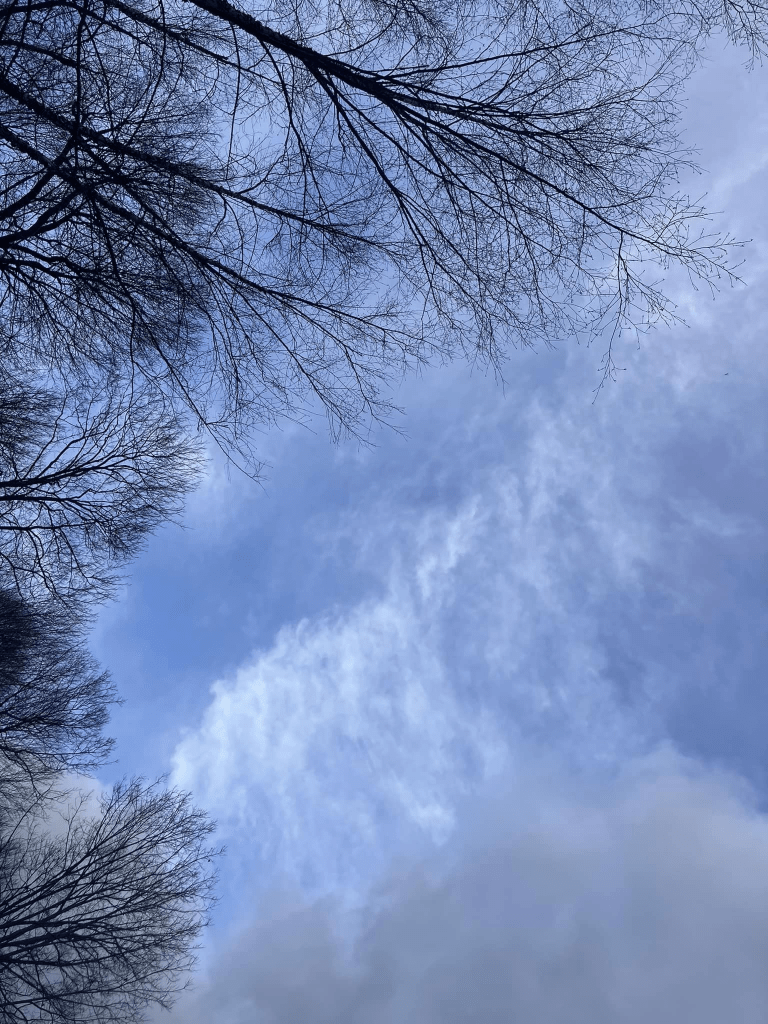
Image Description: Grass with tracks from a vehicle, exposing dirt. Above, is a blue sky with white, puffy clouds. Public domain image.

Zen Master and teacher, Thich Nhat Hanh, says,

Life is filled with suffering, but it is is also filled with many wonders, such as the blue sky, the sunshine, and the eyes of a baby. To suffer is not enough. We must also be in touch with the wonders of life. They are within us and all around us, everywhere, anytime.

This is the very first paragraph in his book, Being Peace.

He continues with these words,

If we are not happy, if we are not peaceful, we can’t share peace and happiness with others, even those we love, those who live under the same roof. If we are peaceful, if we are happy, we can smile and blossom like a flower, and everyone in our family, our entire society, will benefit from our peace. Do we need to make a special effort to enjoy the beauty of the blue sky? Do we have to practice to be able to enjoy it? No, we just enjoy it. Each second, each minute of our lives can be like this.

Do we have to make a special effort to enjoy the blue sky?

Truthfully, yes, sometimes. There are days when it may really be an effort. We may be struggling with ongoing feelings of sadness and anxiety. We may be grieving. We may be longing for a world that is more peaceful and just.

Sometimes, it probably does take a special effort — or at least, a special intention — to enjoy the blue sky. Or the sunshine. Or the eyes of a baby.

But we really can choose the intention to enjoy these too.

Thich Nhat Hanh does not teach people to put their heads in the sand. One of his primary teachings is that love is understanding — that if we want to love others and ourselves, we have to listen and understand one another’s suffering. This is so important.

And alongside that suffering, we can marvel at the joys and the beauty too. “Suffering is not enough,” he says. Joys and beauty can come alongside these pains.

Thich Nhat Hanh says, if we can enjoy and smile at these, we can embody peace — peace that will be made available to the suffering we and others carry.

So today, I put that wonderful intention in the world —
That we might enjoy the sky also.

Renee Roederer