Over the weekend, I had the pleasure of leading the Sunday service at Fort Street Presbyterian Church in Detroit. Though I already knew a little about the church, it became clear that this is a historic location in a number of unique ways:
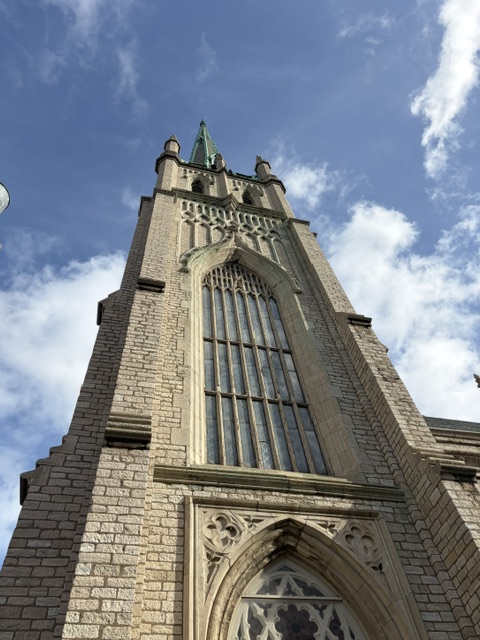
The church building is designed in the Victorian Gothic style, and it has one of the tallest steeples in the United States. Also, when I arrived and sat toward the front, I saw a placard on the pew next to me marking the spot where Theodore Roosevelt once sat and worshiped.
But I especially enjoyed hearing about an underground tunnel that apparently connects the church with Tommy’s, a bar just next door. Some have wondered whether this tunnel might have been part of the Underground Railroad. Others believe it was more likely used during the Prohibition era, perhaps as a way to access a speakeasy. Its history remains uncertain.
What we do know is that this church has deep connections to the abolitionist movement. Some of its earliest members were abolitionists, and the congregation’s history reaches back to before the Civil War. We don’t often encounter buildings that reach back that far. Although the church building was severely damaged by fires and rebuilt according to its original design, the congregation’s history reaches back to 1849.
I have no doubt that the commitments of those early members continue to make an impact today. While we are uniquely ourselves and not fully defined by the actions of those who came before us, communities can have a sense of DNA connected to those who were there at their origins.
I believe that to be true in this case, because the community at Fort Street Presbyterian Church does a great deal to care for its neighbors, especially those who are marginalized and unable to access needed resources.
It’s a reminder that wherever we go, there are foundations beneath our feet. Sometimes that’s literally true, as it is with this tunnel. And it’s certainly true figuratively. We stand on the shoulders of giants, including people we never knew. Still, their influence can find us and inspire us forward.
I wonder what else we stand upon. Whose influence meets us?

