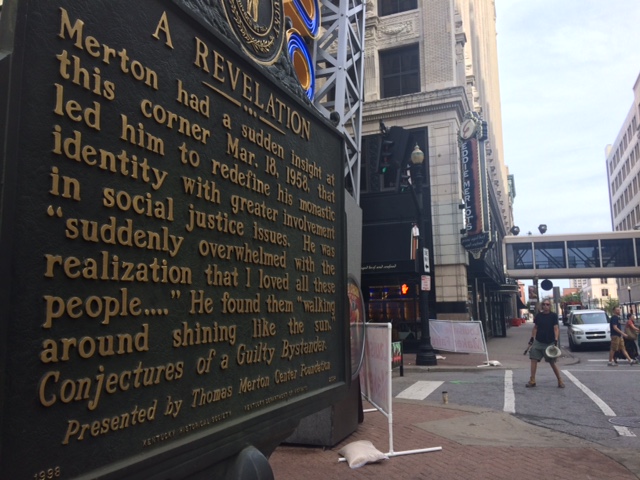
Image Description: A placard at Fourth and Walnut in Louisville, KY, marking the spot where Thomas Merton had a significant spiritual realization.
Any Place and Any Moment
can be the Space and the Time
of Revelation and Awareness.
Any single place and any single moment can open us to understanding and connection.
I’ve been learning a bit from Thomas Merton lately. Merton (1915-1968) was a Monastic Christian who lived in Kentucky. I love a particular both/and in his personal faith: He was a mystic, yet not at all removed from the world. He delved into some of the largest challenges and traumas that humanity has faced. He was a practical theologian and a humanitarian, grounded deeply in a sense of mystical communion with God and other people.
These two aspects of Merton’s faith really came together when he was simply standing at an intersection. He was standing on the corner of 4th and Walnut (now Muhammad Ali Blvd.) in Louisville, Kentucky. As he watched people walk by, he was suddenly overcome with a deep sense of connection. He said he was, “suddenly overcome with the realization that I loved all these people. . .” as they “walked around shining like the sun.”
It changed his whole life.
He probably wasn’t expecting that when he was out running some errands. But any place and any moment can introduce us to a revelation of understanding and connection. Any place and any moment.
When in Louisville a few years ago, I went to this corner. It’s really fitting because there’s still a great deal of foot traffic. There is a placard that commemorates this place and moment, and right behind it, is 4th Street Live — two city blocks typically blocked off for foot traffic with restaurants, and often, live music.
I snapped a photo of this place. I also stood there and remembered people I know as well. It was a meaningful experience.
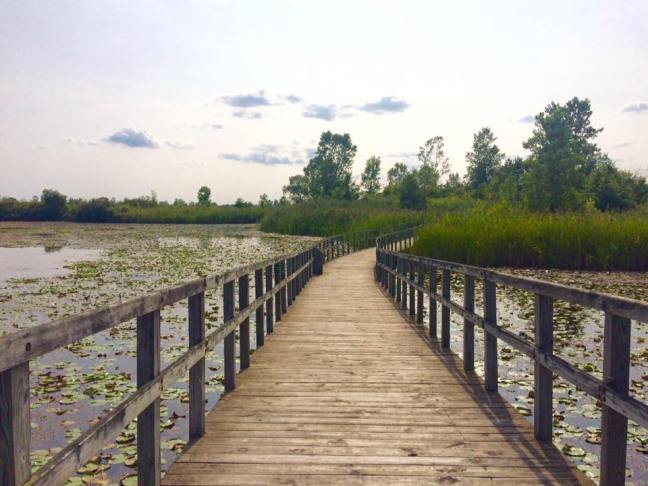
Image Description: A bridge over water with lily pads.
We can choose peace over productivity.
In fact, there may be a number of situations and contexts where we need to hear such freedom.
We really can choose peace over productivity.
We have constructed our culture in such a way to value productivity above much else — including our own wellbeing and the wellbeing of our neighbors.
When we are hurting, or when something in the news cycle hits close to home, how often do internalized messages bubble up to the surface, conveying. . . ?
“Come on. Get on with it.”
“This isn’t as bad as what ________ experienced. Why can’t I get anything done?”
“I don’t have time to think about this. I have so much to do.”
“Look competent.”
“Get it together.”
These are self-critical messages in contexts where our productivity and our constructed image are viewed more highly than our true selves and our need for wholeness.
Alongside 8 high school students named in the news reports, many more were injured at Oxford. Thinking of everyone — first and foremost Oxford students, teachers, administrators, and parents — but also everyone, everywhere, grappling with this pain.
mage Description: A round, chiffon lemon cake with white icing is on top of a white plate.
I drove to my friend’s place. On the way there, I found myself looking forward to seeing her.
And…
I took a moment to recognize how sad and heavy I felt… just about the general state of things in our nation and in our world. I was really feeling it for the few hours that preceded that drive to her apartment.
When I arrived, I was glad to see her. She also cares deeply about the larger questions swirling about us these days. During our time together, I watched and listened as she delighted in the enjoyment of simple things: the coffee shop she drank today, the dress I was wearing a few days ago, her cat, and more.
Another person stopped by to drop off a treat. “I brought lemon cake!” she said as she came through the door.
“Oh my gawd!!!”
My friend exclaimed with such genuine delight. It filled me in a way I needed.
It makes complete sense to grieve and feel heavy about collective pain, confusion, and hardship. We’ll keep feeling these, at times, in waves. Some people are in very close proximity to these, and I know that feelings don’t always just switch on and off.
And in the midst of this, challenging as it is, right alongside it, I like to uplift the gift of simple joys too. There are so many tiny, wonderful experiences of daily living. My friend brought that home to me today.
So after saying goodbye to her and walking out her door, I packed up my car with chairs and immediately went to get my own coffee.
Image Description: Two coffees with foam shaped like hearts. Public domain image.
A few times a year, I like to say thank you for following here at Smuggling Grace. I appreciate you taking the time to connect here, and as always, thanks for engaging too. I enjoy reading and hearing your comments virtually on the platform, in emails, or during real time conversation. Thank you!
And I’m always happy to expand the audience as well. Do you know anyone who might enjoy connecting with this blog? If so, feel free to pass it along. The more the merrier!
Also a few times a year, for those who are interested, I extend an invitation to support this blog monthly on Patreon. You can join a team of people who bolster this space of daily reflection. You can alsotip me with a coffee. Both of these are always great gifts, but truly, are never expected. I appreciate you being here. Thank you!
Image Description: Two directional arrows — one toward Hope and the other toward Despair. Public Domain Image.
In the midst of pain — our own or that of the world around us – it can sometimes seem downright foolish to let ourselves become hopeful. It can even be risky —
What if things never get better than this?
What if the next catastrophe still happens?
What if I look like a fool?
Hope takes risk, I suppose. Hope certainly doesn’t put us in control. Hope might invite us to desire things that in the end, we do not get to see.
But hope also has a way of creating things – things that could barely be imagined before. Hope helps our imagination become alive, and from there, when we envision other possibilities, we soon discover that we are called to participate in their creation. Hope leads us somewhere.
And so, in the midst of it all — whatever it is for you; whatever it is for the world — what might it look like to dare to take heart?
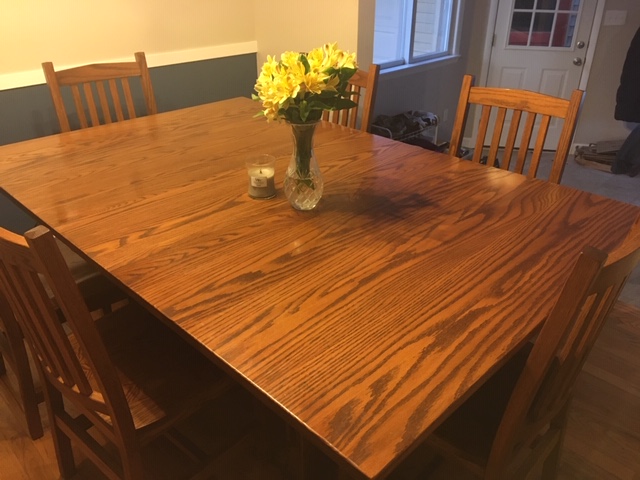
Image Description: A solid oak dining room table with chairs. A green candle and vase of yellow alstroemeria flowers are on the table.
This sermon was preached at First Presbyterian Church of Saline, MI, and it was focused upon Isaiah 65:17-25 and Luke 21:5-19.
Years ago, I attended a Thanksgiving dinner with no mashed potatoes. Gasp! Clutch the pearls! No mashed potatoes. And I love mashed potatoes at Thanksgiving.
Now I’m sure if we went around the room, we could probably all name a favorite dish that we enjoy at Thanksgiving or some other holiday meal altogether — the kind of dish we cannot imagine that meal without. And I’m just curious what yours would be.
For me, it is mashed potatoes. I pile them high every single year. But fourteen years ago, I attended a Thanksgiving dinner with no mashed potatoes. That year, far away from my family, I was living in Texas, so I traveled from Austin to Dallas to visit the Thanksgiving celebration of a good friend’s family. And it turns out, that meal had far greater surprises than the mere dearth of my beloved, holiday spuds.
On the way there, I was nervous. Very nervous in fact. My friend’s family was much more theologically conservative than I was. My friend’s family was tremendously more theologically conservative than I was… To give you an example, when I arrived, I was introduced to a family friend who attends their Thanksgiving celebration every year. She was a scholar — a brilliant one — and she had recently resigned her faculty position at a Southern Baptist college because she felt they were moving to far to the left.
Now, I’m not interested in a stark delineation between conservative and liberal, at least, the ways we tend to be reductionistic and stereotypical about both. That’s too shallow. I wasn’t interested in that then, and I’m not interested in that now. What I was interested in then, and what I am interested in now is how we love our neighbors, and to be honest with you, I felt a great deal of nervousness because I was a 25 year old, young woman in seminary. I had left my own fundamentalist upbringing behind, and I loved theology and thought I might like to teach it someday, perhaps also in a seminary. I had no idea what they were going to think about me or that. I had no idea how they would engage my presence there.
And so we had the meal with no mashed potatoes. No one brings them in this family, or at least, they didn’t that year. And after that meal, the family friend, the scholar who had resigned her position, said, “Alright everyone! Let’s move into the next room. It’s time for the Plato Philosophical Society!”
Apparently, this was a tradition too. After the meal, everyone would move into an entirely different room and talk about theology, philosophy, and also, politics.
Alright… here we go… my blood pressure probably went up a bit. As we moved into this other room, I thought, “I’m going to have to defend myself, who I am, why I’m studying at a seminary, and why these things are important to me.”
But the first question at the Plato Philosophical Society had nothing to do with these. The family friend raised this question at the table:
“Do you think that the earth is is 6,000 years old?”
She was basing this question off of a fundamentalist interpretation of Genesis, the first book of the Bible. The friend who invited me to this gathering is an astronomer. I was curious if she might feel like she may have to defend what she studies. But as for me, I can tell you that this is not a question I typically ask of the universe or even the Bible.
And so, there I was, plunged into a question that I never ask. And something very interesting began to take place… once we opened up that question… once we entered it, a whole other set of questions emerged… very human questions…
The universe seems older… Would God trick us? Can God be trusted?
What can we know with our senses? In fact, what can we know at all?
Can we be trusted to understand? Who and what do we trust to teach us things we can’t understand?
Are there times when we knew something to be true, outside of rational ways of understanding?
These questions were connectional questions. Suddenly, we were thinking about human experience; our spiritual lives; our human living, learning, and loving; and our collective living with one another. And as we pondered these things together, something took me by surprise — something more surprising than a lack of mashed potatoes at a Thanksgiving meal. This family friend, the scholar who resigned a position at a Southern Baptist college because she thought they were moving too far to the left, called me, a 25 year old woman and seminarian, a theologian three times in this conversation. She said that word aloud. She assigned it to me. I felt seen and affirmed. I even felt called in that identity at the table. And I did not see that coming. I was grateful for it.
I learned something that day, and fourteen years later, I still think of it:
We need each other’s questions.
We do. There are times when we are separated enough from one another that we begin to ask entirely different questions. There are some questions of my faith that frankly, I have stopped asking, and I imagine that some have stopped asking the questions that my communities tend to ask. Even if we may have very different answers… we still need each other’s questions because they are places to encounter God and meet one another. They can even be places of transformation. We may even discover that within them, we are named and called, sometimes even by people we’d readily assume would never name us or call us genuinely.
We need each other’s questions.
Now, you may wonder, Renee, what does any of this have to do with our scripture texts today? Quite a bit actually, because when I hear this morning’s texts from Isaiah and Luke, it seems they are speaking two different languages. One is filled with an abundance of hope and re-creation, and the other is filled with destruction and apocalypse.
They speak to unique contexts, of course.
The text in Isaiah speaks to the people of Judah who had been taken captive to live as exiles to Babylon. Their temple had been destroyed. They lost their homeland, their entire way of life, and their sense of dignity. They lost hope for themselves, and this passage proclaims hope in abundance on their behalf.
The text in Luke speaks to 1st century Jews who were living under the occupation of Rome. Jesus was in the presence of people who were talking about beauty of the temple — the longed-for, rebuilt temple — and he warns that it will be destroyed with large-scale, cosmic apocalypse and the personal betrayal of relatives and friends. This passage speaks about destruction.
Listen once more to these passages side by side:
Isaiah says, “For I am about to create new heavens and a new earth; the former things shall not be remembered or come to mind.”
Luke says, “There will be great earthquakes, and in various places, famines and plagues; and there will be dreadful portents and great signs from heaven.”
Isaiah says, “They shall build houses and inhabit them; they shall plant vineyards and eat their fruit.” And, “They shall not hurt or destroy on all my holy mountain.”
Luke says, “As for these things that you see, the days will come when not one stone will be left upon another.”
Of course, these two passages are written to two different contexts and entirely different groups of people, each with their particular emphases. But I wonder, if both of these passages could suddenly become personified, what would that be like? What if they could sit down together at a table and have a conversation? Say, have mashed potatoes together?
Maybe we’d discover that their statements of healing and destruction come from a place of different questions: “After losing everything, will we ever experience healing again?” one might ask. “Is it possible that our occupiers will ever face accountability and lose their power over us?” the other might ask.
Different questions and different statements, but once they are entered, don’t they come from similar places? Very human places? Desiring the end of evil and longing for a hopeful, flourishing future? I wonder what kind of family meal these personified passages might share with one another. I wonder what sort of encouragement they might give each other. I wonder how they might name each other and call each other.
I also wonder how they might name us and call us.
Because the truth is, we bring very different hopes, questions, desires, longings, and wonderings when we walk in the door of this sanctuary on Sunday morning, even if we’re all a part of the same community. Those hopes, questions, desires, longings, and wonderings are present right now. Perhaps some of us are filled with joy and possibility this morning. Perhaps some of us are tired, having had experiences where we were not named or called in light of who we truly are. Maybe some of us have a sense of aliveness in creation right now. You might love all this snow. Maybe some of us are wearied by the world’s troubles right now.
We need each other’s questions. Because frankly, we need each other.
We need the encouragement of one another. It’s a great gift that God has given us to each other, and here we are. So for the rest of this service, may it be a family meal, even if no literal food is present right now. May words be nourishment. May song be refreshment. May the human presence of our neighbors be accompaniment. May this place house us at a family table — all of our learning, our growing, our naming, and our calling. Amen.