Image Description: A white question mark, written in chalk, on a blackboard.
Something I’m pondering…
Concern and worry are not quite the same. They’re different experiences, I think.
When we’re concerned about something, we take it seriously. And this feels proactive: We think ahead. We consider consequences. We galvanize our strength, our inner resources, and our community resources.
But…
When we’re worried about something, we just spin around our own anxiety. It can feel like a whirlwind.
It’s not easy, and sometimes, not possible to just snap our fingers and exit worry. Anxiety is very physical, and when it takes hold, we’re really in it. This deserves compassion and never shame or criticism.
I wonder, if we can practice moving our worry energy into concern energy, might we inhabit a different stance? Then we can be in a different relationship with what we face or fear.
Sometimes, we take on too much — more tasks than we can actually do, more emotions than we can adequately hold, or more directions in which we can easily move.
Sometimes, I take on too much.
I’ve also gotten much better at this over the years. But I was raised and socialized in ways that made me feel as though I was responsible for everything — responsible for everyone’s feelings and everything that needed to happen.
In the midst of my care work, I cannot do this. It doesn’t help me or frankly, anyone.
So I’ve pondered this quite a bit: There is a difference between being responsive and being responsible.
When needs come my way, I want to be responsive. I want to listen well. I want to extend care. I want to hear the needs in the way that a person is presenting them. I want to hear their own resources (practical, emotional, financial, social, or spiritual) and when it’s helpful, as often as I can, I want to connect this person and need to more people who can help meet that need. That is being responsive.
We are not always responsible for every task or emotion needed, nor are we the cause or end of the situations that created the need in the first place.
But we can participate. We can care. We can be responsive, and this is vital action.
Image Description: Trees in a forrest with shared roots visible on the surface of the ground. Red, fallen leaves from autumn are interspersed among the roots. Photo, Renee Roederer.
Show your roots — Make known the ones you named you (the truest you) Make known the ones who shaped you (the still becoming you) Live roots made visible.
The love, The care, The nurture, The belonging.
The wholeness, of every community, of every neighbor, of every parent, of every friend, of every guide,
Over time, particularly in Western cultures, the word believe has become quite narrowed in its meaning. For instance, in the context of my own Christian tradition, when people hear the word believe, they may hear it as—
. . . I believe in God.
. . . Do you believe in Jesus?
. . . I believe what the Bible says.
. . . Do you believe in heaven? —
people typically understand the word believe to mean “intellectual assent to a propositional idea.” In that framework, people consider these statements and questions, and then choose to affirm or reject them as logical possibilities.
But what if that’s too narrow a definition of the word believe?
The English word believe has been shaped greatly by the frameworks of the Enlightenment and Modernism. The words of the Hebrew Bible and Greek New Testament, however, speak of something quite different in their original languages.
These are words of the heart. . . words of will. . . and words of action. The words that often get translated into the English word believe are actually verbs of love, devotion, trust, purpose, and action.
Recently, I was reading Christianity After Religion: The End of Church and the Birth of a New Spiritual Awakening by Diana Butler-Bass. (Great book. Check it out.) She suggests that if we want to best translate these verbs into English, it would be better to use a word like Belove. . .
. . . I belove God.
. . . Do you belove from Jesus?
. . . I belove the way of love that the Bible reveals.
. . . Do you belove toward the Transformation of All Things?
Of course, these sentences I’ve created are remarkably clunky. But they cast a different vision entirely, don’t they?
The life of faith is not some intellectual, get-it-right-or-else game, working to conform the intellect (and in some instances, stretch it to incredulity) toward a set of particular propositional affirmations. It is not an endeavor to complete a holy, ‘check yes’ list and thus secure a key to a distant, heavenly future – the ultimate fire insurance.
The life of faith is much deeper.
It is love of God — Love itself, revealed among us,
– and –
It is love of Neighbor — Love itself, enacted between us.
I had a meeting at the University of Michigan campus, and when I finished, I realized I was really hungry. It was almost 10pm, close to Chipotle’s closing time. I walked in, and I was just about to order. Then, at the precise moment when the staff member asked me what I would like, I realized I had left my wallet in the car.
“Oh, you know what? Nevermind. Don’t start that. I just realized I left my wallet in the car.”
“That’s okay. We’ll make it for you anyway.”
“But I don’t –”
“Oh, no worries. Really, it’s okay. Glad to do it. We wouldn’t want you to go hungry.”
He said this in such a sincere way and seemed to take pleasure in offering this gift to me. I ended up with a free burrito bowl, and it was very kind.
When I left, I found myself reflecting upon those words of intention and action: “We wouldn’t want you to go hungry.” He meant it. It was kind.
But when I left, I began to reflect. . . wondering how often people are honest that they’re hungry without ever receiving such a statement from us, or most importantly, the food they need. I found myself thinking about times when we’ve encountered the needs of people but consciously or unconsciously, put them into the category of, “They’re always hungry. That’s a type of person who is hungry. And a person to avoid.” Racism and classism are certainly a part of this.
I found myself remembering that there are humanitarian food crises in parts of the world right now.
And then there are people we meet in our daily encounters.
“We wouldn’t want you to go hungry.”
That intention and that action needs to grow in us.
Yesterday, I shared that my greatest stress reliever these days involves walking outside and noticing beautiful aspects of nature. Here are some more photos of flowers and trees from this season.
My best stress reliever involves walking around and noticing nature. I also love to photograph what I find and share it, usually on Instagram and Facebook stories.
If you find your thing, keep it going. Here are photos of colorful leaves and colorful flowers.
Image Description: Three pink flowers on a vine, each in the shape of a heart. A blue sky is in the background.
Years ago, a therapist said to me,
“I never challenge a client or bring up a deeply-held, difficult topic until I can tell that the person is really close to saying it themselves.”
Years ago, a professor once said to our class,
“When I was training to be a pastoral counselor, I worked with a supervisor and talked my sessions over with him. Once, I had a client who was deeply in denial. It was so obvious. One week, as I was planning for our session, I came up with a process to really tell her the truth and point all that denial out to her. But my supervisor stopped me. He said, “You know, the reason people have defense mechanisms is… they have things they need defending from.”
Image Description: Two silhouettes; One is helping pull another up while climbing a rock. There’s a blue, starry sky in the background.
Truly, a way to be culturally subversive…
Ask for help — for what you need. Big things and small things. Do it frequently. Invite people into your needs, and trust (even if you feel those cultural messages begin to rise within you) that it gives people joy, gratitude, and a sense of connection to be asked to help you.
(Don’t you feel that way when people ask you for help? Why should you believe you’re the one exception?)
So be culturally subversive — Face those internalized messages head on, That you’re somehow burdensome or a bother, or asking too much, or being too much.
Face it, and be a full-time, authentic rebel, Need it, Name it, Ask it.
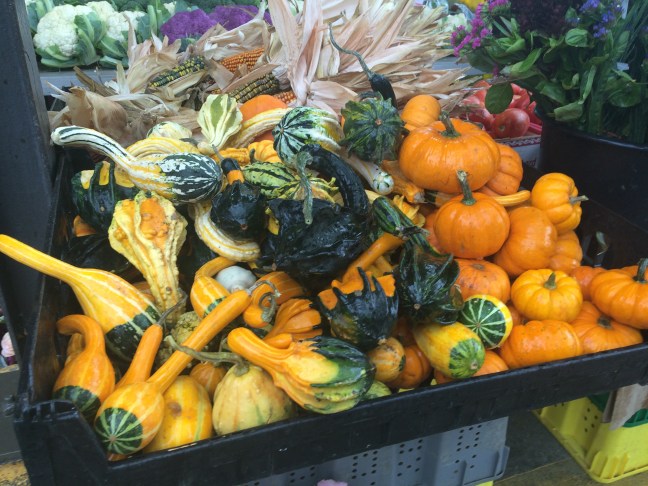
A few days ago, I spontaneously laughed aloud at the grocery store when I saw an assortment of decorative gourds. (Photo, above). In and of themselves, there’s nothing particularly funny about them. They just reminded me of something.
They reminded me of my first job. How many people can say this? As a high schooler, my first job ever was
Gourd Shellacer.
Yep, I worked at a farm where my main task was to spray shellac on decorative gourds to make them SHINE. Shine with all their decorative glory!
And to me, the funniest thing about this is that when I later applied for my second high school job, the application asked for my previous employment history. I didn’t know what to write for my previous job title. So I wrote,
Gourd Technician.
What a ridiculous thing to say. I suppose partly this was for my own amusement. But the person interviewing me did actually ask, “So what is a Gourd Technician?” and I had to answer!
I think in the moment, I laughed about it, said I was a Gourd Shellacer, but I didn’t know how to name that precisely on an application.
Thankfully, I got the serving job despite the oddities.
You know, if we pay attention throughout our day, I bet we can all find a bunch of silly, spontaneously memories. And they might just bring us some joy, as strange as they and we might be.