Giving From Who We Are

present-box-with-ribbons-tied-around-it_800

Image Description: A brown box with a red ribbon wrapped and tied around it.

— I know a person who facilitated guided meditations over Zoom for free every day this week. She did this for loved ones and people totally new to her. Then she passed along the recordings. They were so lovely and helpful.

— I know a person who has been sewing masks up a storm. She realized she can make these quickly, and she’s passing them along to loved ones and people unknown to her.

— I know a person who offered to teach improv games over Zoom to a support group of people that typically meets over the phone. Many participants have never seen each other’s faces, and his offer allowed them to do this for the first time while playing together in fun and meaningful ways.

— I know a person who ran a virtual Boston Marathon in his Michigan hometown. He wanted to turn the term ‘social distancing’ on its head and encourage people to run or walk any distance on April 20 while giving to social causes. He raised approximately $6,000 to support people experiencing homelessness in Flint.

I love when people give uniquely from themselves, using their best gifts and skills and turning them toward others. We can all do this.

–Renee Roederer

Zoomed Out?

Zoom

Image Description: In blue writing, the image says “Zoom,” and in gray writing beneath, it says “Joining a Meeting.”

Over the last couple of days, I’ve been feeling isolation fatigue.

I don’t just mean that I’m tired of being alone, though I definitely am. I mean I’m literally tired. I feel fatigued in the isolation.

This is a very typical response to this very atypical time we’re experiencing. So far, I’ve mostly avoided this by staying positive and connected to others. But the fatigue has caught up with me over the last couple of days.

This is a common experience too. And if you’re feeling it as well, I want to share some information which might affirm and confirm your experiences. Here are two helpful articles I read this week:

Here’s why you’re so exhausted, despite doing less during the coronavirus pandemic — and how to feel better

The reason Zoom calls drain your energy

I admit I laughed while linking this second one because I’m going to join a Zoom call in 45 minutes — one of a few today. Thankfully, this next one will involve my mentor doing some teaching with the Presbytery of Detroit. And that will genuinely energize me.

I welcome that energy. Here goes!

—Renee Roederer

Combining Energies

omer

Yesterday, at the invitation of a loved one, I joined a Zoom call with a community and experienced something very new to me. This community studies and practices Kabbalah, the Jewish tradition of mystical interpretation of the Bible.

Right now, this community is practicing the counting of the omer. Week by week, they explore the principles and energies from the Tree of Life, shown on the image above, and they ask themselves, what can we learn from combining these energies? They are…

Keter/Crown
Chochmah/Wisdom
Chesed/Kindness
Netzach/Eternity
Malkhut/Kingdom
Yesod/Foundation
Tiferet/Beauty
Hod/Splendor
Gevurah/Judgment (or Severity, more about that in a moment)
Binah/Understanding*

This week, the community is exploring Gevurah. In this image, that’s translated as ‘judgment.’ Last night, we used the word, ‘severity.’ Each day, in the counting of the omer, this community explores permutations by combining Gevurah with one of the other energies. Guvurah and Crown, Wisdom, Kindness, Eternity, Kingdom, Foundation, Splendor, and Understanding. What does severity mean when viewed through the lens or energy of these others?

Last night, we considered Gevurah and Yesod — severity and foundation.

How might Gevurah become a foundation?

Our teacher shared that Gevurah is not about punishment. But it is about a firm sense of saying No. When Gevurah is a needed foundation in our lives, we do things like set hard boundaries in our relationships: It’s not okay to be treated wrongfully. Gevurah as a foundation also may look like a commitment to justice. We practice severity — that is, strength — toward injustice.

I appreciated this time very much, and now, it has me thinking about the combination of energies more generally as well. Yesterday afternoon, the Interfaith Round Table gathered leaders together from 12 different faith traditions (also over Zoom, of course). We discussed how our communities are doing during this time of crisis. We shared the gifts and challenges we’re discovering in responding to this time. This was certainly a combining of energies as we shared unique forms of wisdom, struggle, and gratitude. We felt the benefit of being together.

Then, later in the day, I shared with a few people that I was feeling bummed — not overwhelmingly or devastatingly so, but persistently and mildly so. I felt that throughout much of the day. But I ended my day with a phone conversation with one of the people closest to me. During this time, I found myself so grateful for her, even while feeling bummed, and I thought about the strength of this connection in relationship over time. I felt that even while we’re all separated. This experience was a combination — and transformation — of energies.

I’m going to keep thinking about this: What energies do I need to combine?

–Renee Roederer 

*I used slightly different transliterations of Hebrew here rather than listing them exactly as they are in the image. This local community spells (or rather, transliterates) a few of these energies differently than what’s in the image.

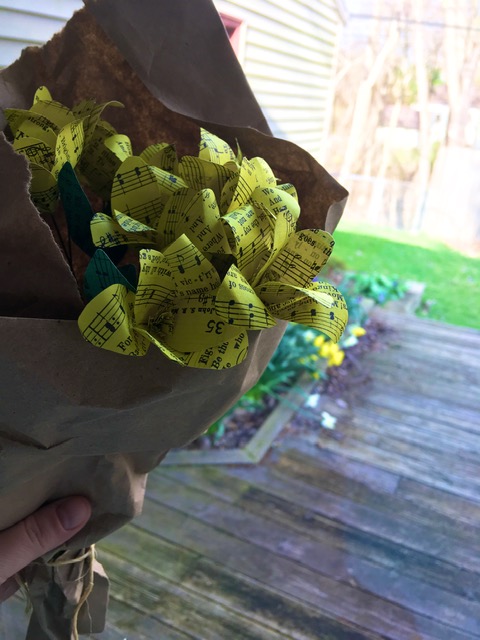
My Lovely, Permanent, Yellow Flowers

IMG_7790

Image Description: My bouquet of yellow flowers. Daffodils are in the background of the image.

Lately, when I’ve been gathered in groups for reflection and discussion (over Zoom and the like) I’ve asked these questions:

What is a little grief you have? 
– And –
What is a little joy you have?

As we experience this pandemic and time of economic uncertainty, we are definitely acquainted with the big griefs we carry. We are concerned for the losses we know, for our loved ones, and for our own health. We grieve disruptions and the ways our lives are different than they were just a couple months ago.

But do we make space to name the little griefs? The ones we probably wouldn’t name, because stacked up against the larger ones, they seem a bit more insignificant?

I’d like to say that they’re not insignificant. They matter to us also and are worth grieving. They might also serve as symbols for the larger griefs we’re carrying too.

Likewise, do we make space to name the little joys? The ones we probably wouldn’t name because they’re typically more mundane than others we might have shared in the past? Yet we find even more gratitude for them now?

These are not insignificant either. They matter to us and are worth sharing with others. They might also serve as symbols of encouragement and hope alongside all we’re carrying too.

When I’ve asked these questions in groups, I’ve also given a particular answer a number of times. One of my little (but not insignificant ) griefs is this: I always keep yellow alstroemeria flowers on my table. I also keep some in my writing room. They are lovely, and they brighten up the space. They also last such a long time in a vase — typically three weeks. For this reason, they’ve come to take on meaningful symbolism to me. And when they begin to wilt and the flowers begin to fall, I typically go to Trader Joe’s and buy more. I’ve had a long streak of having these flowers on my table. Sure, they aren’t nearly as important to me as all the other things we’re carrying collectively, but I’ve been sad to lose their presence. You can disinfect your groceries, but you can’t disinfect your flowers.

I shared this with some people while back, and…

This sharing has led to a little but not at all insignificant joy. I feel big gratitude about it.

Yesterday, I received a package on my doorstep (some of you all know I love surprises, including tiny gestures) and this one felt amazingly huge. A friend had some permanent, yellow flowers made for me. And the petals are made from hymnals. So they have all these lovely words.

And they came in a bouquet! This meant so much to me. Big joy. Lovely connection. So very thoughtful.

I am so eager to put these on my table. And now I’ll remember big connection in the little grief. Thank you, good friend.

—Renee Roederer

That’s Bananas! (Har)

Bananas

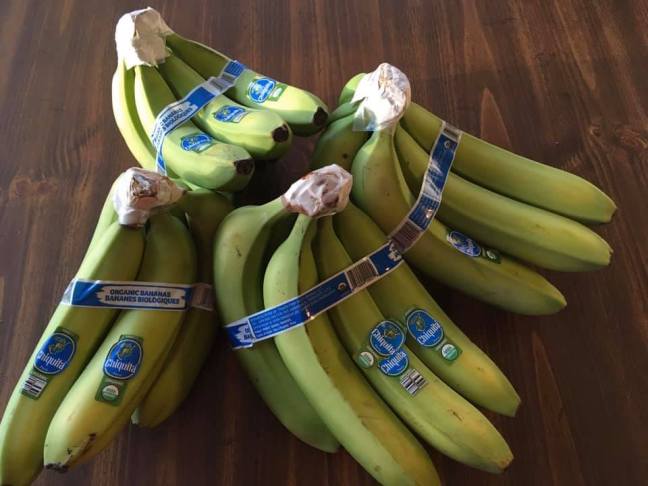
Image Description: My plethora of bananas.

My grocery delivery came. Hooray! When I first looked outside and saw all the items on my doorstep, my eyes went straight to the bag that instantly caused me laughter.

I ordered 4 bananas.
I received 4 bunches of bananas.

They were all in one bag.

Obviously, I can’t eat 23 bananas. Lots of folks told me these were destined for banana bread. That certainly sounds delicious, but I actually plan to pass three of these bunches along to others. I’ll deliver them to other doorsteps over the next few days.

This Day is B A N A N A S.

–Renee Roederer


I Believe You

The video above comes from Facebook live. If you have any trouble accessing it in this format, feel free to click here. 

This is a sermon I prepared for Northside Presbyterian Church in Ann Arbor this morning. I thought I would share it too if it’s helpful. I’ve also prepared a transcript in here if you’d like to use that.

As we begin, I’ll read the story first. It comes from the Gospel According to John, chapter 19 verses 20-31.

When it was evening on that day, the first day of the week, and the doors of the house where the disciples had met were locked for fear of the religious leaders, Jesus came and stood among them and said, ‘Peace be with you.’ After he said this, he showed them his hands and his side. Then the disciples rejoiced when they saw the Lord. Jesus said to them again, ‘Peace be with you. As the Father has sent me, so I send you.’ When he had said this, he breathed on them and said to them, ‘Receive the Holy Spirit. If you forgive the sins of any, they are forgiven them; if you retain the sins of any, they are retained.’

But Thomas (who was called the Twin), one of the twelve, was not with them when Jesus came. So the other disciples told him, ‘We have seen the Lord.’ But he said to them, ‘Unless I see the mark of the nails in his hands, and put my finger in the mark of the nails and my hand in his side, I will not believe.’

A week later his disciples were again in the house, and Thomas was with them. Although the doors were shut, Jesus came and stood among them and said, ‘Peace be with you.’ Then he said to Thomas, ‘Put your finger here and see my hands. Reach out your hand and put it in my side. Do not doubt but believe.’ Thomas answered him, ‘My Lord and my God!’ Jesus said to him, ‘Have you believed because you have seen me? Blessed are those who have not seen and yet have come to believe.’

Now Jesus did many other signs in the presence of his disciples, which are not written in this book. But these are written so that you may come to believe that Jesus is the Messiah, the Son of God, and that through believing you may have life in his name.

When the scene of our scripture passage opens, we might be surprised to remember that it is Easter day itself. It is the very day of this shocking resurrection experience, but the disciples of Jesus are hiding behind closed doors and living in fear. I think we can relate this year… Mary Magdalene, one of their own, has shared incredible news with them. She has already told them that she has seen Jesus alive, but they have yet not seen Jesus themselves. Maybe some of them might risk wondering if it really could be true. . . Others, as we know, dismissed her story entirely. They believed it to be an “idle tale.”

So there they are hiding behind locked doors, scared for their lives, and in this story, the resurrected Jesus chooses to meet them right there. He shows up on the other side of that locked door right in their presence. And what does he say? He speaks words of comfort: “Peace be with you,” he says. Then the story shares that after he greeted them with these comforting words, he “showed them his hands and his side.”

That’s kind of an interesting thing to do, isn’t it?
He showed them his wounds from the crucifixion.

The disciples were overwhelmed with joy in his presence. They had been locked away from life, and life met them right where they were. Jesus, risen to new life, stood among them, and the he commissioned them to service. He said, “As the Father has sent me, so I send you.” And he gave them the gift of the Holy Spirit. This moment changed everything for them, and all of them were called to new life. They were all astounded, and all of them were sent forward from his presence.

Well, all of them except Thomas.

Thomas wasn’t there in that moment when Jesus appeared to his disciples behind the locked doors. We don’t know what he was doing. Maybe he was behind locked doors somewhere else — social distancing — or maybe he was living outside with greater courage.

But this is what the story shares: He missed it. I can’t imagine what it would be like to hear all of this amazing news secondhand without encountering Jesus himself. Maybe Thomas had grief. Maybe he had isolation after missing out. FOMO. Maybe he had doubt about it all.

It seems to be that way. Thomas said to the rest of the disciples, “Unless I see the mark of the nails in his hands, and put my finger in the mark of the nails, and my hand in his side, I will not believe.” So Thomas continued to stay connected to these disciples, believing something different than they did and maybe feeling something different than they did.

Whatever he believed, and whatever he felt, Jesus met Thomas right in that place too. One week later, all the disciples were gathered together, and this time, Thomas was there. Interestingly, the story shares that the door was shut yet again, but Jesus appears in that house with them. He was among them, and once more, he said, “Peace be with you.”

Then Jesus looked straight at Thomas. Jesus met him in his grief. He met him in his isolation. He met him in his doubt. Jesus said, “Put your finger here and see my hands. Reach out your hand and put it in my side. Do not doubt but believe.”

Do not doubt but believe.
Believe, Thomas. . . that is, trust. . .

Jesus is there before Thomas, meeting him right where he was struggling.
Jesus is there before Thomas, as one who has known suffering and pain himself,
one who has known grief, isolation, and trauma in his body,
and that very one – the one who suffered and died – is risen to new life.

Both of these realities are overwhelmingly powerful. Jesus is risen from suffering and death. And God, found in the human embodiment of Jesus, is a God who still bears wounds. This God is one who knows what it means to suffer and chooses to bear those marks of woundedness forever. As theologian Nancy Eisland shared in her writings,* Jesus is the Disabled God. This is the God who meets Thomas, and this is the God who appears to us today.

Thomas is overwhelmed. Both of these realities – the suffering and the resurrection – are absolutely powerful. Thomas is overcome, and he exclaims with joy and wonder, “My Lord and my God!” He has moved from doubt to the highest profession of faith. Thomas sees the living God with wounds. He sees life standing before him, meeting him in his own place of woundedness. This changes everything.

Jesus didn’t leave Thomas out of the resurrection experience, and so I imagine that Jesus didn’t leave Thomas out of the commission either. “As the Father has sent me, so I send you.” In our scripture text, we don’t hear Jesus saying those words again, but I’m sure the calling remains constant. Thomas was included in that also.

And as we are gathered here this morning, we may very much be like Thomas. We carry own grief, isolation, and doubt, but gathered in community, we seek to remind one another that there is a God who is living and breathing — a God that journeys with us in suffering and the experience of death. A God who loves us to the core of our being, and one who commissions us to love others.

Maybe we can invite one another to hear those words for ourselves this morning. “As the Father has sent me, so I send you.” And here’s where it becomes challenging and life-giving at once:

If we are sent, even sent in a sense from inside our own homes,
If we are sent as the Father has sent Jesus,
If we are sent with the gift of the Holy Spirit,
we are being sent forward toward the world’s woundedness.

We are called to show up in solidarity in the presence of great suffering and pain. We are called to believe the stories behind that pain — never doubting, but believing. These stories of human pain are real.

And we are called to speak the new life of resurrection which God breathes into the world and desires for every human being and every community. That is how high this calling is. It is challenging and life-giving at once.

The God we worship chooses to bear wounds, and this God cares for those who carry their own wounds. But so often, people doubt not only God but the stories of the wounds themselves.

I have a friend named Sarah Watkins who wrote something succinct on Facebook, but I thought it spoke volumes in its power. She said, “If you want to be a good ally to someone, believe them. Do you know how often people who are marginalized and abused are doubted about their own experiences?”

She goes on to say,

“I believe you were assaulted.
I believe you were blocked from voting.
I believe you are in constant pain.
I believe the cop pulled you over because of your skin color.
I believe your boss/supervisor/colleague harassed you.

I believe you.”

We can believe, and when we do that among our neighbors, I think we are all called to new, resurrected life.

I’ll close with another story. On a couple of occasions, I’ve had the privilege to meet Dr. Allan Aubrey Boesak. Dr. Boesak is a prolific writer and theologian. He has a long history of being present alongside those marginalized and oppressed in South Africa and a number of other places.

During the Apartheid in South Africa. Dr. Allan Boesak served as an advocate for justice, working to change laws and restore dignity to so many who faced discrimination and were even killed because of the color of their skin.

I heard Dr. Boesak speak at the Next Church conference a couple years ago in Atlanta. He ended a keynote lecture there in a powerful way. He said that at the end of our lives, and at the end of time when God has reconciled all things, perhaps God will say to us, ‘Show me your wounds.’

He said,

In that moment – even as people of resurrection – if we have none to show, perhaps God will ask us, ‘Wait. Was there nothing worth fighting for?’

And in that moment, he said, even if we stand there with no obvious signs of solidarity, this very God will show us his hands and his wounded side, and we will know that we were worth fighting for.

“As the Father has sent me, so I send you.”

As we leave this time, we are called to journey with our neighbors, even locked inside our own houses.
We have stories to believe.
We have truth to tell.
We have human lives worth advocating beside.
We have resurrection to live.

To this we say thanks and yes.

Amen.

–Renee Roederer

*Nancy Eisland wrote about this in her book, The Disabled God: Toward a Liberatory Theology of Disability.

Cabin Non-Fever

IMG_7678

Image description: A vegetable, bean soup I made. It’s in my favorite, blue bowl.

I am very committed to not getting the coronavirus (or of course, passing it on). So with the exception of a trip to the bank drive through, two walks in the neighborhood a while back, and taking out my compost, recycling, and garbage, I have stayed in my house for 33 days. I imagine you might have a streak that long also.

The truth is, I don’t want to get that sick. I have a classmate from high school who got the virus and had a high fever for 17 days straight. (She’s doing much better, thank goodness!) My body has historically not done well with high fever, so I don’t want to risk that personally. I think of people who have much bigger vulnerabilities too. This virus is difficult and unpredictable.

This is why I’ve ordered my groceries for delivery.

It’s important to note, by the way, that this is a total privilege. It reveals something about my socioeconomic status that I can work from home, at least for the time being, and that I am in a position to choose not to go out. It’s led to some disruptions, of course, like when my grocery order was canceled on Sunday (see that post) after which I struggled to find a new delivery for a while (now I have one coming  next Tuesday). But many people can’t make a choice to stay in. This is privilege.

In the midst of this, however — staying in my cabin and keeping up my non-fever — I’ve noticed that I’ve come to appreciate small things much more.

When my grocery order was canceled, I was bummed, but not too concerned because I’ve been freezing soups in preparation for something like this. I’ve started pulling them out of the freezer. But last night, I decided to cook whatever I could find. I threw in all my last fresh ingredients. It was a hodgepodge of things… a little of this, this, and this. Sure, what the heck, how about this.? And hmm… what if we throw in the last bit of the queso from Chipotle..?

And you know what? I think this was the best soup I’ve ever made. It was my throw-all-the-rest-of-the-things-in-there soup, and it was literally the best. I didn’t even know I had enough ingredients for a best-ever soup. It included some of the frozen things, and they added a lot.

And eating that soup… in my cabin non-fever… it was just… glorious. I savored every bite.

This is a bizarre time, and trust me, I never thought I would be living this life chapter in this way. And in our own unique ways, we’re all experiencing the oddities and anxieties of this time. But sometimes, the small things give us delight in whole new ways.

Like a throw-it-all-together soup.

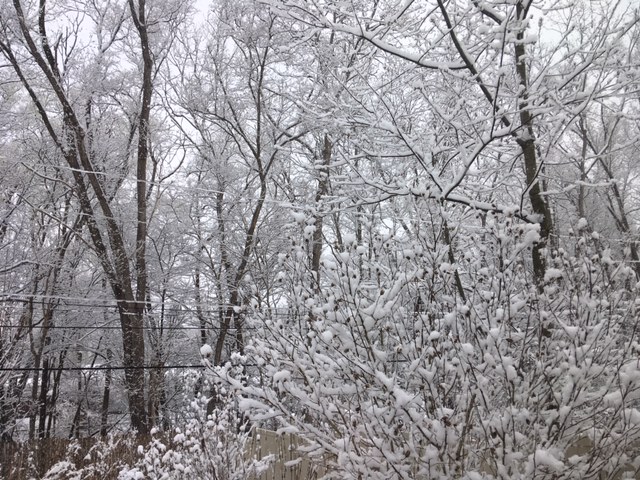
Oh, also, it snowed hard this morning. I might get to make that snowman after all!

–Renee Roederer

IMG_7693

Image Description: Snow on the branches in my backyard.

Embracing the Weird

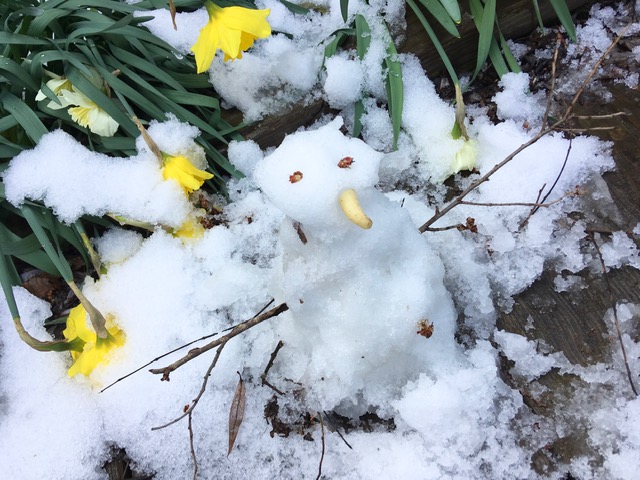
small snowman

Image Description: A small snowman with sticks for arms. I wish I could have made one!

These days, my mail comes as late as 7pm. Yesterday, it didn’t come at all.

Snow fell hard in Michigan for a few hours yesterday and accumulated. I sincerely considered going outside to build a 1-2 foot snowman after I finished some tasks. It melted before I was done.

I turned on some music yesterday and went for a 20 minute run inside my house. There’s a loop in the house, so I just ran indoors.

What a weird time we’re living. Might as well embrace parts of it.

–Renee Roederer


Holy Disruption

french horn

Image Description: A french horn. Public domain image.

In the midst of stay at home orders, church services have changed quite a bit. Over the last five weeks, I’ve been Zooming with my local church in Ann Arbor. Though separated in our various homes, our time together online has been meaningful and surprisingly intimate. In some very real ways, we’ve grown closer. It’s a reminder that church has never been the building. Church is always the community.

While communities are all dispersed from one another, Zoom has bridged some distance too. Because after this service was over on Sunday, I zoomed right into another one. I was able to join my folks at Farm Church in Durham, North Carolina. Every time I visit, I love being with this community. Typically, we spend an hour outside getting dirty while gardening. Then we come inside to worship in ways that are creative and meaningful. My mentor was the co-planter of this community (pun intended), and it has been special for me to follow this community from the the beginning, when it was merely an idea and a dream (by the way, a literal dream — like a middle of the night one — check it out).

It was Easter Sunday. And while I would do just about anything for this pandemic and quarantine to end, I also recognize that it has allowed me to do things I wouldn’t be able to do otherwise, like be with Farm Church on Easter.

And I love how Allen Brimer, pastor and co-planter, started our time together. It was appropriate to the day and wonderfully silly. He talked about resurrection as a holy disruption, so… we were invited to be disruptive. He gave instructions, and then we were off to make disruptive sounds.

GO! People started vocalizing, and I immediately ran to get a pot and pan. Others did the same. There we were banging, yelling, making silly sounds, and then…. bwahhhhhhhhh… someone just started playing a french horn. And we all burst into laughter.

It was such a goofy, wonderful, perfect surprise.

Holy disruption. This time we’re living is painful and dangerous. It’s disrupting our daily lives and limiting what we can do. I have no desire to assign silver linings to it. That being said, midst of it all, I suppose it is resurrection-like when we are able to connect differently. I can Zoom into Farm Church, sure. But beyond that, it is also inviting us to connect differently — not just in format (something like Zoom) but in substance. We are invited to take care of each other on a whole different level, and I see expressions of this almost daily. We are invited to realize we are more connected than we think we are. This aspect is a Holy Disruption we need.

—Renee Roederer