Image Description: A school lunch with a chicken salad sandwich, carrots, a pear, and a red and white carton of low-fat milk.
A public school district in Pennsylvania recently threatened parents with the possibility sending their children into foster care if they did not pay their school lunch debt. In the wake of this, multiple people have offered to pay the debt on behalf of all the families, but the school district has refused those offers.
Sometimes, greed isn’t about money. Sometimes, it’s about power, domination, and intimidation:
Image Description: $5, $10, $20, and $50 bills laid on top of one another.
Jesus talked a lot about money and material possessions. Like, a lot. Almost more than anything else. The most frequent topic in his teachings is the Kin(g)dom of God. But right after that, it’s money.
He taught about money all the time.
And contrary to what the 1% and today’s prosperity gospel leaders might teach, Jesus did not discuss how to get wealth and hoard it. He did not tell people that their personal worth was dependent upon particular possessions. He did not advocate that people give money in order to get much more in return.
And he did not uphold or promote an economy of extraction. In his day, the Roman Empire occupied his land, taxed the people exorbitantly, and marginalized the poor. Wealth moved from the masses to the few.
No, in his very first sermon, Jesus spoke about his calling through these words of Isaiah:
‘The Spirit of the Lord is upon me, because he has anointed me to bring good news to the poor. He has sent me to proclaim release to the captives and recovery of sight to the blind, to let the oppressed go free, to proclaim the year of the Lord’s favor.’
Then he included marginalized and oppressed people in everything he did. He empowered their leadership. Alongside them, he walked on foot around Galilee and Judea and taught quite a bit about greed and wealth.
It seems that part of our collective liberation involves freedom from greed and the trappings of wealth. Perhaps we need to talk more about this too. . .
Someone in the crowd said to him, “Teacher, tell my brother to divide the family inheritance with me.” But he said to him, “Friend, who set me to be a judge or arbitrator over you?” And he said to them, “Take care! Be on your guard against all kinds of greed; for one’s life does not consist in the abundance of possessions.” Then he told them a parable: “The land of a rich man produced abundantly. And he thought to himself, ‘What should I do, for I have no place to store my crops?’ Then he said, ‘I will do this: I will pull down my barns and build larger ones, and there I will store all my grain and my goods. And I will say to my soul, ‘Soul, you have ample goods laid up for many years; relax, eat, drink, be merry.’ But God said to him, ‘You fool! This very night your life is being demanded of you. And the things you have prepared, whose will they be?’ So it is with those who store up treasures for themselves but are not rich toward God.” -Luke 12:13-21
Image Description: The photo is taken from above. We see the arms of two people, and each is holding a white mug of coffee over the surface of a light brown table.
This sermon was preached at Northside Presbyterian Church and was focused upon the story that is told in Luke 10:38-42. An audio recording is above and a written manuscript is below.
Three stories:
–Last month, I had the occasion to be present and stand alongside loved ones as they spoke vows and began their married life together. It is a sacred gift to officiate the wedding ceremonies of some the people closest to me, and I have been fortunate to do that many times. These two are a part of our large family-of-choice.
The ceremony was in Colorado at a venue with a view of the mountains. Gorgeous, right? Except that on this particular June weekend, it was rainy, and everything was shrouded with fog. The day before, when Ian and I drove through the fog to travel to the wedding rehearsal, Siri announced to us, “You’ve arrived at your destination,” and Ian immediately said, “Have we?” We could barely see a thing.
On the day of the wedding, there was a lot of rain, but just before the ceremony began, thanks to the radar, we realized that if we waited about twenty minutes, we would probably have a clear window to have the ceremony outside. That being said, we had a plan. If it started raining more, we had a code word together, an agreement by which we would skip straight to the vows: Chimichanga.
Thankfully, we never had to chimichanga, and things turned out to be quite magical. When I walked outside to welcome all the guests and give some announcements before we began, the mountains were covered in fog. Just as I was finishing my announcements about photography, I looked over my shoulder and said, “Not that it’s a great view…” except in the mere twenty seconds of my announcements, the fog had faded away. I turned around with those words — “not that it’s a great view” — and then added, “Oh my goodness! It completely opened up!” It really had! Everyone cheered. And then we began the processional, which I kid you not, was “Here Comes the Sun,” by the Beatles. That was planned ahead of time. So lovely.
And when these two stood before one another, I shared a quote that I love so much. It is a favorite, go-to quote in my life. This is where I’m leading with this story — this quote by Frederick Buechner from his book Whistling in the Dark:
“In the entire history of the universe, let alone your own history, there has never been another day just like today, and there will never be another day just like it again. It is the point to which all your yesterdays have been leading since the hour of your birth. It is the point from which all your tomorrows will proceed until the hour of your death. If you were aware of how precious it is, you could hardly live through it. Unless you are aware of how precious it is, you can hardly be said to be living at all.”
When this couple stood before each other, it was clear that this moment was a culmination point, that it included a host of people, stories, and other moments embedded into this one. And this moment was also a launching point, as it would springboard experiences of people, stories, and countless, additional moments.
Of course, we might think about things like this during a wedding. But as I shared with the couple that day, Frederick Buechner wasn’t talking about a wedding or even major milestones. He was talking about every single today we have. Every today — every moment — is a culmination point and a launching point.
What does it mean to be present to this day? What does it mean to be present to all that is embedded in this day we’re living? What does it mean to be present to God, who is present to us in this day we’re living?
–Now you might not know this, but I cut a serious rug in this sanctuary exactly 8 days ago. Did you know this? It’s true.
Last weekend, Ian and I hosted one of the most incredible celebrations. Back to that large, constructed, chosen family that we have… Last Friday through Sunday, we hosted what we called the Chosen Family Reunion. Thirty people came to Ann Arbor from ten states to visit us all at once. It was spectacular. Most of us lived in the same place a whole decade ago. Now, we live in a variety of geographical areas, but we’re still connected.
People stayed in AirBnBs and hotels, but most of the weekend was spent hanging out at our house. We shared three meals together at the house as well as some downtime. And then we had a dance party right here at Northside Presbyterian Church! Thank you for letting us use this space.
And the whole weekend had me thinking about space…
How does it change things — specifically, how does it change your living space — after…
… the children have played tag in your backyard?
… a loved one has delighted in the fireflies around your house?
… a loved one has played the banjo on your deck?
… some people who’ve never met — I added a few Michigan alums — realized the connections they share while sitting around your kitchen table?
… or when you’ve closed your eyes, as I did, sitting on my deck, marveling that I can hear so many voices of my deepest loves all at once?
It changed me. It has changed our living space. I hope in some way, it added something to this congregational space too, as this space certainly added to us.
What does it mean to be present to one another? What does it mean to be present to all that is embedded in our relationships? What does it mean to be present to God, who is present to us in our relationships?
–Three weeks ago, I visited Temple Beth Emeth here in Ann Arbor to worship with them during their first ever Pride Shabbat. Last month, alongside Dwight Wilson, I became the Co-Director of the Interfaith Round Table of Washtenaw County. One of the most meaningful aspects this position is the privilege to visit local congregations and meet people in their communities. During the Pride Shabbat, we prayed, sang, and honored people who are lesbian, gay, bisexual, transgender, and queer. We listened to poetry and stories from LGBTQ members of the synagogue, and we enjoyed the singing of the Out Loud Chorus whose members were there as guests. It was all so lovely.
And while this was the first time Temple Beth Emeth had held a Pride Shabbat, during their time of worship, they also participated in weekly rituals for their community. I was very touched by these and by one moment in particular. There was a time to name those who have died, honoring them and upholding each other in our grief, wherever people happened to be in their grief, and especially for those experiencing an important anniversary of loss.
As we got to this moment, Rabbi Josh Whinston invited people to speak the names of loved ones when his eyes met theirs. And so, with his own vision, he scanned the entire community from one side to the other, row by row, and when his eyes met our own, many people named names. Some cried.
Oh, to be seen in the names we carry… how powerful….
What does it mean to be present to what humanity carries? What does it mean to be present to what we are carrying? What our neighbors are carrying? What does it mean to be present to God, who is present to us in all that we carry —at times, carrying us in our joys and sorrows alike?
Jesus made himself present with Martha and Mary, two sisters from Bethany, and all the people they hosted and held together in their home. So often, when we explore this text, we seek to juxtapose these two sisters. We essentialize them in their doing and in their being, as if these are two entirely different spheres of life.
Then we tend to juxtapose these parts of ourselves too, don’t we? Often, we find ourselves wrangling internally with our doing and our being, at times feeling guilty for rest, pleasure, relaxation, and contemplation.
And our internal critic arises — is it our voice? Internalized voices? The voices of a productivity-obsessed culture? This internal critic chimes in and says, “Do you not care that there is so much to do? So many needs? Such a long list?”
And yet, as Jesus says, there is one thing
— a Better Part — Knowing and Being Known, Loving and Being Loved, Listening and Learning, Resting in the Renewal — Belonging.
After all, doesn’t the best Doing come from these?
I leave the story of Mary and Martha at the end of this sermon, not as a last minute toss in, but as another kind of culmination — a place where we can arrive, rest, and ponder. A place where we can remember the power of presence.
These days, many of us rightfully ask questions of action. What can I do? What can we do? How can we take action on this need? That need?
These questions and answers are important. In fact, this church is going to ask some of these crucial questions after worship, pondering how to come alongside immigrants, migrants, and refugees.
But we should never forget how much impact presence can have. The presence of God, grounding us. . .Our presence toward one another. . . each of us. . . and all of us collectively.
How do we offer and receive it with intention? How do we marvel when it meets us so meaningfully?
Image Description: A large number of fireflies are shining their lights in the woods.
Last weekend, 30 people traveled to Ann Arbor from 10 different states to visit us all at once. It was spectacular. Most of us lived in the same place a whole decade ago. Now, we live in a variety of geographical areas, but we’re still connected.
People stayed in AirBnBs and hotels, but most of the weekend was spent hanging out at our house. We shared three meals together at the house as well as some downtime. And then we had a dance party at a local church! It was honestly one of the most meaningful weekends I’ve ever had.
And in light of that, here’s something I’ve been pondering…
How does it change things — specifically, how does it change your living space — after…
… the children have played tag in your backyard?
… a loved one has delighted in the fireflies around your house?
… a loved one has played an instrument on your deck?
… some people who’ve never met realize the connections they share at the kitchen table?
… you’ve closed your eyes, sitting on your deck and marveling that you can hear so many voices of your deepest loves all at once?
It changed me. It has changed our living space.
These days, many of us rightfully ask questions of action: What can I do? What can we do? How can we take action on this need? That need?
These questions and answers are important.
But we should never forget how much impact we have with presence. Our presence changes things — the presence of each of us and all of us collectively.
How do we offer and receive that with intention? How do we marvel when it meets us so meaningfully?
[Image Description: A silhouette of a person stands and looks at the band of the Milky Way in the sky.]
Sometimes, I marvel at who is in my life.
Sometimes, I am stunned to ponder that I could begin alone
then
become
connected
to
who after
who after
who after
who.
And this never ends.
It’s like a Big Bang, really.
A Whole Universe of Belonging.
We each start as a singularity.
Then
each one of us
bursts forth,
brought into an abundance of connections,
born anew bit by bit
through the particularities of relationship.
And these particularities
create
build
form
nurture
cultivate
and
renew.
They expand.
This is an ever expanding Universe —
this Cosmos
of
who after
who after
who after
who.
[Image Description: A pair of black glasses is set on top of a gray laptop. There is a gray phone case to the left and a white computer mouse to the right.]
“Mom — Grandma! Look!”
This is the phrase I heard so many times while I was in Kroger. A young girl — maybe 8 or so — kept requesting her Grandma’s attention. She kept accidentally calling her Mom but then correcting herself.
“Mom — Grandma! Look!”
Then Grandma would look, and she did so with affection every single time. And that’s when the little girl would break into song. I wonder what sort of personal connection they had to this song. It was known to just about everyone in the store, but it seemed to have particular meaning to them.
“Oh, when the saints! Go marching in! Oh, when the saints go marching in!”
“Mom – Grandma! Look!” The girl opens the ice freezer. “Oh, when the saints! Go marching in! Oh, when the saints go marching in!” They laugh.
“Mom – Grandma! Look!” The girl picks up a grocery bag and starts marching. “Oh, when the saints! Go marching in! Oh, when the saints go marching in!” Grandma sings too.
“Mom – Grandma! Look!” The girl turns around in place. “Oh, when the saints! Go marching in! Oh, when the saints go marching in!” People are watching them interact, but the girl mostly just notices her Grandma.
Over and over again, she is expressing a need to be seen, perceived, and known, and Grandma is seeing, perceiving, and knowing with affection. This is such a profound, human need.
Certainly, we don’t all shout “Lookit!” and break into song in the grocery store, but that being said, I don’t think we ever outgrow this need to know and be known. It is a joy to recognize the moments when we are held in a loved one’s attention, and it is a joy to be attentive toward loved ones with the same kind of affection and connection.
I find myself resolving to this: We need connection. I don’t want to see past people. Of course, sometimes I do exactly that. But instead, I hope to perceive people joyfully— in their discoveries, in their element, in their vulnerability (when invited), and in their own joys. And I want to be seen, perceived, and known these ways too.
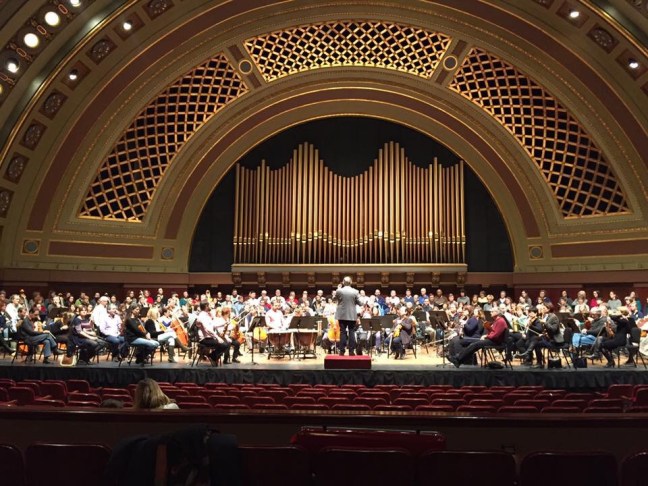
[Image Description: A choir, an orchestra, and a conductor are rehearsing on a stage. In front of the musicians, there are red chairs in an auditorium. Large organ pipes are behind the musicians.]
I’m a musician, and these days, I find a particular musical technique to be a helpful metaphor for personal and community sustainability. I want to offer a quote from Michael Moore about this:
“This morning I have been pondering a nearly forgotten lesson I learned in high school music. Sometimes in band or choir, music requires players or singers to hold a note longer than they actually can hold a note. In those cases, we were taught to mindfully stagger when we took a breath so the sound appeared uninterrupted. Everyone got to breathe, and the music stayed strong and vibrant… [In] “protest fatigue” – we will literally lose our will to continue the fight in the face of the onslaught of negative action. Let’s remember MUSIC. Take a breath. The rest of the chorus will sing. The rest of the band will play. Rejoin so others can breathe. Together, we can sustain a very long, beautiful song for a very, very long time. You don’t have to do it all, but you must add your voice to the song. With special love to all the musicians and music teachers in my life.”
–Michael Moore
We go through rhythms of action, rest, play, showing up, taking space away, living in solidarity, honoring the Sabbath… practicing presence with one another and our own bodies and minds, we rest within and act upon deepest values that undergird our lives.
We all take turns. Our rest is beneficial for our community. Our action is beneficial for our community.