[Image Description: A round, chiffon lemon cake with white icing is on top of a white plate.]
I drove to my friend’s place to pick up some chairs. She’s generous to let me borrow them for a big event we’re hosting this weekend.
On the way there, I found myself looking forward to seeing her.
And…
I took a moment to recognize how sad and heavy I felt… just about the general state of things in our nation and in our world. I was really feeling it for the few hours that preceded that drive to her apartment.
When I arrived, I was glad to see her. She also cares deeply about the larger questions swirling about us these days. During our time together, I watched and listened as she delighted in the enjoyment of simple things: the coffee shop she visited today, the dress I was wearing a few days ago, her cat, and more.
Another person stopped by. “I brought lemon cake!” she said as she came through the door.
“Oh my gawd!!!”
My friend exclaimed with such genuine delight. It filled me in a way I needed.
It makes complete sense to grieve and feel heavy about collective pain, confusion, and hardship. We’ll keep feeling these, at times, in waves. Some people are in very close proximity to these threats, and I know that feelings don’t always just switch on and off.
And in the midst of this, challenging as it is, right alongside it, I like to uplift the gift of simple joys too. There are so many tiny, wonderful experiences of daily living. My friend brought that home to me today.
So after saying goodbye to her and walking out her door, I packed up my car with chairs and immediately went to get ice cream.
[Image Description: A green pen is on top of a yellow sheet of paper. The paper is a list written in green ink, and parts are crossed off.]
Yesterday, I was defeated by a to-do list.
It still remains, technically unwritten;
but piece by piece,
and point by point,
it chiseled itself into my brain.
Do this, then –
Do that, then –
Achieve this, then –
Accomplish that.
It hammers.
It sculpts.
It hardens and solidifies.
Pristine and chiseled,
it presents itself complete and paramount.
And it does all of this. . . For The Goal.
(Or at least, that’s what I’m led to believe).
Instead, this to-do list, this master carpenter,
becomes a goal in and of itself.
If I’m not careful,
my thriving will diminish,
my playing will diminish,
my living will diminish,
while
my toiling,
my striving, and
my working,
grow,
extend,
increase,
accumulate.
Forget the real goals!
The living,
The playing,
The thriving!
Suddenly, these are less than a host of check marks,
Suddenly, these have less value than solid lines marked through words.
Suddenly,
DO and DONE
become more
than LIVE and LIVED.
Well, today, I turn a corner.
I will not cross LIFE off some oppressive list.
Peace and pleasure will permeate my work,
and no lines will run through
BREATHE
LOVE
ENJOY and
SAVOR.
Yesterday, I was defeated by a to-do list.
Today, the goal shifts.
[Image Description: Bright, yellow flowers with green stems and leaves on a brown table with two brown chairs behind them. The flowers are leaning over the container in many directions.]
I bought some flowers at Trader Joe’s on Saturday. I don’t know what type of flowers these are (do you?) but they’re lovely. And I like to buy them because when we put them in a vase, they will often last for weeks.
So I was sad and pretty surprised when I kept them in their sleeve on a table for just a couple hours and they wilted completely. (Way more than the first photo above). It was such a quick transformation that I assumed I needed to put them immediately in the compost.
“Well, I guess I’ll try,” I thought. I put these extremely wilted flowers in a vase with water and plant food. Then I ran an errand, and when I came back, they had perked right up. This too was completely surprising to me. And a couple of days later, they are even stronger and more vibrant.
Sometimes, nourishment is the work.
Nourishment is what we need. We can give this gift to ourselves in self-care. And community-care can be even more transformative, when with consent and empowerment, we are nourishing each other.
[Image Description: Bright, yellow flowers with green stems and leaves on a brown table with two brown chairs behind them. Now the flowers are tall and straight.]
We tend to juxtapose them,
Martha and Mary, in
their doing, and
their being,
as if these are two entirely different spheres of life.
We tend to juxtapose these parts of ourselves,
internally wrangling with
our doing, and
our being,
at times, feeling guilty for
rest
pleasure
relaxation
contemplation.
Our internal critic
(our voice?
internalized voices?
the voice of a productivity-obsessed culture?)
chimes in to say, Do you not care that there is so much yet to do?
So many needs?
Such a long list?
Yet
There is one thing,
a Better Part —
Knowing and Being Known,
Loving and Being Loved,
Listening and Learning,
Resting in the Renewal —
Belonging.
Doesn’t the best Doing come from this?
Now as they went on their way, he entered a certain village, where a woman named Martha welcomed him into her home. She had a sister named Mary, who sat at the Lord’s feet and listened to what he was saying. But Martha was distracted by her many tasks; so she came to him and asked, “Lord, do you not care that my sister has left me to do all the work by myself? Tell her then to help me.” But the Lord answered her, “Martha, Martha, you are worried and distracted by many things; there is need of only one thing. Mary has chosen the better part, which will not be taken away from her.” – Luke 10: 38-42
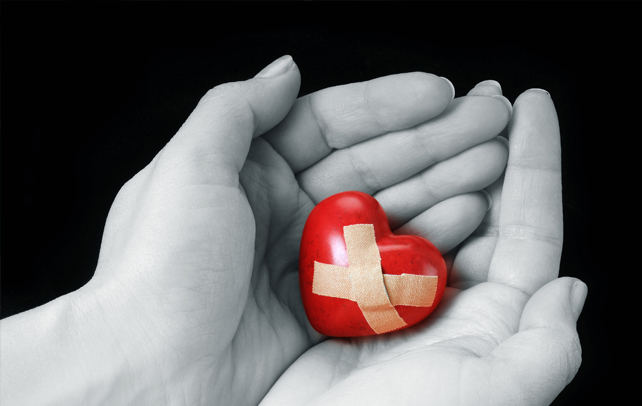
[Image Description: Two hands come together to hold a red, heart-shaped object with two band aids on it, crossed like an x. The hands are in black-and-white, and the heart and band aids are in color.]
This is a simple thought, but I think it’s beautiful and often true to the experience of life.
The verb ‘heal’ is both active and passive.
At times, we say,
“Heal,” i.e. “be healed.”
At other times, we say,
“Heal,” i.e. “act as a healer.”
Healing is –
Something we receive,
Something we take in,
Something we allow to sit with us,
Something we invite inside, and it makes a home with us.
Healing is –
Something we cultivate,
Something we enact alongside others,
Something we breathe into the world,
Something we work at, like kneading dough.
Frederick Buechner says that our calling is found in “the place where your deep gladness and the world’s deep hunger meet.” [2]
It makes me wonder. . .
What needs are present in our own lives?
How can we receive healing?
What needs are present in the world?
How can we work as healers?
And. . .
. . . Are there any intersections where those could come together as a calling?
[Image Description: A welcome mat with the word ‘Welcome’ printed in blue and in all caps. The mat is light brown with vertical stripes of blue, orange, green, and turquoise both above and below the word ‘Welcome.’]
What spaces do you inhabit?
What would it look like if they became more expansive with an even greater sense of welcome?
I am sitting with these questions. Passing them along.
[Image Description: Two hands holding, and sunlight is shining around them.]
This sermon was preached at Allen Park Presbyterian Church in Allen Park, Michigan and was focused upon the story that is told in Mark 12:38-44. An audio recording is above and a written manuscript is below.
“And who is my neighbor?”
That was the follow-up question that someone once asked Jesus. First, that person had asked, “What is the greatest commandment?” and Jesus answered, “‘You shall love the Lord your God with all your heart, and with all your mind, and with all your soul, and with all your strength,’ and the second is like it: ‘You shall love your neighbor as yourself.’”
Jesus speaks these words in the 12th chapter of Mark, just before our passage today.
When the writer of the Gospel of Luke tells the same story, the original inquirer asks a follow-up question. “And who is my neighbor?” He may have been seeking to clarify, but it seems more likely that he was trying to justify the ways he was already limiting to whom he was connected and related.
“And who is my neighbor?”
I find myself thinking about that when we ponder the story that is before us today.
Jesus begins by sharing a word of warning about religious leaders. He says, “Beware of the scribes who like to walk around in long robes” — I notice that I’m the one wearing a robe today — “and to be greeted with respect in the market-places, and to have the best seats in the synagogues and places of honor at banquets. They devour widows’ houses and for the sake of appearance say long prayers.”
They devour widow’s houses. . .
Jesus had noticed the patterns of behavior in these particular leaders and the harmful impact their actions were having upon the lives of vulnerable neighbors. Jesus saw into the hearts of these leaders and noted how tempting it is to desire the power of affirmation, recognition, and religious admiration. He also instructed his disciples to steer clear of this.
Jesus noticed so much about the people around him, about the world around him. He looked into the heart. And he looked upon his neighbors and our neighbors from his own heart, uplifting their worth, journeying alongside them, loving them, and declaring them to be a part of God’s Kingdom. He invites all of us into that same Kingdom alongside vulnerable neighbors.
Jesus spent his life noticing.
Jesus spent his life uplifting.
And so, the story continues. . .
He sat down opposite the treasury, and again, he began to notice things.
The story tells us that many rich people came and put in enormous sums of money. These enormous sums didn’t go unnoticed. The sound of them clamored through the air. The treasury of the temple had long, metallic receptacles that were shaped like trumpets, and people placed their offerings inside. Sometimes, they flung their offerings inside these receptacles, and when all those metallic coins made contact, the sound went before the givers, and all took notice. So what happened when Jesus saw the rich, the powerful, and the leaders of this religious institution making spectacles of themselves only to be followed by the little tinkle of two copper coins given by a vulnerable widow?
Jesus saw her.He really saw her. He called attention to her and voiced his observations perhaps because the others, including his disciples, said nothing and noticed nothing. Some around them were too busy making spectacles of themselves. Why would they value the great sacrifice of this widow?
The tragedy is even actually greater than ignoring her: The people surrounding her had the resources to help and come alongside her, and yet they were spending their time “devouring widows’ houses.” This woman, this child of God, gave all she had to live on in the very same receptacle as those who were willing to destroy her. She gave to God, and Jesus uplifted her gift. But the story has tragedy in it too. I think Jesus wants us to notice this, just as he noticed it.
“And who is my neighbor?”
Mother Teresa used to say, “If we have no peace, it is because we have forgotten that we belong to one another.”
Are we aware of how deeply we belong to one another?
How far will those boundaries stretch? Who be included? Who will be viewed with worth? Who will be uplifted? Who will be seen, noticed, known, cared for, valued, and empowered through the lens of neighbor? Through the lens of kinship?
Because if the most vulnerable of this world are noticed and loved by Jesus, if they are uplifted as people belonging to the Kingdom of God, and we are invited into that Kingdom, it means that we are invited into that Kin-dom. We are invited to occasions of all our barriers breaking down, for our sense of relatedness to expand, to be one family together, one humanity together, living in this creation that God has spoken into being and loved with all God’s being.
It’s that freeing. But it’s also that challenging because truly, if we have no peace, it’s because we have forgotten that we belong to one another. And let’s be honest. Quite often, we have forgotten that we belong to one another.
In a few days, many people will gather and celebrate the 4th of July. Among all the many things on our minds that day, many will choose to remember veterans. We rightly give care and respect to the members of our families and larger circles who are veterans, including those who have known the pain of wars. They are deserving of our care and respect. But I wonder… do we also have a sense of kinship with veterans who are currently experiencing homelessness? Do we have a sense of kinship with poor, young men and women who would prefer never to enlist, but feel that is their only way out of poverty? How far does our relatedness go?
Sometimes, we have forgotten that we belong to one another. I know that I have forgotten.
And at this time of year, many congregations choose to go on mission trips, at times, to places around the globe. Or some congregations create kits or shoeboxes for children in other nations. When this happens, we don’t know the names of the children who receive these things, but we know those children do have names. We hope that when they receive them, they experience a sense of love and value — love from God, love from neighbors like us. But I wonder… do we also feel a sense of relatedness when these children become more visible to us? When they are enduring poverty and have tangible needs? When they are fleeing violence? When they are incarcerated or detained? When children just like them end up in the stories of our news cycles, are they still our neighbors, or are they viewed primarily as symbols, maybe even objects of debate?
Sometimes, we have forgotten that we belong to one another. I know that I have forgotten.
We are called to be relationship with one another, delighting in one another in care, mutuality, and kinship — to see those who are often forgotten and experience the presence of God in the presence of one another. This is the kind of partnership and kinship that Jesus keeps calling us to again and again.
“And who is my neighbor?”
The truth is, we never arrive fully in these relationships, certainly not through our own efforts. But again and again, Jesus is calling us…
It makes me wonder, what might Jesus want to uplift in this congregation? Who might Jesus want to uplift? How might Jesus want to challenge each one of us? How might Jesus be inviting us now once more to love our neighbors — to love our neighbors as ourselves — more expansively?
I am grateful that Jesus journeys with us too. I am grateful that Jesus notices us in great love too. And that love is beckoning us into a calling that keeps emerging, a calling that keeps challenging, a call that keeps expanding…
I’ve had some moments like that over the last few months. Fortunately, it’s just been a few days here and there rather than a sustained season, but when those days have come, they have really come. Meanwhile, I know that some among us carry a sense of depletion that feels more sustained, and there are deep longings for greater energy. Wherever we find ourselves, I’d say, what is. . . simply is. No judgment, and we can give ourselves a lot of grace.
I especially ponder this when I consider all the movement work that is happening within us and around us. As we know quite well, there’s always more to do than any one of us can do alone. The size of it all can feel pretty daunting. Fortunately, we do actually have each other, and we bring different pieces to the work.
In the midst of that, this is pretty crucial: We need to keep the renewable resource callings going.
What I mean is that we all have callings — tasks, endeavors, activities, visions, and rhythms — that uniquely energize us even as we give them energy. As much as we give them energy, we receive energy back. They’re like renewable resources for us.
With so much need, we might forget to prioritize them. We might sacrifice them because we sacrifice our own self-care. But we need self-care. And. . . at the very same time, we should never underestimate how helpful these renewable resource callings can be to our movements and communities. They come so naturally and fill us so much that they might not seem like work. But they would be taxing work to someone else. It’s helpful to keep these callings precisely at the core of our work because they are uniquely alive in us.
And our movements and communities absolutely need our aliveness.
Sometimes, we have to do what we have to do, and that includes tasks that drain us. Some even add risk to us. But there are renewable resource callings too. They enrich us and our communities.
[Image Description: A tree with two large, split branches emerges from a creek. The bark is brown, and there are smaller branches above with green leaves. The water in the creek is light brown with white bubbles on the surface from rapids. Some stones and sticks are in the lower left part of the image on land.]
When I took this photo over the weekend, the water in this creek was much higher than average. But year round, when the levels are lower, this tree is planted within the water. It’s always connected to the water.
I paused for a moment, recognizing that trees don’t merely have their own individualized set of roots. They are often connected to entire root systems underground. This tree, planted in water, likely nourishes other trees too. The trees receive nourishment from the ground table as well, but I imagine (or at least, I like to imagine) that this tree contributes in a special way.
I found this to be a lovely parable of sorts.
All too often, we are socialized to feel guilty for resting, or practicing recreation, or limiting productivity, or caring for our bodies. Cultures of capitalism and ableism have formed and socialized us in these ways.
But we are worth rest, recreation, pause, and care.
We are worth nourishment.
Why should we continue to feel guilty? We need and deserve all of these. And when we center them, planting ourselves in them, we inevitably nourish others too.
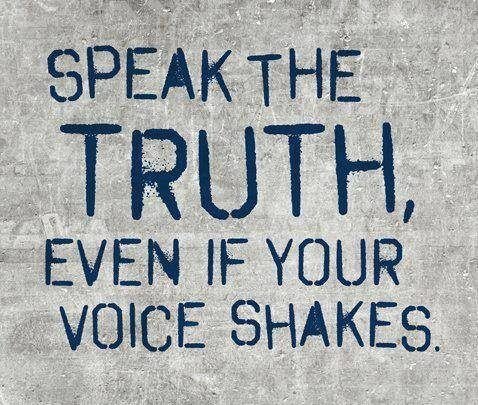
[Image Description: Gray background, Blue text. In all caps, it reads, “Speak the truth, even if your voice shakes.”]
CN: Migrant children in detention, Childhood Neglect
This is a difficult thing to name, but it’s important to call this to our minds and our action:
So often, when children experience neglect —
the absence of adult attention and mirroring, emotional safety and support, food, water, shelter, medical care, language development, learning, affection, hygiene, and other essential human and developmental needs —
they find ways to blame themselves.
Neglected children concoct stories, weaving together a host of “causes and effects” that aren’t linear or actually true, but these narratives are internalized and deeply believed. Sometimes, these blame narratives emerge directly from the words of adults, but they also emerge as a survival strategy.
After all, if the mistreatment your fault, if it’s something you’re doing, something you’re failing to do, or something just “bad” about who you are… there might be chances to change this. If you can figure out just what it is… if you can determine what is so guilty or shameful about you… you might be able to fix this. The mistreatment, which seems to be deserved, might be temporary.
Alongside all the physical dangers of neglect, this survival strategy comes at a great cost. Guilt and shame are internalized at the deepest levels. But this survival strategy also shields from the intolerable: Children cannot bear to believe they are trapped indefinitely among adults who will not care for them or who are thoroughly unsafe, even if that is the true story.
This week, we have heard troubling testimonies about migrant children as young as 7 and 8 years old who were made to be responsible for the care of toddlers in detention. Children cannot parent children. In addition to compounding physical neglect, this sets up scenarios for children to feel guilty. They do not have the capacity to meet the physical and emotional needs of younger, distressed children — children who are separated from the parents who could actually care for them.
So what is the true story here? And what story are we going to tell them?
What story will actually reach these children? Actually liberate their conditions and change their reality? What actions will remove the separation and the neglect?
We also should not bear a reality where children are trapped indefinitely among adults who will not care for them or who are thoroughly unsafe. We must change that story.





 Have you felt depleted lately?