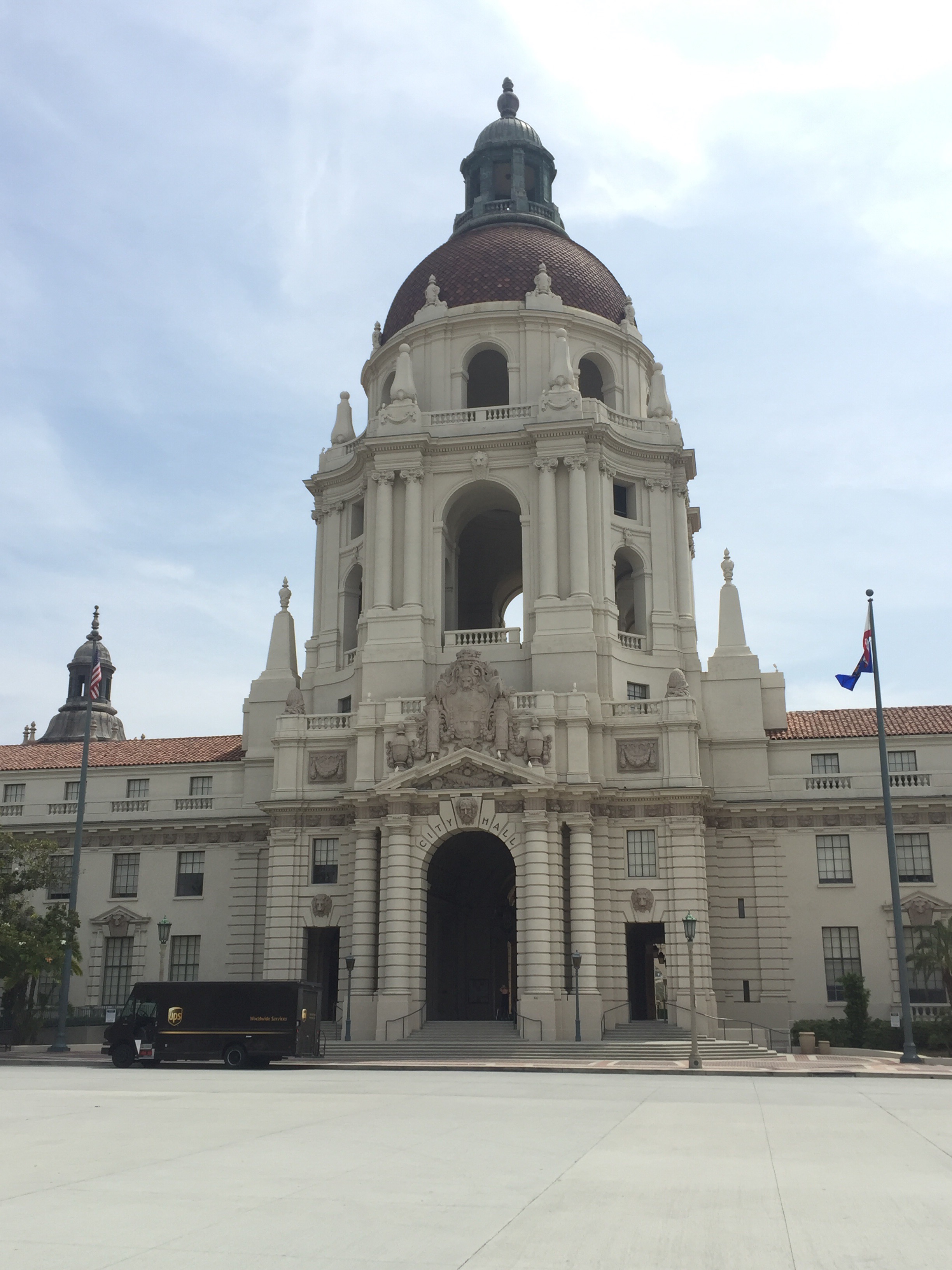

Hello, dear friends. I am pleased to say that my Presbyterian tradition and my absolute love for all things Portlandia are intersecting this week. I am in Portland for the next seven days to attend the General Assembly of the Presbyterian Church (U.S.A.).
General Assembly happens every two years and is an occasion when thousands of Presbyterians come to a convention center and make major decisions together. The process is both passionate and parliamentarian. It feels like a family reunion and forges its own twitterverse of opinions, connections, and inside jokes.
I’m thrilled to be here. While here, I have several priorities: I will blog and tweet about events, write for an online journal, and hold conversations with leaders who are forming new worshiping communities in our denomination. I expect to learn a lot and connect deeply.
So, here’s a fair warning: For about a week, this blog will become very Presbyterian-specific. But Presbyterians care about our neighbors and justice in the world too, so this isn’t ultimately an insular experience.
Yet in all honesty, at times, this is about to get very Presbydorky. Just letting you know.
As a case in point, I would like to offer today an excellent video that was crafted by the Revs. John and Krystal Leedy.
In the aftermath of the horrific mass shooting and large scale loss of life in Orlando, Donald Trump quickly took the stage on behalf of his campaign and called once again for a total immigration ban of Muslims into the United States. He said the U.S. must suspend immigration from areas of the world where there is “a proven history of terrorism.”
Donald Trump may have forgotten that his words can also terrorize as they incite and mobilize fear. Or perhaps he hasn’t forgotten at all.
Perhaps that is precisely his campaign strategy.
Perhaps he is quite aware of its efficacy.
We must ask these questions of ourselves:
What will Donald Trump’s rhetoric do to us? What will it incite and mobilize in Americans?
Inaccurate and irresponsible language behind these debates can easily ignite a culture of Islamophobia and violence against Muslims in the U.S. and around the world.
Donald Trump says his proposed immigration ban will be temporary “until our country’s representatives can figure out what is going on.”I shudder to think what his conclusion would be to that inquiry.
Since Donald Trump is already scapegoating Muslim immigrants and speaking information that is blatantly false (for instance, saying publicly that the Orlando shooter was “born an Afghan” while he was a lifelong U.S. citizen) I do not have confidence that Donald Trump would accurately assess ‘what is going on,’ nor that he would address challenges without incendiary language toward exclusion and violence.
Yes, I shudder to imagine Donald Trump’s conclusion to ‘what is going on.’
I fear the ways this rhetoric can radicalize us.
Do we really think we are incapable of mass violence ourselves? Are we unwilling to recognize the ways we commit violence in this nation and around the world in the name of our fears and mistrust? Can we deny that too often in our history we have sought to dominate others and abuse power? Will we recognize that any religion or national ideology can serve as the platform for radicalized violence?
We have opened the door to this language.
How will it affect our world?
As we know, we are living a deep and devastating week together. The last few days have felt quite heavy. Our nation and local communities are grappling with deep grief and pain after the violence and losses at the Pulse Nightclub in Orlando, Florida.
In times of national sorrow, we feel pain, anger, numbness, and confusion. We also feel a sense of powerlessness as an ever-pressing question resounds within our minds and hearts:
What can we do?
In the days and months ahead, we will answer that question with action, empathy, solidarity, and change. We must work for all of these. We must. and
When that question arrives and lingers,
When it presses — What can we do? —
We can live an immediate answer
that is simple yet fiercely powerful: We can see and be seen.
This happened last night in Ann Arbor, Michigan on a large scale. In fact, it was nothing short of miraculous.
In the wake of our aching, national pain –
in the loss of particular human lives,
in the loss of a sense of safety,
especially for our LGBTQ friends —
Ann Arbor showed up last night on behalf of Orlando.
In only 48 hours, four organizers and an entire town of people came together to sing, play, and witness an impromptu performance of Mozart’s Requiem in memory and honor of victims in Orlando. Leaders of the LGBTQ community, local clergy, and city and university leaders also spoke powerfully with messages that were convicting, vulnerable, authentic, and loving.
Last night, we saw our transgender, bisexual, gay, lesbian, and queer friends and neighbors with meaning and value.
Last night, we saw our community stand alive with hope and power for change.
It begins with seeing and being seen.
It continues with the same,
when we live generously and act forcefully on behalf of
people we have seen and known,
people with worth and value.
So I want to thank Austin Stewart, Arianne Abela, Kevin Fitzgerald, and Colin Knapp —
four powerhouse musicians, friends, and advocates who organized an entire Requiem in 48 hours. It was nothing short of a miracle.
I want to thank Alaina Brown, Ashley Dixon, George Shirley, and Stephen West who served as soloists in the Requiem.
I want to thank all singers and orchestra members who arrived to perform this music with depth, sensitivity, and power.
I want to thank First United Methodist Church for holding the rehearsal.
I want to thank the UMS Choral Union and First Presbyterian Church for providing musical scores which allowed heartfelt emotions to translate written music into great meaning.
I want to thank Jim Toy, Austin Stewart, Aaron Dworkin, Chris Taylor, and Mark Schlissel for their opening words which inspired us.
I want to thank a number of local clergy and religious leaders who shared closing words and sent us forward with more reflections.
And I want to thank the entire city of Ann Arbor and members of other communities who joined us last night. It was astounding to see so many people standing together in Hill Auditorium. This city heard the performance and will carry the meaning forward.
To close, this moment remains on my mind:
Last night, I had the privilege to sing next to Arianne Abela, one of last night’s organizers. Before the concert began, she and I both had tears in our eyes, marveling at the vast number of people in the audience, aware that this number had arrived with only two days notice. We realized that the audience was probably thinking the very same thing about us as they saw the number of musicians standing on stage. More than 300 musicians were facing them.
Together, we thought about that. . . musicians and audience members marveling simultaneously about the presence of one other. . . That’s when we said,
We have lost entire worlds today.
We have lost a universe of sacred lives and loves.
The Talmud says it this way:
“Whoever destroys a soul, it is considered as if he destroyed an entire world. And whoever saves a life, it is considered as if he saved an entire world.”
Perhaps we feel we are losing our breath and even our words to describe today’s horrific and enraging news. In the early hours of the morning, entire worlds faced great violence.
At this moment, we know a particular set of numbers which begins to express some form of what happened – numbers of those who have died and those who are wounded. But the numbers can’t possibly express the loss. Those numbers represent neighbors, friends, siblings, children, partners, coworkers, heroes – sacred human lives with names, identities, stories, and personalities. Each one, particular. Each one, an entire world.
And in the wake of this news, more souls – whole worlds full – are wounded by the trauma of it all, feeling the grief of the countless connections that cannot accurately be enumerated.
We have lost entire worlds today.
We have lost a universe of sacred lives and loves.
Perhaps we feel we are losing our breath and even our words to describe today’s horrific and enraging news.
And. . .
It makes me wonder what kind of universe we want to live in.
It makes me wonder what world we will fight for.
[Photo Credit: Dougal Waters and Paul Taylor via Getty Images]
Last week, I stumbled upon an article that was fierce in its truth telling. Its words brought home a crucial point we need to hear: Wellness is not the answer to our overwork. That is, it isn’t the answer alone.
The only cure for overwork is to stop working.
We live in a culture fueled by a growing insatiability for greater profits and production. As such, we are working longer hours than ever before with pressures for constant availability, and there are fewer days off. But if we want individuals and communities to be truly healthy — including our sense of teamwork at work — we actually have to work less, and we actually have to make that commitment a priority.
Zoë Krupka brings this home in the article I mention: No, it’s not you: Why ‘Wellness’ Isn’t the Answer to Overwork. Krupka is concerned that we run this rat race of overwork continuously, thinking that a little meditation, yoga, or exercise will be able to keep its effects at bay. Physical and spiritual practices of wellness are truly great for us, but over time, the cumulative effects of overwork do harm our bodies, mental health, and relationships.
We have limits, and
We actually have to stop working.
And let’s get honest: There can be a cost to honoring this commitment. In the article, Krupka mentions stories of clients she counsels in therapy. Her clients are hard workers who gave their best efforts, but their work was never perceived to be enough in their workplace culture. In one company, all people were told if they do not perform at 150% capacity of their position descriptions, they are not pulling their weight.
It takes courage to assert human needs for limits and balance. It can even get you disciplined or fired. Without question, that feels scary, and even more so when we have financial needs, family members who depend on us, or a desire to progress in our careers. But do we really want to work in a cultures that thrive on this kind of fear? When we’re working 60, 70, and 80 hour weeks consistently, even when we’re meeting the goals, those fears can still hang over our heads. No amount of work seems to keep them at bay.
And sadly, the great irony is this: More and more, studies are showing that productivity is significantly higher with fewer hours. Productivity drops after 50 hours, and it falls off a cliff beyond 55. We are working harder and losing more of our lives for less productivity.
We all want to work hard and do our best. Above all, we want to work in ways that add meaning, creativity, worth, and purpose. But when we feel like we’re losing our life to work — losing time with family, depriving ourselves of friendships, always rushing, and continually feeling the pressures of the impostor’s syndrome — is it really worth it?
We have to stop, and
We have to change our relationship to work itself.
Dr. Cynthia Rigby, one of my professors in seminary, talks about this, and I love her language for it. She says that often, we think we need a bit of recreation to refuel us with more energy to jump back into the rat race. Instead, she said, we need Sabbath and play to help us change our relationship to the rat race itself — not mere recreation but re-creation.
As an addendum, I also love this quote from Barbara Brown Taylor:
“At least one day in every seven, pull off the road and park the car in the garage. Close the door to the tool shed and turn off the computer. Stay home, not because you are sick, but because you are well. Talk someone you love into being well with you. Take a nap, a walk, an hour for lunch. Test the premise that you are worth more than you can produce–that even if you spent one whole day of being good for nothing, you would still be precious in God’s sight. And when you get anxious because you are convinced that this is not so–remember that your own conviction is not required. This is a commandment. Your worth has already been established, even when you are not working. The purpose of the commandment is to woo you to the same truth.”
I’m so grateful that abby mohaupt is sharing with us today as a guest blogger on Smuggling Grace. abby carved out an intentional season to try impossible things, and powerful stories have emerged. You are invited you to read the photo captions as part of the rest of the text.
It started on Easter. My partner and I went to celebrate the miraculous resurrection of Jesus with a local church in the morning, and in the afternoon, we released the ashes of our recently deceased sweet cat into the ocean.
I watched the waves carry her out into the open, and it felt like we’d done the impossible, letting go.
I remembered my years as a pastor preaching and teaching on Easter, claiming that this pivotal day in our Christian calendar is God’s promise that the impossibility of life is conquering death
–that death does not have the final say. The impossible is possible.
As Christians, we’re called to believe the impossible. I began to wonder if we’re also called to live the impossible. What might it be like to do impossible things between Easter and Pentecost? How would I change?
I started out wanting to do an impossible thing every day.
I had hard conversations with people… entering into dialogues which were vulnerable and honest. I tried to be unafraid. I worried that I would come across as angry or negative, instead of clear. After a couple of these conversations, I realized that these hard conversations weren’t impossible, just hard.
In the meantime, I deepened relationships with several colleagues and friends over conversations and explorations that we otherwise wouldn’t have had together. (Also, I learned to say “you are driving me crazy” in a life-giving way, and I learned to stand up for myself more than once.)
And after a couple more, they just felt real.
I pushed myself physically too, looking for joy while I run… and being more mindful about who I am in the world, and coming up with impossible goals for exercise. The more I ran, the more joy I found. And one week I took 100k steps in five days. The second time I did that particular impossible thing, it was easier, and I realized that I was conditioning myself—that the more I did the impossible, the easier it became.
I began to think I was in training for a big impossible thing. And it became less important that I did an impossible thing every day… and more important that I keep an eye out for the opportunity to try.
As my impossible muscles stretched and moved, I thought about perspective and power and possibility. When I was in Washington, DC, it was painfully obvious that a lot of what I do on a regular basis (fly across the country, for example) is impossible for so many people. I felt like my brain was being trained to think outside of my own experience… to re-think exactly what I mean by the impossible.
And I wondered if God is God and I am not, who am I to do the impossible?
Still, I thought a little about my capacity to do the impossible. And there were still things I couldn’t do (like yell at a white male staffer in DC who was totally rude to my African American BFF or plan to bring my sister-by-choice to the San Diego Zoo to see the pandas because it could jeopardize her immigration papers). But my power and privilege changes my sense of those limitations and my capacity to exercise my ability to do the impossible.
Later I discovered what I thought was going to be the biggest impossible thing. In April, I accepted a spot in a PhD program Drew University, which means I’ll leave a job I love working with people I love. To do this, I’ll move across the country, away from my partner and start something new. It felt scary but also exciting… and like I was crossing the finish line at my first half marathon. And just like a marathon finish—it feels a little less impossible now that it’s done.
Weeks later, after a few more hard conversations and refusing to work on my days off, on one of my long runs, I began to think.
I realized that more than a decade I’ve spent trying to forgive one person in my life and the last two years trying to forgive another two people—
I spent a few miles thinking about how my inability to forgive that old hurt had let the new hurt emerge. But that old hurt was huge—it changed the course of my life and changed almost all the relationships in my life at the time. That old hurt welled up in me, with anger and fear and hopelessness.
And at point on that run, I said to myself, “I think forgiving this person is impossible.”
I stopped midstride.
Impossible was the point of this season of my life.
I started to think about what it would mean to forgive and what and who I really needed to forgive. And I began to think about where that forgiveness needed to take place.
And so I found myself back at the ocean.
On the way home from that trip to the sea, I thought about how far I’d come since Easter. I thought about how little I understood about the impossibility of Easter before I tried to do the impossible.
And then suddenly, from the shadows of some memory, came a passage from “Through the Looking Glass” by Lewis Carrol:
“Alice laughed: “There’s no use trying,” she said; “one can’t believe impossible things.”
“I daresay you haven’t had much practice,” said the Queen.
“When I was younger, I always did it for half an hour a day. Why, sometimes I’ve believed as many as six impossible things before breakfast.”
Believing in and practicing the impossible takes practice. When we try the impossible little things, we prepare ourselves for the great big impossible things we can’t imagine. And I can’t wait for that next impossible thing.
-Abby Mohaupt
abby mohaupt is a teaching elder in the pcusa. she loves coffee, long distance running, and jesus. she keeps a bag of crayons in her bag at all times. sometimes she blogs at www.featheology.org
In the season of Pentecost, I am creating blog series that spotlights individuals, communities, organizations, and churches that are pursuing creative, new ideas.
For a year and a half, my husband and I have had a sweet relationship with one particular, wild cottontail rabbit. It all started in January 2015 when she decided to move in with us.
We lived inside alone, of course, but she took shelter under our deck outside. She made it her home that entire winter. When spring arrived and the snow melted, we noticed that she loved to rest under our rose of sharon bush. For this reason, we named her Rosa. And from that moment onward, we’ve absolutely delighted in our special yard bunny.
Throughout the spring, summer, and most of the fall, Rosa was always around. Sometimes, she was in the front yard, but most frequently, she stayed in the backyard near her rose of sharon bush where she would nibble on grass and eat her fill. We enjoyed watching her hop to and fro, and Ian even grew an entire clover garden just for her.
All of this attention might seem excessive, I suppose, but we have thoroughly enjoyed having Rosa as a neighbor. And why not? Why not delight in this little creature and grow fond of her as she grows (and eats our grass which always grows. . .)? Why not have a special love for her?
Others joined in too. Last year, throughout her stay, Rosa became a Facebook character. I posted photos from time to time and shared what she was doing. Then when I ran into friends and acquaintances around town or at the grocery store, folks would occasionally ask about her by name. “How’s Rosa these days?”
At some point in the fall, Rosa scampered off for a while. We missed her but blessed her on her way. But this spring, something wonderful happened.
Rosa came back.
At first, for our own enjoyment, we decided she was the “same bunny.” But not long after she arrived, we spotted her nesting in the very same place she did the year before. Then we learned that wild cottontail rabbits are pretty territorial in their homemaking. This was really our yard bunny, back for another season.
So we’re back to delighting in her.
This is what I have learned from Rosa, our yard bunny:
Rosa inhabits a delight that is larger than she knows. Rosa hasn’t done anything to make us love or enjoy her, and if she leaves, we won’t love or enjoy her less.
The delight comes from an existence beyond her, but it’s for her. Rosa doesn’t know that we live inside a decorated house or go to work. She definitely doesn’t know about the existence of Facebook or grocery stores where people ask about her specifically. But all of this delight exists for her, and in ways larger than I can understand, I assume it affects her well.
I believe this is all true for us too.
At the center of things, a delight exists for us beyond anything we can understand fully, but it’s really for us. And who knows? Perhaps that affects us well. I like to think so.
We’re worth loving.
As the summer continues, we’ll continue to delight in Rosa, and the story is unfolding. Because. . .just a few days ago, a new little being emerged. Rosa has given us a grandbunny, and we’re already smitten.
Introducing Lita (full name, Rosalita):
We’re a bit odd in all of this, I know. But we delight well.
And they’re worth it.
This sermon was preached at St. Andrew’s Presbyterian Church in Dearborn Heights, Michigan and was focused upon Mark 5:21-43. The audio recording is above and a written manuscript is below.
Mark 5:21-43
Desperate, Jairus fell at Jesus’ feet.
Jairus was likely overwhelmed to the point of exhaustion and helplessness, but he kept going and kept pleading because he was desperate. His precious little girl – only 12 years old – was in his words, “at the point of death.” We only hear two sentences from Jairus, but they’re packed with desperation. “My little daughter is at the point of death. Come and lay your hands on her, so that she may be made well, and live.” Just two sentences. But perhaps we can imagine the urgency in Jairus’s voice as he spoke to Jesus, because the story also tells us that while he was lying on the ground at Jesus’ feet, Jairus was begging Jesus repeatedly. Jesus had compassion at the first word, but we can imagine the desperation in Jairus’s voice. Perhaps he repeated himself and begged again and again, just to feel a slight amount of confidence, like he was making something happen. Sometimes silence can feel very scary in times of great need. Or perhaps as he kept speaking in urgency, his sense of panic and anxiety grew even stronger like a fearful refrain. We don’t really know.
But we do know this: Jesus noticed this desperation and had compassion on Jairus and the little daughter he had yet to meet. We don’t know what Jesus said to Jairus, but we can imagine that Jesus’ was moved with love and care. The story says it simply. “So he went with him.” Jesus entered Jairus’s need and went with him.
Jairus was a person of prominence in his town and in his religious community. As the leader of the synagogue, he was revered as a person of significance and honor. But even people of privilege can be reduced to desperation when death is so near, especially when a child’s life is in danger – something that should never be, something more frightening and heartbreaking than just about anything else we can experience.
Jesus noticed. He was present to Jairus’s desperation. Jesus went with him.
But things did not go smoothly or according to plan. Desperation was rising in other places too. There was a woman. There was a woman whose identity had been reduced to mere nothingness. In her experience, it wasn’t as though she were simply ignored. That would be a difficult reality for sure, but it would be simpler than the one she was living. She wasn’t simply ignored. She was isolated. Others feared her. She had a difficult hemorrhaging disease which caused her to bleed continuously, and under the law at the time, that made her continuously ritually unclean. She couldn’t worship in the public spaces. She couldn’t come into contact with anyone else. Because if she did, she would make others ritually unclean too, at least until they performed the essential rituals to become clean again, rituals that would allow them worship freely and publicly.
But she didn’t have that option. The bleeding never stopped. She had done everything she could imagine to be healed of this disease, everything in her power to become ritually clean once again, but nothing worked. She had spent all her money, everything she had on doctors who couldn’t heal her. Now she was not only sick but financially destitute. She had nothing, and she had no one. She had been isolated for twelve years of her life. Socially, she was a nobody. She had no prominence, but she too was desperate.
And as the saying goes, desperate situations often lead to desperate measures. She had heard about Jesus, and she came up with an audacious plan. She said to herself, “If I but touch his clothes, I will be made well.” In all of her experience so far, every typical avenue for healing had not worked. It would be easy to doubt this plan, but she seemed so convinced and convicted. What a shocking and offensive plan it was! If she touched Jesus, she would make him ritually unclean under the law and render him incapable of laying hands on anyone else for healing. She could hijack his ministry, at least for a while. How offensive this was! But she was convicted and she trusted this plan. It went from an audacious idea to an offensive action. She put the plan into place. She touched Jesus.
On one hand, what confidence. . . She had confidence in Jesus. She believed she could simply touch his robe and she would be made well. And maybe. . just maybe, I wonder if she had confidence — even just a little bit – that she had worth as a human being made in the image of God. She needed this healing.
I wonder if she thought this action would be insignificant to Jesus. . . perhaps because another part of her believed that she was insignificant herself, a nobody. She could just touch him. No one would notice! After all, no one else seemed to notice her pain. No one else seemed to see her as the human being she was. This would be easy. She could be healed, and it would over. Simple and done.
But things did not go smoothly or according to plan.
Jesus noticed.
In the midst of a crowd that was pressing in on every side, Jesus noticed. When the woman touched his robe, he felt that power had gone out from him. And he asked a seemingly ridiculous question: “Who touched my clothes?” The disciples were perplexed by this question. The crowd was so large and intense, that the people were pressing in on them, likely making it difficult to keep moving ahead with Jairus to meet his daughter. “You see the crowd pressing in on you,” they said. “How can you say, ‘Who touched me?” But Jesus pressed on with his question, turning around to see who had done this.
Then the woman, who thought she would be invisible, could not avoid being noticed.
Jesus noticed and loved her.
Desperate, the woman fell at Jesus’ feet.
We don’t know what this woman said to Jesus, but we can imagine the desperation in her voice. The story tells us that as she lay there at his feet, she told Jesus the ‘whole truth,’ – the truth about her condition and the truth about her audacious plan. She must have expected great condemnation, first from Jesus who was now ritually unclean because of her choice and also from the crowd who was admiring him and pressing in on him the entire way. She must have expected a terrible ending to this attempt at healing, just like all the other attempts.
But things did not go smoothly or according to her expectations. Jesus was overcome with compassion and was in awe of her trust and conviction. “Daughter, your faith has made you well; go in peace, and be healed of your disease.”
Daughter. . . What an amazing word! What an amazing thing to say to a woman who had been robbed of all her dignity. This woman was no less worth healing – she was no less worth noticing – than the little daughter Jesus was on his way to save. Jairus’s little girl was twelve years old, at the point of death, and this woman, who had been bleeding continuously for twelve years, was always at the point of death. This woman was also a daughter, a person of great faith, a person of worth to God. No sense of desperation could ever take that holy birthright away. In the moment, she was healed of her disease. But she was also healed of her invisibility. She was seen and noticed as the person of worth she was.
But then tragedy struck. Some people came from Jairus’s house and said, “Why trouble the teacher any further? Your daughter is dead.” These were the words that Jairus had dreaded and feared. They had been delayed too long, in large part, by this audacious woman. What could be done now?
Surprisingly, Jesus could not be deterred in his determination to accompany Jairus in his own pain. Jesus noticed, saw Jairus in need, and saw more possibilities than could anyone else could imagine in the moment. Jesus, who was now technically ritually unclean, marched into a scene with mourners who were weeping and wailing, and he said, “The child is not dead but sleeping.” How audacious that was. If he but touched the girl, she would be made whole, and she would live. And that is what he did. “Talitha cum! Little girl, get up!” And this precious daughter of Jairus and this daughter of God was made whole, restored to life.
In life and in death, we belong to God. That is a conviction we voice together. We say it in our creeds and confessions. And we hear it in the words of scripture, written by the Apostle Paul. In life and in death, we belong to God. This is good news for us today.
This is good news for us every day of our lives because we too know desperation, and we live in a world where people are experiencing desperation greater than anything we can easily imagine. In life and in death, we belong to God. We are God’s people, and God desires to heal us.
This is good news for us today because we can take such a conviction with us when times get difficult. We do need healing. We have weathered forms of sickness from which there has been no cure. We have also known death. I wish I could preach from this passage and tell us that every disease will be healed in this lifetime and that even when little children die, they can be raised to life again if we will just take them by the hand. I wish I could say that. But we have seen difficult situations.
But here is some healing truth: Jesus notices. Jesus enters our pain and transforms it, and he will not let us go. He will not let disease or death or any other kind of tragedy separate us from the love of God. He will not let anything separate us the worth we have as God’s human beings. He will always accompany us. And he will heal us in a myriad of ways along the journey. We can have peace in the midst of great difficulty. That is a real form of healing.
And in just a little while, we will experience this kind of love and healing in a very tangible way at the table, where we will take our need, and we will bring it to Jesus who says, “I have come that they may have life and have it abundantly.” So we invite one another: Come in audacious faith. Come and see him. Come and know the Holy God who will walk with you toward healing – toward faith, toward peace, toward confidence, toward worth. Come.
In the middle of the night two summers ago, Ben Johnston-Krase received one of the best ideas of his life. At the time, he was a pastor in Southeast Wisconsin, but while he slept, he dreamt he was traveling to a new church to become their pastor. Once he arrived, he was surprised to discover that the church was. . . a farm.
When he awoke, a good feeling lingered. He realized there might actually be something to this vision. . . At 3:17am, he was suddenly awake with a flurry of ideas: What would it be like to worship in a barn? What if Sunday School involved children caring for chickens? What if all resources on a farm could be leveraged to address hunger? In homes, in prisons, in nursing care facilities?
He wondered, “Is anyone doing anything like this?” He started Googling, and he couldn’t find anything like it. He went to GoDaddy.com to see if FarmChurch.org was available. It was, and he bought it on the spot.
And that’s when the dream got bigger than Ben’s ideas alone.
The next day, he called Allen Brimer, a seminary classmate and close friend who had been a farmer before becoming pastor. After talking to his family, Allen responded right away, “I’m in.”
The flurry of conversations continued. A third family joined too, and the Johnston-Krases, Brimers, and Werts were all in agreement: They were actually going to dream, create, and launch Farm Church. They decided to take a great deal of personal risk. They quit their jobs to pursue this vision with their full attention and energy.
And that’s when the dream got bigger than their ideas alone.
The vision spread, and people around the nation began contacting them in the hopes that they might bring Farm Church to their town. The pastors, their partners, and their kids all entered a discernment process to figure out where they should move. After a lot of prayer and consideration, they decided upon Durham, North Carolina.
And that’s when the dream got bigger than their families alone.
These families made a commitment to follow every thread of conversation once they arrived in Durham. As a result, vital partnerships emerged. Within a year, they received land to farm right within the city, and SEEDS, a local non-profit, gave them space to hold worship services. Most importantly, people of all ages have caught the vision and made it theirs too. Together, they are embodying it. Together, they are embodying church.
And the dream will clearly get bigger.
Farm Church considers ‘church’ to be a reality much larger than a building or central location. They don’t even want a building. Church is not something they go to. It’s something they are.
This is truly a community on behalf of a larger community. They are purposefully embodying church, and together, they will leverage all resources of their farm to feed hungry bodies.
It’s beautiful.
We can catch this vision too. Please consider donating, and allow yourselves to be inspired by this video below.
In the season of Pentecost, I am creating blog series that spotlights communities, organizations, and churches that are pursuing creative, new ideas. See also. . .
Last week on social media, I was pleased to announce a major project that has been underway for more than a year. A wonderful team of people from the Presbytery of Detroit has designed a new opportunity for young adults to move Detroit, where they will experience a year of mission and service, intentional community, spiritual direction, and vocational discernment. This new program is called the Motor City Mission Corps.
I’d like to tell you more details about the Motor City Mission Corps and share why I believe so strongly in this program.
What is the Motor City Mission Corps?
The Motor City Mission Corps is a new service endeavor initiated and supported by the Presbytery of Detroit which invites young adults (ages 19-30) to live in the city and serve a year in mission. Through an intentional community model, young adult participants will live together, explore spiritual formation and vocational discernment, and work alongside four excellent site placement partners that are reducing blight and poverty in Detroit:
Our program will forge even greater connections between these four organizations and will provide formative experiences for young adults, shaping their faith and service for many years to come.
We Need Help to Launch This Program
For a year, we have worked on this project as partners, and we are ready to put our plans into action. But in order to launch the Motor City Mission Corps, we need to secure start-up costs: This funding will provide housing, utilities, food, insurance, and a monthly stipend for young adults and will allow us to hire a Site Coordinator, the staff leader who will recruit and mentor young adults in our program.
To do this, we have started a GoFundMe Campaign to launch the Motor City Mission Corps into action. Please visit the link, and if you are able to do so, I encourage you to give. Even small gifts go a long way when a number of people give collectively.
Your financial giving will lay a strong foundation that will ensure the vitality and sustainability of the Motor City Mission Corps into a long and healthy future.
Why I Believe in the Motor City Mission Corps
Without question, the Motor City Mission Corps is on the short list of projects I am proudest to have helped create. Our team is strong, and we believe in our vision.
This is why I believe in that vision:
1) I believe in Detroit. There are many economic and infrastructure challenges in Detroit, but there are also resources of ingenuity, strength, and longevity. Our program will practice Asset Based Community Development. We believe that Detroit’s residents will be the best teachers and mentors for young adults, and we honor the gifts and perspectives they will bring to solve problems in their own communities.
2) I believe in young adults. I have had a lot of experience working with young adults over the years, and I celebrate the energy, questions, and vitality they bring to organizations and opportunities for service. We will recruit young adults who are eager to learn and grow; they will do this through relationships with site placement staff members, local residents, and their cohort of young adult peers.
3) I believe in community ownership. We believe strongly in this program we have dreamed together, but it is not ours alone. In fact, it is not fully realized. It needs the vision and support of the wider community.
Though we need funding to make all of this happen, I am not merely talking about finances. We need individuals, families, congregations, and community organizations to add their perspectives, ideas, and encouragement to this great dream that is emerging among us.
This is why I believe in the Motor City Mission Corps. I hope you will add your encouragement and support to this dream too.