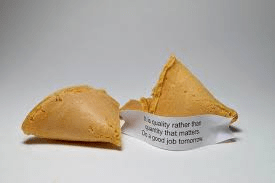
A fortune cookie split open. The fortune reads, “It’s quality rather than quantity that counts. Do a good job tomorrow.” Public domain image.
My title really says it. This year, I ducked invitations, and I’m not traveling anywhere. Things have been so busy as of late that I just really need some time to myself.
I won’t be eating turkey. I might get some Chinese food. Mostly, I’ll be streaming shows, listening to podcasts, and resting.
I bet some people will call, and when they do, I’ll answer and enjoy greeting them. But I won’t be seeing anyone, and I’m really looking forward to time curled up at the house.
Do you need some time to yourself? Maybe not for the holiday, but sometime? I’ll encourage you to take it too.
We’re wrapping up November. In the last week or so, what if we made it NOvember?
We can reflect upon, choos3, and act upon what it means to say, “No.”
This might mean… — saying no to tasks that aren’t best for us to do, — saying no to what brings down our energy, — saying no to beliefs that no longer serve us, — saying no to narratives (external, internal, or cultural) that are painful distortions, — saying no to injustices, — saying no to systemic ways of doing harm, — saying no to old patterns we no longer want, — saying no to doing too much, — saying no to unreasonable expectations, — saying no to… (fill in the blank)
And I’m also going to reflect upon, choose, and act upon this realization: When we say “no,” to some things, we are making way to say “yes” to other things.
We are making space for our best affirmations, intentions, and priorities.
Yesterday afternoon, about 60 people gathered in a graveyard, and together, they encircled the casket of their loved one. The experience was at times playful and at other times poignant. I had met this loved one a few times, and in fact, I had just seen her three weeks ago.
But I am very close to her daughter, and I was there to support her as she offered a eulogy for her Mother.
“She’s a work of art,” I thought as I listened to my friend speak. It takes such strength to write something so meaningful and to speak it aloud while surrounded by that circle. In such moments, everything means; nothing is insignificant. Everything carries meaning, and everything expresses meaning. I was impressed not only by her ability to speak her own truth and memories but also by the way she made sacred space for others to do the same, all while feeling the emotions of the present moment.
A beautiful life, A complicated life, We are all so beautiful and complicated.
As we stood around this circle, my friend said, “I was struck by something one of my Mom’s friends said recently. The people around my Mom’s life are a web, and what affects one affects everyone.”
Someone else then offered to sing and repeated the words, “We are woven together,” as part of a chorus.
I thought, does anything matter more than that web? The people who surround our life, and the people whose lives we surround?
Though I love it, I’ve been too focused on the details of work lately. I’m not talking about the community within that work. I mean I’ve been way too focused on to-do lists. I’ve been rushing. I’ve been stressed. My muscles are often tense.
If the work isn’t connected to that web, it’s just a stress-inducing list. But when that web is formed across all our spheres of life — family (born and chosen), friends, daily rhythms, and yes, work — then it is worth our energy.
It’s better to do our living and loving with that vision in mind.
A rose covered with ice and snow. Photo: Renee Roederer
If you’ve been following this blog for a while — or if you know me on Facebook — you know that I’m an avid nature photographer. I make it a habit to get outside every day and take photos of whatever is growing or changing around me. Sometimes people compliment the beauty of the images, and I always laugh and say, “Well, I can’t take much credit for that. It’s just beautiful subject matter.” And that’s true.
But then they’ll add, “It’s not just that. You’ve got an eye for this.” That means a lot to me.
Recently, my Mom said the same thing — but she added something. “You know you get this from your Dad,” she said.
I sat with that for a moment. And the more I thought about it, the more deeply it touched me. Of course I get this from him. My Dad was an amateur photographer too, especially when I was very young, and he took so many photos of nature. Somehow, I had never connected that thread myself.
I can be honest here: My relationship with my Dad was often conflicted. He died years ago, and those layers of complexity remain part of my story. But hearing my Mom say that — realizing that this way of noticing beauty, of slowing down, and paying attention through a lens is something he gave me — feels like a small bridge stretching across time.
This practice that brings me meaning, connection, and grounding, and I realize that every single day carries a strand of him in it. A redemptive one. Sometimes, when I focus and take a photo, I realize he’s part of that frame too.
“Zeigarnik found that our brains are wired to remember unfinished tasks better than completed ones. Like a to-do list, once we finish a task, our brain checks it off to free up mental bandwidth.
“But this also means that, the more unfinished tasks we have running in the background, the more resources our brains dedicate to keeping track of them.”
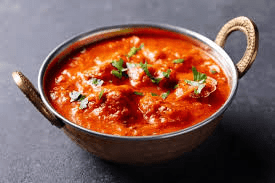
I was sitting at a table in an Indian restaurant with a dear friend. Before the server approached our table, we were already talking about how pleasantly fragrant the place was.
While ordering my curry, I added, “Mild, please.”
The server replied, “Mild? Or Baby Mild?”
“Did you say ‘Baby’? Oh, yeah, probably Baby. When it comes to spice, I’m a Baby.”
We laughed. But I must have seemed a little unsure.
So she added, “We could make it between Baby and Regular Mild.”
That’s when my friend said, “Toddler Mild,” and we all laughed again.
Yes, Toddler Mild. By the way, it was the perfect spice level. I enjoyed every bite.
The book cover of The Body Keeps the Score: Brain, Mind, and Body in the Healing of Trauma by Bessel van der Kolk
Slowly and intentionally,, I’ve been listening to Bessel Van Der Kolk’s pivotal work, The Body Keeps the Score: Brain, Mind, and Body in the Healing of Trauma on audiobook. Truly, I’d place it in the top five books I’ve ever read. I recommend it frequently to others.
The book is remarkably insightful and impactful in addressing how traumatic experiences are carried in the body. In addition to explaining the physiology of post-traumatic symptoms in detail, he uplifts a number of somatic approaches to healing trauma in our bodies and relationships.
Today, I’d like to uplift a quote that really spoke to me. Bessel Van Der Kolk says,
“Study after study shows that having a good support network constitutes the single most powerful protection against becoming traumatized. Safety and terror are incompatible. When we are terrified, nothing calms us down like a reassuring voice or the firm embrace of someone we trust.”
After hearing him talk about so many other protective factors, studies, and forms of therapy, I thought it was really significant for him to say that support networks and forms of community are the single most powerful protection against becoming traumatized.
When you reach out to someone… When you share how you’re really doing… When you introduce people to each other… When you learn about community organizations… When you suggest community resources…
You are participating in the protection of the body, mind, and spirit. You are building networks that protect yourself and your neighbors from becoming traumatized.
Image Description: People are placing long, white candles into shallow pools of water. There are holes to hold the candles.
These days, I pray to the God between us.
Not to a distant God far away off in the sky somewhere. Not to a mechanistic God, constantly making things happen with the push of a “save” or “smite” button, reminiscent of some old Far Side cartoon.
I pray to the God between us.
Beyond us, yes, but only in the sense of being greater than any one of us. That, and calling us to transformative realities beyond what we typically allow ourselves to imagine. Never far away.
Between us. With us. Among us.
A couple days ago, I found myself reflecting upon one of the most powerful experiences I ever had in a worship service. It was 10 years ago at Mo Ranch, a camp and conference center in Hunt, TX. I was there with a couple hundred college students at a conference aptly called College Connection.
That night, we were together around 9 PM. The beginnings of a warm summer were just beyond the door of the building, and the space was filled with hundreds of candles. Students sat on the floor in close proximity. Together, we sang a lot of beautiful choruses, music with rich meaning.
Midway through that time together, we began to sing a powerful song called “Prayers of the People.” Already, we could hear the tinkling of rain on the metal roof.
The song is by Ben Johnston-Krase. He was there with us, leading us on the piano as we sang it together. We sang these words, not necessarily about ourselves, but about humanity at large. . .
We are hungry, whoa, we are hungry, We are hungry, whoa, we are hungry, We are man, woman, we are children, whoa, we are hungry. . .
And that’s when it happened. We moved onto the main part of the chorus:
So let the rains go, let the healing river flow. Let justice roll like waters. Let the days begin when new life enters in, and let your kingdom come.
Right then, a deluge of water poured from the sky onto that tinny sounding roof. And not only that. It began to flood the space where we were sitting!
Thankfully, this was not from the roof above us, but it did come through the door onto the floor. Some of us got up quickly to move and cover electric cables, but other that, we just let it happen. As we continue to sing those words, we let that water flow right to the tables that held our candles.
The imagery and the synchronicity was not lost on us. We wanted justice to roll like waters, and in that moment, we even believed it possible.
So what happened that night? Did a far away God, off somewhere in the sky, push a “rain” button and mechanistically make that happen? Certainly, if there’s a God, we might say that God made the glories of rain. But if there’s a mechanistic process to everything that happens, I have to start worrying that there’s a cancer button, and a tomahawk missile button, and a school shooting button. I don’t believe that everything that happens is destined to happen.
But I pray to the God between us. Because when that glorious rain happened, I think God was between us, waking us up to the sacred moment as we recognized beauty and sensed a real calling to justice.
I think God is always between us, constantly inspiring us to act in transformative ways, sometimes beyond what we can easily imagine if we will notice what is around us and who is around us.
And without question, the God between us turns us toward one another, so we can marvel at the shared humanity around us.






 Smuggling Grace