Interruptions

This morning, I find myself thinking about interruptions — the types of unexpected experiences that change our lives in powerful ways. Some interruptions are undoubtedly disruptive, but others are gifts we never expected, like,
-the life-changing person we didn’t anticipate meeting,
-the invitation that put us in the right place at the right time,
-the story that encouraged us to ask a new question,
-the feedback that taught us something unrecognized in ourselves,
-the movement that emerged rather organically.
Though rarely sought after intentionally, some interruptions add depth and direction to the scope of our lives. They can also bring us into community in powerful ways. They are some of the greatest gifts we receive.
Today, I am pondering these kinds of interruptions in my life and giving thanks. While unexpected at the time, much later, these are the kinds of experiences we cannot imagine our lives without.
What are some of yours?
“But this was first” — A Meaningful Thought


I was interviewed recently for a podcast, and it was such an enjoyable experience. The Wheelie Good Podcast! is focused on cycling, and Doug French, the host, interviewed me about my immensely large project of e-biking from my home to every street in Ann Arbor in alphabetical order. This endeavor is wildly inefficient, but adventurous!
Doug is such a great interviewer. We started by talking about my project, but soon he was asking about different roles I’ve had and chapters I’ve lived. I felt a bit like I did a life review. And I think I was able to give at least a nod to just about every single community I’ve ever loved. It was so lovely.
A lot of the podcast centers upon epilepsy and community. Not surprisingly, that involves my leadership role with the Epilepsy Foundation of Michigan, but also my own experience growing up with epilepsy in childhood.
Doug said something that no one has ever said to me before. It’s also not a thought I’ve ever had.
I was talking about how my work at the Epilepsy Foundation of Michigan has been a 2nd career for me. Then I added, “But this is not an island I’m just visiting for a while. This is the pathway I see myself on for a very long time.”
Then Doug said, “But also, this was first. You were born with this.”
That’s a simple thought and on the surface, it’s about chronology. But it also felt special. Yes, 2nd career. But I’ve returned to the foundation — a key part of the beginning of my story. That’s not just about chronology. I feel so purposeful in this, and with gratitude. It makes me feel a sense of wholeness too, like I’m healing a part of my experience as well.
I’m still thinking about that line. The podcast episode will be out in about a month, and I’m looking forward to listening — and sharing it — when it’s ready.
—Renee Roederer
Steadfast Worth
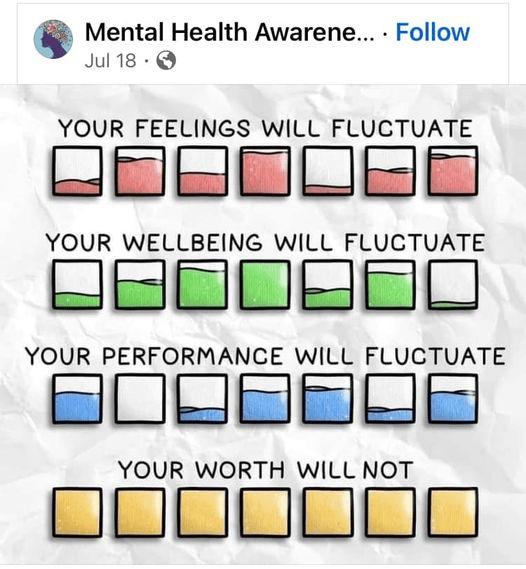
From time to time, we may need a reminder like this. As this image shares,
Your feelings with fluctuate
Your well being will fluctuate
Your performance will fluctuate
Your worth will not
This is true. There is nothing that any external forces, internal beliefs, relational conflicts, complex emotions, personal expectations, or failures can do — nothing — to diminish the worth of ourselves or our fellow human beings. So if that’s true, how will we view ourselves today? And how will we view those around us?
Meditations of the Heart by Howard Thurman

During these turbulent times we must remind ourselves repeatedly that life goes on.
This we are apt to forget.
The wisdom of life transcends our wisdoms;
the purpose of life outlasts our purposes;
the process of life cushions our processes.
The mass attack of disillusion and despair,
distilled out of the collapse of hope,
has so invaded our thoughts that what we know to be true and valid seems unreal and ephemeral.
There seems to be little energy left for aught but futility.
This is the great deception.
By it whole peoples have gone down to oblivion
without the will to affirm the great and permanent strength of the clean and the commonplace.
Let us not be deceived.
It is just as important as ever to attend to the little graces
by which the dignity of our lives is maintained and sustained.
Birds still sing;
the stars continue to cast their gentle gleam over the desolation of the battlefields,
and the heart is still inspired by the kind word and the gracious deed.
There is no need to fear evil.
There is every need to understand what it does,
how it operates in the world,
what it draws upon to sustain itself.
We must not shrink from the knowledge of the evilness of evil.
Over and over we must know that the real target of evil is not destruction of the body,
the reduction to rubble of cities;
the real target of evil is to corrupt the spirit of man
and to give his soul the contagion of inner disintegration.
When this happens,
there is nothing left,
the very citadel of man is captured and laid waste.
Therefore the evil in the world around us must not be allowed to move from without to within.
This would be to be overcome by evil.
To drink in the beauty that is within reach,
to clothe one’s life with simple deeds of kindness,
to keep alive a sensitiveness to the movement of the spirit of God
in the quietness of the human heart and in the workings of the human mind—
this is as always the ultimate answer to the great deception.
Excerpted from Meditations of the Heart by Howard Thurman
A Novel Therapy: What Is EMDR?
What is EMDR?
Adam Copland writes,
The Best Drug I’ve Ever Taken Wasn’t Even a Drug. It was EMDR Therapy.
EMDR stands for Eye Movement Desensitization and Reprocessing, and it’s a highly effective treatment for trauma and high stress. Here’s how it works:
What is Eye Movement Desensitization Reprocessing Therapy?
EMDR is a helpful form of therapy for people who
1) want an experience that is somatic (reorganizing the brain and body’s reactions to trauma, stress, and anxiety)
and/or
2) want to do something that can accomplish a lot in a relatively short period of time
and/or
3) want to do less talking with a therapist (though this can also be a part of the process if desired or the therapist thinks it’s helpful) particularly if it’s hard to put emotions into words.
Dr. Bessel Van der Kolk, the author of The Body Keeps the Score: Mind, Brain, and Body in the Healing of Trauma shares that “I’m pretty sure that our EMDR study had by far the best outcome of any PTSD study ever done… It proves that there is something unique and amazing about EMDR.”
This Week in Nature





Neato Curiosities: 5 Ways Space Travel is Actually Good for You
5 Ways Space is Actually Good for You
“Space travel is infamously bad for your health. But it turns out that in some very specific cases, space travel may actually be beneficial. Like by strengthening your bones, or repairing your DNA.”
Only the Tiniest Sliver of Humanity Has Been Bombarded with This Much News

I kind of said my point in the title.
But it’s true: when you think about the entire span of human existence, we’re living in the tiniest fraction of history where people receive constant, up-to-date streams of global, national, and local news. No human generation before us has ever experienced this level of information all at once.
I started thinking about this while listening to a podcast that mentioned TV news anchors from not-too-long ago — Ted Koppel, Peter Jennings, Katie Couric, Dan Rather. I realized I’m probably part of the last age group that remembers when the news happened primarily at specific times of day. You’d catch it in the morning or the evening, or read about it later in a newspaper. That was it.
Even into the mid-2000s — I remember turning on the 6 p.m. news daily in 2005 while cooking dinner — the world felt connected, but our information still had boundaries. Before 24-hour coverage, before smartphones, most people only knew what was happening locally or what they could read about after the fact.
It’s important to stay informed. It’s even more important to take action. These aren’t abstract stories — they’re real people, real places, and the real natural world we share. This is true locally, and it’s true globally. We’re connected, and our struggles are connected. But our brains weren’t built to process everything all at once, all the time.
We live in the smallest sliver of human history to experience this constant flood of information.
I don’t say this as an excuse to check out (though taking breaks helps). I say it so we can give ourselves — and one another — a bit of grace. Of course it feels overwhelming sometimes. Doomscrolling has existed for, what, maybe twenty years tops? For most of us, probably ten. This is new terrain for the human nervous system.
Here’s where I’m really going with this:
Maybe it’s worth stepping outside, getting to know our neighbors, and caring and advocating for what’s right in front of us. And it’s definitely worth linking those efforts to people and places elsewhere. The world is vast, but our attention can still move with care — one human moment at a time.
—Renee Roederer
Self Family Reunion

What if you could be gathered together in one place with a version of yourself from every age of your life? From baby to current age of adulthood?
What if every age of yourself was present toward all the others, gathered together like a family reunion of sorts? What would that be like?
-Would certain ages pair together for care?
-Would certain ages avoid each other?
-Would certain ages wander off somewhere and find some space to voice their stories, or maybe do some reconciliation work?
-Would certain ages impart wisdom to the other ages?
What might the current you want to say to your younger selves? What might your younger selves want to say to the current you? Truth be told, our younger selves are always present in some way, embedded into the rest of our lives. We can access the various parts of ourselves, and in a sense, even be in relationship with ourselves.
I wonder what would happen in this family reunion?
 Smuggling Grace