Image Description: People clink their glasses together at a dinner party. Also, these people in a stock photo are not spreading COVID-19. Because they’re a stock photo. 🙂 Public domain.
Yesterday, 163,405 people were newly diagnosed with COVID-19 in a single day. That’s a 73% increase from the daily cases average two weeks ago.
Yesterday, 1,171 loved ones died from COVID-19 in a single day. That’s a 33% increase from the daily loss of life average two weeks ago.*
Hospitals are pushed beyond capacity. This is difficult for COVID-19 patients, of course, but it also ends up impacting people with other health emergencies. And it delays necessary surgeries that people need.
When we meet and gather indoors (a task that is understandably desired) it is dangerous because these kinds of gatherings are fueling this spread. It’s difficult to sacrifice this, especially as it stretches on, but we need to keep making wise choices.
This is difficult to grapple with, but it’s not overdramatic. It’s true:
Sometimes people connected to us end up dying — people who weren’t even at the dinner party.Sometimes people connected to us end up experiencing long-term disability (a higher percentage than people who die) — people who weren’t even at the game night.
This is tough, but we are in a tough collective situation. It requires tough individual actions.
ur collective mental health is waning too, which is no small thing. How can we support ourselves and each other and making these necessary choices, but also feeling connected?
We’ll have to be creative in choosing what is much less risky.
But first we have to believe this: What we’re doing is risky.
Image Description: Brown leaves from oak trees that have fallen on an asphalt pathway. Photo, Renee Roederer
I looked up and watched several leaves float down from the sky. They were falling in real time from very tall trees.
“They’ve never been untethered before,” I thought with some sadness, because for some reason, I tend to anthropomorphize things. I watched them fall to the ground.
I kept walking and pondered how intertwined root systems existed underneath my feet, unseen as I walked along this pathway with trees on either side.
Sometimes, we’re more connected than we think we are.
Image Description: A sunset with hues of orange, pink, and deep purple amidst trees. Photo, Renee Roederer.
I was finishing up my daily walk as the sun was setting, and I snapped some beautiful photos with deep purple in the sky. Ahhh… So nice.
And I saw a bat. Ooh, cool!
Then another. Then more. Then lots.
And I ended up running out of the woods (and laughing at myself running) because too many bats were flying near me. It was a funny scene. I screamed once. I chuckled. But mostly, my heart was racing.
They kept swooping down near me for bugs. Don’t do that!
Once I got out of the woods, I also laughed imagining the scenario that I’ve been this cautious about COVID only to get rabies.
“Renee was the most disciplined person we knew about not getting COVID, but sadly, she got rabies, refused water, and died.”
Thankfully, I hightailed it out of there.
Image Description: A sunset with hues of orange, pink, and deep purple amidst trees. This image contains NO BATS. THEY’RE NOT ALLOWED. Photo, Renee Roederer.
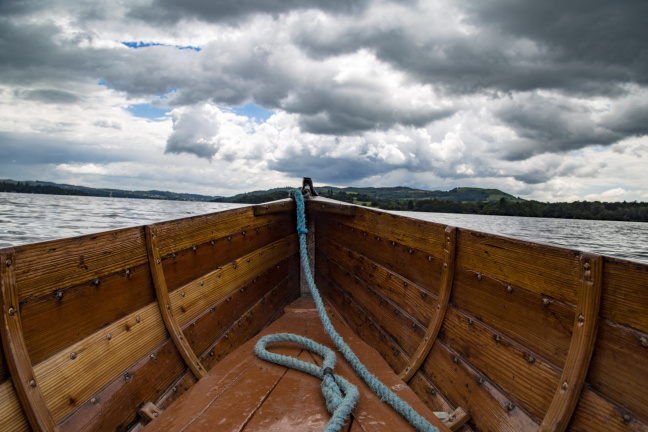
Image Description: The bow of a wooden boat with a blue rope inside. Public domain image.
This sermon was preached at Covenant Presbyterian Church in Southfield, Michigan and was focused upon the story that is told in Matthew 8:23-27.
The last few days, and even the last few hours, had been a whirlwind. Jesus and the disciples had connected with so many people — people whose lives existed on a large continuum of social location.
After Jesus finished teaching the Sermon on the Mount, he came down from the mountain, and an enormous crowd was following him. That’s when a leper, a social outcast, had the audacity to come and kneel before him, saying, “If you choose, you can make me clean.” And Jesus did choose, not only choosing to heal him, but also choosing to touch him — one carrying a contagious disease, one who had been cast out from connection in the community.
Then Jesus and the disciples entered Capernaum, a city in Galilee. And when they arrived, a centurion approached Jesus, a person who had been given power and authority. He was alarmed about the health of his servant at home. And Jesus merely spoke the word and healed this servant.
These two moments were extraordinary — the healing of a leper, the healing of a servant merely by speaking a word. The needs were great; the healing was great.
And then next, the need for healing came close to home. Jesus entered Peter’s house and soon learned that Peter’s mother-in-law was lying in bed with a fever. So he healed her, and then immediately, she began to serve a meal to Jesus, Peter, and the disciples. Meanwhile, all of these people from the growing crowds heard what had been happening. That very evening, many people came to Peter’s house, asking for healing. And the story says that “Jesus cast out the spirits with a word and cured all who were sick.”
Jesus and the disciples must have been amazed at it all — joyful and overwhelmed. After all, don’t we feel both joy and overwhelm in times of amazement?
This is the great whirlwind of all that had happened over the last couple of days, and this is the context of what was happening right before Jesus and his disciples got into a boat and began to travel across the Sea of Galilee.
Jesus had seen the large crowds continuing to follow them, and he said, “Let’s go to the other side.” So he got into a boat, and his disciples followed him.
I wonder what they were thinking as they began this journey… Maybe there was a sense of relief. All of this excitement had also been exhausting. Maybe there was a feeling of adventure. All of this had also been quite new, quite engaging. And now, they were traveling to the other side of these waters, and the other side would not be Galilee but Gadara, a city that was a member of the Decapolis and a center of Greek culture in the region. Who knows what they would experience there?
We don’t know what Jesus and the disciples were feeling, but they did enter that boat. They departed, away from crowds, away from excitement, away from exhaustion. Perhaps now, they were expecting smooth sailing, but of course, as we know, that’s not what happened.
The Sea of Galilee is actually pretty small. When we hear a word like ‘sea,’ we expect an expansive body of water. But the Sea of Galilee is only 13 miles long and at its greatest width, only 8.1 miles wide. This was not a large body of water. But despite its small size, the Sea of Galilee was known to produce very large waves, especially during storms.
A storm was developing. The story says that “a windstorm rose on the lake, so great that the boat was being swamped by waves.” The scene turned into chaos pretty quickly. They were on a small boat together, and all of water was entering that boat with them. Even though they were on a small body of water, they were in the middle of it with no more crowds to help them. They were there together, but with a great feeling of being alone as they tried to bail out that water. How could it be possible that they just experienced all of this vitality together just days and hours before, and now, they would conclude it all by sinking and dying in the middle of the Sea of Galilee? This must have felt surreal — how could that be true? And yet, that seemed to be right before them.
And what’s more, they had just watched Jesus do extraordinary things among their neighbors, but right now, in their chaos and panic, they looked over, and Jesus was sleeping. He was sleeping. No doubt, he was exhausted from all that had happened before, but when they saw him sleeping, they must have been terrified. Maybe they were understandably angry too.
They went and woke him up and said, “Lord, save us! We are perishing!” This seemed like the end to them. They were utterly terrified. And then Jesus says something unexpected,
“Why are you afraid, you of little faith?”
How could they not be afraid? The winds and the waves were pummeling their tiny boat. But then Jesus followed his question with action. He got up and rebuked the winds and the sea, and suddenly, there was a dead calm. He calmed that storm with his presence, and they were amazed. They were shocked. They were puzzled.
And they said to one another, “What sort of man is this, that even the winds and the sea obey him?”
And seemed as though they had gone from abject terror to awe. [1]
And while the first involved great risk and peril, the second was unsettling too. Awe can be unsettling in this way. They had feared that Jesus had abandoned him. Now they were in awe that a great presence was with them, a presence greater than they had expected… It was wonderful, and it was unsettling.
And so I wonder, what do we do with a story like this one? Is it unsettling to you and me?
It might be… because we could sit with it and think through its implications in ways that seem to say, “Jesus calms every storm. Jesus turns everything around. Jesus will save us from every peril.” We could sit with that implication, but it might unsettle us, because we know that is not always true.
We do live in a world with cancer… and war… and freak accidents… and poverty… and people who cause what seems to be infinite harm with never a consequence. We live in a world with depression… and family separations… and family estrangements… and addictions… and grief that seems larger than we can handle.
These are real, and sometimes, they seem to be pummeling our lives. Sometimes, it might even feel as though Jesus is sleeping.
But we of little faith… sometimes, just a little faith… come to discover moments, unexpected moments, when we sense that a presence greater than we have previously imagined is with us. Can you recall moments like that? I imagine we might have stories to share. And we experience moments like that, we feel awe… a sense of wonder, a sense of the sacred, mixed with perplexity, and mixed with a little bit of hope. Today, wherever we are and however we are, we are invited to rest into that, maybe even just a little bit, discovering that this presence loves us and is holding us fast.
Jesus himself will not be protected from all peril. In fact, the Gospel goes on to tell us that he loved so deeply, so broadly, so radically that the powers-that-be were threatened. He was unjustly arrested. He was unjustly murdered by the state.
It seemed as though all hope had been lost. But even here, we discover God’s presence — the presence of God found in Jesus found even on the cross, that instrument of ancient torture. We discover a God that says, “Where you suffer, I suffer. I am profoundly with you. I am profoundly for you.” And in the resurrection of Jesus, we discover a God that says, “I am calling you to new life, even here. Even in destruction, even in heartbreak, even in death.”
And here is one of the greatest mysteries of all. We ourselves are being invited to embody that kind of presence in this kind of world — this world that knows all of these things. We’re invited to step into that and perhaps invite ourselves and our neighbors to experience awe.
Years ago, when I was in seminary, I remember a classmate saying something so simple but so beautiful. In a prayer, she kept repeating a rhythm and a refrain. She said words like these, “God, may we add our care to your care. May we add our compassion to your compassion. May we add our presence to your presence.”
Maybe that is our prayer collectively today, that we might discover the presence of God as we dare to embody the presence of God in the world — not that we ourselves are God or little gods, but that our lives are truly accompanied, beckoning us to accompany other lives.
Perhaps this story unsettles us.
But perhaps it also empowers us, as we discover greater presence among us and we dare to add our own presence too.
Image Description: My Dove chocolate wrapper from yesterday. Inside, it says, “Inhale the future, exhale the past. — Layne R., Ohio”
Last night, in President-Elect Joe Biden’s speech to the nation, we heard a number of words voiced aloud. We heard “systemic racism” named as an injustice we must dismantle and “disability,” and “transgender” as markers of identity, dignity, and rights.
I am here for it!
Now, let’s make it more than a speech and hold this new administration and ourselves accountable to act in these ways.
Image Description: Geese flying in a V. Public domain image.
That moment when you awaken to the sound of geese flying over, and you think peacefully, ah, yes, Mary Oliver… That’s right… You don’t have to be good…
Then three minutes later, you hear giggidy jillion more fly over, and it sounds like an utter symphony of clown horns.
Image Description: A map of the United States. The Upper Midwest is highlighted in red. Public domain image.
I’ve been walking for 20 days now throughout my county on what I’ve been calling my Pilgrimage in Place.
Three times I’ve worn a particular dress, and every single time I’ve worn it, this has happened:
As I pass by, someone says,
“I really like your dress!”
And I reply,
“Thanks! And I got it for $17!”
Then they reply with, “Well done!” “That’s awesome!” or “Oh my gosh, love that!” One person even raised the roof.
Why do Midwesterners like to celebrate bargains they got on clothes? Why is this a thing? Why do I always say this? Am I deflecting a compliment? Do I know that they will celebrate this? Clearly, I do know it because I expect this every time.
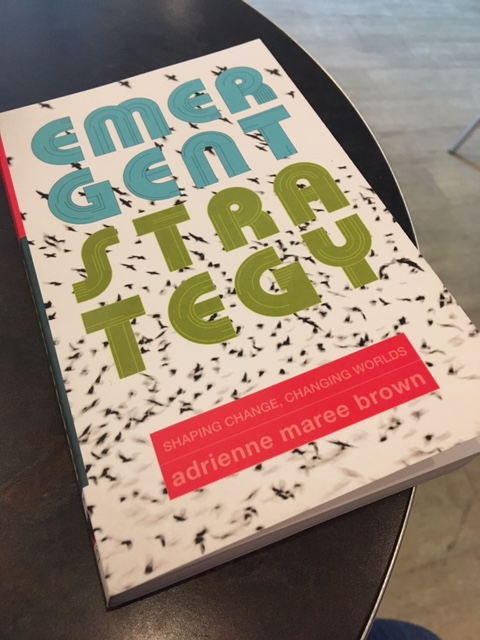
Image Description:A book is on top of a brown, curved table at an angle. Its title is “Emergent Strategy: Shaping Change, Changing Worlds” by adrienne maree brown.
Today, I’d like to share two quotes from adrienne maree brown’s book, Emergent Strategy: Shaping Change, Changing Worlds:
1) “Remember you are water. Of course you leave salt trails. Of course you are crying. Flow. P.S. If there happens to be a multitude of griefs upon you, individual and collective, or fast and slow, or small and large, add equal parts of these considerations: that the broken heart can cover more territory. that perhaps love can only be as large as grief demands. that grief is the growing up of the heart that bursts boundaries like an old skin or a finished life. that grief is gratitude. that water seeks scale, that even your tears seek the recognition of community. that the heart is a front line and the fight is to feel in a world of distraction. that death might be the only freedom. that your grief is a worthwhile use of your time. that your body will feel only as much as it is able to. that the ones you grieve may be grieving you. that the sacred comes from the limitations. that you are excellent at loving.”
2) “Do you already know that your existence–who and how you are–is in and of itself a contribution to the people and place around you? Not after or because you do some particular thing, but simply the miracle of your life. And that the people around you, and the place(s), have contributions as well? Do you understand that your quality of life and your survival are tied to how authentic and generous the connections are between you and the people and place you live with and in?
“Are you actively practicing generosity and vulnerability in order to make the connections between you and others clear, open, available, durable? Generosity here means giving of what you have without strings or expectations attached. Vulnerability means showing your needs.”
If we’re feeling anxiety, let’s feel those feelings. And let’s invite others to show up with and for us.
If we’re feeling grief, let’s feel those feelings. And let’s invite others to show up with and for us.
If we’re feeling hope, let’s feel those feelings. And let’s invite others to show up with and for us.
If we’re feeling love, let’s feel those feelings. And let’s invite others to show up with and for us.
And let’s keep showing up with and for others too.
Image Description: Chalk drawing of a pink heart, surrounded by colors of green, yellow, and purple. Public domain.
I love this quote from author Linda Hogan:
“Suddenly, all my ancestors are behind me. ‘Be still,’ they say. ‘Watch and listen. You are the result of the love of thousands.’”
It’s astounding that any of us are here as the precise people we are. We are the result of the love of thousands…. We can think about all the people who most closely share our DNA. We would not exist in the way we do had innumerable lives not included stories with very specific details, leading them to the lives of one another.
But, of course, well beyond DNA, we are shaped by thousands of people whose stories, life outcomes, and forms of wisdom have shaped the course of our own lives. We are also shaped by whole communities of people over time.
“Suddenly, all my ancestors are behind me. ‘Be still,’ they say. ‘Watch and listen. You are the result of the love of thousands.’”
I found this quote in a meme that was passed around quite a bit on social media a few years ago. If it was printed somewhere too, and you know where, let me know.