As we approach Election Day, the best thing I know to do is be present. I’m trying not to get too ahead of myself with hopes or anxieties, though it’s absolute natural to feel contact with both. Instead, I’m going to try to be present to whatever need, feeling, or hope emerges. One thing at a time… We’re not likely to know election results fully tonight, though we’ll see.
Here’s a question I’ve been asking myself, and I’ll offer it here if it’s helpful:
What values are you committed to living, no matter the result?
Yesterday, I had the occasion to lead readings, reflections, and prayers in a virtual once-an-hour vigil with interfaith colleagues. I’ll share my video here if it’s helpful.
This format didn’t have captions, so if you’d like a transcript, feel free to email me at revannarbor@gmail.com.
Image Description: Three light brown stones stacked on top on of one another. They’re placed on sand, and there are concentric circles in the sand, like a ripple effect.
“We teach who we are.”
This is something that a mentor’s mentor used to say. She may have meant a variety of things by that statement, but she certainly meant that we end up teaching, extending, and tending to others in ways that reflect the most deeply held lessons from our own experiences, the kinds that rest (at times, after a struggle) at the core of our being.
“We teach who we are.”
It reminds me again that the word ‘heal’ is both active and passive at the same time. We heal in receptive ways. Healing is something that we receive, even as we work to create the conditions that make it possible.
And when we receive and integrate healing into our own lives (and this is always a process rather than an arrival) we also begin to heal — that is, participate actively in healing of others.
“We teach who we are.”
We’ve all received; when people welcome us through their own agency, we can extend our healing and learning toward others.
Image Description: Three, pink flowers connected to a vine, and they look like they’re in the shape of hearts. A blue sky is in the background. Public domain image.
While writing, I went to an online thesaurus to look up alternatives for the word ‘connection.’ It’s not that I didn’t want to use that word; it’s that I had used it twice in the same sentence. What could I say instead?
I expected to find synonyms that would denote how items, moments, or people are more generally associated, but instead, I found all of these personal, relational terms:
These are words I think about a lot, and for some reason, I was surprised that the synonyms for ‘connection’ took on such personal forms. It was a reminder that our connections with each other, even the more general ones, matter quite a bit. We never know how deep they might run, or how we might connect people in ways that lead to their own relationships over time.
Image Description: 3 Jack O’Lanterns. Public domain image.
Hello, Dear Friends! Thank you for visiting Smuggling Grace and reading my daily posts here. I’m committed to sharing my written content free of charge, and I hope that these pieces provide some hope and encouragement during challenging times. Once per month, for those who would like to support this work, I offer opportunities to contribute.
Want to Trick or Treat me? (Hopefully treat? Because I love tacos, bagels, and coffee delivered to my house).
If you would like to become a monthly patron, I have a Patreon Page. Feel free to check it out. Or, if you’d like to give a one-time gift, you can do so here.
Imagine… with a small donation, you can provide the funds for a highly isolated, pandemic person to have yummies. TREATS!
I checked the COVID numbers at the New York Times and saw that on Wednesday, October 28, there were 81,457 new COVID cases reported in the United States.
I made a Facebook post with the following statement: “81,457 new cases yesterday.”
Then after pushing ‘post,’ I immediately edited it. “81,457 newly diagnosed people yesterday.”
It’s always people, families, and communities.
Then on Thursday, we hit another record. “Approximately 86,000 newly diagnosed people.”
Image Description: The Huron River with trees of many colors reflected in the water. Photo, Renee Roederer.
If you’ve been following my blog for the last few weeks, you’ll know that I’ve been on a personal trek. Bit by bit, I’ve been walking the Border to Border Trail, otherwise known as the B2B in Washtenaw County, Michigan. The whole journey is 70 miles long. Yesterday, after 14 days of walking a portion each day, I hit a milestone and finished the longest segment which runs from Ypsilanti through Ann Arbor. Now I’m going to start walking to Dexter, and then I’ll finish the last portion.
I’ve been thinking about how some people travel to Spain or France to walk a pilgrimage, perhaps most famously El Camino de Santiago. But this gem is right here where I live. I’ve seen beautiful sites, discovered segments previously unknown to me, and taken some of the most wonderful photography. I’ve enjoyed sharing the images.
This is my pilgrimage in place. I am paying attention to the scenery around me and to my internal landscape of feelings, hopes, and daydreams.
This has been a lovely experience. Plants… bridges… scenes of colorful leaves…
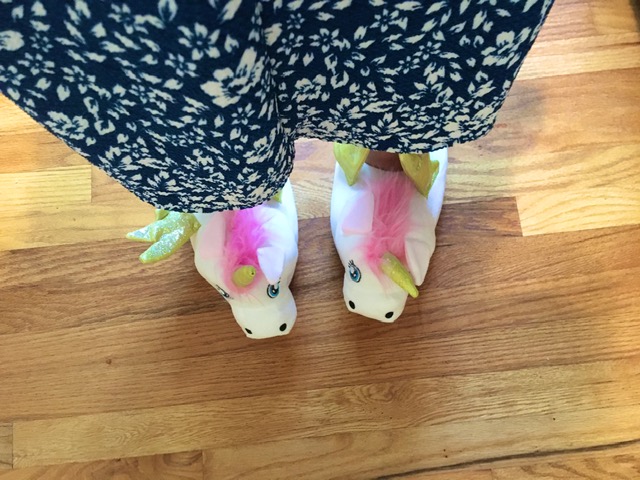
Image Description: Two unicorn slippers in all their glory. They are white with hot pink hair, golden wings, and golden horns. I’m wearing them and standing on my hard wood floor.
I was in a planning meeting, and we were gathered together on Zoom (because, of course). As a team, we’re pretty casual with each other, because we’re friends as much as we’re leaders.
Because we’re leaders, we were planning details for a big event on Zoom (because, of course). And in the midst of the meeting, someone swiveled their chair around and moved their laptop. That’s when we saw a teddy bear on a couch in the corner of their room. “Oh, that’s [Bear’s Name — forgive me, I forgot this being’s name].”
Right then, in a moment of great professionalism, I stood up and said, “I’m wearing unicorn slippers!” and showed them off to everyone. I was dressed up for the meeting, except for my mythical footwear, purposefully out of view on Zoom (because, of course). Then suddenly, every single person spontaneously retrieved a stuffed animal nearby them in their respective houses, and we showed them all off.
I’m nearly 40, and I was one of the youngest people in the room.
Image Description: A child skips a rock across water. Public domain image.
When so much in our world is outside of our control, we might find ourselves saying, “Well, I guess this is all I can do…”
We might not feel a full range of choices. In fact, we might feel remarkably far removed from choices. Instead, we may think of one thing or a couple tiny things, and resign ourselves with, “Well, I guess this is all I can do…”
We can easily get into this mindspace when so much is beyond our control.
But during beyond-our-control-situations, maybe that one thing we can do is what we can really do. We can let it be enough. We can allow it to make space for other possibilities. We can bring it to other people and connect it (and ourselves) to trusted loved ones and new relationships.
Sometimes, “all I guess I can do” is what we can really do. That’s okay, and even good.
Image Description: Son of Spinach, a backyard groundhog, stands near a rose of sharon bush.
This story about my favorite groundhog ended up in my sermon yesterday. So I thought I’d share this little piece again. Enjoy!
Over the years, I’ve had many animal neighbors in the backyard, including a number of groundhogs. One of my favorites was a groundhog named Son of Spinach (at least, that was his name to me). Sadly, he died last year. He was quite a character.
He didn’t show up every day, but he had a den nearby, so from time to time, he would show up in the backyard. And to say something both true and alliterative, Son of Spinach was so overly skittish. At the smallest noise, he would run away to hide, sometimes under the deck. This quality felt like an endearing, funny, sad combo.
Occasionally in the mornings, Son of Spinach would feast on the backyard grass quite out-in-the-open. And if I made the slightest sound, like unlocking the screen door, he ran for cover under the deck. I found myself wondering, how long will he stay down there? How much recoup time is necessary for the popping sound of a lock? How long will it be before he feels safe again?
Then, sometimes, I’d think of us – that is, we humans. We hide and recoup too. Sometimes, we need alone time or sustained opportunities for self and community care.
But other times, we just doubt ourselves.
When it comes to the second, I hope we know there’s a whole out-in-the-open living opportunity for us.
Image Description: A person with light skin, brown hair, and brown eyes looks into the camera while wearing a blue mask with small white flowers. Public domain image.
Because of these choices, 8 people died, and *none of them attended the wedding.*
Our choices impact other people’s outcomes — the quality of life that people are having and even the outcome of living itself. When we make risky choices while having the ability to choose otherwise (some don’t have that ability, and that upsets me too, but many of us do) we are denying people the liberty we say we’re trying to uphold. Liberty involves being able to make your own choices to live, correct?
Approximately 224,000 people have died from COVID, and yesterday in the U.S., we had the highest number of daily contracted cases that we’ve had since this virus started moving through our population.
Hospitals in Colorado, Nevada, Utah, and Wisconsin are filling up beyond capacity. One of the members of my family is a physician in Colorado, and that hospital reached total capacity two days ago. And when people came in for acute care — for COVID or for something else — there was nowhere to send people because all the neighboring hospitals were filling too.
COVID is hard to control totally, yes, but the spread of this virus did not have to be and still does not have to be this broad and extensive. 224,000 people is a high number… But people are more than numbers. This is another matter entirely when this is about your Grandmother, or your Son, or your Best Friend.
And though 224,000 is a high number of lives lost, an even larger number of people are dealing with Long-Covid — sickness that is lasting months and seems to be causing long-term damage to respiratory, cardiovascular, and neurological systems.
And as COVID runs through our population, the economy is stalled and more people are losing jobs. Because healthcare is often tied to employment, people’s healthcare is now at risk during a pandemic.
No matter how deeply we’re impacted personally, all our lives are disrupted. The longer we refuse to think collectively, the longer this persists with all its damage…
If we care about liberty, we have to care about the liberty of people beyond ourselves.