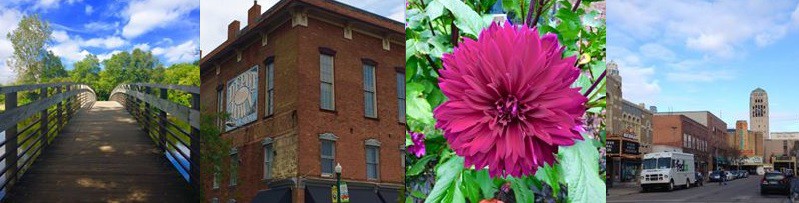
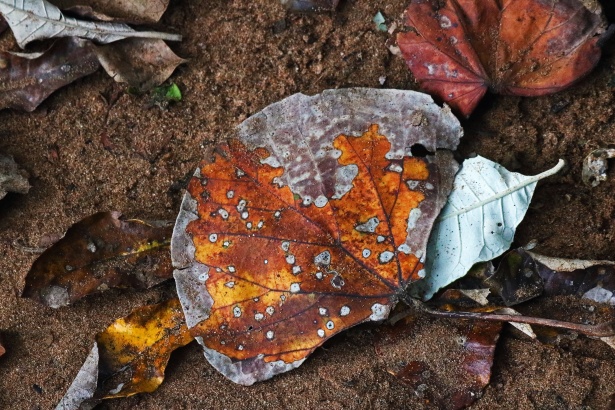
I looked up and watched several leaves float down from the sky. They were falling in real time from very tall trees.
“They’ve never been untethered before,” I thought with some sadness, because for some reason, I tend to anthropomorphize things. I watched them fall to the ground.
I kept walking and pondered how intertwined root systems existed underneath my feet, unseen as I walked along this pathway with trees on either side.
Sometimes, we’re more connected than we think we are.
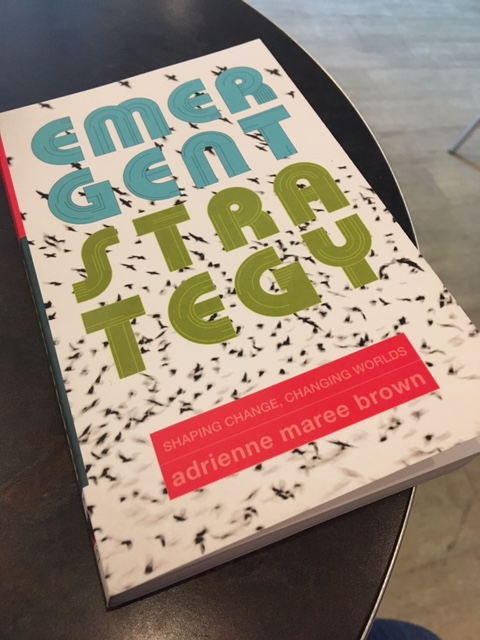
Image Description:A book is on top of a brown, curved table at an angle. Its title is “Emergent Strategy: Shaping Change, Changing Worlds” by adrienne maree brown.
Today, I’d like to share two quotes from adrienne maree brown’s book, Emergent Strategy: Shaping Change, Changing Worlds:
1) “Remember you are water. Of course you leave salt trails. Of course you are crying. Flow. P.S. If there happens to be a multitude of griefs upon you, individual and collective, or fast and slow, or small and large, add equal parts of these considerations: that the broken heart can cover more territory. that perhaps love can only be as large as grief demands. that grief is the growing up of the heart that bursts boundaries like an old skin or a finished life. that grief is gratitude. that water seeks scale, that even your tears seek the recognition of community. that the heart is a front line and the fight is to feel in a world of distraction. that death might be the only freedom. that your grief is a worthwhile use of your time. that your body will feel only as much as it is able to. that the ones you grieve may be grieving you. that the sacred comes from the limitations. that you are excellent at loving.”
2) “Do you already know that your existence–who and how you are–is in and of itself a contribution to the people and place around you? Not after or because you do some particular thing, but simply the miracle of your life. And that the people around you, and the place(s), have contributions as well? Do you understand that your quality of life and your survival are tied to how authentic and generous the connections are between you and the people and place you live with and in?
“Are you actively practicing generosity and vulnerability in order to make the connections between you and others clear, open, available, durable? Generosity here means giving of what you have without strings or expectations attached. Vulnerability means showing your needs.”
If we’re feeling anxiety, let’s feel those feelings. And let’s invite others to show up with and for us.
If we’re feeling grief, let’s feel those feelings. And let’s invite others to show up with and for us.
If we’re feeling hope, let’s feel those feelings. And let’s invite others to show up with and for us.
If we’re feeling love, let’s feel those feelings. And let’s invite others to show up with and for us.
And let’s keep showing up with and for others too.
Image Description: Three light brown stones stacked on top on of one another. They’re placed on sand, and there are concentric circles in the sand, like a ripple effect.
“We teach who we are.”
This is something that a mentor’s mentor used to say. She may have meant a variety of things by that statement, but she certainly meant that we end up teaching, extending, and tending to others in ways that reflect the most deeply held lessons from our own experiences, the kinds that rest (at times, after a struggle) at the core of our being.
“We teach who we are.”
It reminds me again that the word ‘heal’ is both active and passive at the same time. We heal in receptive ways. Healing is something that we receive, even as we work to create the conditions that make it possible.
And when we receive and integrate healing into our own lives (and this is always a process rather than an arrival) we also begin to heal — that is, participate actively in healing of others.
“We teach who we are.”
We’ve all received; when people welcome us through their own agency, we can extend our healing and learning toward others.
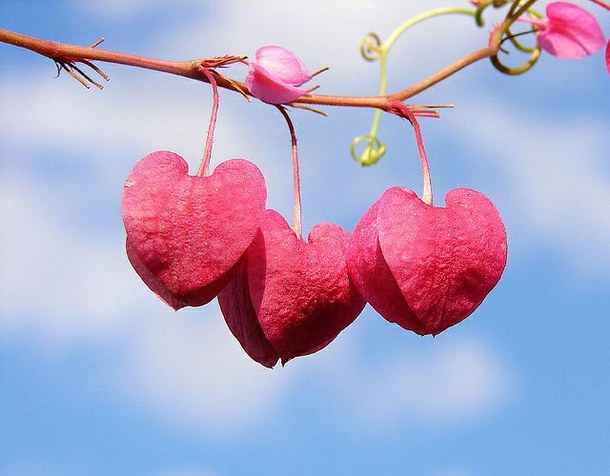
Image Description: Three, pink flowers connected to a vine, and they look like they’re in the shape of hearts. A blue sky is in the background. Public domain image.
While writing, I went to an online thesaurus to look up alternatives for the word ‘connection.’ It’s not that I didn’t want to use that word; it’s that I had used it twice in the same sentence. What could I say instead?
I expected to find synonyms that would denote how items, moments, or people are more generally associated, but instead, I found all of these personal, relational terms:
These are words I think about a lot, and for some reason, I was surprised that the synonyms for ‘connection’ took on such personal forms. It was a reminder that our connections with each other, even the more general ones, matter quite a bit. We never know how deep they might run, or how we might connect people in ways that lead to their own relationships over time.
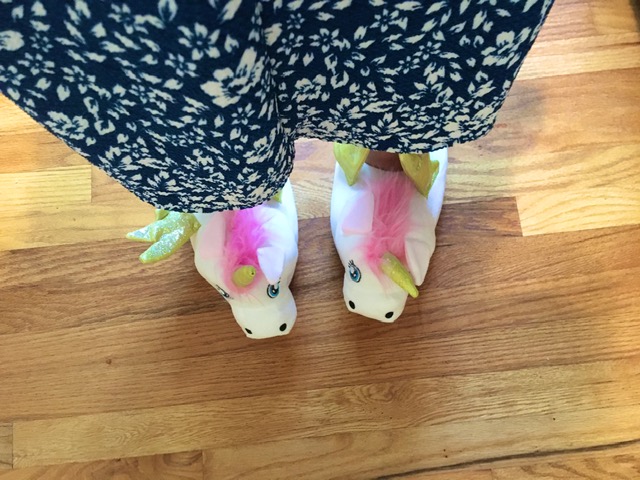
Image Description: Two unicorn slippers in all their glory. They are white with hot pink hair, golden wings, and golden horns. I’m wearing them and standing on my hard wood floor.
I was in a planning meeting, and we were gathered together on Zoom (because, of course). As a team, we’re pretty casual with each other, because we’re friends as much as we’re leaders.
Because we’re leaders, we were planning details for a big event on Zoom (because, of course). And in the midst of the meeting, someone swiveled their chair around and moved their laptop. That’s when we saw a teddy bear on a couch in the corner of their room. “Oh, that’s [Bear’s Name — forgive me, I forgot this being’s name].”
Right then, in a moment of great professionalism, I stood up and said, “I’m wearing unicorn slippers!” and showed them off to everyone. I was dressed up for the meeting, except for my mythical footwear, purposefully out of view on Zoom (because, of course). Then suddenly, every single person spontaneously retrieved a stuffed animal nearby them in their respective houses, and we showed them all off.
I’m nearly 40, and I was the youngest people on the screen.
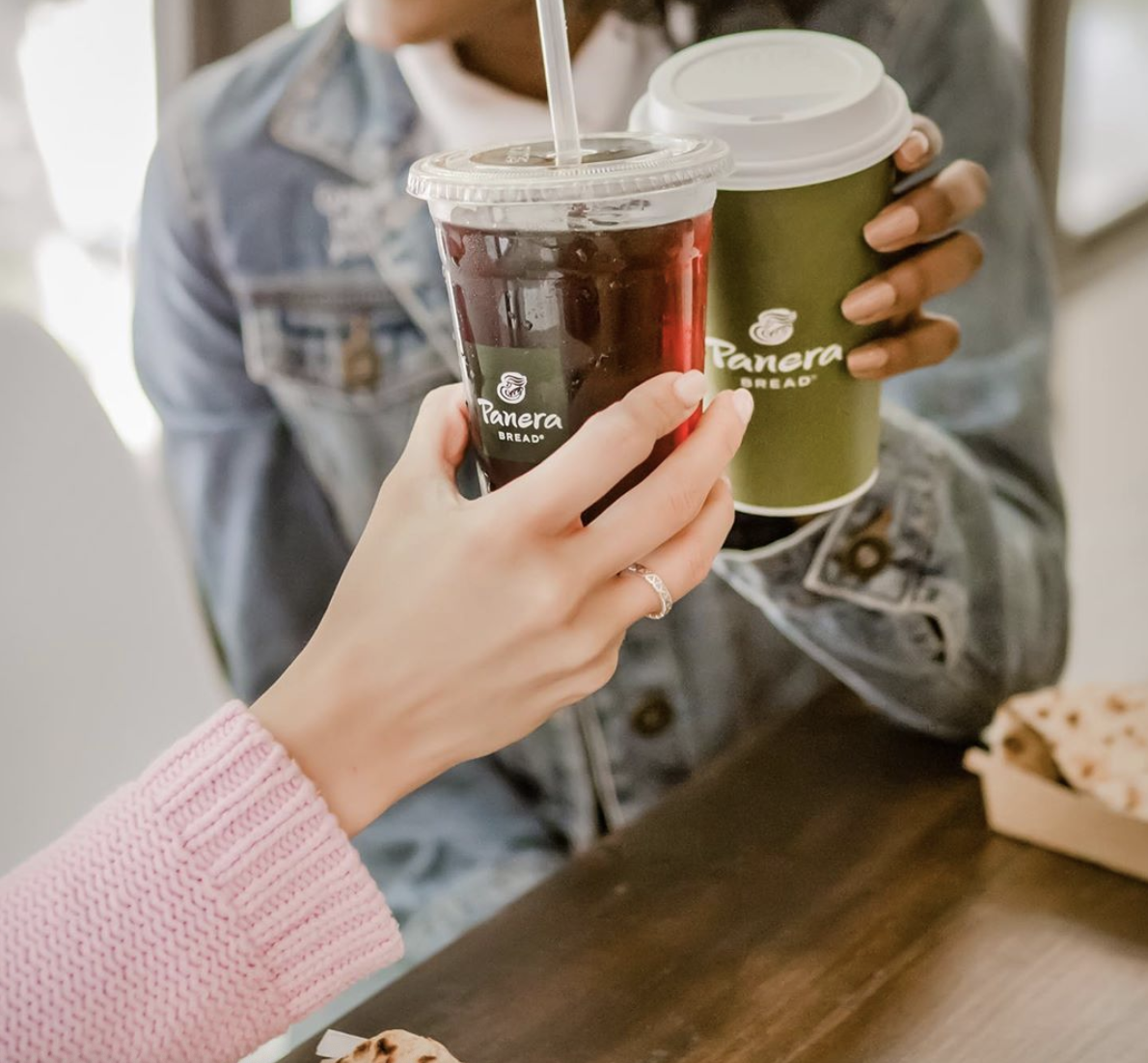
Image Description: Two people “clink’ their Panera coffees together. Photo, Panera, Instagram.
I walked into Panera to get my morning coffee, as I often do. (By the way, I don’t intend to be a commercial, but do you know that you can get a coffee subscription at Panera, and for $8.99 a month, you can receive unlimited coffee? It’s amazing!) When I opened the door, Bill Wither’s “Lean on Me” was playing inside the restaurant. As I walked over to the coffee station and began to fill up, I was singing along under my breath.
Sometimes in our life, we all have pain, We all have sorrow. But if we are wise, We know that there’s always tomorrow.
“Listen to us,” a woman nearby said. I hadn’t noticed, but three other people were singing quietly, just as I was.
We laughed, smiled big, and then all four of us started singing together, and right at the moment of the chorus too — Lean on me! When you’re not strong!— in harmony.
I want to sincerely thank my friends for helping me rehome a spider friend. For a bit more than a week, a red-femured spotted orb weaver has been making an elaborate web right near my front door and mailbox every single evening.
Concerned that this might be a phobia for my mail carrier (or anyone else approaching my door) I’ve knocked down the web every single morning with a broom. At that moment, my web artist has scurried upward on a thread to hide in the gutter behind a leaf. Every 24 hours, we would go through the same process. Elaborate web-spinning, broom deconstruction, leaf hiding.
After a while, I asked this spider what their name was, and inwardly, I sensed Herbie, which seemed like a pretty good name. So we coexisted for a week or so, and every evening, I would take a few minutes to turn on the porch light and watch Herbie do his magic. Honestly, it is pretty amazing that a spider can make something so beautifully and geometrically proportional.
A few days ago, I asked if anyone local on my FB timeline genuinely liked spiders. I thought someone might take down the web while I was out of town. I ended up staying home instead, but I’m still glad I asked this question, because I discovered that two of my friends do indeed like spiders. In addition to helping with the web, they were willing to place Herbie in a container and rehome him in a park.
My friends did not disappoint. Herbie now lives in a local park with local park bugs.
I hope there is plenty for him to discover. After all, I discovered something unexpected too:
Turns out I have Herbii.
We’re gonna let the other one spin her web a bit further down from my porch. But now the doorway will be free. And I know if I need another retrieval, these friends are up for the job. I’m so thankful for the help!
Two coffees with foam shaped like hearts. Public domain image.
“At the end of the month, I always like to say thank you for following here at Smuggling Grace. I appreciate you taking the time to connect here, and as always, thanks for engaging too. I enjoy reading and hearing your comments virtually on the platform, in emails, or during real time conversation. Thank you!
And I’m always happy to expand the audience as well. Do you know anyone who might enjoy connecting with this blog? If so, feel free to pass it along. The more the merrier!
Also at the end of the month, I always extend an invitation to support this blog on Patreon. Or! You cantip me with a coffee!Both of these are always great gifts, but are never expected. I appreciate you being here.