Two coffees with foam shaped like hearts. Public domain image.
“At the end of the month, I always like to say thank you for following here at Smuggling Grace. I appreciate you taking the time to connect here, and as always, thanks for engaging too. I enjoy reading and hearing your comments virtually on the platform, in emails, or during real time conversation. Thank you!
And I’m always happy to expand the audience as well. Do you know anyone who might enjoy connecting with this blog? If so, feel free to pass it along. The more the merrier!
Also at the end of the month, I always extend an invitation to support this blog on Patreon. Or! You cantip me with a coffee!Both of these are always great gifts, but are never expected. I appreciate you being here.
Last month, I had some out of town guests, and we had brunch together. At the end of the meal, we asked the server if she would take our photo. She held up my phone to do that and then said, “Oh, it’s pretty backlit.”
“That’s okay,” we said, “It doesn’t have to be Insta good.” (That is, shareable on Instagram)
“Oh, this one’s for the mems!” she answered. We smiled at that phrase, and I’ve been using it ever since. Yes, this one’s for the mems — we’re capturing a snapshot of the memories we’re making right now, and with gratitude.
Lately, I’ve been wondering, “Am I sharing an obnoxious amount of happy photos on social media?”
You know what I mean, right?
Social media gives off a certain air that every single thing is rosy and literally picture-perfect. Most people share the best moments of their lives — not the explosion of frustration upon spilling coffee on new shirts, not the moments of running late, not the frenetic work schedule, not the moments of yelling at our kids and regretting it, not the moments of loneliness or existential fear.
We don’t always share those. But we know those moments are there behind the scenes, right?
They are.
They’re in my life too.
But my goodness, pre-vaccination lockdown was so extremely isolating for such an expansive amount of time. All I want to do is see loved ones and make memories.I long for that. And some part of me needs to capture those moments, you know?
Image Description: A child skips a rock across water. Public domain image.
When so much in our world is outside of our control, we might find ourselves saying, “Well, I guess this is all I can do…”
We might not feel a full range of choices. In fact, we might feel remarkably far removed from choices. Instead, we may think of one thing or a couple tiny things, and resign ourselves with, “Well, I guess this is all I can do…”
We can easily get into this mindspace when so much is beyond our control.
But during beyond-our-control-situations, maybe that one thing we can do is what we can really do. We can let it be enough. We can allow it to make space for other possibilities. We can bring it to other people and connect it (and ourselves) to trusted loved ones and new relationships.
Sometimes, “all I guess I can do” is what we can really do. That’s okay, and even good.
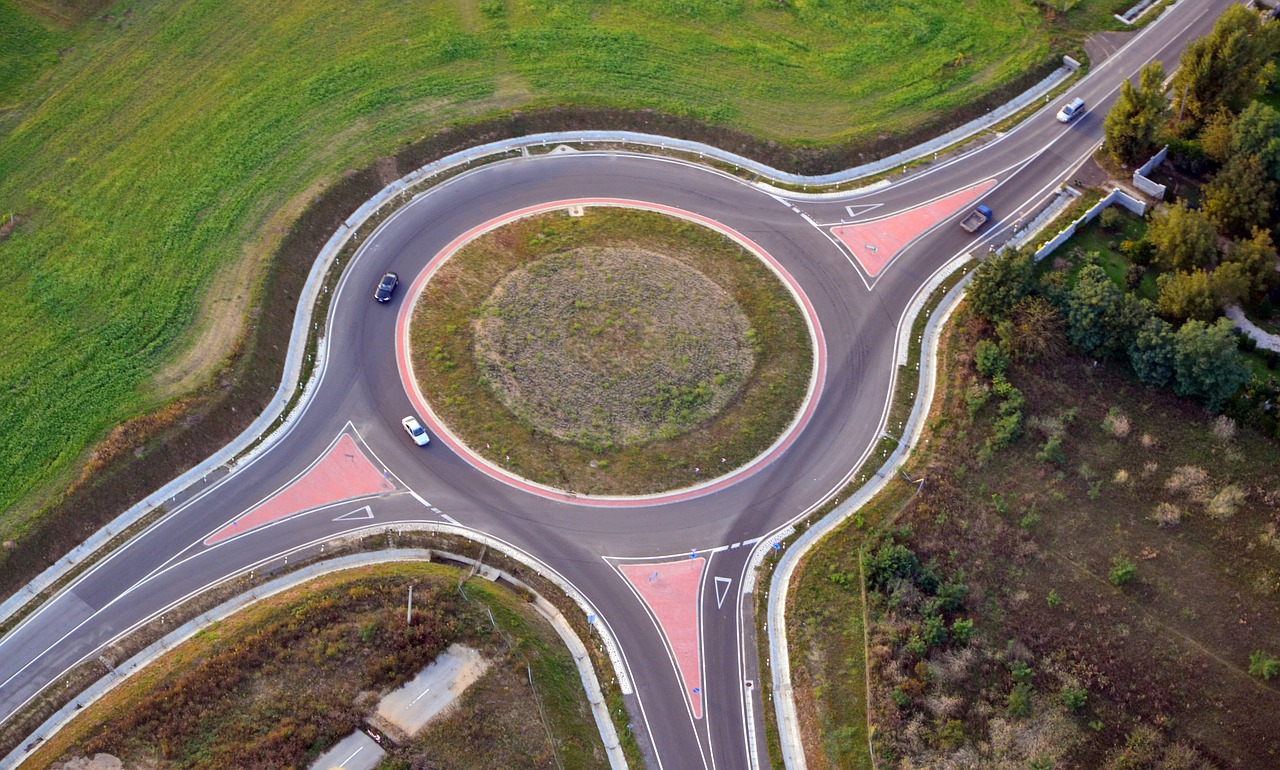
Image Description: A roundabout. Public domain image.
Earlier this week, I missed a turn, so I began to drive back to where I came from.
At the precise moment I entered a roundabout and circled in the other direction, “Total Eclipse of the Heart” started playing at the radio, and it was super satisfying.
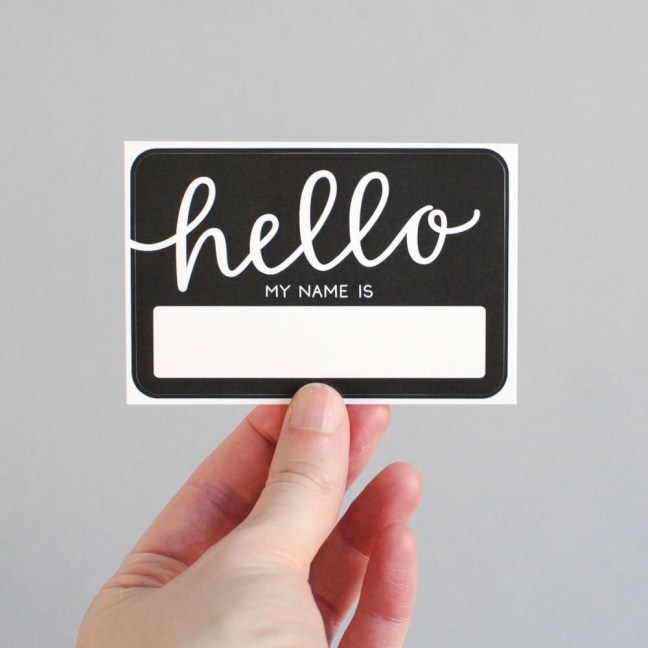
Image Description: A black and white name tag sticker says, “Hello, my name is” with a blank space to write a name.
Recently, I had the opportunity to hear some folks encourage a particular person, and I noticed that something kept happening quite naturally. Instead of simply saying,
“We’re with you. . . We believe in you. . . We know you can do this. . .”
they also kept adding the person’s name:
“We’re with you, [Name]. . . We believe in you, [Name]. . . We know you can do this, [Name].”
Throughout all of this, I was reminded of how powerful names can be. In the context of expressing love, gratitude, or encouragement, names themselves can be words of deep affection.
After I had already been pondering this, in a different context, a friend said that she wanted to hear her name more. She felt like people hadn’t said her name as often lately, a name she shares with a relative she lost years ago.
Perhaps somewhere within us, we’re all longing to be addressed by name. This sacred process of speaking and hearing names comes from a place of being known and honored as the ones we are. We are seen and cared for in all our particularities.
When addressing others with love, gratitude, and encouragement, I’m going to start speaking names much more often and much more intentionally.
When I find myself driving and jamming to a song on the radio, it’s usually because I love that particular song, or it perfectly syncs with my mood. But yesterday, I found myself beaming with smiles for a whole different reason. A song brought me to a quirky, funny memory.
Did you ever have an imaginary friend when you were a kid?
I did, when I was four. But my friend was not from any typical, imaginary friend category.
A friend my age…? No.
An animal…? No.
A toy come to life…? No.
My imaginary friend was…. wait for it…
Yep. My imaginary friend was Davy Jones of the band The Monkees.
I am literally laughing aloud right now as I type this blog post. Such an overly-specific imaginary friend!
Davy became my bud because as a four year old, I loved watching The Monkees on their exceedingly cheesy Nick at Nite television show. Davy and I would play games, and for a brief period of time that I remember, I would buckle a seat belt for him in the car.
Yesterday, while driving to Royal Oak, Michigan, the Monkees’ song, “I’m a Believer” came on the radio. I smiled at my childhood memory and laughed. I also like the song though I’m no longer a believer that Davy Jones is buckled in next to me in my car. (And, you know… thankfully. Though I suppose I could then ask him directly, “Davy, what were you and your boys thinking when you recorded this song?”)
I didn’t ask Davy anything yesterday in my car. But to myself, I thought, “This is funny. I should blog about this. Or maybe put it in a future comedy set.”
But then I thought, “Wait… but is this also kind of embarrassing?”
It’s a quirk.
It’s both funny and embarrassing. And also endearing. And also, as I’ve already said, super overly-specific in a delightful way.
So I share.
But mostly, I share the invitation to love your quirks today.
Right now, I have some kind of spider outside — I think it’s an adolescent if you will; a not fully grown Orb Weaver — who builds an elaborate web every single night right on my front porch very close to my mailbox and front door. Every single night.
I think… this could be a serious phobia for my mail carrier, right? Plus, I’d like anyone to be able to approach my front door without fear.
So every single morning, I take a broom and knock down this web. The spider then goes upward and spends the day in the gutter of my house, hiding behind a leaf that has also landed there. Then this process repeats.
I know this spider needs to eat. I do not disparage this natural desire. I’m also amazed by his ability to spin this web. (Oh, by the way, his name is Herbie). Last night, I turned on the porch light to watch it happen. I was a little creeped out by all those moving legs, but I was also impressed.
I just want him to learn not to do it… right there. It’s the worst kind of location for me. (Well, except for inside).
Anyway, I want you to know this too:
Two times when I’ve knocked down this web, some flies flew away! I’m annoying one but saving some.
Image Description: Light shining through the trees of a forest.
Father Greg Boyle is a person I really appreciate. He’s the founder and spiritual leader of Homeboy Industries in Los Angeles. Homeboy Industries provides jobs, training, tattoo removal, therapy, and a variety of classes for people who are leaving gangs and people who have been recently incarcerated. In the midst of these opportunities, Homeboy Industries has created a large, extended family of kinship — many meaningful relationships over time.
Father Greg was once a guest on Krista Tippett’s On Being. During that interview, he uses a beautiful phrase about the mutuality of relationship. He says that in kinship, we serve as enlightened witnesses, helping each other ‘return to ourselves.’
Toward the beginning of the podcast, he uses some language from Cesar Chavez. Once, a reporter said to Chavez, “These farm workers sure do love you. . .” And to that, he replied, “The feeling’s mutual!”
That line came up again when he discussed this beautiful experience of returning to ourselves. To bring it home, he told a story about one of the homies named Louie and a mutual blessing they shared with some humor. I want to share Greg Boyle’s words below:
“You want to be as spacious as you can be, that you can have room for stuff. And love is all there is, and love is all you are. . .
“Alice Miller, who’s the late, great child psychologist, talked about how we’re all called to be enlightened witnesses — people who, through your kindness, tenderness, and focused, attentive love, return people to themselves. And in the process, you’re returned to yourself.
“Like I have a homie named Louie who just turned 18. And he’s kind of a difficult kid. You know, he’s exasperating, and he’s whiny. And he works for me — although work may be too strong a verb. But homies lately have asked me for blessings, which is odd — it’s like in the last three years — and they always ask me on the street or in my office. And they never say, ‘Father, may I have your blessing?’ They say, ‘Eh, G, give me a bless, yeah?’ And they always say it the same way.
“So this kid Louie, I’m talking to him, and he’s complaining about something. And finally, at the end of it, he says, ‘Eh, G, give me a bless, yeah?’ I said, sure. So he comes around to my side of the desk, and he knows the drill. And he bows his head. I put his hands on my shoulder. Well, his birthday had been two days before, so it gave me an opportunity to say something to him. And I said,
‘You know, Louie, I’m proud to know you. And my life is richer ’cause you came into it. And when you were born, the world became a better place, And I’m proud to call you my son. Even though — ‘
And I don’t know why I decided to add this part —
‘– at times, you can really be a huge pain in the ass.’
“And he looks up, and he smiles, and he says, ‘The feeling’s mutual!’
And suddenly — kinship so quickly. You’re not sort of this delivery system. But maybe I returned him to himself, but there is no doubt . . . that he’s returned me to myself.”
Friends, I hope you’ve had this kind of experience lately, even if socially distanced.
Or I hope you can recall this kind of experience — of returning and being returned — in a way that fills you right this instant in the present moment.
Image Description: Six young people are sitting on a concrete wall. The photo is taken from behind them. Public domain image.
Connections build empathy and solidarity, and these commitments create supportive and protective communities. Everyone needs this, especially when we face difficult challenges.
Hugh Hollowell, founder and director of Love Wins Ministries in North Carolina, says that the opposite is homelessness isn’t just being housed. The real opposite of homelessness is community. When we extend our community relationships to include others, it is less likely that someone will experience homelessness. People often lose access to shelter because they’ve lost relationships.
We all need community support and care –
when we’ve lost a job,
when we’ve lost a loved one,
when we’ve begun a transition,
when we’ve left a religious community,
when we have mental health needs,
when we have financial needs,
when we have a deportation order,
when we’ve received a diagnosis,
when we don’t know where our next meal is coming from.
Does someone come to mind when you read this list? Can you reach out to them so that their access to community ties are strong?
Do you find yourself on that list? Do you know that you’re worth support and belonging? You are. Reach out to someone and let them know how you’re really doing.
Community is an intrinsic good, and we all need it.