In my town, one gas station is consistently much cheaper than the rest. It ebbs and flows like all the others, but relative to the others, it’s always much cheaper.
Last night, I stopped by to fill up my car. I went inside and paid with cash so it would be 10 cents cheaper than the debit/credit option. After filling up, I had to go back inside once more for change because my car didn’t need as much as I paid. Some others around me did the same.
And when we walked back to our respective cars, we were all rejoicing and cheering for ourselves, as if we had been so clever and won a game. We scored gas under $4! There was an instant kinship. Team Petrol Savings.
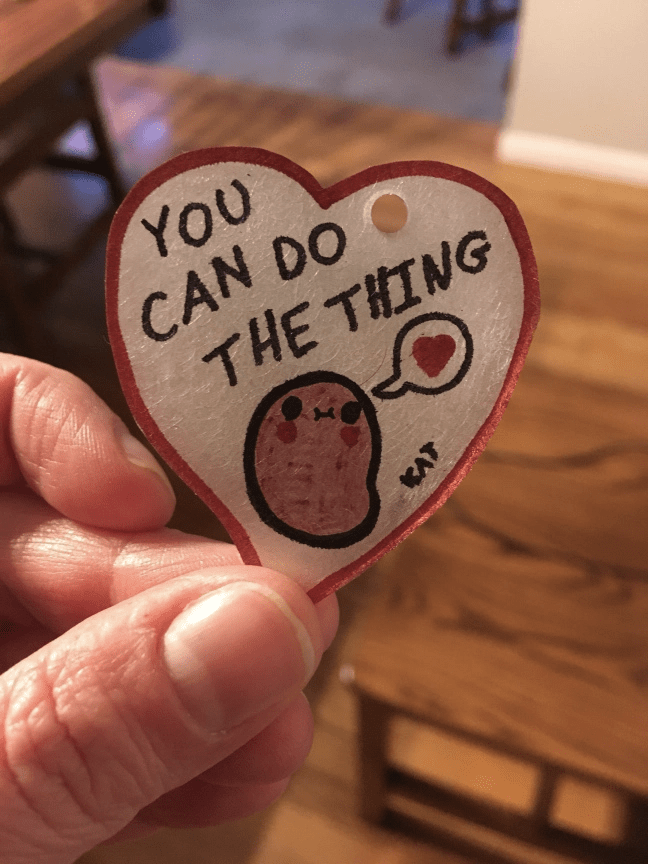
A while back, a friend of mine made this cute little sticker and sent it to me and some other colleagues. It’s a potato, and it says, “You can do the thing!”
Yesterday, someone told me, “When Christine Blasey Ford testified, that just fired me up. I made a sign in protest, and I went and stood in front of the Lansing Capitol. A lot of people honked in support.”
For some reason, I really needed to hear that little story. Did that action keep Brett Kavanaugh from being confirmed on the Supreme Court? No, it didn’t. But did it matter? Yes.
Did it let people know that they themselves were being supported? Yes. Does that matter? Yes.
Did it let officials know that they are being watched? Yes. Does that matter? Yes.
Did it allow someone to express their emotions and resonate with what was happening? Yes. Does that matter? Yes.
Did perhaps inspire someone else to take action or tell their story? Probably. Does that matter? Yes.
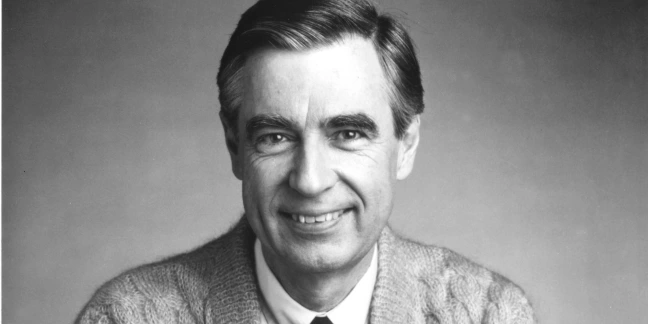
Image Description: A black and white photo of Fred Rogers, smiling.
“If you could only sense how important you are to the lives of those you meet; how important you can be to the people you may never even dream of. There is something of yourself that you leave at every meeting with another person.”
Image Description: Scrabble blocks spell the word ‘Joy.’ Public domain image.
A mentor of mine often says this: “It’s not stealing my joy!”
Whatever the it may be, it certainly could steal joy.
He’s been through many difficult hardships over the span of his life — personally, interpersonally, and socially across the decades. He doesn’t sugar coat any of them. He’d also tell you that he’s had many great gifts and blessings alongside them all.
But this statement of his — “It’s not stealing my joy!” — is about daily delights. It seems he doesn’t want to give an inch of his joy to anything or anyone who would harm or oppress.
I know that for many people, this is much easier said than felt, especially when we’re in the thick of it. All of the other feelings are valid, of course, and he feels those too. And there are days, and maybe even months or years, where we can’t easily flick the switch and turn on joy.
But I so appreciate this perspective and this posture toward living.
I took the elevator up 20 floors, stepped out, and opened the door to the AirBnb where a friend and I would be staying for the next two days. Our host greeted us as he walked toward the door from the kitchen.
“Hi! Glad you’re here,” he said.
“Thanks,” I replied. “Welcome!”
Wait, what? Did I just say, “Welcome,” to our host inside his own apartment? Yes, I did. So weird.
I was embarrassed and laughed. “Why did I say that to you?” We all laughed.
I like the Enneagram. It’s a personality profile that types people according to their primary motivations. In addition to the 9 primary types, there are subtypes too. My subtype is called “The Host.”
So I guess I just went on autopilot. Or my mirror neurons did something strange right as he was welcoming us. Either way, that was a weird, on brand welcome wagon moment from me.
While riding a train, Jacob Collier’s rendition of “Here Comes the Sun” emerged as I pushed the shuffle button in my Spotify library. I was close to arriving at home.
“I want less striving,” I thought to myself while listening. “And more resting.”
And I realized that I mean something deeper than getting more sleep, recreation, and unstructured time — though absolutely, yes to all of those. Here Comes the Sun… There’s a sense of relief in the lyrics and the music. Here it comes… Finally.
I want to rest in a sense of culmination. Yes, deep rest and relief into the knowledge that goodness is emerging from all of the previous working, yearning, hoping, building, and dreaming. Even as there are challenges — and so much of it heaped onto us in these days –aren’t the many goodnesses among us and around us culminations of these?
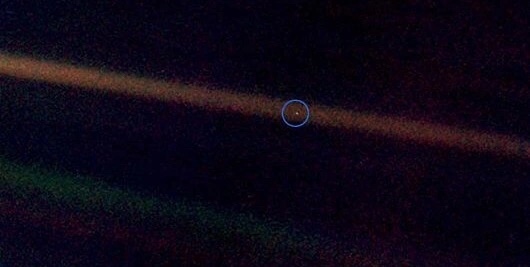
Look again at that dot. That’s here. That’s home. That’s us. On it everyone you love, everyone you know, everyone you ever heard of, every human being who ever was, lived out their lives. The aggregate of our joy and suffering, thousands of confident religions, ideologies, and economic doctrines, every hunter and forager, every hero and coward, every creator and destroyer of civilization, every king and peasant, every young couple in love, every mother and father, hopeful child, inventor and explorer, every teacher of morals, every corrupt politician, every “superstar,” every “supreme leader,” every saint and sinner in the history of our species lived there–on a mote of dust suspended in a sunbeam.
The Earth is a very small stage in a vast cosmic arena. Think of the rivers of blood spilled by all those generals and emperors so that, in glory and triumph, they could become the momentary masters of a fraction of a dot. Think of the endless cruelties visited by the inhabitants of one corner of this pixel on the scarcely distinguishable inhabitants of some other corner, how frequent their misunderstandings, how eager they are to kill one another, how fervent their hatreds.
Our posturings, our imagined self-importance, the delusion that we have some privileged position in the Universe, are challenged by this point of pale light. Our planet is a lonely speck in the great enveloping cosmic dark. In our obscurity, in all this vastness, there is no hint that help will come from elsewhere to save us from ourselves.
The Earth is the only world known so far to harbor life. There is nowhere else, at least in the near future, to which our species could migrate. Visit, yes. Settle, not yet. Like it or not, for the moment the Earth is where we make our stand.
It has been said that astronomy is a humbling and character-building experience. There is perhaps no better demonstration of the folly of human conceits than this distant image of our tiny world. To me, it underscores our responsibility to deal more kindly with one another, and to preserve and cherish the pale blue dot, the only home we’ve ever known.
The Mad Farmer, Flying the Flag of Rough Branch, Secedes from the Union by Wendell Berry
From the union of power and money From the union of power and secrecy, From the union of government and science, From the union of government and art, From the union of science and money, From the union of genius and war, From the union of outer space and inner vacuity, The Mad Farmer walks quietly away.
There is only one of him, but he goes. He returns to the small country he calls home, His own nation small enough to walk across. He goes shadowy into the local woods, And brightly into the local meadows and croplands. He goes to the care of neighbors, He goes into the care of neighbors. He goes to the potluck supper, a dish From each house for the hunger of every house. He goes into the quiet of early mornings Of days when he is not going anywhere.
Calling his neighbors together in to the sanctity Of their lives separate and together In the one life of the commonwealth and home, In their own nation small enough for a story Or song to travel across in an hour, he cries:
Come all ye conservatives and liberals Who want to conserve the good things and be free, Come away from the merchants of big answers, Whose hands are metalled with power; From the union of anywhere and everywhere By the purchase of everything from everybody at the lowest price And the sale of anything to anybody at the highest price; From the union of work and debt, work and despair; From the wage-slavery of the helplessly well-employed.
From the union of self-gratification and self-annihilation, Secede into the care for one another And for the good gifts of Heaven and Earth.
Come into the life of the body, the one body Granted to you in all the history of time. Come into the body’s economy, its daily work, And its replenishment at mealtimes and at night. Come into the body’s thanksgiving, when it knows And acknowledges itself a living soul. Come into the dance of the community, joined In a circle, hand in hand, the dance of the eternal Love of women and men for one another And of neighbors and friends for one another.
Always disappearing, always returning, Calling his neighbors to return, to think again Of the care of flocks and herds, of gardens And fields, of woodlots and forests and the uncut groves, Calling them separately and together, calling and calling, He goes forever toward the long restful evening And the croak of the night heron over the river at dark.