The Inevitable View of Belovedness

Over the last few weeks, I’ve had the pleasure to re-read my favorite book of all time. It’s Gregory Boyle’s Tattoos on the Heart: The Boundless Power of Compassion. I admit that I cry easily, but still, I do not exaggerate: The first time I read this book, I had to close it and pause at least 20 times due to tearing up.

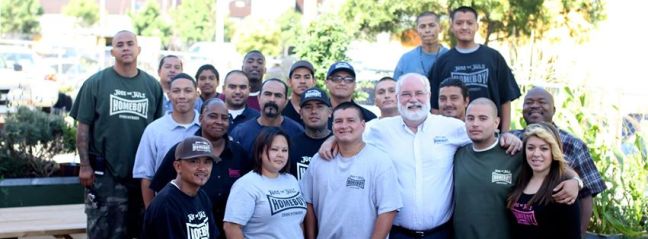
Greg Boyle tells powerful vignettes about his community at Homeboy Industries in Los Angeles. Homeboy Industries provides jobs, counseling, and classes for people who are looking to exit gangs. Many of them are teenagers and young adults. Many have known long spells of incarceration. But long before they ever joined a gang or experienced that incarceration, they have carried deep burdens of trauma. As Boyle says, “Kids who join a gang are not running toward something. They are always running away from something.”

The whole book is filled with compassion, and it works to address an internalized belief we tend to carry, one that distorts our views of others and ourselves – that is, “the sneaking suspicion that some lives are worth less than other lives.”

That is the lie we must confront.

Greg Boyle confronts that lie by telling stories of transformation. He’s a Jesuit priest, and he weaves theological reflection together with stories of his relationships at Homeboy Industries. Throughout the book, he encounters shame with love and compassion. We get to hear the transformative moments when these loved ones truly began to know for themselves that they are worth loving. We might step away from the book coming to know that more deeply for ourselves too.

We need to mirror this kind of love toward one another, especially when a suspicion seems to be growing that some lives are worth less than other lives.

That’s the lie of our age, and it’s simply untrue.

Greg Boyle tells a sweet story about a man and his father, and he opens that story up to speak a conviction about God and human worth. I want to leave it with all of us today for own thinking and our own loving.

As his health was failing, an old man moved in with his adult son, someone that Greg Boyle knows personally. In the evening before bedtime, the son would read aloud to his father. In a beautiful role reversal, the adult son put his father to bed every night.

The son would often invite his father to close his eyes while he read aloud, but over and over again, he would catch his father looking at him. He would say, “Look, here’s the idea. I read to you, you fall asleep.” The father would apologize, but at some point, one eye would eventually pop open.

This went on every single night. When it was time to sleep, the father could not take his eyes off of his own son.

Greg Boyle says that God is like this: “God would seem to be too occupied in being unable to take Her eyes off of us to spend any time raising an eyebrow in disapproval. What’s true of Jesus is true for us, and so this voice breaks through the clouds and comes straight at us. ‘You are my Beloved, in whom I am wonderfully pleased.'”

God just keeps looking at us with love and wonder.

Maybe we need to pop one eye open and view each other with this kind of love too – no longer heaping shame upon shame, accusation upon accusation, or stereotype upon stereotype, but viewing one another love and wonder.

One eye inevitably and playfully open.

Renee Roederer

The Place that Calls You


Yesterday, I walked home while the weather and landscape were in transition. After spending some time on the University of Michigan campus, I had taken the bus home.   I got off my stop and began to walk the rest of the way to my house. My socks were soggy and waterlogged from melting snow.

When I walked by my neighborhood park, I stopped to take in the scene because the view was so beautiful. I took the photo above, but it doesn’t do it justice. In the midst of winter, we were having a warmer day. Rain had fallen for most of it, causing the the snow to melt, and now, without the rain, there was a thick layer of white fog rising from that snow. It lifted into the air under a blue sky which had tints of emerging red. The sun was hinting at setting.

I paused it to take it all in.

I stood there wearing a Michigan hoodie, the first time in a long while I didn’t need to wear a coat. I was reminded that spring will come.

But most of all, I was reminded of connection. . . a connection to a place. . . I felt a deep sense of calling to a place and along with it, gratitude.

There is great beauty in the place that calls you. Moving beyond thoughts of scenery, we all find ourselves in particular locations among particular people for particular spans of time. A calling to a place is a calling to all that particularity – people, purposes, problems, possibility.

If you think about the place where you live, it won’t take long for names to emerge in your mind.  They rise from the ground like that fog. The places where we live bring us into communities, and the people in those communities change us.

And in times of collective struggle and hardship, to use a Biblical phrase, we may find that we have been called together “for such a time as this.” That is a holy thing. I encourage us to spend some time pondering this – our calling to a particular place and moment of time.

Yesterday, standing in that spot, I had the opportunity to reflect on this.

I have loved everywhere I have ever lived, but I have a particular kind of relationship with Ann Arbor. Perhaps some of it is rooted in the realization that we spent years dreaming of Ann Arbor before ever  had an opportunity to live here. From California, we thought about Ann Arbor a lot; if fact, we used to have strategy conversations: “How do we get to the Midwest in general, and if possible, Ann Arbor?” We would ask ourselves this question and discuss it as we took evening walks among the palm trees in our Pasadena neighborhood.

There were tangible reasons for this hope, mostly a realization that the University of Michigan would be a good fit. But beyond that, I felt something beckoning us to live here. That was a sense of calling.

And this place still calls me. Never static, our time in Ann Arbor has had twists and bends. We’ve experienced energy, purpose, grief, and loss. At one point, I had to completely re-imagine and re-orient what I was doing here. It was very hard, but it also brought me renewed vision and purpose. Most of all, through it all, in it all, above it all, the calling toward place has always brought us toward people. Those names come to mind for me right now.

We’ve been together for such a time as this.

We’re together right now for such a time as this.

Keeping that in mind, all of us can take in the scenery of our calling. Snow melts. Spring emerges. It’s impermanent, and the landscape always changes. Our calling changes too. It’s an alive kind of thing.

And who knows? For any of us, there might be chapters of places still unknown and uncharted, places we’ll ground ourselves in the future.

But for now, feet firmly on the ground, we are where we are.

And I hope it brings us together for such a time as this.

Renee Roederer

Inherent Worth and Preciousness (with Handshakes!)

This is my favorite news story from last week, and I’ve been thinking of it ever since. When these 5th grade students from Charlotte, N.C. enter the classroom each day, Barry White Jr., their teacher, does an individualized handshake with each one of them.

All the students crafted their own signature moves with Mr. White, and each day, they get to put them into action.

I love this story because it is a beautiful display of worth and belonging — something these students deserve to know and internalize each and every day. We all have the capacity to celebrate worth in one another and mirror that inherent worth to each other in our relationships.

When I look at the large, systemic problems in our communities and in our world, many are rooted in a sinister and traumatic, internalized belief that is there is a hierarchy of worth — that some lives are simply worth more than other lives. This is a horrific, internalized lie.

Sometimes consciously and sometimes unconsciously, we build and prop up systems based on these hierarchies — often rooted in race, class, national origin, gender, sexuality, and religion — and the effects cost human lives and justice across entire societies. The belief builds the system, and the system works to confirm the belief, even as it also works to benefit those at the “top” of the hierarchy.

But this 5th grade teacher is doing something different. He is mirroring inherent worth, a deep-seated preciousness that can’t be lost. And these kids are learning to internalize it while they have a lot of fun right at the beginning of their day.

It’s a reminder that these systems need to be dismantled in large-scale work, but the “small” work is never insignificant. Seeds are planted in the holy, day-to-day expressions of looking each other in the eyes — our children, our friends, people we’ve never met — and conveying, “You matter.”

The large-scale work always begins with that.

Renee Roederer

What is Your Resilience Story?

Dear ones, what is your resilience story? 

Have you thought about that recently? It might be helpful to bring such stories to mind – to recall those chapters and moments when we endured stress, challenge, trauma, and loss and bounced back, perhaps even unexpectedly, into renewed life. 

When we were empowered to keep going. . .

When we gained grit and resolve. . .

When we experienced resurrection, despite the pain we have known. . .

When we gained insight we cannot lose. . .

Resilency is often totally unexpected, but it happens around us and through us all the time. Certainly, none these forms of growth transform trauma into a collective good. Far from it. But there are times when resiliency accompanies even our greatest pain and brings us through despite what we might have anticipated.

We are living in a time of collective stress and fear. As I talk with people, many saying that they are feeling despair and dread. If that’s where we are, I encourage us to honor those feelings. 

And beyond feelings, some are facing tangible concerns and threats. We need to take these seriously and create protective strategies in our communities.

We will be even more empowered to do so if we can remember resiliency. What is your resilience story? Can you call it to mind?

In some ancient languages, the word ‘remember’ does not simply mean that we recall something from the past. It means that we make it present.

Mental health experts tell us that people tend to gain healing from stress, challenge, trauma, and loss when they can put their experiences into a personal narrative. Can you take some time today to tell your resilience story to yourself? Can you put its power into your body, mind, and spirit?

And one of the best strategies for gaining resiliency is to connect with good and trusted relationships of support and care. Have you told anyone your resilience story lately? There is great power in sharing such stories with one another.

Consider doing that. Tell someone. And wherever you are and however you’re feeling, let this story be a gift that guides you.

Renee Roederer

When 17 Year Old Neil deGrasse Tyson Met Carl Sagan

[Photo by NASA Goddard Space Flight Center: Neil DeGrasse  Tyson visits NASA Goddard]

I know I’m really late to this party, (especially since we’re an astronomy family) but Neil deGrasse Tyson’s Cosmos: A Spacetime Odyssey is literally one of the best things I’ve ever seen. I started watching it on Netflix last week, and it is stunning.

I expected to feel a certain level of awe and wonder while watching it. After all, it’s an exploration of the UNIVERSE with Neil deGrasse Tyson. The universe has not disappointed in that regard.

But in addition to feeling general wonderment at its size, scope, and mystery, Cosmos has really evoked emotions in me. The visuals and simulations are truly gorgeous, and Neil deGrasse Tyson is a skilled storyteller. He weaves together some of history’s most wonderful stories of scientific discovery with an exploration of the cosmos – demonstrating the incredible immensity of its largest astronomical bodies and the utter complexity of its smallest particles and organisms.

In the first episode, after already being so impressed and moved by all of these things, Neil deGrasse Tyson brought me to tears. He concluded the episode by pulling out an old planner and showing it to the audience. It was Carl Sagan’s calendar and planner from 1975.

On December 20th, it reads, “Neil Tyson.” That is the date that Carl Sagan invited the 17 year old Neil deGrasse Tyson to Cornell, where he spent time with him, talked about science, and welcomed him in a way that changed the trajectory of deGrasse Tyson’s life. During that visit, Carl Sagan pulled one of his own books off the shelf, and autographed it, saying, “To Neil, a future astronomer.”

This story really moved me. Carl Sagan had not even started his own Cosmos series yet, but it would come, then someday down the road, this young teenager would continue in that tradition — not only continuing such a series, but becoming another well-known astrophysicist and science communicator to the general public.

As I mentioned above, this series highlights the incredible existence  of the largest astronomical bodies and the tiniest particles and organisms of the cosmos. After experiencing that in the first episode, I also began to ponder how tiny moments in our lives can lead to huge impacts.

It was just one day in time – December 20, 1975 – but Carl Sagan welcomed Neil deGrasse Tyson with such warmness and intention, that it changed the direction of his life. Neil deGrasse Tyson says he thinks of this moment quite intentionally when he welcomes youth, young adults, and prospective students. Carl Sagan’s actions cascaded into many small moments of intentional welcome.

This is a reminder that small connections matter, especially when we welcome people purposefully and with intention.

In our nation right now, many of are pondering how to initiate and grow large-scale movements for safety, equity, and justice. When we see their opposites – violence, inequity, and injustice – it is easy to lose heart. One of my concerns is that people will become demoralized and inactive.

These large scale movements and visions are utterly crucial and necessary, but the tiny encounters we cultivate also matter. So if you’re feeling demoralized, I want to say this: Look for the tiny moments and relational connections too. We might just experience or cultivate a sense of welcome that changes lives.

Renee Roederer

Heartspace

hearts

Heartspace.

This is my word for 2017. It’s not an actual word, of course, but it’s my best attempt to describe a reality that is difficult to name. It’s a wordless feeling for the reality of human connection we experience when we know each other deeply and are deeply known in relationship.

Heartspace.

It’s a feeling of wonderment when we see people living fully as themselves.

It’s a feeling of gratitude when we get to witness people being fully alive.

Heartspace.

When we were crossing into this new year, I had this feeling one day and realized that try as I might, I could not come up with a name for it. Have you ever had a moment when someone you care about says something or does something that brings you to absolute wonderment in who they are?

For instance, we might imagine an adult who just happens to catch the precise moment when a child discovers something new. “Oh, look at her. ..” that adult might feel  deeply within herself, along with a sense of gratitude and wonderment at the chance to see it happen.

Heartspace is that “Oh, wow. . .  isn’t he wonderful?. . . look at them go!” feeling.

We might describe it as a swelling sense of pride, except that would fall short, because it’s not about us. It’s about the other person. But it’s filled with connection.

We feel this for people we mentor.
We feel this for our friends.
We feel this for our children, grandchildren, nieces, and nephews.
We feel this for our partners.
We feel this for strangers we chance meeting – people who demonstrate a sense of aliveness in the ways they’re living, calling us into greater aliveness too.

There are so many moments, so many memories,  when I can remember this swelling feeling of wonderment-connection. I know I have felt it for others. I know others have felt it for me.

I decided to name this Heartspace. When we feel this for one another, we enter that reality.

I want to prioritize it in 2017. This kind of love and connection keeps us grounded. It keeps us going. Most importantly, it gives us sacred opportunities to see people thrive, not on our own terms but theirs. It is a beyond-ourselves kind of love, but in it, we find ourselves too.

Yes, let’s have more of that.

Heartspace.

This Powerful Question

love
My good friend and colleague Mihee Kim-Kort asked a tremendous question a few days ago. I want to pass that question onto all of us. She asked,
“What will you inaugurate this year?”
 
We would do well to ponder that question and lean into it, allowing ourselves to dream and committing ourselves to act.
 
Today, I inaugurate a day of calling loved ones, reminding them that they are beloved — absolutely treasured for who they are and a great gift of presence and meaning in my life.
 
Today, I inaugurate a stronger commitment to what has already been inaugurated in our world. Even if these are not at their fullness, they are fully alive, capturing our imagination and working their way into tangible transformation — justice, equity, love, neighborliness, peace, and resurrection.
 
Today, I inaugurate a stronger commitment to truth, aware that I do not contain it or grasp it alone, but that it is a necessary, collective calling.
 
Today, I inaugurate a stronger commitment to moral imagination, trusting that when we are empowered with a Love beyond ourselves, we become partners in the creation of the Kindom of God, the Beloved Community, and the collective dreams that do not yet have names.
 
Today, I inaugurate a stronger commitment to sanctuary in all its forms, preparing to protect and shelter people who are marginalized and threatened. And in my own calling, alongside others, I commit to create sacred, sanctuary relationships that provide presence in the midst of spiritual trauma when religion is used to justify marginalization and threats.
 
Today, I inaugurate a stronger commitment to recognize my failings and shortcomings, examining the impact of my actions and confessing honestly when I fall short of these commitments.
 
Today, I inaugurate a stronger commitment to be on the journey with others — aware that righteousness calls us to resist what is wrong, vision calls us to voice truth to power, and peace calls us to live prophetically.
 
What will you inaugurate this year?

That Glorious Crescendo

change

I have always loved that huge, prolonged, build-up crescendo in the Mumford & Sons song, “Lover of the Light.”

It starts at 3:44 and builds for a whole minute until 4:43.

I hear a bit of a metaphor in this music — a musical parable, if you will. Almost every time I listen, I end up thinking about change. This is what the best kind of change can sound like.

Intriguingly, the crescendo starts after these words:

“You may not trust the promises of the change I’ll show.
But I’ll be yours if you’ll be mine.”

Then we’re off.

We hear a motive.
And it repeats.
And it repeats.
And it repeats.
And it repeats

It keeps repeating the entire time. It keeps on sounding.

And soon, other themes and chords emerge. They begin to accompany it. Then they grow and become progressively stronger. The initial theme remains, but it is no longer the sole focus. Our attention is now drawn to the collective whole.

Change.

Over the years, I’ve shared a Howard Thurman quote with many people: “Don’t ask what the world needs. Ask what makes you come alive, and go do that, because what the world needs is people who have come alive.”

Of course, I do believe we should ask what the world needs. But I also think that our aliveness — our dreams, our connections, and the callings which fuel us — can be some of the best gifts we offer our neighbors. They are ripe for collective change.

So whatever it is. . .
that dream,
that hope,
that longing,
that resource,
that gift,
that ability which comes so easily that you forget it’s special,

Keep doing it.

Put it out into the world and double down on it. Because it may come along and accompany someone else’s gift. And other people may come along and begin to accompany yours.

There may be obstacles (there probably will be) but that is how the best, life-giving change is made.

So bring it into the light.

Renee Roederer

He Enraged Us

mlk

[Wikicommons: Montgomery Arrest, 1958]

He enraged us.
Through and through, he made us furious with his revolutionary visions and resolute demands. His words were inspiring, and his actions revealed unwavering commitment, no doubt. But those very words and actions enraged us to the core.
We should remember it.
We should hold it up as truth on a day like today —
a mirror of memory to reveal this present moment
and its proclivity for malice.
After all,
we tend to revile the truth-tellers,
we tend to reprimand the troublemakers.
THIS Truth-teller
THIS Troublemaker
had the audacity to weave words into expansive dreams.
THIS Truth-teller
THIS Troublemaker
had the courage to cultivate change through collective action.
He exclaimed truth aloud — shouted it to the rooftops — and called our caste systems into question.
He made us question ourselves —
our prejudice,
our privilege,
our power structures.
He enraged us.
We still ask his questions, and we have just scratched the surface of his dreams. Maybe one day, we will realize their depths.
But until we do, we’ll need people to enrage us. And we’ll need to join them.

Come and See

public-domain

[Public Domain]

This sermon was preached at Northside Presbyterian Church in Ann Arbor, Michigan and was focused upon John 1:29-46.  An audio recording is above and a written manuscript is below.

John 1:29-46

Our story begins with declarations. Proclamations. We might even say, exclamations.

For some time now, John the Baptist has been out in the wilderness. People were coming from Jerusalem and all of Judea – droves of people — to be baptized by him in Jordan River. John had started quite a movement.

I admire that movement and appreciate so much of what John has to say in our sacred texts, but when it comes to his demeanor, I admit, he is precisely the kind of religious person I might avoid altogether.  John was intense, fiery, and eccentric. He definitely looked different than most, and he had some intriguing habits too: John dressed himself daily in camel’s hair and ate delicious dinners of locusts and wild honey.

He may have been quirky and strange, but John was on to something. More importantly, he was called. He was called into the wilderness, outside of the center of power where he spoke truth to power. He was called to life-changing work, and he issued life-changing invitations.

And in the end, that work changed him. That work invited him. In the midst of it all, John encountered Jesus in those waters of baptism, and he recognized Jesus for who he was.

John, as strange as he was — intense, fiery, eccentric, and quirky – pointed to Jesus and identified him. While he was with two of his disciples, John made declarations. Proclamations. We might even say, exclamations. “Look, here is the Lamb of God!” he said.

And that initiated a swirl of questions.

Those disciples began to follow Jesus quite suddenly on foot. I imagine there were a lot of silent questions, swirling about in their minds, like, “Who is this? What does it mean to say he is the Lamb of God? Where is he going? What is he doing? What is this all about?”

Those swirling questions may have remained silent in their own minds, but even with their feet, these disciples asked questions because they were curious. The word ‘disciple’ literally means ‘learner.’ Somehow, perhaps even beyond what they could understand, they were drawn to learn about this Jesus. There must have been so many questions.

But before they could begin to formulate any of their questions into words, Jesus asked a question of his own. Jesus turned and saw them following, and he asked, “What are you looking for?”

What are you looking for?

That’s an intriguing question. If fact, these are the very first words Jesus speaks in the Gospel of John. What are you looking for?

In some ways, it’s a bit funny to imagine these disciples following behind Jesus, curious, yet attempting to be stealthy, never announcing their presence or saying anything. Jesus is the first to speak to them. Quite suddenly, he asks such an important question. Maybe they were surprised or startled by his words. I wonder if they stammered a bit in response. Whatever they felt in that moment, these disciples answered with an intriguing question of their own: “Rabbi, where are you staying?”

On one hand, that seems like a simple, surface question. “Where are you staying?” Where are you living right now? But in the original language of this text, that question asks, “Teacher, where are you dwelling?” Where are you abiding? Their curiosity is getting at something deeper.

So Jesus responds with a simple yet life-changing invitation:

“Come and see.”

Come and see.

Come and see where I am dwelling. . . where I am abiding. Come and be a part of this life-changing work. Come and respond to this life-changing invitation. Come and see.

The Gospel of John is of known for its opening text – its beautiful prologue. Maybe you remember it. It says, “In the beginning was the Word, and the Word was with God, and the Word was God.” These words describe Jesus in mysterious and mystical ways. Then, that same prologue says this: “And the Word became flesh and dwelt among us.”

I love how Eugene Peterson translates those words in The Message: “The Word became flesh and blood and moved into the neighborhood.”

Rabbi, where are you staying?” those disciples asked. Where are you dwelling? Where are you abiding?

The answer is, with us.

With us in the human neighborhood.

Jesus says, “Come and see.”
Come and see how I am with you.

Come and see how I call you to a purpose larger than you can begin to imagine.

Come and see how I will initiate the Kingdom of God and invite your participation in it.

Come and see how I will speak truth to power and greed – how I will flip tables and express anger when religious institutions use power and greed to exploit the people.

Come and see how I will include all of the outsiders – those who are oppressed and marginalized.

Come and see, not only how I will include them, but how I will lift them up – how I will empower them and send them forward to live a life of resurrection.

Come and see.

These words are a prologue too – a beginning point and a life-changing invitation. They are God’s declaration to us. God’s proclamation. We might even say, God’s exclamation.

I love what happens next. . .

After saying these words to these disciples – “Come and see” – many more are invited in. They ask questions of their own and begin to answer that invitation. Andrew talks to Simon Peter, his brother. Jesus talks to Phillip. Phillip goes and finds Nathaniel with a declaration of his own: “We have found him about whom Moses in the law and also the prophets wrote, Jesus son of Joseph from Nazareth.”

To that, Nathaniel asks a pointed question: “Can anything good come out of Nazareth?” I love the honesty of that question. Like Nathaniel, there are times when we wonder if anything good is coming. . . and if any of this makes much of a difference.

Phillip doesn’t chastise Nathaniel for asking that question or even raising a bit of cynicism. He just answers with the very same invitation, “Come and see.”

So,  I wonder, where does this find us this morning?

Maybe we have entered this sanctuary and time of community with declarations of our own – deep convictions about who God is and how God loves. Those deep convictions remind us that we are called to live our lives in response to that love.

Maybe some of us have entered this sanctuary and this time of community with questions: Who is God? This Jesus? This way of the Spirit? What’s it all for?

Or maybe today, we’re in a place of asking a set of pointed questions: Does any of this matter? Can anything good come out of Nazareth? Can anything good come out of the Church? We might ask our questions from a place of skepticism or cynicism. Or perhaps we ask out of pain.

Well, wherever we are, the invitation continues voice itself.
Come and see.

Come and see how God loves.
Come and see how Jesus lives.
Come and see how our lives can be transformed and empowered to follow in that very direction.

We’ve come to a place of beginnings and transitions.

  • We are in a new year. Today is only the 15th day of 2017. This new year may bring a sense of new hopes or new challenges.
  • We are a few days away from the inauguration of our 45th President. Some are rejoicing in that shift, but we also know many people in our nation are afraid — afraid of what this means and afraid of what will happen.
  • We live in a moment where wealth inequality is stark and greed is running rampant without much accountability. We are concerned how this reality is leaving some behind.

Maybe we feel all of these things.

Maybe we bring them into the sanctuary and this time of community.

Yet the midst of them, we hear the same invitation.
Come and see.

And there is nothing passive about that invitation. It’s not —
Wait and See.

It is active in every way.
Come and see.

We are invited to come and participate where Jesus is dwelling – with humanity —
sharing our meals,
sharing from what we have,
sharing from who we are.

binding wounds,
empowering hearts,
marching for justice.

Together, in this active invitation, we begin to walk toward this great vision, and with God’s empowerment, we participate in it coming into being.

So, let’s go to the place where Jesus dwells —
God with us;
with humanity
Come and see.

Renee Roederer