HOPE and Resolute Determination

I walked back to my car yesterday after attending an outdoor festival. When I arrived, I discovered that someone had parked absurdly close behind me. It made me laugh aloud. It was clear that the person(s) were trying to fit their whole car in front of a no parking sign. (Side note: They  didn’t even make it. They just ended up as close to me as possible). There was a car parked in front of me too. So now, of course, I had to wonder how on earth I was going to get out of there.

I did the only thing I that would work. I turned on the car, and for a decent amount of time, I inched up and back. . . up and back. . . up and back, cutting the wheels back and forth. I must have done it 20 times.

“There’s a metaphor in here somewhere,” I thought and laughed to myself.

Actually, there are probably a lot of metaphors in there, but this was the one I needed personally:

Renée Roederer, (and anyone else following along) while working and hoping and waiting for necessary change happen, if you get angry and hurt by the setbacks, you don’t have to lose heart. Perhaps it will happen from time to time, but you don’t have to fall to the depths of believing that nothing will change. Nor do you have to imagine worst-case scenarios of what could come next. You stay determined, resolute, and assured that your work toward change, and more importantly, the collective work toward change is truly impacting things, even if they’re not fully fixed or resolved. Keep going. Keep hoping resolutely. Keep that full change in your vision. Keep working for it.

The metaphor I don’t want to live is a life where change happens one inch at a time. No, not that. Sometimes, we need to be bold and push ahead.

But many times, hope works like that. Bit by bit, it works to stay assured, calling us to keep going resolutely.

I want that. Resolute hope and steadfast, come-what-may determination.

Renee Roederer

Life at the Horizon

Last week, I had the wonderful opportunity to spend time at North Topsail Beach in North Carolina. In fact, I would say it was a sacred opportunity. Our family rented a beach house, relaxed, ate delicious food, and laughed so very hard. The entire experience filled me so much.

And I needed it.

When I arrived, I told myself that I wanted to gain some insights for myself and my wider community just by paying attention, and the ocean is unquestionably a gorgeous context for paying attention.

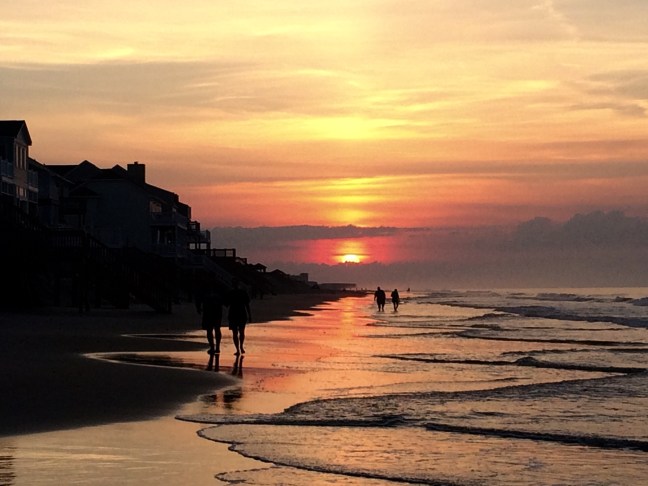
I suppose if there was a theme to the experience, it would involve my gratitude to spend a week living at the horizon. I found a lot of symbolic meaning there all week long. Most mornings, Ian and I woke up at 5:30 AM to walk toward the sunrise on the beach. The sun showed up daily over the eastern horizon, right on time as predicted, and given the state of the morning clouds, each sunset looked a little bit different.

Two moments at the horizon were especially incredible. One morning, we turned east to walk toward the sun while the full moon was directly behind us to the west. We were walking on the beach between the sun and the moon! They were nearly 180 degrees from one another in the sky. We enjoyed the sun on the way and the moon as we returned to go home.

Then on our last night, we had the pleasure to watch a moonrise over the ocean. I don’t know that I’ve ever seen anything quite like that… From the lowest part of the horizon, a full, huge, red moon rose upward from the sky, uniquely illuminated because of the position of an invisible sun. It was breathtaking.

Diana Butler Bass is a theologian and religious historian I admire quite a bit. She harkens our attention to the Horizon as a symbol for God. No matter how far we look or how far we travel in its direction, the Horizon is always before us and beyond us. Yet it is also consistently with us, continually on our plane.

I found myself thinking of that again and again this week. Sometimes, we have the sacred privilege to let our surroundings to speak to us. As I get back to a rhythm that involves work, screens, and the news cycle, I hope to continue to pay attention in this way.

And I might just find a place in Ann Arbor where I can watch a glorious sunrise.

Renee Roederer

When Purple Wisdom Washed to Shore

A few evenings ago, I had the pleasure to stand right alongside the ocean. I loved listening to the sounds of the waves breaking and the seagulls cawing.

I stood at the edge for a long time, letting my thoughts come and go like waves themselves, then at times, letting them subside entirely. At this moment, I was more interested in listening than thinking.

I found myself seeking wisdom for myself and my wider community. 

I realized it’s a real privilege to be there and added my awareness to that. Then I decided to stand there and really take it in, wondering if I might find insights of some kind.

I let my feet sink deeply into the earth. Though the sands shifted and changed quite readily, it was a firm kind of stance. I thought about fearfulness – the many fears I tend to carry and the fears we are carrying collectively. These are understandable fears. 

But I took that stance because I was seeking something else. From time to time in my life, I’ve had moments when I felt remarkably empowered and enabled to hold strong, speak prescient truth, or embody steadfastness even in the face of fear and inevitable loss.

“I want more of that,” I thought. “For me. For us.”

I want wisdom and insight toward less fear. I want an alive form of fierceness that loves passionately and transforms the particular narratives and the particular violence that we are living.

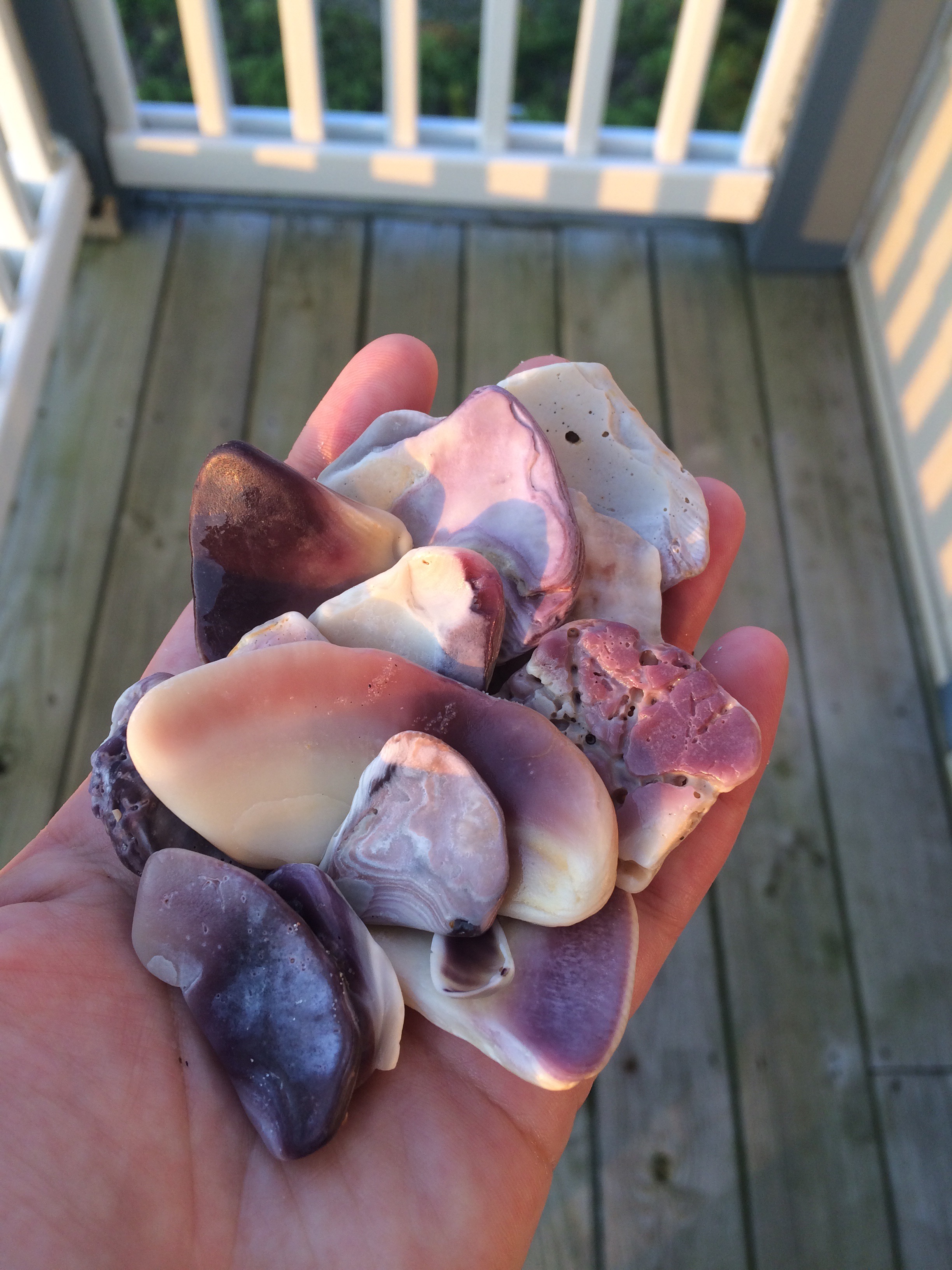
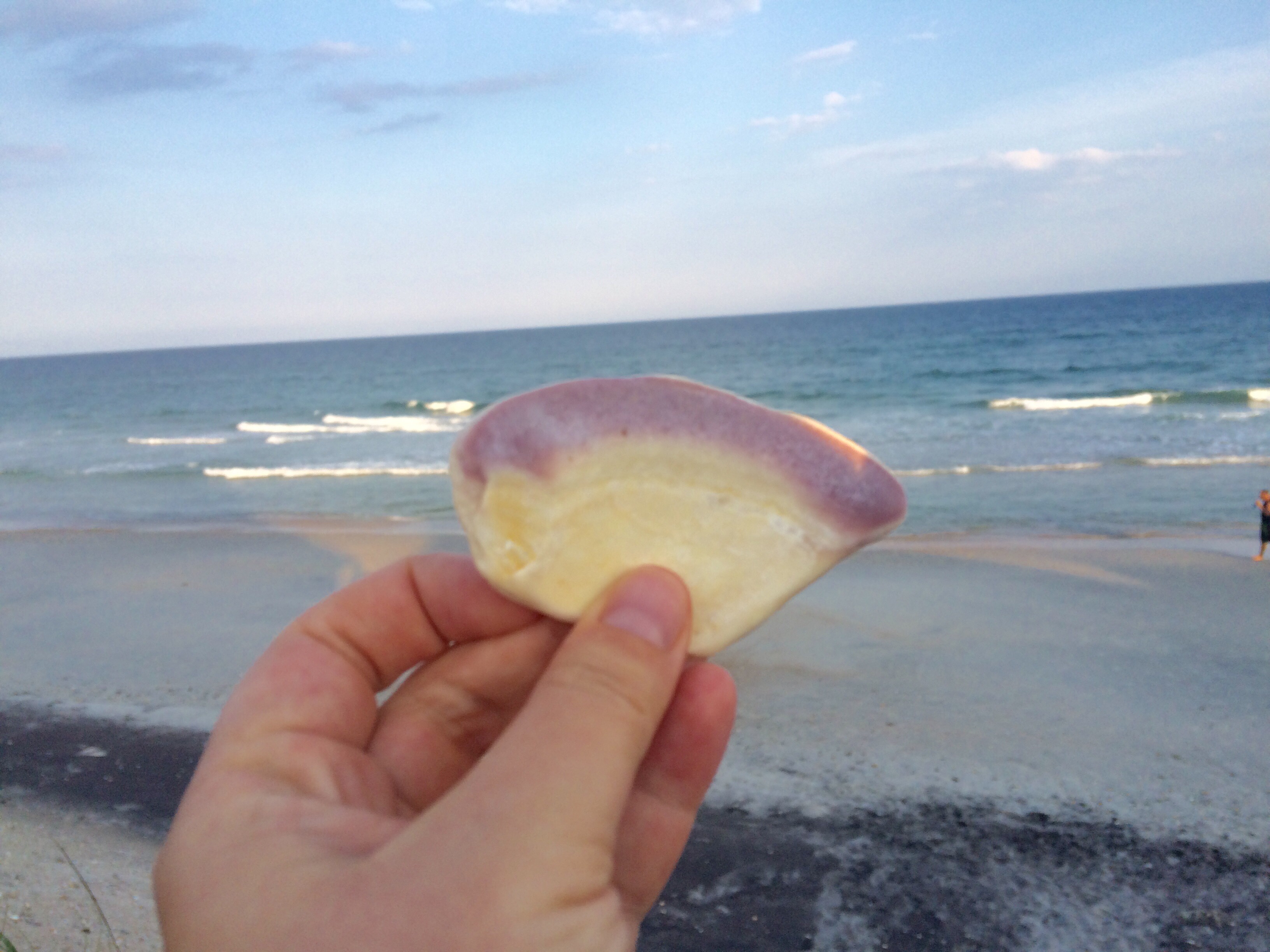
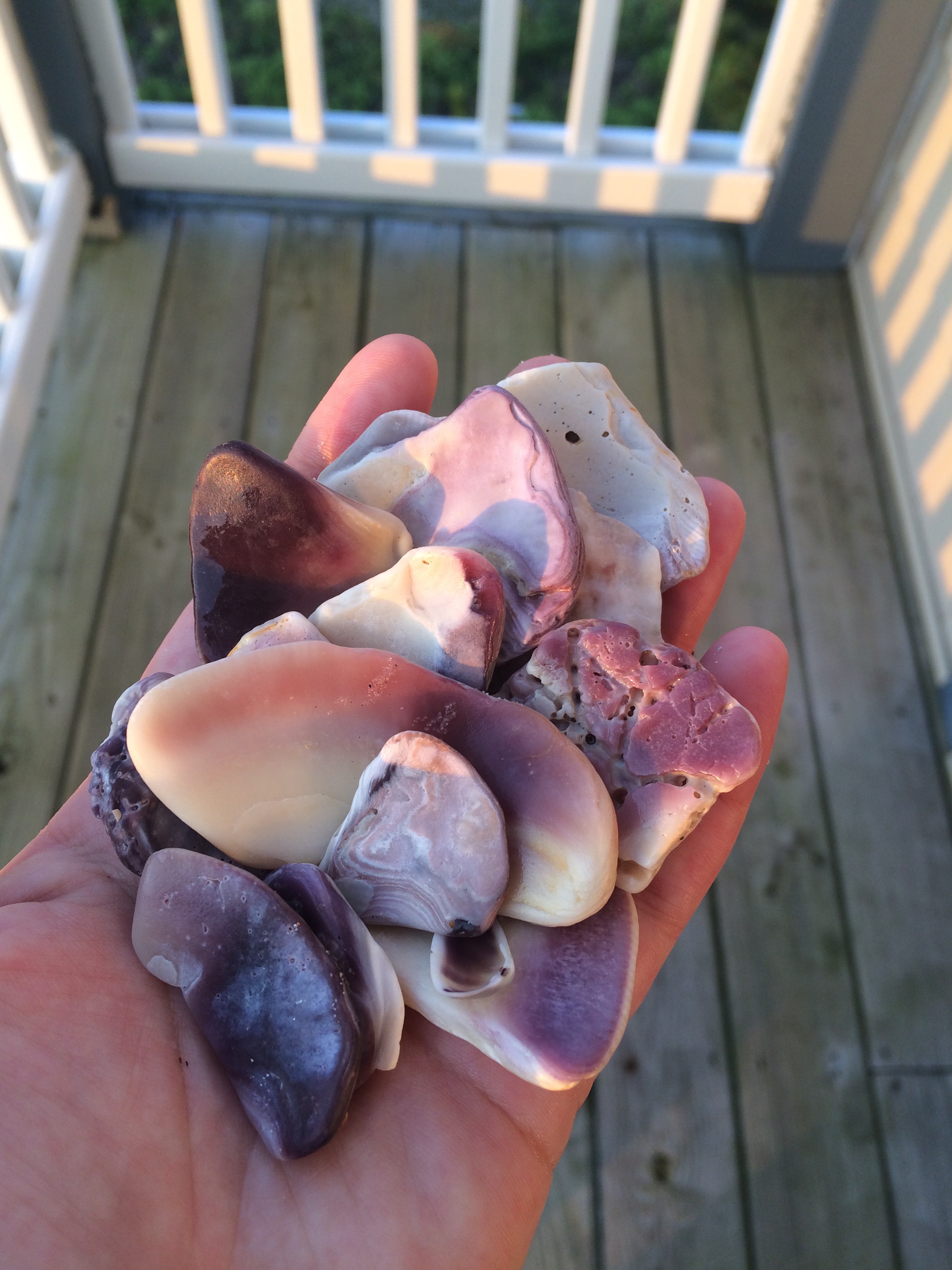
Not much later, a shell washed right up to my feet. It was lined with a lovely shade of purple.

I smiled.

Ah, yes, purple. The color often associated with wisdom and spiritual insight. The color often associated with sacred noticing.

Then a few minutes later, it happened again. A second purple shell washed up next to me.

Yes. I loved it. So then I started looking. 

Empowered by the symbols of wisdom at my feet, I started moving my feet down the shoreline, looking for more. In twenty minutes, I found the first handful.

Then after dropping those off in my room, I quickly found a second handful.

An abundance of purple shells.

An abundance of symbolic wisdom toward less fear.

This search for recognition on a beach certainly didn’t transform all of our challenging narratives or all our challenging violence. But for a moment, it changed my relationship to them. And it made me wonder how to keep searching.

I want more of this. For me. For us.

Renee Roederer

For One Week, Literally, Less Thoughts

I’m going to try something.

This week, for myself and my wider community, I’m going to prioritize a different way of processing. I’m going to privilege intuition.

Many of us are easily inundated with thoughts – verbal internalizations which help us process what’s around us, often with a particular kind of logic. Verbal thoughts are not to be disparaged. They are one vital way to process information, create meaning, and make decisions.

But if this is the only way we process the world, we can miss other ways of finding knowledge and insight. Particular thoughts can overtake us and move toward the rumination of anxiety. These thoughts can also take our focus away from our present moments, our surroundings, our relationships, and our bodies.

But have you ever slowed down thoughts and opened space for an aha moment? Can you recall one of these moments for you and your community? Perhaps we can open ourselves to more of these.

Last week, I watched InnSaei – The Power of Intuition, a documentary on Netflix. Scientists and researchers talk about the human brain and various types of processing. Much of our brain’s processing happens outside of our consciousness. But if we can slow our thinking, paying attention to what’s happening in our bodies and our surroundings, insights emerge apart from conscious, verbal, logical thought.

For instance, think about people who have solved scientific, mathematical, or social problems through their dreams. Intuition works like that but in our waking life too.

So here’s what I’m going to do. This week, I happen to be in a place where I can be outside in nature quite a bit. When I’m not purposefully using words in conversations, reading, or writing, I’m going to try to breathe, slow down my thoughts, and just pay attention.

If I start ruminating on something, no judgment. I’ll just bring myself back to pure noticing.

I’m curious if I might gain some intuitive insights I have yet to imagine.

Want to try it with me?

Renee Roederer

Pentecost

img_8486

On Pentecost morning,
I walked toward a red, fiery sun.
There she was, right on time:
5:57am.
Not a moment sooner or later.

Precise
and
Dependable.

Astonishing
and
thoroughly
Surprising.

Each day,
she lifts herself upward,
responsible and resplendent,
constant and confounding,
the same
daily disclosure
of a marvelous miracle.

Each appearance new and particular,
Each arrival common and original,
she
with us,
on our plane –
the horizon of our wonder.

Here is a story both old and new:

Before he died,
one of my most Beloved People
spoke this saying to me all the time:

“Now remember well,
and bear in mind,
that a jaybird’s tail sticks out behind.”

If I looked confused,
he would say,

“There are some things
you can always count on.”

Despite the torrents of trauma,
Alongside the presence of pain,
exist
Beauty and
Relationships and
Sacred Love
that can be trusted.
that can be expected.

We watch them rise.
Even daily, we marvel with them.

Right on time,
they are Sacred Flame,
they are Holy Tongues,
they are Mighty Words,
they are Spirit Breath.

They are Pentecost –
at once
completely mundane,
completely miraculous.

Money Isn’t Our Only Currency

Money, when used well collectively (admittedly, it isn’t always) serves as a currency. Like a  current, it flows through communities and creates an economy of care through patterns of giving and receiving.

But money isn’t our only currency.

Years ago, I went to a workshop led by Eric Law. He is an Episcopalian priest, author, and church consultant. The workshop I attended was based on his book, Holy Currencies: Blessings for Sustainable Missional Ministries. That workshop was designed for church contexts, but additionally, I find his way of thinking to be applicable to any organization or community that seeks sustainability in life-giving ways.

Eric Law invites us to think about a variety of currencies as they flow through communities and create patterns of care through sustained giving and receiving. In addition to money, he names these to be especially important for sustainable organizations, communities, and intentional efforts for change:

1) Time and Place

2) Gracious Leadership

3) Relationship

4) Truth

5) Wellness 

These are vital currencies too.

After all, an organization can have all kinds of money, but if it has created a culture where it’s fundamentally unsafe to tell the truth, it’s not life-giving, viable, or sustainable.

Likewise, if a community pursues financial resources to the detriment of wellness, it causes harm rather than vitality.

If a community uses resources like money and power to stratify relationships rather than empowering those relationships toward equity, it creates injustice and oppression.

It’s pretty clear that we need to prioritize much more than money if we want to grow healthy communities and organized efforts for sustained change.

What other currencies would you add?

Renee Roederer

Jesus Talked About Money More Than Almost Anything Else

money

Jesus of Nazareth talked a lot about money and material possessions. Like, a lot. Almost more than anything else. The most frequent topic in his teachings is the Kin(g)dom of God. Right after that, it’s money.

He taught about money all the time.

And contrary to what today’s prosperity gospel leaders might teach, Jesus did not discuss how to get wealth and hoard it. He did not tell people that their personal worth was dependent upon particular possessions. He did not advocate that people give money in order to get much more in return.

And he did not uphold or promote an economy of extraction. In his day, the Roman Empire occupied his land, taxed the people exorbitantly, and marginalized the poor. Wealth moved from the masses to the few.

No, in his very first sermon, Jesus of Nazareth spoke about his calling through these words of Isaiah:

‘The Spirit of the Lord is upon me,
   because he has anointed me
     to bring good news to the poor.
He has sent me to proclaim release to the captives
   and recovery of sight to the blind,
     to let the oppressed go free,
to proclaim the year of the Lord’s favor.’

Then he included marginalized and oppressed people in everything he did. He empowered their leadership. Alongside them, he walked on foot around Galilee and Judea and taught quite a bit about greed and wealth.

It seems that part of our collective liberation involves freedom from greed and the trappings of wealth. Perhaps we need to talk more about this too. . .

Renee Roederer


Fossil Fuels and Greed

[Photo: NASA]

When Donald Trump withdraws this nation from the Paris Accord, as news sites are reporting this morning that he is about to do, I really believe that other nations should consider placing sanctions on the United States. I don’t like saying that, but perhaps that becomes necessary.

If people are enabled to wreck our climate, they are catalyzing tremendous harm to generations behind us. And it’s not as though these effects cannot be seen now. Island nation states are literally trying to figure out where they will evacuate their citizens in the next ten years.

It troubles me that one person is enabled to make this decision on our behalf, creating harm for years to come.

And it troubles me that the greed of the fossil fuel industry lies behind it.

We could invest in renewable energy, add ingenuity and new possibilities to our nation, and create a host of new jobs in the process.

But our nation, including its politicians, serve fossil fuel moguls and their money.

Renee Roederer

Productivity Is Neither Worth Nor Fullness

beach

Wealth is not synonymous with worth.

Likewise,

Productivity is not synonymous with worth.

Productivity has never been the full measure of our lives, nor what it means to be human. But I think it’s quite possible to internalize the opposite. At times, I confess that this false belief emerges in my deeply internalized thinking and feeling.

Our culture conveys that productivity is the highest good, yet if we chase after it — I don’t merely mean working well in a meaningful way, but if we chase after it– we are rarely satisfied.

When it becomes the totality of our time or our self-understanding, we soon find that it is chasing us. In this mindset, no matter how much time we put into our labor, it is never enough. And we are never enough. In this thinking and feeling, it’s possible to have internalized individuals or groups swimming around in our minds, either from the present or from the past, who judge us consistently as falling short. This may even happen just slightly outside our consciousness.

It’s easy to internalize these people and these beliefs. Yet truly, productivity is not synonymous with worth.

We do not need to reach a certain benchmark to be worthy of love, care, and belonging. We do not need an enormous salary to convey that we matter.

Yet as human beings, we need wholeness and fullness. Sometimes, this means that we need different experiences — rest, renewal, rejuvenation. Sometimes, this means that we need different parts of our brain to be active — the creative, the playful, the intuitive. These add to our own lives, and they also add to our communities.

I’m going to repeat this today and let myself believe it because it is really true:

Productivity is neither worth nor fullness.

Renee Roederer

Why Teach Our Children to Share if We Ourselves Believe It’s Wrong?

Okay, I’ll admit that my title is a bit sarcastic and snarky. But this is honestly a question I’ve been reflecting on recently. . .

Why do we teach our children to share if we, as adults, fundamentally believe that it’s wrong — some even believe it’s immoral — to share with other adults?

Or in practice,

Why do we teach our children to share if we ourselves hardly ever share with others?

Let me up the ante here: I’m talking about wealth.

A dangerous, every-person-for-himself ideology seems to growing. It’s certainly not new, but it’s gaining even greater influence. This ideology thrives on greed and justifies itself through a mix of pride, individualism, Ayn Rand objectivism, and prosperity theology purporting to be Christian. Then it claims to be morally superior.

After all, no matter how vulnerable a person may be (ahem, including from structures built on this ideology) it would be immoral to help or share from our wealth because that would decrease self-reliance, and we choose not to share, you know, for the good of the other person.

Um… okay. Your greed is showing.

Want to know how far some will take this ideology? Some have argued that schools should stop providing free lunches to impoverished students in order to teach self-reliance and grit. Why not just take it to the next step then and stop providing food to all children entirely?

Oh, that’s right. You only meant those children.

Sure, there is certainly such a thing as toxic charity, and we should avoid that. But make no mistake: We can share from our wealth. If we did this, we could create an economy and society of care and wellbeing that upholds all and leaves no one behind. We could eliminate poverty. We could make sure that children and vulnerable adults do not die of preventable diseases.

Think this is a pipe dream? It’s not.

But it requires sharing our wealth willfully and with purpose. I’m not only talking about the 1% (though I certainly am). I’m talking about people like me. I’m talking about people who read this blog. I’m choosing to challenge myself with this. I’m choosing to challenge you with this.

Why do we accept a dog-eat-dog society as normative and good? Everyone benefits when all people have what they need. Are there areas of our lives where we have much more than we need? Let’s find the most effective ways to share that wealth.

Renee Roederer