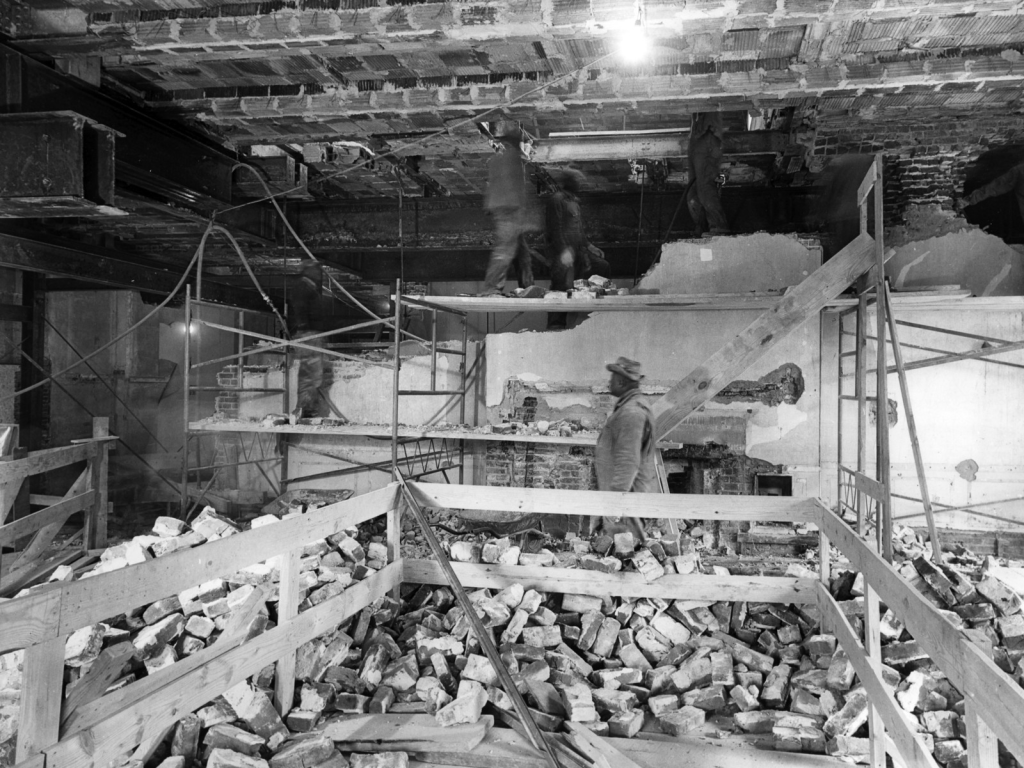
Image Description: A black and white image of a structure in renovation. This photo is from the renovation of the White House.
While listening to a podcast,* I heard a gorgeous quote from author Andy Crouch that caught my attention. I thought I would share that today:
“We know that the way we’re formed is by proximate, inescapable encounter with another person who deeply loves us, who is willing to let us be vulnerable in their presence and who is themselves willing to be vulnerable in our presence and calls us to a renovated life. That’s the way anybody changes.”
We need this. We can receive this. We can provide this. We can participate in this.
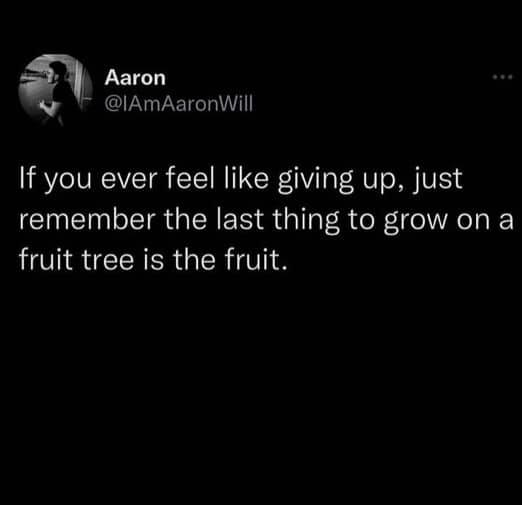
I really appreciate this tweet from Aaron Will (@IAmAaronWill). It reads, If you ever feel like giving up, just remember the last thing to grow on a fruit tree is the fruit.
I hope this can encourage us in many of the unique, specific situations we’re living.
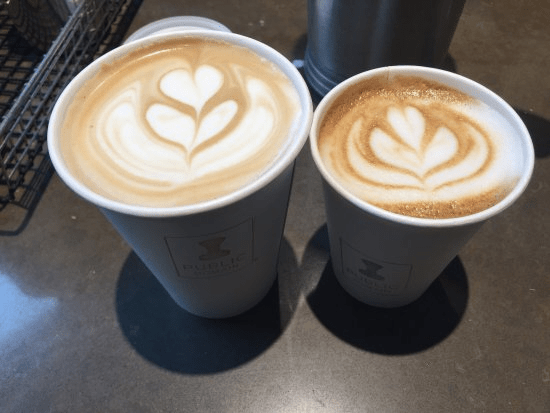
Image Description: Two coffees with foam shaped like hearts. Public domain image.
A few times a year, I like to say thank you for following here at Smuggling Grace. I appreciate you taking the time to connect here, and as always, thanks for engaging too. I enjoy reading and hearing your comments virtually on the platform, in emails, or during real time conversation. Thank you!
And I’m always happy to expand the audience as well. Do you know anyone who might enjoy connecting with this blog? If so, feel free to pass it along. The more the merrier!
Also a few times a year, for those who are interested, I extend an invitation to support this blog monthly on Patreon. You can join a team of people who bolster this space of daily reflection. You can alsotip me with a coffee. Both of these are always great gifts, but truly, are never expected. I appreciate you being here. Thank you!
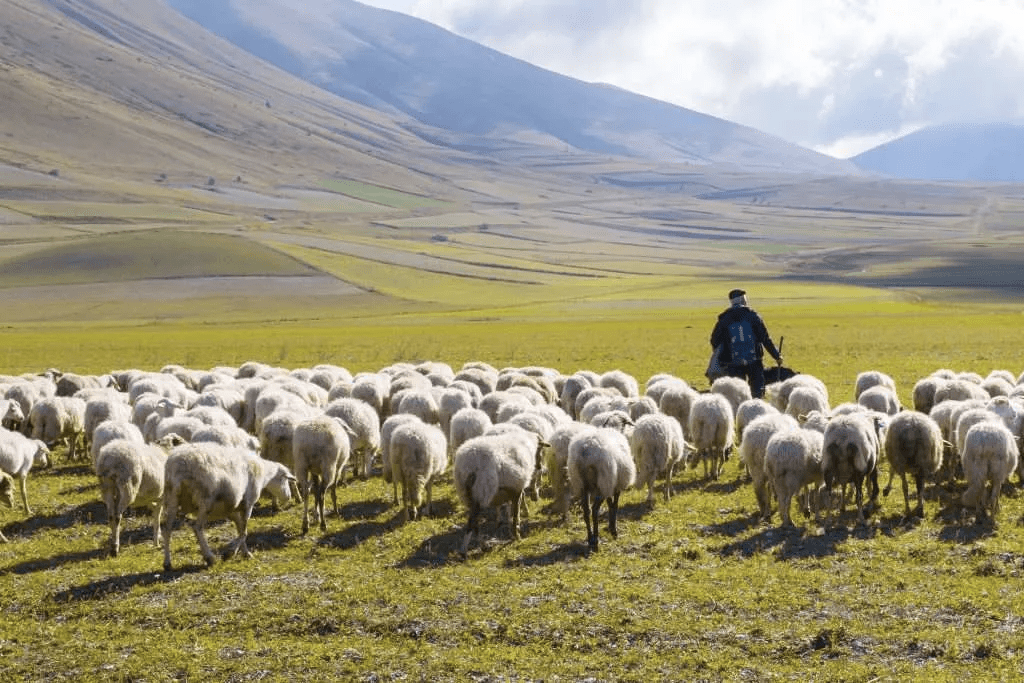
Image Description: A shepherd among sheep. Public domain.
This sermon was preached with First Presbyterian Church in Saline and was focused uponPsalm 23.
Psalm 23 is a psalm of presence and comfort.
I found myself grateful last week when I looked to see which scriptures were listed in the Revised Common Lectionary for this Sunday. There it was: Psalm 23. It seemed to be right on time. For years, we’ve been living a collective time of disruption, concern, and large-scale change. We need a psalm of presence and comfort.
We also just need… presence and comfort. We need these from each other too. And today, we invite each other to a Beyond-Presence and a Within-Presence that many of us call God. In this God, there is a love deep and abiding, and larger than disruption, concern, and large-scale change. And without diminishing any part of how challenging these are — they are real and upsetting; after all, they are disruption, concern and large-scale change —we may need to remind each other that love shows up even there. God shows up there. We want to show up there with our love with and for each other, with and for our neighbors.
Psalm 23 tends to show up right there — right in these kinds of realities. Psalm 23 is often read at the bedsides of those who are sick or dying. It’s read in memory care nursing homes, and sometimes, people with dementia are still able to recite it along with others, because they put it to memory so long ago, and it’s in a deep place where they can recall it. Psalm 23 is read in times of war. It’s read at funerals. It’s been recited internally in people’s thoughts, awake in the middle of the night during high stress and insomnia.
It would be remarkable to know the full history of this Psalm — all the places where it has been read, all the languages, and especially, all of the specific situations it has spoken into. I would like to know that. I am sure many of us have specific stories, and specific situations we would lift up from our own lives of the lives of loved ones. Maybe it might help to bring those people and those moments and those loves to mind too. We can invite them to provide presence and comfort for us.
The Lord is my shepherd, I shall not want.
The Psalm begins this way.
I don’t want the beginning of this psalm to be a mere platitude in any way. We know that some *are* in want. To give just one example, before the pandemic began 1 in 8 children lived in poverty. That number is now closer to 1 in 4 or 1 in 5. These years have disrupted our typical rhythms, and some have found themselves suddenly without work or resources. This is real, and we may need to grieve these changes. But is this not precisely the kind of place where love should show up? Where God should bring presence and comfort, and where God can stir up our presence and comfort to address these needs tangibly?
When the pandemic began, Washtenaw County, we TP-ed each other’s houses. This was true, of course, in a totally different way than that phrase usually suggests. Local organizers started a Facebook page called Washtenaw County Mutual Aid + Resources. In that space, people began to help one another to address a variety of needs.
It was beautiful to watch. In that space, some let people know about public resources and how to access them. Some are advocated for sick leave. Some are requested Venmo, PayPal, and CashApp accounts of those who were losing incomes due to cancelations and job losses, and they were sending money along. And you guessed it: People started thread that invites people to pass toilet paper along to those who need it. Remember when that was in short supply? We were TPing each other’s houses.
In our faith tradition, there are stories about Jesus feeding crowds of 4,000 to 5,000 people from a mere five loves of bread and two fish. These enormous crowds had been following him and assembling together to request healing and to listen to him teach. As you might remember, the disciples wanted to send them away to surrounding towns to buy food, but Jesus said, “You give them something to eat.”
Maybe right then, there was the sound of crickets. Silence. “How do we do that?” They certainly wondered.
They were probably panicking. It’s a task too large, and they didn’t necessarily want to be responsible for people growing weak and fainting.
And maybe they also want a break. Please. I need some introvert time. Send them awaaaaaay for a while.
“We only have five loaves of bread and two fish,” they said. Could that have been a sarcastic response? Or maybe just a declarative, matter-of-fact one? A practical one?
“We’re not going to be able to do it,” they think.
But then, a miracle happens. Jesus begins to break that bread and share that fish, and everyone has enough to eat. They even finish with twelve baskets left over.
What happened here? The traditional interpretation I’ve heard most is that Jesus reveals himself to be a creator: He’s in alignment with The Creator and is one and the same. He miraculously creates and multiples this food out of virtually nothing. That’s a beautiful interpretation.
But I’m also intrigued by another interpretation:
What if Jesus began giving this food away to the first few people as a deliberate teaching moment? Modeling this first, what if people then understood he was issuing an invitation? What if they then reached into their pockets or satchels or baskets or whatever they used back then and began to share the food they have too? Giving and receiving, what if they passed it all around to their neighbors and were amazed to discover that there’s enough? Even more than enough?
I think that’s a beautiful interpretation too, and there is sacred truth to both of them.
That invitation continues right now.
The Lord is my shepherd, I shall not want.
There is presence and comfort in that statement, but it’s not a platitude. If God is our shepherd, we might be a part of that vision and calling, adding our own presence and comfort, adding our own resources.
So we might ask ourselves these questions:
What need do I see or know about? What abundance do I have? How do I make them match?
Or even… What meager, small thing do I have? What tiny thing can I share as part of a collective contagion of giving? Something that might chip away at a need and inspire more giving?
These are good questions.
The Psalm ends this way:
Surely goodness and mercy shall follow me all the days of my life, and I shall dwell in the house of the Lord my whole life long.
Over the last few years, we had periods in time when we were separated from our sanctuaries, unable to gather in person, and there was some very real grief about that. But I think we were also reminded that house in our relationships, so we still exist there, and we can’t do anything but exist there, even our whole lives long, because we love each other, and we are that house. In these relationships, we may house each other’s needs. We may find our own needs held within that house.
And as a household, we can also recognize goodness and mercy. And we can receive goodness and mercy. And we can share it. We can understand that our relationships are a part of this psalm of presence and comfort. We can keep adding our presence and our comfort too.
Yesterday afternoon, I had the great occasion to listen to Dr. Anthony Fauci speak. The University of Michigan held a Comeback Commencement for the Class of 2020. Two of my loved ones finally got that chance to have a commencement ceremony. Dr. Fauci received an honorary doctorate from the University of Michigan, and he was the commencement speaker. I’ve included a video of his speech below.
Two portions of his speech really stood out to me, and I appreciate these dual callings he issued to us. 1) We must challenge what he calls, ‘the normalization of untruths,’ and 2) it’s important not to let the difficulties of our age steal all our joy. From this second place, we realize we can shape life differently.
“What troubles me is that differences of opinion or ideology have in certain circumstances been reflected by egregious distortions of reality. Sadly, elements of our society have grown increasingly unfazed by a cacophony of falsehood and lies that often stand largely unchallenged, ominously leading to an insidious acceptance of what I call ‘the normalization of untruths.’ We see this happen daily, propagated through a range of information platforms, social medias, so-called news organizations, and sad to say, certain elected officials in positions of power. Yet the outrage and dissent against this alarming trend has mostly been muted and mild. If you remember nothing else from what I say today, I truly appeal to you, please remember this: It is our collective responsibility not to sink to a tacit acceptance of the normalization of untruths, because if we do, we bring danger to ourselves, our families, and our communities. This is how a society devolves into a way of life where veracity becomes subservient to propaganda, rather than upheld by a guiding principal for creating and sustaining a just social order.”
— And —
“In closing, I’ve been speaking to you over the last few minutes about the serious issues we are facing in our current world, and so putting the serious business aside for a moment, I want to close with a reminder about the joyousness of your life to come and what a bright future you have. Allow yourselves to cultivate this joy as much as you do your professional accomplishments. Find your source of joy and happiness and fully embrace it. And think upon your future as that stated by the political theorist John Homer Shaw, and I quote, ‘The future is not some place we are going to but one we are creating. The paths are not to be found but made, and the activity of making them changes both the maker and the destination.'”
I have an annual rhythm in my yard. Typically a Mama Bunny, perhaps one born here in the past, returns to the yard, sojourns for the summer, and has a new baby.
Every year, I name the bunnies, and each name is connected to the one before it. Rosa, Rosalita, Litalou, Louisa, Isabella, Bellatrix, and Trixie. This year, I’m hoping to have an Edith. Welcome, bunnies! 8 generations of them. 🙂
One of my friends has a term that I have started using too. She says we all need, “Bop Friends.” You know, the kind you can bop around with — people who can send you a text and say, “What are you doing right now? Do you want to ______?”
I think Bop Friends are a special kind of gift.
Well, last night, one of my friends basically created a Bop Party. His spouse, another beloved friend, finished her last ever law school exam, so in her honor, he called a bunch of people together and arranged a party. We all ended up at a local restaurant, and it was hilarious and fun. None of us started our day knowing that this was going to happen, and I loved that. It’s going to lead to more bopping too. Some of us live in the same part of town, and we are now planning potlucks for the summer. We created a group chat so we can go bop walking.
We just magnified all the bop possibilities at the bop party.
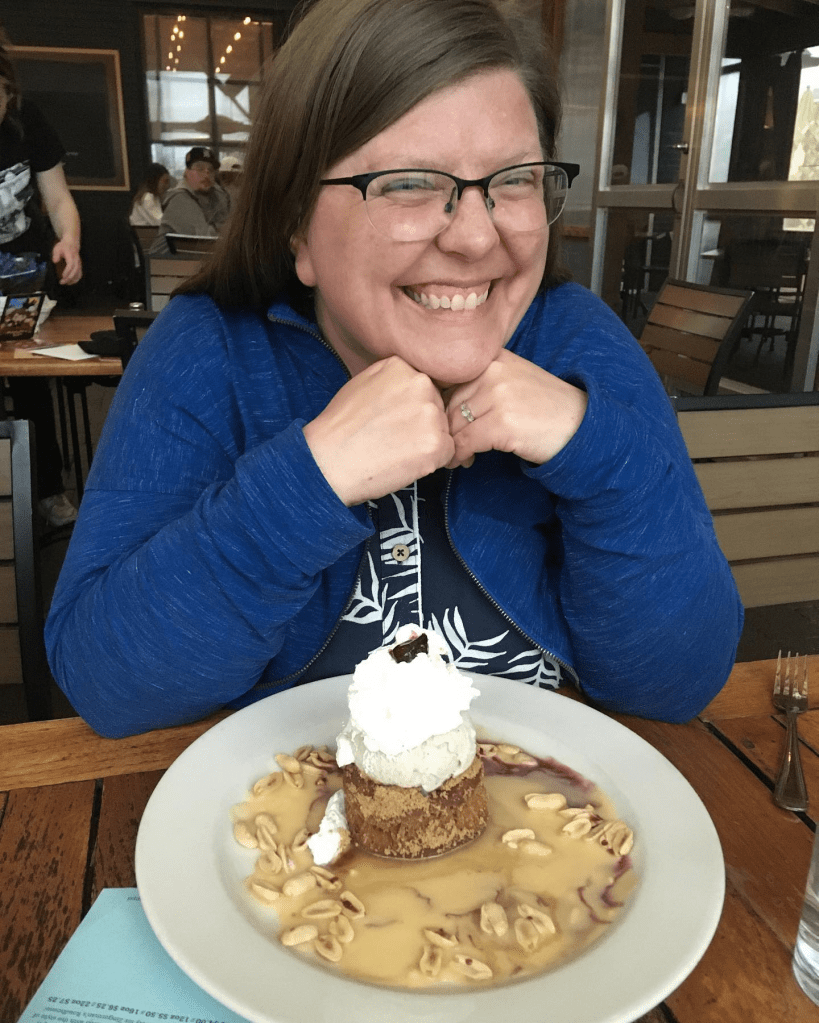
Oh, and I got to eat a donut sundae. With bop friends.
Image Description: A gorgeous, crispy donut in peanut sauce with ice cream, whipped cream, and a cherry. I am posing with it and smiling big, wearing a blue dress and blue jacket.
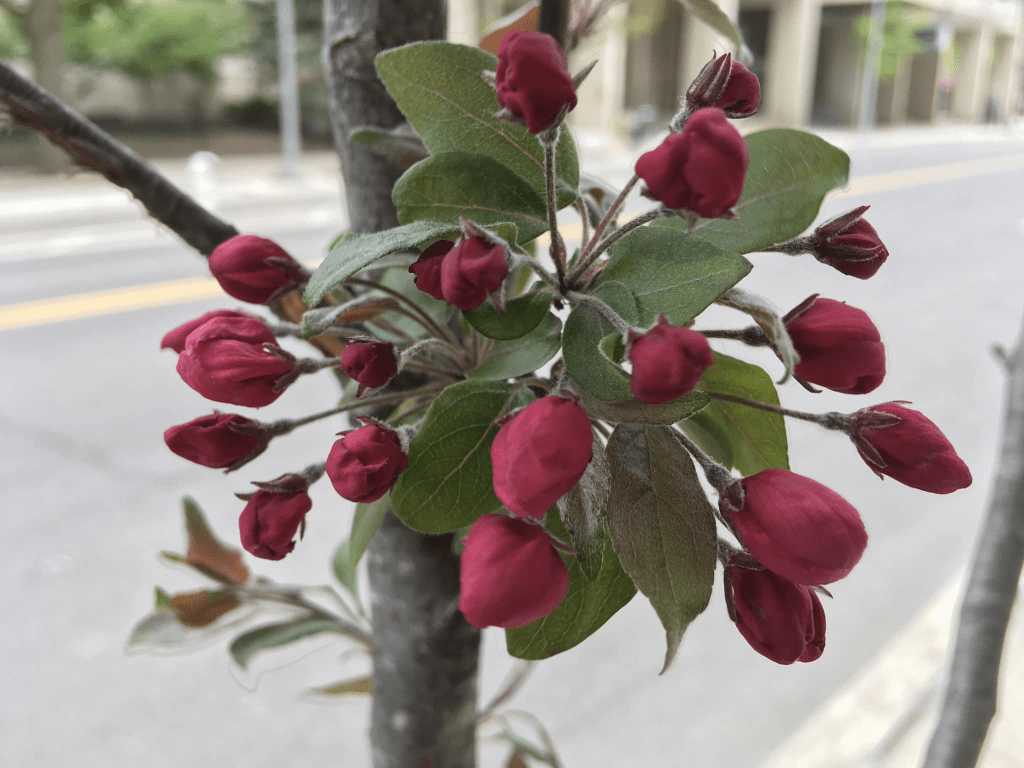
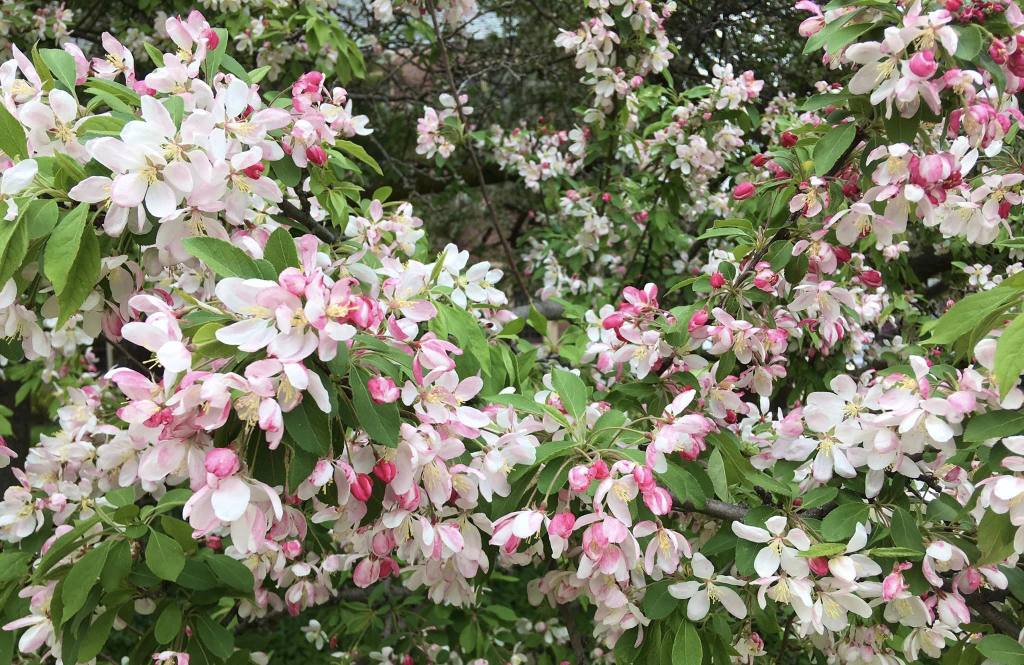
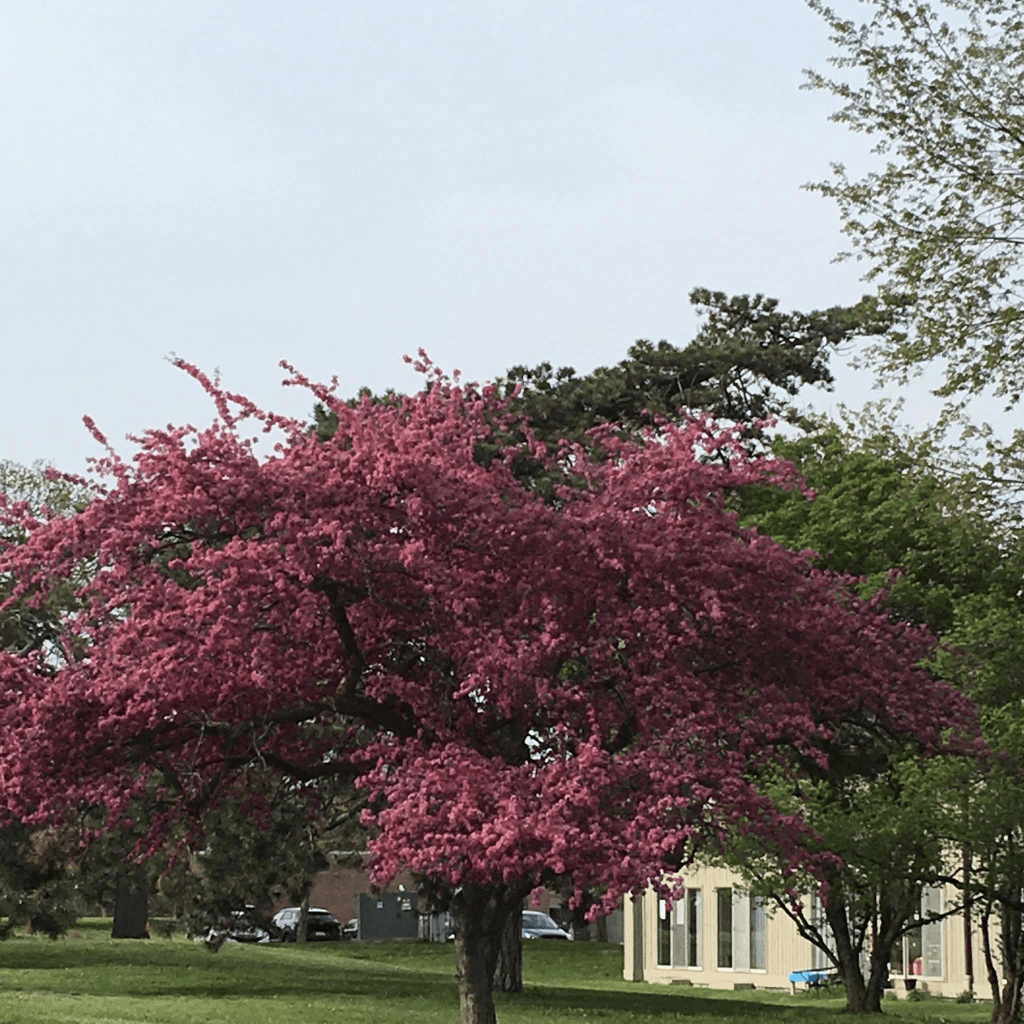
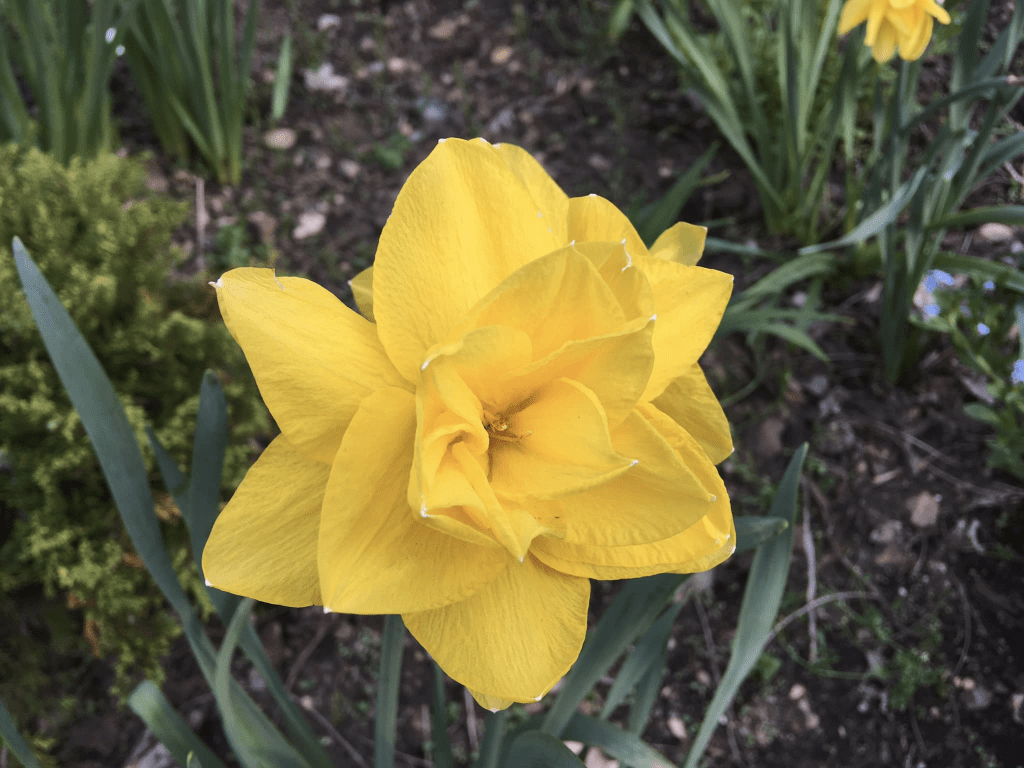
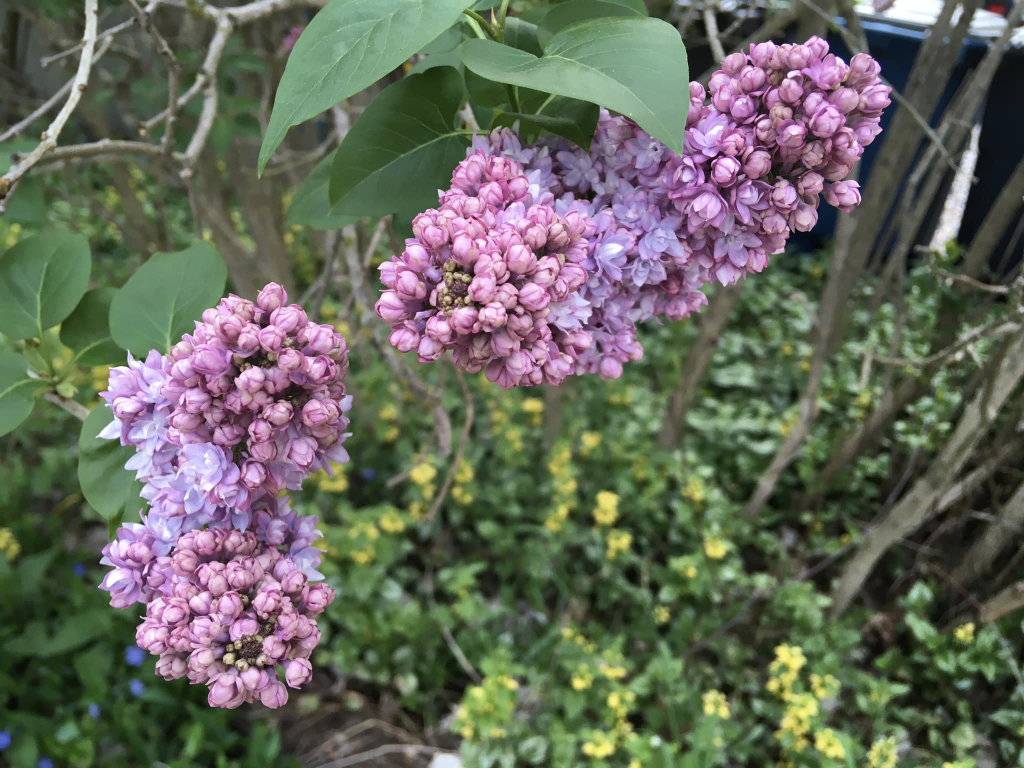
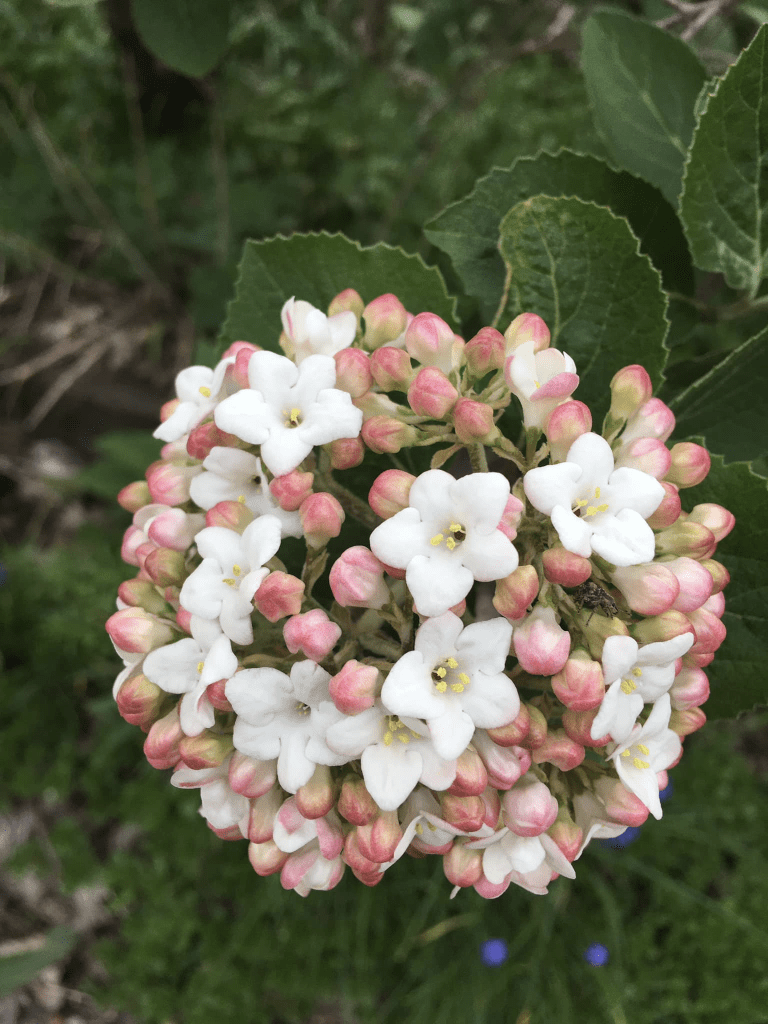
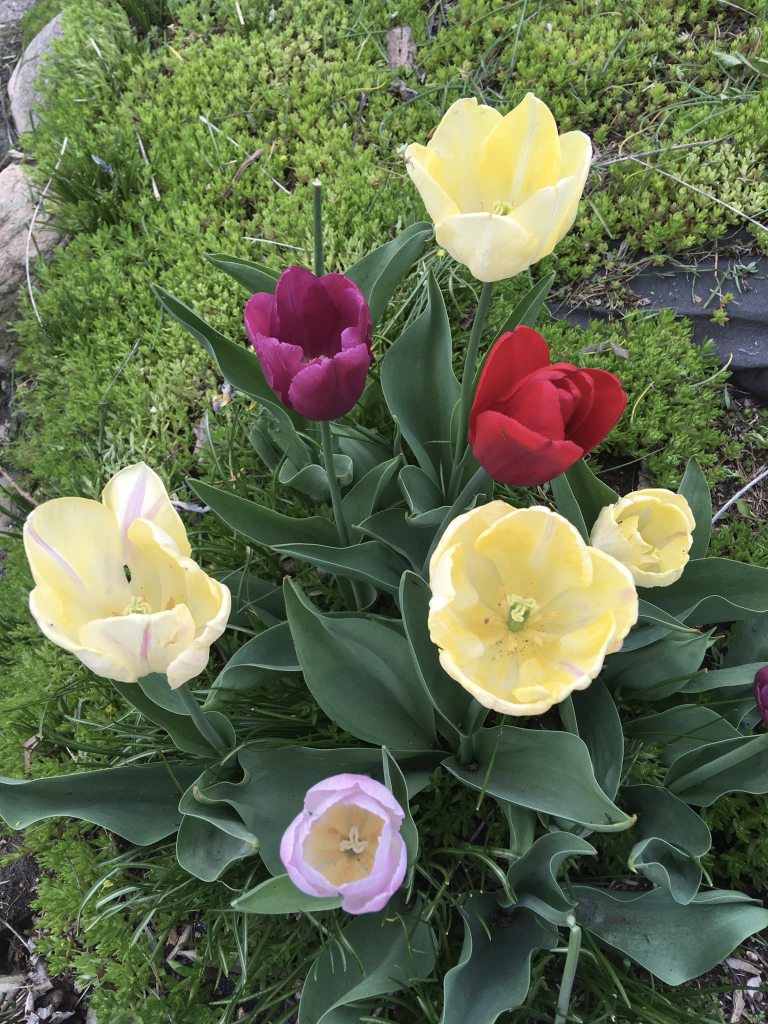
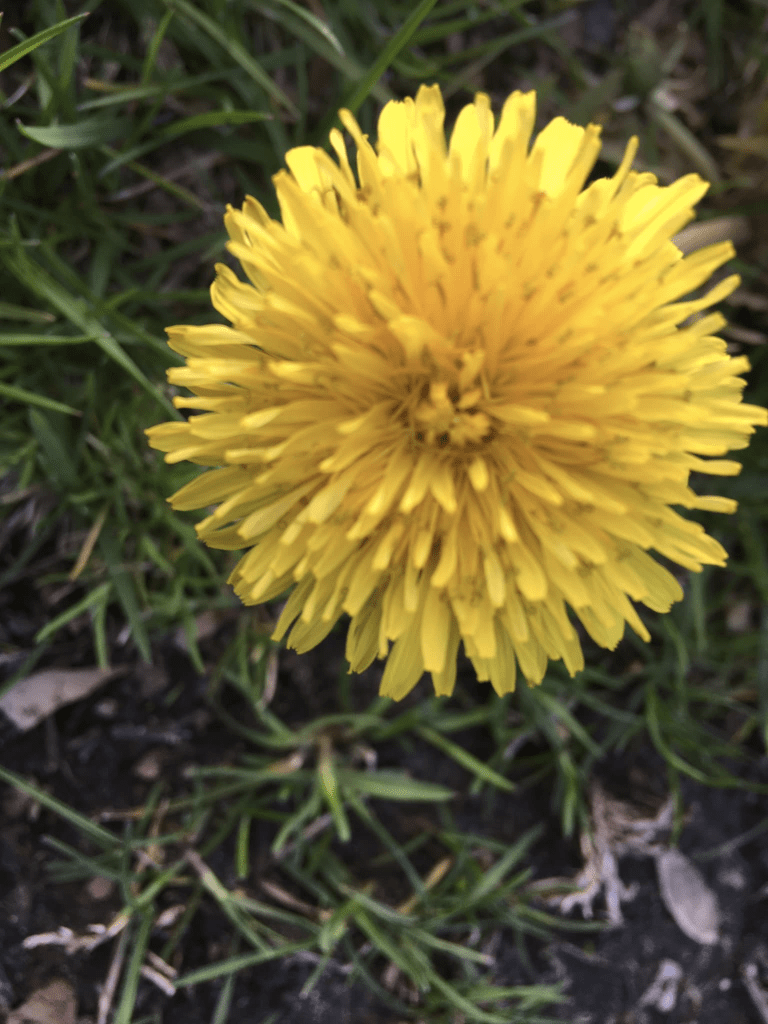
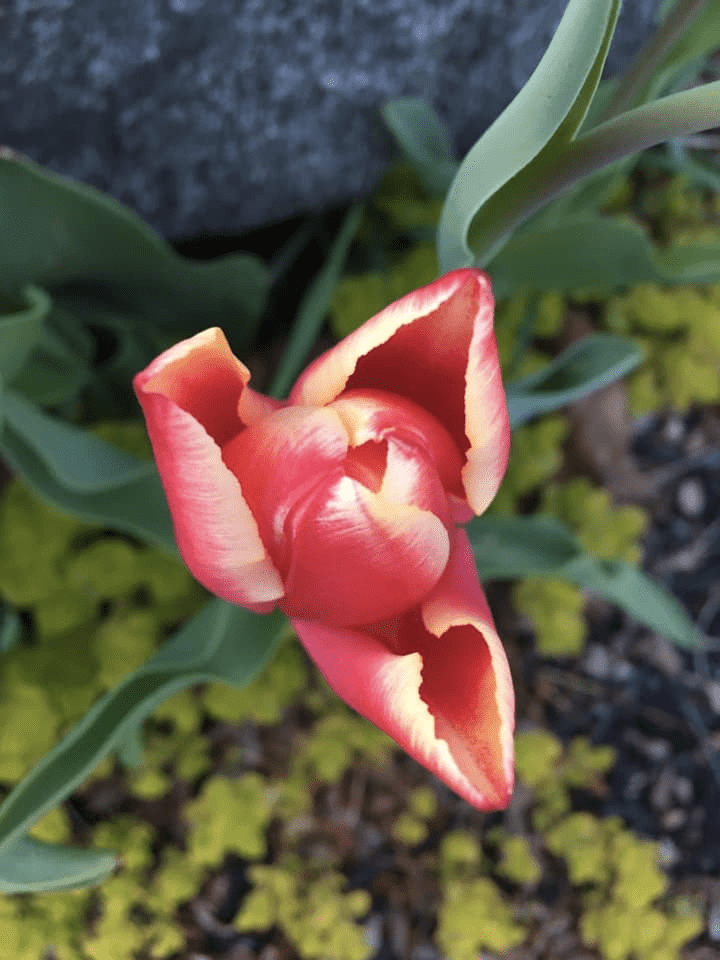
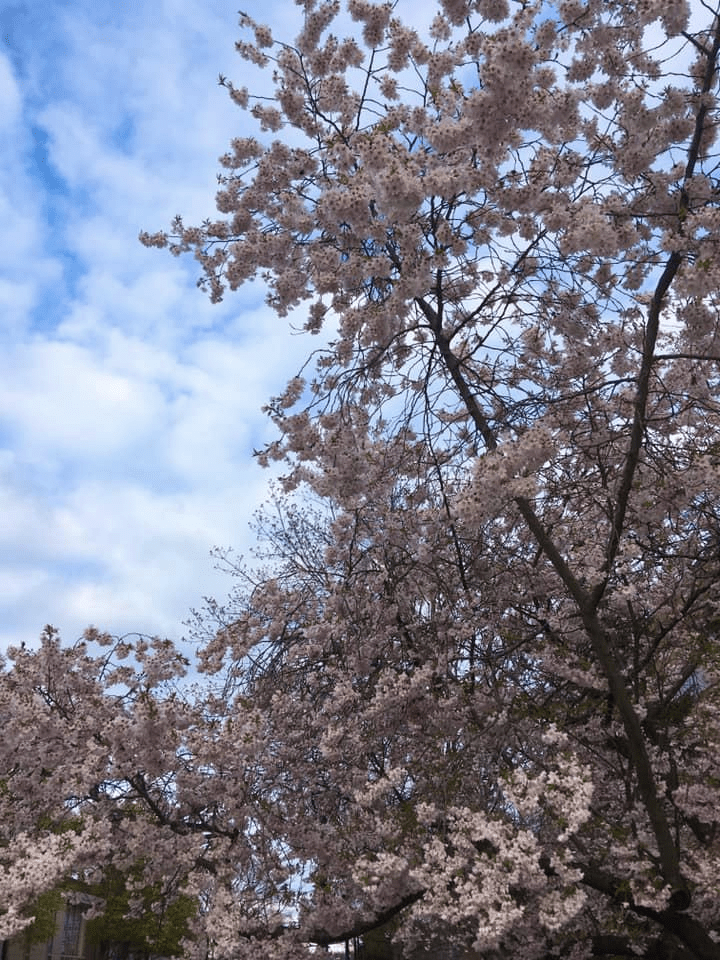
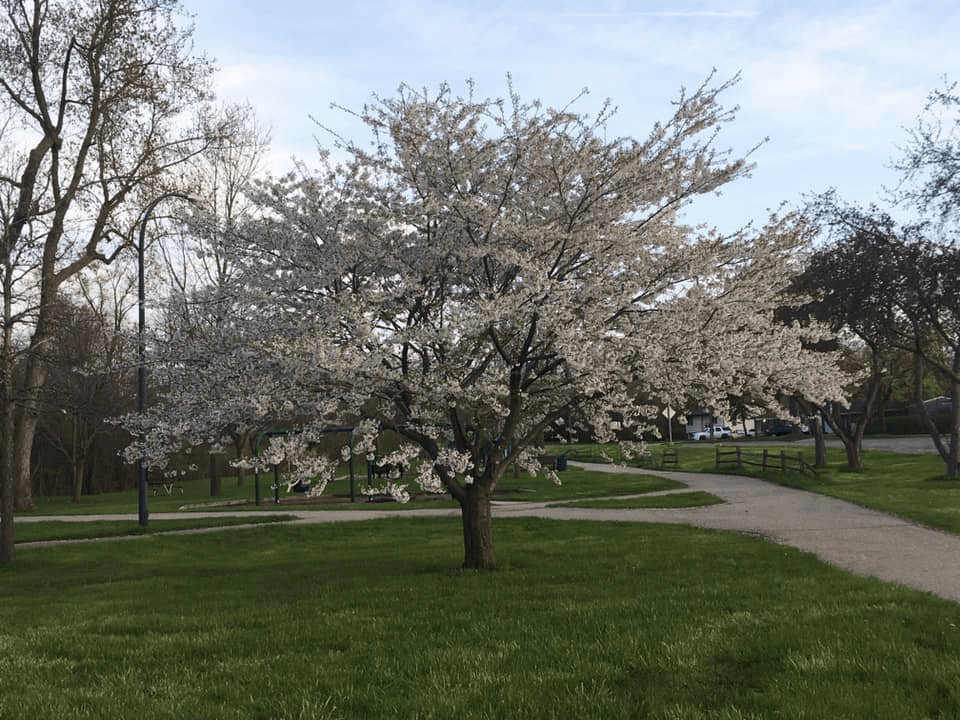
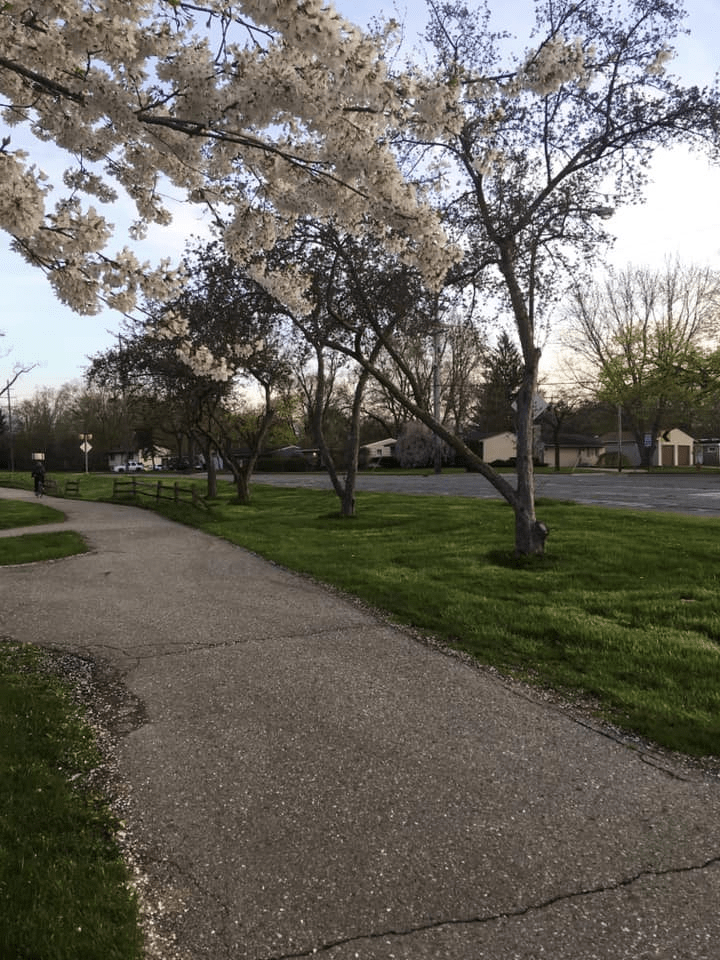
I hope that these images of spring flowers and trees lift your spirits a bit today. One of the best gifts I give myself is the daily rhythm of getting outside and viewing how gorgeous earth is — right here in my own neighborhood. ❤
I am writing my blog post much later than is typical for me. I feel pummeled by the news.
I am concerned, not only about the outcomes, but also the line of argumentation. I feel pummeled by the news.
It seems like preparation (or at least the potential for it) to roll back a large number of rights, and when added together, that could both impact the majority of our population, and each person and community in very particular ways.
I do feel pummeled by the news.
This doesn’t mean all of this will happen. It doesn’t mean that we won’t push back hard. It doesn’t mean we won’t care for each other and keep building a better vision that honors the particularity and diversity of people with a variety of needs.
But this news — the potential outcome and the argumentation — brought my body to fast-track nervous system dysregulation. A trauma response of freeze. And migraines. And exhaustion.
And I realize, if one of the best ways we can care for each other right now, is being safe for each other, one of the best things we can do is try to care for our bodies so that they feel as safe as they can.
I’m doing some work today, but I’m also taking it easy.
And whenever and however you feel pummeled, I hope you will too.