Before I go any further, it’s important to say that this pandemic is far from over. That’s true in our country, and at this moment, it’s very true within my state. In particular, India is in serious crisis at the moment. So we’ll need to keep taking precautions in a variety of ways based on where we are within the vaccination process and based on the best scientific recommendations before us. My heart goes out to people who are suffering with COVID.
I want to honor this. I also recognize there’s a certain level of privilege in having access to vaccines. That’s so important to say.
For the purpose of this post, ever since I had my first vaccination on March 22, I’ve been calling May 3 my “Donezo Day.” It’s the arrival point two weeks after my second vaccination. According to the CDC, I am fully vaccinated as of today.
The pandemic isn’t done, and I’ll continue to wear my mask in public spaces. But a particular chapter is done for me as of today. And with so much gratitude, I am looking forward to doing some of the things I haven’t done in a long time.
Here’s a small one, and yet one I am thrilled about: I’m going back to Trader Joe’s today for the first time in more than a year. And big ones are coming up too — I can’t wait to spend more time with also-vaccianted-loved-ones.
Unless you have health conditions that cause serious reactions to them, please get vaccinated, friends. Most of all, this helps us collectively. This is how we defeat this coronavirus.
When we connect with a sense of Beyond — when we zoom out to see a larger field of view — we see ourselves in a different light. We encounter our finitude, our fragility, and our power.
In 1990, the space probe and explorer Voyager 1 was 13 years old and 3.7 billion miles away from the earth. On February 14 of that year, scientists commanded the probe to turn around and take a photo of the earth. That command resulted in this image. Astronomer Carl Sagan called it “the pale blue dot.”
He added poetic meaning and power when he added convicting words to this image. He said,
Look again at that dot. That’s here. That’s home. That’s us. On it everyone you love, everyone you know, everyone you ever heard of, every human being who ever was, lived out their lives. The aggregate of our joy and suffering, thousands of confident religions, ideologies, and economic doctrines, every hunter and forager, every hero and coward, every creator and destroyer of civilization, every king and peasant, every young couple in love, every mother and father, hopeful child, inventor and explorer, every teacher of morals, every corrupt politician, every “superstar,” every “supreme leader,” every saint and sinner in the history of our species lived there–on a mote of dust suspended in a sunbeam.
The Earth is a very small stage in a vast cosmic arena. Think of the rivers of blood spilled by all those generals and emperors so that, in glory and triumph, they could become the momentary masters of a fraction of a dot. Think of the endless cruelties visited by the inhabitants of one corner of this pixel on the scarcely distinguishable inhabitants of some other corner, how frequent their misunderstandings, how eager they are to kill one another, how fervent their hatreds.
Our posturings, our imagined self-importance, the delusion that we have some privileged position in the Universe, are challenged by this point of pale light. Our planet is a lonely speck in the great enveloping cosmic dark. In our obscurity, in all this vastness, there is no hint that help will come from elsewhere to save us from ourselves.
The Earth is the only world known so far to harbor life. There is nowhere else, at least in the near future, to which our species could migrate. Visit, yes. Settle, not yet. Like it or not, for the moment the Earth is where we make our stand.
It has been said that astronomy is a humbling and character-building experience. There is perhaps no better demonstration of the folly of human conceits than this distant image of our tiny world. To me, it underscores our responsibility to deal more kindly with one another, and to preserve and cherish the pale blue dot, the only home we’ve ever known.
Image Description: A person in silhouette jumps between two stacks of rocks. A blue, cloudy sky is in the background.
Do you know this saying?
If a thing’s worth doing, it’s worth doing well.
Don’t get me wrong. I support hard work and excellence and all of that, but ultimately, I appreciate what G.K. Chesterton has to say about this. He was known for turning common sayings on their head in order to gain greater meaning from them. He started to say this instead:
If a thing’s worth doing, it’s worth doing badly.
That’s better. It may sound strange to our ears, but it’s more life-giving. Because if we think about it, it brings home this truth: If a thing is worth doing, it’s worth doing. Period. No matter the result.
– This saying bolsters people who are willing to try something innovative, even as they recognize the possibility for failure. If it turns out badly, it may be the necessary catalyst for learning. The process or the failure itself may yield insights and discoveries toward the next idea, one that would have never been conceptualized beforehand.
– This saying bolsters people who are pursuing a calling, even as they reckon with the reality that some will place roadblocks in their path. The journey toward any kind of calling takes twists and bends. At times, the these turns are remarkably unfair. At times, they are thoroughly unjust. I do not make light of this. They are harmful — not good. But the calling can emerge in spite of them.
– This saying bolsters people who are willing to tell the truth, even as they recognize it marks them for risk. Whistleblowers come to mind, in particular. There are times when we honestly cannot afford such risks. But when we can, there is life and vitality in speaking truth to power. Even if we do not shift the power entirely, those words of truth are out there in the world. They keep working. I trust that they take on a life of their own, especially as they inspire more people to come forward and speak truthfully.
It’s messy.
But if a thing’s worth doing, it’s worth doing badly.
Two coffees with foam shaped like hearts. Public domain image.
Here we are at the end of the April, heading into May.
At the end of the month, I always like to say thank you for following here at Smuggling Grace. I appreciate you taking the time to connect here, and as always, thanks for engaging too. I enjoy reading and hearing your comments virtually on the platform, in emails, or during real time conversation. Thank you!
And I’m always happy to expand the audience as well. Do you know anyone who might enjoy connecting with this blog? If so, feel free to pass it along. The more the merrier!
And I wish you a wonderful spring! Wherever you are, I hope you’re starting to have some lovely weather.
Also at the end of the month, I always extend an invitation to support this blog on Patreon. Or! You cantip me with a coffee!Both of these are always great gifts, but are never expected. I appreciate you being here.
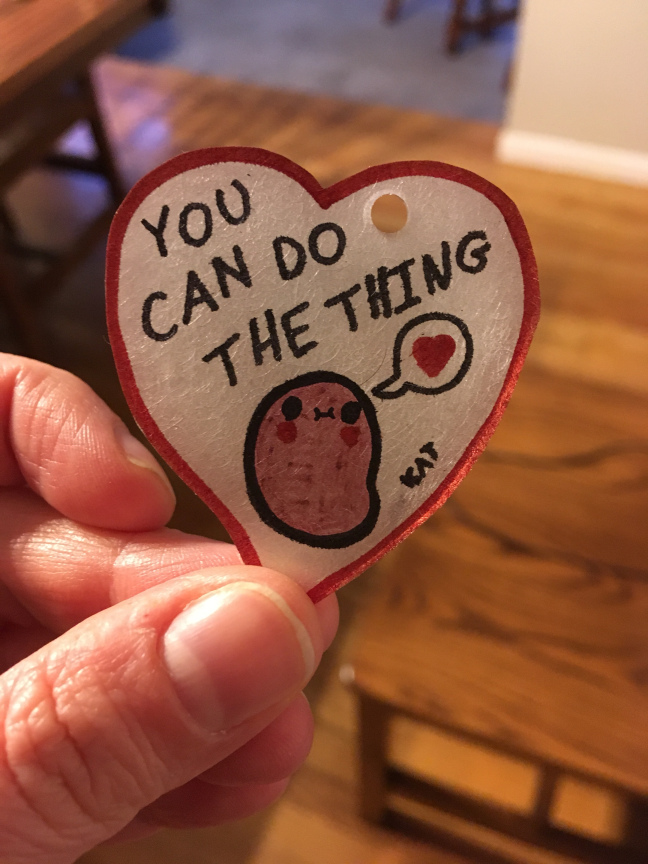
A while back, a friend of mine made this cute little sticker and sent it to me and some other colleagues. It’s a potato, and it says, “You can do the thing!”
So I offer it as encouragement in whatever direction you need.
Image description: Two hands come cupped together to make the shape of a heart. Sunlight is shining through.
One of my best friends has a nightly ritual with both of her daughters. They are five and three, both completely precious. Every night, after reading to them, my friend says these final words before they go to sleep:
“Who loves you?”
Then both girls go through this litany of naming who loves them (sometimes with help) — parents, grandparents, teachers, and friends. Sometimes the stuffed animals get named too.
I think this is a very dear practice. It’s wonderful that these girls rehearse love right at the end of the day before they fall into sleep.
Perhaps we’ve never taken a moment to go through a list of people in our minds like this, but maybe that would actually be a good idea today. We never outgrow the need for this kind of awareness, a calling to mind of those who love us.
Image Description: A thought bubble with a lightbulb inside. Public domain image.
A Stress Relief/Trauma Life Hack*:
Get curious.
Ask yourself a new question. Go down a rabbit trail of learning. Explore something novel. Get to know someone. Delight in something unknown. Try something new.
Every time we explore new things, we are creating new chemical reactions in our brains. Our neurons fire, and our brains develop new patterns and associations. This is invigorating and stimulating. When we have interest and feel delight, we ease stress.
Curiosity is also a pathway to empathy. It helps us imagine the thoughts, feelings, and experiences of others. It also helps us have empathy for ourselves: Why do I think these thoughts, feel these feelings, and do things this way? Both kinds of curiosity are helpful during times of trauma and personal difficulty.
So let’s get curious.
And I’d love to hear from you: What are you learning or exploring these days?
* I want to thank Shannon Dingle for a series of tweets she did in which she gave some valuable ‘trauma life hacks.’ I’m borrowing her phrase, so I want to give a nod to her work and her Twitter handle: @ShannonDingle
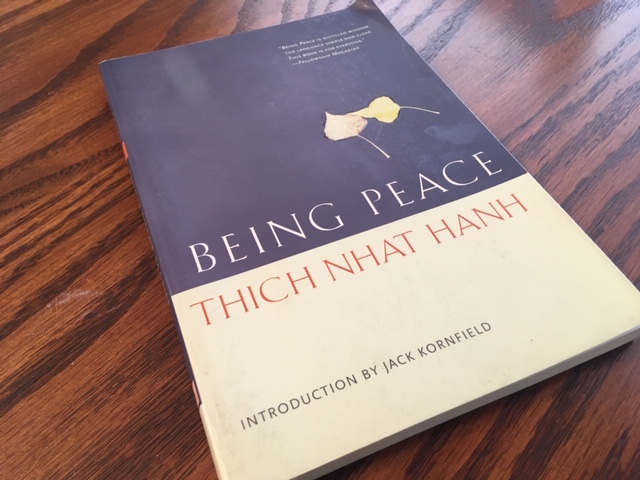
Image Description: The blue and white cover of the book, Being Peace. Under the title, it reads “Thich Nhat Hanh,” naming the author of the book. The cover also says, “Introduction by Jack Kornfield.” At the top right is a quote that reads, “Being Peace is distilled wisdom, the language simple and clear. This book is for everyone. — Fellowship Magazine.” There are also images of two leaves falling to the ground.
A Stress Relief/Trauma Life Hack*:
Sit and smile.
Meditation is calming for the body. When we get quiet, sit still, notice our breathing, and clear our thoughts — or often more accurately, notice our thoughts as they come and go — we ease our nervous systems. We activate the calming mechanisms of the parasympathetic nervous system, and our fight, flight, freeze, and fawn reactions slow down and fade for a while.
We can also practice smiling.
I’m certainly not a person who tells others, “You should smile!” (Women hear this all the time, and it’s irritating. We also know that people are feeling grief, anxiety, and stress). But when we sit and smile, breathing in and out, we can shift some of the feelings in our body.
Here’s what Zen Buddhist monk, Thich Nhat Hanh shares in his book, Being Peace:
“I would like to offer one short poem you can recite from time to time, while breathing and smiling.
“Breathing in, I calm my body. Breathing out, I smile. Dwelling in the present moment I know this is a wonderful moment.
” ‘Breathing in, I calm my body.’ This line is like drinking a glass of ice water-you feel the cold, the freshness, permeate your body. When I breathe in and recite this line, I actually feel the breathing calming my body, calming my mind.
” ‘Breathing out, I smile.’ You know the effect of a smile. A smile can relax hundreds of muscles in your face, and relax your nervous system. A smile makes you master of yourself. That is why the Buddhas and the bodhisattvas are always smiling. When you smile, you realize the wonder of the smile.
” ‘Dwelling in the present moment.’ While I sit here, I don’t think of somewhere else, of the future or the past. I sit here, and I know where I am. This is very important. We tend be alive in the future, not now. We say, ‘Wait until I finish school and get my Ph.D. degree, and then I will be really alive.’ When we have it, and it’s not easy to get, we say to ourselves, ‘I have to wait until I have a job in order to be really alive.’ And then after the job, a car. After the car, a house. We are not capable of being alive in the present moment. We tend to postpone being alive to the future, the distant future, we don’t know when. Now is not the moment to be alive. We may never be alive at all in our entire life. Therefore the technique, if we have to speak of a technique, is to be in the present moment, to be aware that we are here and now, and the only moment to be alive is the present moment.
” ‘I know this is a wonderful moment.’ This is the only moment that is real. To be here and now, and enjoy the present moment is our most wonderful task. ‘Calming, Smiling, Present moment, Wonderful moment.’ I hope you will try it.”
— Thich Nhat Hanh, Being Peace, pages 15-16
* I want to thank Shannon Dingle for a series of tweets she did in which she gave some valuable ‘trauma life hacks.’ I’m borrowing her phrase, so I want to give a nod to her work and her Twitter handle: @ShannonDingle
Image Description: A graphic of a brain viewed from above. At the top of the image, it says “Left Hemisphere” and “Right Hemisphere.”
A Stress Relief/Trauma Life Hack*:
Move your body side by side.
Bilateral stimulation is a big form of stress release for the body. Swing your arms. Left side, right side in a repetitive way. Take a walk. Left side, right side in a repetitive way. Use your hands to tap on your chest or your legs. Left side, right side in a repetitive way. With headphones, listen to bilateral stimulation music on Youtube. Left side, right side in a repetitive way.
Bilateral stimulation is soothing. Even more significant, it can help the brain store memories in new, helpful ways. (More about that in a moment).
We are emerging from a time of collective trauma, and in the midst of this, we can experience emotional flooding. We can have big, internal reactions of anxiety, irritability, restlessness, hyper-vigilance, and trouble sleeping. These physical feelings give us the sensation that we are continuously on guard, waiting for something challenging but unknown to happen. With all of these, our nervous systems are in a state called hyperarousal. Or, in emotional flooding, we can sense our emotions going flat or numb. We might sleep more, struggle to get out of the bed in the morning, have depressive symptoms, feel continuously fatigued, or get to a place of dissociation where we lose contact with our feelings — becoming disconnected from the moment, ourselves, or our typical lives. With all of these, our nervous systems are in a state called hypoarousal.
We might experience one of these more than the other, or we might bounce back and forth between hyperarousal (top of the next image) and hypoarousal (bottom of the next image). This can be jolting. If you’re experiencing any of these things, please know that they make complete sense given what we’re experiencing collectively, and you’re not alone. We can be very gentle and kind with ourselves in the midst of these things.
(Levine, Ogden, Siegel)
In the midst of present, collective trauma, older traumas from our lives might resurface too, either in our thinking memories or in physical reactions in our bodies. We might not be aware that this is happening because the experience can be one of additional hyperarousal and hypoarousal without necessarily being one of thinking and recollection. We need to show ourselves gentleness and kindness here too.
Bilateral stimulation can be helpful.
When we experience trauma, individually or collectively, the memories of that trauma can be split in our brains. The thinking, recollection, logical memory of the event is stored in left brain, while the emotional memory of the event is stored in the right brain. And if these are not reprocessed physically (building brain connections between the thinking memory and the emotional memory) these can keep us feeling stuck. Hyperarousal is traumatic stress stuck “on” and hypoarousal is traumatic stress stuck “off.” In the midst of these, bilateral stimulation is soothing (try it!). And it can also help move these various forms of memory around in our brain so that they are no longer stuck.
One extremely powerful and effective form of bilateral stimulation is a form of therapy called EMDR. (Check out this article: The Best Drug I’ve Ever Taken Wasn’t Even a Drug. It was EMDR Therapy) EMDR stands for Eye Movement Desensitization and Reprocessing. When we move our eyes back and forth side to side, or do other forms of bilateral stimulation, we can create a physical state that is something like our REM cycles of sleep. With a therapist, we can use these forms of bilateral stimulation to reprocess traumatic memories, shifting how they are stored physically in our brains and bodies. This helps us shift the ways we are stuck in post-traumatic states of hyperarousal and hypoarousal.
It’s amazing that this stuff works!
So I recommend doing EMDR with a therapist, and this can be done for large traumas and for smaller forms of stress too.
But you can try some forms of bilateral stimulation at home as well. Here’s one form of bilateral stimulation that I learned from Andrea Thomas, one of my colleagues. It’s called the Butterfly Hug.
Cross your arms across your body in a self-hug.
Allow your thumbs to be the “body” of the butterfly. Your other fingers are the “wings.”
Tap your fingers — the wings — on your arms, left side, right side in a repetitive way.
This can be soothing. While you try this, tell yourself messages that are loving, kind, and gentle. Your brain and body are processing these messages at a deep, physical level. Bilateral stimulation makes those connections deeper.
* I want to thank Shannon Dingle for a series of tweets she did in which she gave some valuable ‘trauma life hacks.’ I’m borrowing her phrase, so I want to give a nod to her work and her Twitter handle: @ShannonDingle
Image Description: A red cartoon heart with white arms gives a self-hug.
A Stress Relief/Trauma Life Hack*:
Give yourself a hug.
Sure, you may feel silly, but try to put that away for a few reasons: 1) It’s good to give yourself self-compassion, 2) no one is watching, and most importantly, 3) this has great health benefits because it releases stress.
When we hug, our brains reduce chemicals like oxytocin and dopamine (big, feel good chemicals) and you know what? While it’s certainly great to hug another person, our brains don’t fully know the difference between an other-people hug and a self-hug, especially if we place good intentions of self care into that hug. Some are sheltering-in-place alone, and this is genuinely helpful.
Hugs also stimulate the vagus nerve. Yesterday, I wrote about the importance of activating the parasympathetic nervous system (it calms our fight or flight responses). The vagus nerve is a special hack to know about, because it plays a big role in that system. When we hug, we stimulate pressure points in our skin called pacinian corpuscles, and these receptors fire signals to the vagus nerve. Among other things, the vagus nerve plays a role in regulating blood pressure. Hugs, including self-hugs, activate this system and frequently, lower blood pressure.
* I want to thank Shannon Dingle for a series of tweets she did in which she gave some valuable ‘trauma life hacks.’ I’m borrowing her phrase, so I want to give a nod to her work and her Twitter handle: @ShannonDingle