Image Description: A green pen is on top of a yellow sheet of paper. The paper is a list written in green ink, and parts are crossed off.
Yesterday, I was defeated by a to-do list. It still remains, technically unwritten; but piece by piece, and point by point, it chiseled itself into my brain.
Do this, then – Do that, then – Achieve this, then – Accomplish that.
It hammers. It sculpts. It hardens and solidifies. Pristine and chiseled, it presents itself complete and paramount.
And it does all of this. . . For The Goal. (Or at least, that’s what I’m led to believe).
Instead, this to-do list, this master carpenter, becomes a goal in and of itself.
If I’m not careful, my thriving will diminish, my playing will diminish, my living will diminish, while my toiling, my striving, and my working, grow, extend, increase, accumulate.
Forget the real goals! The living, The playing, The thriving! Suddenly, these are less than a host of check marks, Suddenly, these have less value than solid lines marked through words.
Suddenly, DO and DONE become more than LIVE and LIVED.
Well, today, I turn a corner. I will not cross LIFE off some oppressive list. Peace and pleasure will permeate my work, and no lines will run through BREATHE LOVE ENJOY and SAVOR.
Yesterday, I was defeated by a to-do list. Today, the goal shifts.
Happy Spring! Here are some photos I’ve captured on my recent nature walks. I look forward to watching everything blossom and grow, bit by bit. Here are days of blue skies, trees, plants…
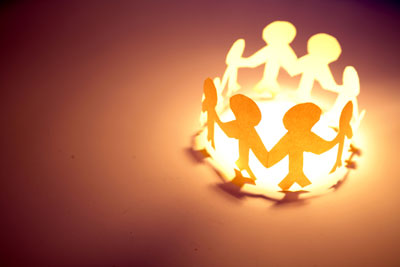
Image description: There is an orange-brown background, and toward the right side of the image, there is a circle of symbols of people made from paper. They are holding hands in the circle, and a light is shining in the middle of the circle.
Sometimes, we have a zero-sum mindset about rest, care, and personal growth.
We feel anxious or guilty about prioritizing rest, care, and personal growth because somewhere deep down inside us, we believe… if we choose to prioritize these for ourselves… deliberately receiving from others, setting up daily rhythms of personal care practices, or engaging extended periods of intentional, internal work… we believe… we are somehow taking from others.
Some of us have also been socialized to view care in these ways.
I’m not talking about falling off the grid entirely (though by all means, it’s helpful to do this temporarily here and there). I just want to make a claim that rest, care, and personal growth are not necessarily selfish, which is something we can easily fear or feel guilty about. This zero-sum mindset easily creeps in amidst parenting, pastoring, organizing, and caregiving.
We, ourselves, are intrinsically worth rest, care, and personal growth. We matter.
But also, when we keep our connections with others in mind, this is not a zero-sum situation — our rest, care, and personal growth is always embedded in relationships. It is always for the benefit of the community. We are refreshed and energized. We bring our fuller selves to our relationships, roles, and work. And when our rest, care, and personal growth stay in contact and connection with others, we pay attention to the systemic forces which make it much more challenging for some to experience those extended times of rest, care, and personal growth. Our care becomes more intentional here, and respecting people’s agency, we practice care outwardly, prioritizing others also. We take care of each other. We cultivate care spaces in mutuality together.
I wonder why we think these are divided from one another — personal healing and receiving versus community care work. As if we can only do one or the other.
After all, who’s to say they aren’t absolutely connected?
A drop of water falls and creates a ripple effect. Public domain image.
“We teach who we are.”
This is something that a mentor’s mentor used to say. She may have meant a variety of things by that statement, but she certainly meant that we end up teaching, extending, and tending to others in ways that reflect the most deeply held lessons from our own experiences, the kinds that rest (at times, after a struggle) at the core of our being.
“We teach who we are.”
It reminds me again that the word ‘heal’ is both active and passive at the same time. We heal in receptive ways. Healing is something that we receive, even as we work to create the conditions that make it possible.
And when we receive and integrate healing into our own lives (and this is always a process rather than an arrival) we also begin to heal — that is, participate actively in healing of others.
“We teach who we are.”
We’ve all received; when people welcome us through their own agency, we can extend our healing and learning toward others.
Image Description: The Instagram logo — A square with rounded edges that is purple at the top, pink in the middle and lower right, and orange at the bottom and bottom left. Inside that, there is an outline of a white square with rounded edges. Then inside that, there is an outline of a circle and a dot to its upper right. Together, all white outlines look like a camera.
I was playing around with Instagram stories (that’s where you can post photos, memes, etc. and they’ll last 24 hours) and I decided to use the Instagram sticker that invites friends to ask questions. My prompt said,
“Please ask me a question, silly or sincere.”
People then asked their questions, and I had the occasion to share those questions along with my answers. These included time-tested inquiries of wisdom, like,
“How many Lowe’s would a Rob Lowe rob if a Rob Lowe could Rob Lowe’s?”
and, “Who is the mean girl of fruits?”
But then hours after I posted this, someone asked me,
“What do you want?”
What a good question, I thought. On one hand, we might spend a lot of time working toward personal gratification in a variety of ways, but what do we want? Like really want? Deep down?
I’m grateful I had the occasion to ponder that. I made a list and shared it. These are some things I want:
-A Big, Chosen family
-Laughter
-Storysharing
-Love/Access/Affirmation/Belonging/Self Determination for All Bodies
-Horizontal Churches (working to flatten church hierarchies)
-Providing Resources for Each Other
-Belonging-Structures and Economic Systems built upon the intrinsic worth of people rather than their capacity for productivity
That’s all the space I had to create a list. There are more things I want, but those are some of them.
What do you want? Like really want? Deep down?
Oh, and the answer is, Rob Lowe can’t rob any Lowe’s, because every time he tries, he gets distracted by the health store he passes on the way.
Image Description: Three gray-brown rocks are stacked upon each other, each smaller than the one beneath it. The rocks are on top of sand, and the sand has tracings with concentric circles as if there is a ripple effect from the rocks.
To the Person That Harms, To the Family That Wounds, To the Shame That Devours, To the Violence That Festers,
To the Grief That Upends, To the Diagnosis that Stuns, To the Substance That Hooks, To the System That Discriminates,
You,
Yes, You,
Any of You, or All of You, or More Than You (That Which Stays Silent or That Which Exists Beyond Lists)
You.
You have never been a gift in disguise — not tied with a bow or packaged with grand, silver linings.
But here’s one thing you’ve yet to figure out:
The more you knock us off balance — The more you pummel, The more you trounce, The more you disrupt and delight in the off-kilter,
The more we come to know what our balance is.
And that balance, when we know it, when we can name it, when we can internalize it, is Strength Beyond Strength.
That Balance is Our Sacred Invitation. That Balance is Our Secret Intervention.
The cover of Bryan Stevenson’s book, Just Mercy: A Story of Justice and Redemption
It takes courage to see what is purposefully held out of view.
In addition to making targets out of particular human beings, abusive, unjust systems have ways of keeping that harm out of view. Very often, the broader community is kept from knowing that harm, either because it is held in secret, or because it is removed quite purposefully from the rhythms of their daily lives.
A few years back, I read the book, Just Mercy: A Story of Justiceand Redemption by Bryan Stevenson. It’s difficult, powerful, beautiful, and challenging at once. While reading it, I recognized how much I am not seeing. And I know I do not look often enough or advocate enough.
I would like to share some quotes from this book today. These are found on pages 15-16:
“When I first went to death row in December 1983, America was in the early stages of a radical transformation that would turn us into an unprecedentedly harsh and punitive nation and result in mass imprisonment that has no historical parallel. Today we have the highest rate of incarceration in the world. The prison population has increased from 300,000 people in the early 1970s to 2.3 million people today. There are nearly six million people on probation or on parole. One in every fifteen people born in the United States in 2001 is expected to go to jail or prison; one in every three black male babies born in this century is expected to be incarcerated.”
“Some states have no minimum age for prosecuting children as adults; we’ve sent a quarter million kids to adult jails and prisons to serve long prison terms, some under the age of twelve. For years, we’ve been the only country in the world that condemns children to life imprisonment without parole; nearly three thousand juveniles have been sentenced to die in prison.”
“We have declared a costly war on people with substance abuse problems. There are more than a half-million people in state or federal prisons for drug offenses today, up from just 41,000 in 1980.”
“Finally, we spend lots of money. Spending on jails and prisons by state and federal governments has risen from $6.9 billion in 1980 to nearly $80 billion today. Private prison builders and prison service companies have spent millions of dollars to persuade state and local governments to create new crimes, impose harsher sentences, and keep more people locked up so that they can earn more profits. Private profit has corrupted incentives to improve public safety, reduce the costs of mass incarceration, and most significantly, promote rehabilitation of the incarcerated. State governments have been forced to shift funds from public services, education, health, and welfare to pay for incarceration, and they now face unprecedented economic crises as a result. The privatization of prison health care, prison commerce, and a range of services has made mass incarceration a money-making windfall for a few and a costly nightmare for the rest of us.”
Of course, we can say that it takes courage to see what is purposefully held out of view, but the greatest courage is found among those who are directly impacted and those who are pushing for criminal justice reform and abolition.
What is being kept from view among us? Can we see it? Can we see the human beings impacted by it? Can we welcome this vulnerability? Can we make ourselves vulnerable to change?
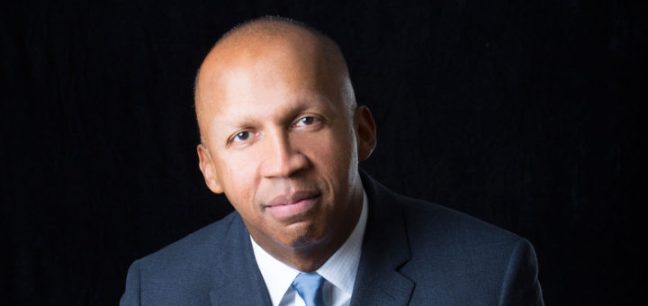
Bryan Stevenson, Executive Director of the Equal Justice Initiative
Who are the people who influenced the people who influenced you?
We might call them the GrandInfluencers. I like to think of this question and these people from time to time.
We are connected more broadly and expansively than we are always aware. Whether we know their names or not, there are people who have had a major impact upon the shape and direction our lives because they had a major role in shaping the people who most influenced and inspired us.
I found myself reflecting on this several years ago when I heard Bryan Stevenson speak in Ann Arbor. Bryan Stevenson was presented with the Wallenberg Medal at the University of Michigan for his vision and service, and afterward, he gave the Wallenberg Lecture.
Bryan Stevenson is the founder and Executive Director of the Equal Justice Initiative, an organization committed to ending mass incarceration in the United States, protecting human rights and dignity, and challenging racial and economic inequities. Within the large, crucial vision of this work, Stevenson has spent decades entering personal relationships with the people he represents in court. They have impacted his life, as he has impacted theirs.
His lecture was filled with stories of human connection as he challenged us to do justice in our neighborhoods, nation, and world and to change our narratives about race and poverty.
He opened the lecture first with a story about his Grandmother. He grew up calling her Mama. When Stevenson was a child, she would give him enormous hugs, and when she finished, she would ask, “Okay, can you still feel me hugging you?” If he said no, she would do it all over again. This became one of their playful rituals, and Stevenson came to know that he was loved and absolutely cherished.
As she was dying, her last words to him were, “Can you still feel me hugging you?”
Beautiful. It’s clear that he does.
She shaped so much of his vision and calling. She was the daughter of enslaved people, and she taught him about the terror and trauma of slavery. She also filled him with a sense of love and worth. Stevenson has been addressing slavery in its many forms throughout his life, protecting human lives, standing up to false narratives, and telling the truth — both about our national history and about human dignity.
In many ways, this started with his Grandmother. Unknown to many future clients, she impacted their lives — and in many cases, affected their freedom — through the formation of Bryan Stevenson.
And Stevenson told us stories about some of these clients. Unknown by name to us, they have impacted the formation of Bryan Stevenson as well, and their stories are now challenging the narratives and power structures of mass incarceration.
We are connected more broadly and expansively than we are always aware.
Who influenced the people who influenced you? Who are your GrandInfluencers?
We honor them with our lives by being ourselves. And though we cannot always predict the direction entirely, when we demonstrate love to others and are present in formational ways, we will embolden and empower people we will never meet.
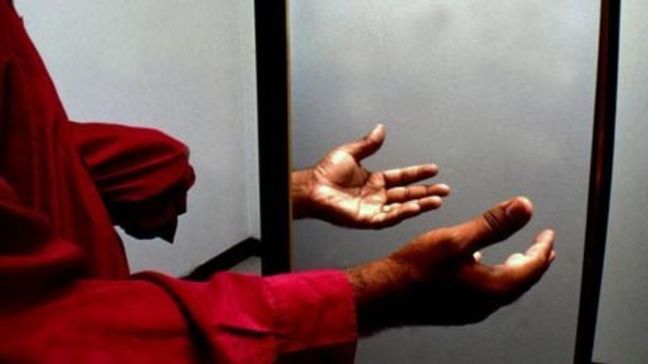
A person holds out one hand and sees it reflected as a second hand in the mirror box (read below for explanation)
V.S. Ramachandran designed an experiment that was utterly brilliant in its creativity and its simplicity. Most importantly, it worked. It was life changing.
Ramachandran is a neuroscientist who is famous for a variety of discoveries about the human brain. In particular, his work has helped reveal the incredible qualities of its plasticity and malleability. Decades ago, he designed an experiment to alleviate phantom limb pain by using two simple mirrors.
Phantom limb pain is a kind of curious thing in and of itself. Documented in medical literature for more than 500 years, many physicians had written about the challenging phenomenon some patients had after losing limbs. For years, even decades, these patients continued to feel a painful sensation in the limb that was missing. Some felt as though their lost arm or leg was held permanently in an awkward or painful position. They remarked that they wished to move it back into a more typical, comfortable position. Of course, that was impossible.
In a flash of curiosity, V.S. Ramachandran created a mirror box. He placed two mirrors together at a right angle and invited people to step inside the box. Suddenly, those who, say, lost their right arm, could see their left arm projected on the right side of their body. Inside the mirror box, it appeared that they had both arms. Then, they could “move” their missing limb into a better position by simply moving their remaining limb. And shockingly, this led to actual relief of the phantom pain! For many people, this was a permanent shift.
I love this experiment. I love that it worked. And if you’ll allow me, perhaps we can also enter this as a bit of a life analogy also:
There are times when we face one another too, and our human brains also have mirror neurons. When we see the emotions of the person standing in front of us, the neurons in our own brains begin to fire and sync with the other person. Isn’t that an incredible thing? (By the way, V.S. Ramachandran has done work on this too.)
At times, we recognize each other and smile, we demonstrate need to one another, we marvel in the presence of one another, and at times, we present pain: broken and insecure attachment, grief and longing, fear and anxiety.
In all of these, in ourselves and in others, we can choose the intention to see one another well. Certainly, with our vision, we can’t save anyone into wellness. But by choosing to mirror back what is true — love, belonging, acceptance, openness, our own humanity and vulnerability — we can create conditions that allow us to see each other and see ourselves with more clarity.
We can see each other with more truth, more safety, and more healing. And sometimes, we can reconnect or reconfigure our relationship with what we need or what we’ve lost. This too is brilliant in its creativity and in its simplicity.
Image Description: The word ‘language’ in a dictionary.
I don’t like when we compare racism to a pandemic, virus, or illness. I hear a lot of that these days.
— This can potentially deflect some of the responsibility for racism. We are building this. We are complicit in this. We do spread it in some ways, no doubt, but we do it quite actively (even if sometimes, subconsciously).
— But even more, when we make this comparison, we are co-opting the language of pandemic, virus, illness, and disability and using it as the symbol to name something as morally evil. In our language, we make associations between illness and moral failing all the time. This increases stigma.