Yesterday, a number of students sat around in a circle on couches and chairs in an area that looks a lot like a living room. Together, at Canterbury House, we had a Service of Evengsong.
At one point, we were speaking the words of a Psalm responsively verse by verse as it was printed in the bulletin. And when we spoke a particular phrase, I smiled.
“My lips will sing with joy when I play to you.”
I wondered, was that supposed to be ‘pray to you’?
If so, I loved that. Play can be prayer, for sure.
Later in the service, we did have a time of prayer together. We sat in silence and simply voiced the names of people and situations that we wanted to lift up. Then Matthew, Chaplain of Canterbury House, led us in the Lord’s Prayer. This was printed in the bulletin too, but with our eyes closed, we totally messed it up. You know exactly where —
And forgive us our SINSDEBTSTRESSPASSES, as we forgive OURDEBTORSTHOSEWHOSINTRESSPASSAGAINSTUS, we said.
And we started laughing!
I mean, this happens in churches sometimes, and I’m used to that. People grew up saying this in different ways. But this time seemed extra and delightfully mangled. I guffawed.
It’s okay to have needs. It’s okay to feel as though we’re in need. It’s okay to express our needs.
And we get to choose how we do it.
Jason Kander, candidate for Mayor in Kansas City, and the founder of the Let America Vote organization, announced yesterday that he is withdrawing from his campaign to address his Depression and PTSD and work on healing.
And he wrote a very beautiful statement about this decision.
I realize that a person in his position might not share so openly, fearing stigma and the pressures of patriarchy. He has been honest and created space for others to share their own needs, seek help, and connect with others in support.
I want to share his statement here today. You can find it most directly on his website. I’ll also paste it below:
“About four months ago, I contacted the VA to get help. It had been about 11 years since I left Afghanistan as an Army Intelligence Officer, and my tour over there still impacted me every day. So many men and women who served our country did so much more than me and were in so much more danger than I was on my four-month tour. I can’t have PTSD, I told myself, because I didn’t earn it.
“But, on some level, I knew something was deeply wrong, and that it hadn’t felt that way before my deployment. After 11 years of this, I finally took a step toward dealing with it, but I didn’t step far enough.
“I went online and filled out the VA forms, but I left boxes unchecked – too scared to acknowledge my true symptoms. I knew I needed help and yet I still stopped short. I was afraid of the stigma. I was thinking about what it could mean for my political future if someone found out.
“That was stupid, and things have gotten even worse since.
“By all objective measures, things have been going well for me the past few months. My first book became a New York Times Bestseller in August. Let America Vote has been incredibly effective, knocking on hundreds of thousands of doors and making hundreds of thousands of phone calls. I know that our work is making a big difference.
“And last Tuesday, I found out that we were going to raise more money than any Kansas City mayoral campaign ever has in a single quarter. But instead of celebrating that accomplishment, I found myself on the phone with the VA’s Veterans Crisis Line, tearfully conceding that, yes, I have had suicidal thoughts. And it wasn’t the first time.
“I’m done hiding this from myself and from the world. When I wrote in my book that I was lucky to not have PTSD, I was just trying to convince myself. And I wasn’t sharing the full picture. I still have nightmares. I am depressed.
“Instead of dealing with these issues, I’ve always tried to find a way around them. Most recently, I thought that if I could come home and work for the city I love so much as its mayor, I could finally solve my problems. I thought if I focused exclusively on service to my neighbors in my hometown, that I could fill the hole inside of me. But it’s just getting worse.
“So after 11 years of trying to outrun depression and PTSD symptoms, I have finally concluded that it’s faster than me. That I have to stop running, turn around, and confront it.
“I finally went to the VA in Kansas City yesterday and have started the process to get help there regularly. To allow me to concentrate on my mental health, I’ve decided that I will not be running for mayor of Kansas City. I truly appreciate all the support so many people in Kansas City and across the country have shown me since I started this campaign. But I can’t work on myself and run a campaign the way I want to at the same time, so I’m choosing to work on my depression.
“I’ll also be taking a step back from day-to-day operations at Let America Vote for the time being, but the organization will continue moving forward. We are doing vital work across the country to stop voter suppression and will keep doing so through November and beyond.
“Having made the decision not to run for mayor, my next question was whether I would be public about the reason why. I decided to be public for two reasons: First, I think being honest will help me through this. And second, I hope it helps veterans and everyone else across the country working through mental health issues realize that you don’t have to try to solve it on your own. Most people probably didn’t see me as someone that could be depressed and have had PTSD symptoms for over decade, but I am and I have. If you’re struggling with something similar, it’s OK. That doesn’t make you less of a person.
“I wish I would have sought help sooner, so if me going public with my struggle makes just one person seek assistance, doing this publicly is worth it to me. The VA Crisis Line is 1-800-273-8255, and non-veterans can use that number as well.
“I’ll close by saying this isn’t goodbye. Once I work through my mental health challenges, I fully intend to be working shoulder to shoulder with all of you again. But I’m passing my oar to you for a bit. I hope you’ll grab it and fight like hell to make this country the place we know it can be.
Jason”
It’s okay to need.
It’s okay to have needs. It’s okay to feel as though we’re in need. It’s okay to express our needs.
Do you remember the piece I wrote and the piece I shared somewhat recently about a movement and ordinance proposed to create a Police Oversight Commission in Ann Arbor?
A Task Force was appointed by the Ann Arbor City Council to consider a vision for a Police Oversight Commission — How would it work? Who would serve on it? What could it do, and how? That Task Force of people spent hundreds of hours discerning, deliberating, and at times, debating that vision. Then they drafted an ordinance.
In the end, the ordinance they proposed came into being because they listened to the community at large. At times, the community pushed them hard, speaking directly to trauma they and their family members have endured in connection to policing in Ann Arbor. These same leaders demanded substantive change.
The Task Force ordinance was representative of these community perspectives, along with a transformative vision. This ordinance proposed a Police Oversight Commission that is 1) entirely independent and 2) adequately funded, with 3) subpoena power and a 4) trauma-informed, confidential approach that works to protect residents who report policing complaints.
And… in response, the Mayor of Ann Arbor drafted an alternative proposal that undid all four of these. And… after appointing a Task Force to do this work, the City Council voted in the majority to replace the proposal with the alternative ordinance. The alternative ordinance is still being amended, but the ordinance of the Task Force is no longer on the table.
It appears that this vision for a Police Oversight Commission might provide oversight in name only. When they have so much to risk, will members of the Ann Arbor community, especially those most vulnerable and marginalized, come forward to voice complaints when their confidentiality is not going to be upheld?
Last week, as people in our nation watched the public hearings and testimony of Dr. Christine Blasey Ford and Judge Brett Kavanaugh, many considered the excruciating pain involved when someone is invited to speak and re-live trauma with the potential ramifications of it being for naught. Alongside Dr. Ford’s testimony, many people found themselves remembering and re-living their own traumas. What happens when people endure these kinds of processes, but with no effective change? And at their own risk, sometimes severely?
Many people advocating for the vision of the Task Force saw similar dynamics in Ann Arbor last night.
The City Council empowered the Task Force to do its work, and in response, numerous people, particularly Black and Brown residents, vulnerable immigrants, people who experience homelessness, people with mental illnesses, and people with low-incomes spoke to their trauma. But then… nothing substantive changed. And then, the Mayor said that members of the community and their advocates had acted like bullies throughout this process.
Last week, the Mayor wrote a Facebook post about believing survivors of sexual assault, yet the people who wrote the confidentiality processes of the Task Force ordinance are survivors of sexual assault and domestic violence, and he removed those processes in his alternative proposal.
Will we believe our neighbors when it comes to abuses endured by police officers and systems of policing?
When this happened last night, I kept thinking about statistics I read in a very prescient book. That book looks at changes in racial demographics and changes in religious affiliation in the United States and pairs them to study much of what is happening culturally in our collective life.
“While the legal terrain has certainly shifted since the 1960s, serious racial disparities remain in the criminal justice system. According to a New York Times investigation published in the wake of the Baltimore protests, both official and unofficial statistics show that African American civilians are far more likely to be killed by police than white people. In records where the race of the victim is identified, about three in ten victims are black — two and a half times their proportion of the population. . .
“. . . Widespread social media usage, too, has allowed protestors to amplify their concerns in ways that weren’t possible even five years ago. In the wake of the Baltimore protests, President Obama emphasized that these clashes were part of an alarming pattern: ‘This has been a slow-rolling crisis. This has been going on for a long time. This is not new, and we shouldn’t pretend it’s new.’
“But for many white Americans, the stories of unfair treatment of blacks by the police and court system did feel new. And the fury with which African American protestors took to the streets after each death also challenged the cherished assumption that the country had moved beyond its racially troubled past into a ‘post-racial’ era. African Americans have contended for decades — or even centuries — that the criminal justice system is stacked against them, but many white Americans continue to believe that police departments and courts can generally be trusted to administer justice. Where African Americans perceive familiar configurations of abuse, many white Americans see isolated incidents. . .
“. . . in 1992, the same year that riots exploded in Los Angeles following the beating of Rodney King, an unarmed black taxi driver, by a group of white police officers, fewer than one in ten (8 percent) black Americans reported that they believed blacks and other minorities were treated the same as whites in the criminal justice system, while 89 percent disagreed. White Americans, by contrast, were almost evenly divided over whether blacks and whites received equal treatment in criminal justice (46 percent agreed while 43 percent disagreed). More than two decades later, the racial perception gap stands at more than 30 percentage points: only 14 percent of black Americans, compared to 47 percent of white Americans, agree that the criminal justice system treats minorities the same as whites. . .
“. . . Shortly after the April 2015 protests and riots in Baltimore, a PRRI survey asked Americans whether they thought ‘the recent killings of African American men by police in ‘Ferguson, Missouri, New York City, and Baltimore,’ were “isolated incidents’ or ‘part of a broader pattern of how police treat African Americans.’ Nearly three quarters (74 percent) of black Americans said that these incidents were part of a broader pattern. Among white Americans, only 43 percent saw the men’s deaths as part of a larger pattern; roughly the same number (45 percent) saw these events as isolated incidents. . .
“Among mainline Protestants — a white subgroup that one would expect to be more aligned with black perspectives because their denominations have a long history of official support for civil rights — the perception gap is no different from whites overall.”
(Portions of pages 151-154)
Will we believe our neighbors? Will will believe survivors of police violence?
All people, and all systems need checks and balances. When we give an immense amount of power to a few individuals or a category of individuals in any system — the same is true in politics and in churches, by the way — human beings are capable of abusing power and will even likely to do so. Remember the Standford Prison Experiment?
Shouldn’t we then provide real and effective oversight to policing, especially when it has the potential capacity to use violent force, separate families, create psychological trauma, and initiate harmful economic outcomes for people?
Or even more, shouldn’t we then transform how this works all together?
In Ann Arbor, our city leaders did not believe our neighbors last night (so often, it is perceived that Ann Arbor is too progressive of a city for police abuses to happen here) or at the very least, they believed it was more important to uphold the current system of policing quite closely to how it is already functioning.
It seems to me that if we want to live wholeheartedly with compassion, care, and protection among our neighbors, we have to believe them. Then we have to transform these systems.
When the worship service began, I noticed how many children were present, especially for a small congregation.
The kids all sat together in the front pews, and when the first hymn started, a few adults helped them find what they were likely most excited about. They opened a chest in the front and handed out instruments — tambourines, rain sticks, and woodblocks.
Then, as all the adults began to sing a slower, opening hymn called “God Is Here,” the kids accompanied the music with their joyful-noisemaking. Musically, these sounds didn’t fit together, and that didn’t matter one bit. Situationally, it was just right. Children were included and leading, and this entry point into the service invited play to be an important part of the community across the age spectrum.
God is Here. I noticed that the kids were singing the hymn text too as they saw the words on the screen up front, a few of them very earnestly, even as they jiggled tambourines.
God is here! As we your people meet to offer praise and prayer, May we find in fuller measure what it is in Christ we share. . .
Here are symbols to remind us of our lifelong need of grace; Here are table, font, and pulpit (and tambourines!) Here the cross has central place. . .
Here our children find a welcome in the Shepherd’s flock and fold, Here, as wine and bread are taken, Christ sustains us as of old. . .
As this service started, these kids didn’t have any big inhibitions. They were also reverent from the perspective of being exactly themselves.
This week, I keep thinking about the word Wholehearted.
I wonder, what it would be like to live this day…
… without fears of what others might think,
reverent from the perspective of being exactly ourselves?
This sermon was preached at Garden City Presbyterian Church in Garden City, Michigan and was focused upon the story that is told in Mark 9:38-50. The sermon also references Isaiah 49:8-23. The audio recording is above and a written manuscript is below.
In order to enter the context of our Gospel story this morning, it’s important to understand what has taken place just before it. It’s important to set the scene.
Jesus and his disciples are in a house together in Capernaum. They had traveled there on foot, and just before today’s passage, they arrived at the house. Once they were settled inside, Jesus asked the disciples a challenging question: “What were you arguing about on the way?” And there was silence… because the disciples had been arguing along the road about who was the greatest.
On that road, they tried to assert dominance with one another, creating some kind of hierarchy about who was better or who was closer to Jesus. But no one spoke up to the tell the truth about what they had argued about on that road.
And that’s when Jesus did something very powerful. In that house, he found one of the children who was staying with them, and he held the child in his arms. Then he said, “Whoever wants to be first must be last of all and servant of all. Whoever welcomes one such child in my name welcomes me, and whoever welcomes me, welcomes not me but the one who sent me.”
This child was not a symbol of dominance. This child did not speak or lead in the community, and this child did not have possessions or power. These are typical markers of dominance. Above all, this child had vulnerability, and it seems that Jesus was conveying, “If you seek to follow me, you are called to relinquish the pathway of dominance and instead walk this pathway of vulnerability. God is found in close proximity to the vulnerable.” It was quite a paradigm shift. It was likely difficult for the disciples to take it all in.
So right after this moment, John says to Jesus, “Teacher, we saw someone casting out demons in your name, and we tried to stop him, because he was not following us.” It seems as though it was quite challenging for the disciples to understand what Jesus was saying — what he was demonstrating with the child in his arms. Maybe the same it is true for us.
In response to this beautiful invitation toward vulnerability, care, and relationship from Jesus, John immediately tries to decide who is on the inside and who is on the outside. He still doesn’t get it. He and the other disciples continue to compound markers of hierarchy and exclusion.
So Jesus breaks the paradigm open again. He says, “Don’t stop him, for no one who does a deed of power in my name will be able soon afterwards to speak evil of me. Whoever is not against us is for us.” But they didn’t understand. They could not comprehend what he was saying to them.
Maybe this is why Jesus then suddenly speaks so strongly. He still has that child in his arms. . . This vulnerable one is loved by God. This vulnerable one bears God’s image. This vulnerable one teaches us that God lives in proximity to those who are suffering, those who are disregarded and pushed out, those who live on the margins, and those who are harmed and abused.
The disciples haven’t understood this, at least not fully. So Jesus speaks strongly and quite suddenly.
With that child on his lap, Jesus says, “If any of you put a stumbling block before one of these little ones who believe in me, it would be better for you if a great millstone were hung around your neck and you were thrown into the sea.” That is strong language. “If your hand causes you to stumble, cut it off. . . if your foot causes you to stumble, cut it off. . . It’s better for you to enter life lame than to have two feet and to be thrown into hell.”
Strong language. The disciples haven’t understood. Jesus tries to wake them up. The disciples also have a calling to live in vulnerability and protect those on the margins.
What Jesus actually says here is, “It is better for you to enter life without these two feet than to be thrown into Gehenna.” Gehenna, that’s the word. Gehenna was not some sort of netherworld or hell in an afterlife. Gehenna was an actual place in this life — the name for a large, continually burning trash heap outside of Jerusalem. Jesus uses this word from time to time and names this particular place with an invitation: You can enter life or you can stay rooted in the context of Gehenna.
I think Jesus is placing this invitation before us also, speaking to our collective calling. He says, “For everyone will be salted with fire. Salt is good; but if salt has lost its saltiness, how can you season it? Have salt in yourselves, and be at peace with one another.”
This is what Jesus tells his disciples, those who seem not to understand. They return again and again toward the pathway of dominance, the pathway of hierarchy and power, and the pathway of determining who is in and who is out. That’s not our calling. But in deeply human ways, we return to this so often.
Jesus calls us back. And it’s to a child. It’s to all the ones who are vulnerable. It’s to the vulnerable places within ourselves, places that God seeks to heal. It’s toward the vulnerability of our own neighbors, guided by love and protection… It’s toward belonging, freedom, and release… away from a life of Gehenna and toward the God who enters proximity with us and chooses us. Yes, this is our calling.
Yesterday, I had some treasured friends over for brunch at our house, and some of them are just getting to know each other. At one point in our conversation, it came up that someone at the table currently belongs to an ECLA Church. That is, the Evangelical Lutheran Church in America. When he mentioned this, he immediately added, “Though Evangelical doesn’t mean what most people associate with it.”
Some of the people around the table did not grow up in a congregation, and others have left the churches they were raised in. He said, “Evangelical means ‘Good News.’”
But my friends around the table had heard that word primarily in connection to particular forms of politics, as well as the communities behind them. “I associate that word with seeking power,” one said. Among some of our neighbors, that is how this word is often received and processed.
But my friend said, “No, this is about ‘Good News.’” And I was really struck by the power in the simplicity of what he said next. “It’s not about working our way up to God through power or hierarchy. This is Good News, the total opposite — God has come to us.”
God lives in proximity toward us… God is present with us in our own vulnerability and in the wounds that we carry… God is present with us in the vulnerability and wounds carried by the whole world…
Aren’t we invited into this kind of Good News?
Jesus teaches us that God takes very seriously harm to the vulnerable.
And so, if you are feeling vulnerable… if you are recalling challenging memories this week… if you are struggling in a variety of ways that have stories and particular pains attached… God descends to you. And God not only descends — God uplifts. God seeks to empower us. God loves you through and through. This is the Good News.
Have we believed somewhere within ourselves that God has forgotten us — perhaps forgotten us in these pains?
If so, we return to our first text, these gorgeous words from Isaiah:
“But Zion said, ‘The Lord has forsaken me, my Lord has forgotten me.’”
In response, this is how God speaks to us. God says,
“Can a woman forget her nursing-child,
or show no compassion for the child of her womb?
Even theses may forget,
yet I will not forget you.
See, I have inscribed you on the palms of my hands;
your walls are continually before me.”
God chooses to be this near to us when we feel vulnerability and pain.
And the calling is before us.
That same text says,
“Your builders outdo your destroyers.”
I love that language.
“Your builders outdo your destroyers.”
Are we prepared to leave this place today, recognizing that God lives in proximity to the vulnerable? And that God is calling us to accompany the vulnerable?
When we have destroyed, we are called to say we’re sorry, confess, make amends, and turn around — forgiveness is there for us, and abundantly — and instead, we’re called to live as builders, ones who built one another up even as we ourselves are being built-up.
If we keep centering our neighbors — the neighbors that God loves, all our neighbors — then we will be called once again, and consistently, to leave this pathway of dominance, relinquish it, and come alive on this pathway of vulnerability and wholehearted living.
This is our calling as disciples. And thank goodness that we have each other, because we keep calling one another. And we keep proclaiming love toward one another — forgiveness, release, connection, belonging, and life.
May God bring us into this life once more, even today.
Amen.
I am grateful to the contributions of the Rev. Rolf Jacobson of the Sermon Brainwave — Working Preacher podcast, who spoke this week and last about “relinquishing dominance.” That influenced my sermon direction.
Life is short, though I keep this from my children.
Life is short, and I’ve shortened mine
in a thousand delicious, ill-advised ways,
a thousand deliciously ill-advised ways
I’ll keep from my children. The world is at least
fifty percent terrible, and that’s a conservative
estimate, though I keep this from my children.
For every bird there is a stone thrown at a bird,
For every loved child, a child broken, bagged,
sunk in a lake. Life is short and the world
is at least half terrible, and for every kind
stranger, there is one who would break you,
though I keep this from my children. I am trying
to sell them the world. Any decent realtor,
walking you through a real shithole, chirps on
about good bones: This place could be beautiful,
right? You could make this place beautiful.
It takes courage to see what is purposefully held out of view.
In addition to making targets out of particular human beings, abusive, unjust systems have ways of keeping that harm out of view. Very often, the broader community is kept from knowing that harm, either because it is held in secret, or because it is removed quite purposefully from the rhythms of their daily lives.
This week, I’m reading Just Mercy: A Story of Justiceand Redemption by Bryan Stevenson. It’s difficult, powerful, beautiful, and challenging at once. As I read this, I recognize how much I am not seeing. And I know I do not look often enough or advocate enough.
I would like to share some quotes from this book today. These are found on pages 15-16:
“When I first went to death row in December 1983, America was in the early stages of a radical transformation that would turn us into an unprecedentedly harsh and punitive nation and result in mass imprisonment that has no historical parallel. Today we have the highest rate of incarceration in the world. The prison population has increased from 300,000 people in the early 1970s to 2.3 million people today. There are nearly six million people on probation or on parole. One in every fifteen people born in the United States in 2001 is expected to go to jail or prison; one in every three black male babies born in this century is expected to be incarcerated.”
“Some states have no minimum age for prosecuting children as adults; we’ve sent a quarter million kids to adult jails and prisons to serve long prison terms, some under the age of twelve. For years, we’ve been the only country in the world that condemns children to life imprisonment without parole; nearly three thousand juveniles have been sentenced to die in prison.”
“We have declared a costly war on people with substance abuse problems. There are more than a half-million people in state or federal prisons for drug offenses today, up from just 41,000 in 1980.”
“Finally, we spend lots of money. Spending on jails and prisons by state and federal governments has risen from $6.9 billion in 1980 to nearly $80 billion today. Private prison builders and prison service companies have spent millions of dollars to persuade state and local governments to create new crimes, impose harsher sentences, and keep more people locked up so that they can earn more profits. Private profit has corrupted incentives to improve public safety, reduce the costs of mass incarceration, and most significantly, promote rehabilitation of the incarcerated. State governments have been forced to shift funds from public services, education, health, and welfare to pay for incarceration, and they now face unprecedented economic crises as a result. The privatization of prison health care, prison commerce, and a range of services has made mass incarceration a money-making windfall for a few and a costly nightmare for the rest of us.”
Of course, we can say that it takes courage to see what is purposefully held out of view, but the greatest courage is found among those who are directly impacted and those who are pushing for criminal justice reform and abolition.
What is being kept from view among us? Can we see it? Can we see the human beings impacted by it? Can we welcome this vulnerability? Can we make ourselves vulnerable to change?
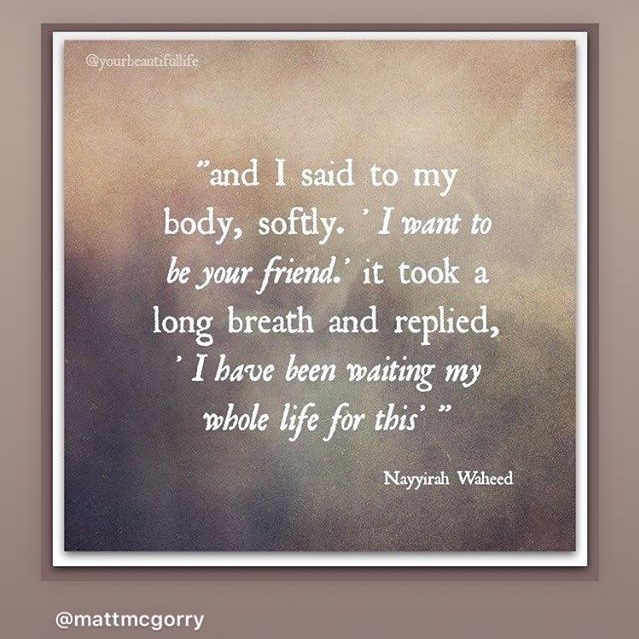
Over the weekend, a friend of mine shared this image from Matt McGorry’s Instagram. I screenshotted it and have since shared it in a few places as well. These words ring true as an experience, and perhaps also, they summon hope and an invitation to welcome.
An invitation to welcome your body… An invitation to love your body… An invitation to befriend your body…
“and I said to my body, softly. ‘I want to be your friend.’ It took a long breath and replied, ‘I have been waiting my whole life for this.‘” — Nayyrah Waheed
Yes!
Our bodies are gifts.
They allow us to do and experience so very much.
We experience the world through our bodies.
Our bodies are particular.
They are a part of our unique identity.
We are always embodied.
Our bodies are vulnerable.
They change, they grow, they struggle, they carry challenges.
They carry the stories of loving, of entering the beauty, complexity, and messiness of relationships.
Surely, the journey of befriending our bodies involves all of these — recognizing our body’s gifts, particularities, and vulnerabilities, and embracing them. This is an act of embracing ourselves.
Some of of us have been socialized away from this. Befriending our bodies is then a counter-cultural, radically loving act, for sure!
Befriending my body has been a large part of my life journey, and I’ve been on that pathway long enough to share that an embrace toward our bodies is an experience of wholeness.
That invitation is always there for us.
No one can befriend our bodies for us. We make that embrace. But I don’t think any one of us can do this alone. For instance… Think about all the people who mirrored our worth to us… Think about the people who invited us — yes, in vulnerability — to try something physical or emotional that we’ve never done before… Think about doctors, therapists, and coaches who have helped us gain knowledge about ourselves… Think about the ones we’ve loved most deeply, and how they have expanded our body’s capacity to love.. Think of… Think of.. Think of…
This act of befriending is ours, but there is always a community behind it. We’ve been loved as embodied people.
Psychologist Bruce Perry shares a particular adage in in some of his books which may seem a bit pithy, but there is a lot of wisdom and thought behind it too. He says,
So often,
“We prefer the certainty of misery to the misery of uncertainty.”
There are times when we assume that pain, chaos, or conflict are going to be constant. Maybe not in every situation, but at least, in particular ones.
There are times when harmful rhythms, patterns, and practices (our own or others) become normalized to us, even though they are causing great difficulty.
There are times when we come to expect very little with resignation or cynicism.
These cause misery, but we feel settled in their sense of certainty. Rather than risking uncertainty, we sometimes prefer what we have become accustomed to because goodness knows,
uncertainty is vulnerable.
Risking hope is vulnerable.
Saying, “No More,” is vulnerable.
Cultivating new possibilities is vulnerable.
It really is vulnerable.
And if you’re doing anything of these things, or if you want to do these things, give yourselves a lot of gentleness and grace. But also give yourself hope and trust. Uncertainty requires risk, but it is generally the pathway by which newness comes.
“Since we have received such a great peace, let us also share peace with one another. The peace of Jesus Christ be with you,” I say.
“And also with you,” they say back.
This is a ritual that I experience, and very often, initiate on Sunday mornings. I frequently travel to many different congregations to lead worship, and most of them include what is called The Passing of the Peace. After saying these words together, we then travel around the room to greet one another, saying, “Peace be with you,” and sometimes, “Good morning.”
Most of the time, we shake hands.
But yesterday, when I was at Kirk of Our Savior Presbyterian Church in Westland, Michigan, I had an experience that was especially lovely. It was just different enough that I will remember it for a long time. And in the midst of it, I felt genuinely and deeply welcomed.
It’s been a while since I’ve been present with this congregation, so I forgot that they do this a little bit differently. Rather than shake one hand, when people greet each other, they place both hands before each other — one person palms up, and the other, palms down. People clasp their hands before each other, look each other in the eye, and say those words.
“Peace be with you.”
And though this is different, it doesn’t feel forced. In this congregation, it feels so authentic. As a guest, not unknown but still relatively new, I felt so welcomed.
The feeling of welcome wasn’t ultimately in the method of greeting — the clasping hands in this way — but it was in the sincerity behind the words, as folks intended them specifically for the people in front of them. For somewhere between three and five minutes, I experienced this repeatedly, and it filled me.
Then when I walked back to the chancel, I heard, “Renee!” as an invitation to come over there for this greeting. It’s been a long while, maybe even a year, since I’ve been present in this congregation, but though a guest, I’m not a stranger either. The people in the choir greeted me too.
“We’re behind you today! Whether you know it or not!” someone said.
He wasn’t talking ultimately about location (nor was it a creepy, “We’re behiiiiiind you” — ha!) but instead, this was a play on words to say they’re cheering me on before the sermon. This too was so sincere and encouraging.
And then, without them knowing this is where I was going, my sermon was about welcome.