When I boarded a plane on Sunday night, I did what most people do. I configured all my stuff so I would have things to do on the flight… phone, headphones, reading material… check. I was all set. Then I chuckled to myself.
“Gracious, this is stigma city,” I thought.
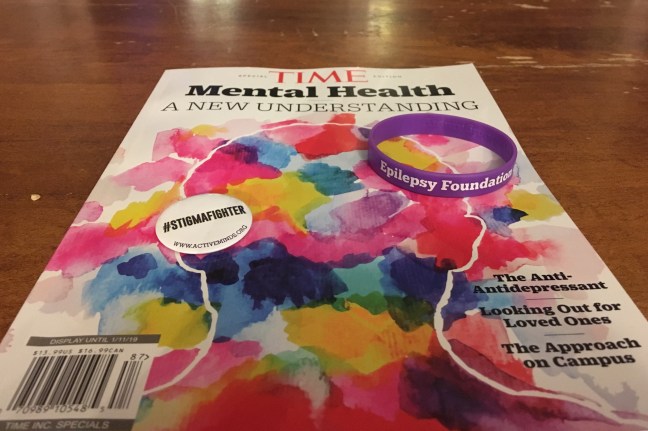
Of course, I didn’t really mean that, nor did I shirk away or hide anything I had assembled. Instead, I smiled, perhaps enjoying an opportunity to buck that stigma tide. I sat there with a whole magazine on mental health on my tray, assembling all the things while wearing a purple bracelet that reads “Epilepsy Foundation of Michigan.” That bracelet also has the phone number of that organization.
I smiled, bucking the tide, but some questions popped into my mind also. When strangers see this bracelet, particularly on a plane, do they assume I have active epilepsy? I no longer do. I’m a remissioner and have been for many years. But does this make people nervous? And since this has a phone number on it, might people assume this is a medic bracelet, like an “In case of emergency, call this number” kind of thing?
A neurologist gave me this bracelet last month, and I occasionally wear it around, normalizing a super common condition that people rarely talk about. That lack of talking makes life much more difficult with people who have epilepsy. I know this personally.
All of this made me ask on that plane, what if there was no stigma?
Goodness knows, particularly when it comes to mental health, stigma creates circumstances where people delay and avoid seeking help. But these needs are so common. When people do seek that help, they sometimes feel shame and assume they cannot talk openly about it. This also makes healing more difficult.
I’m convinced that community is a crucial element of healing for chronic conditions or even stigmatized, temporary needs. When people feel that needs-particular-to-oneself must be hidden from wider community, care is reduced, but even more, a sense of unnecessary isolation sets in. This is wounding in itself.
I know we can’t suddenly snap our fingers and rid ourselves of many various forms of health stigma, but what would we have to do to reduce it?
First, we would have to think a lot about our language. How often do we use words negatively with disabilities, conditions, or identities embedded? We say things like, “That’s so tone-deaf,” or “He was blind to the ramification of his actions,” or “I’m really OCD about that,” (when we really just mean particular) or, “That’s crazy!” or “She’s spazzing out,” or “I’m having a flashback” (to some odd, annoying life detail).
Second — and this is the longer, harder work — we would have to build a real sense of neighborliness where we practice particularity-of-care, where we lovingly know one another at greater depth with awareness that it is really not at all odd that each one of us has needs particular-to-us (healthwise, or fearwise, or personality-wise, or life-circumstance-wise). And with respect and agency of one another, we would participate in caring for those particular-to-each-other needs. This would require that we build an externalized and internalized sense of our neighbors’ dignity. This would require that we raise children to normalize that it’s completely okay for neighbors to be different because… well… we’re all different. We really all have particular-to-us needs. Some are more visible than others, and the visible ones require even greater dignity and respect. With respect, agency, and consent, we can all care for everyone’s needs.
It’s that simple, but it’s really hard work. And it really does require bucking a tide.
Over the weekend, J.J. STARK BLIMP JR. held a wedding in the little town of Albert, Texas. (J.J. STARK BLIMP JR. is the very silly and wonderful acronym created from the first names of our incredible group of friends). K of that acronym got married, and it was absolutely lovely. We all had a really good time at a Texas dance hall, and dance, we did.
During the ceremony itself, the officiant called me forward to give a prayer and blessing. But… I hadn’t received notice that I had a part in the wedding. So I had to wing it. This was no one’s fault; K had sent out information about this, but unbeknownst to us, that info kept going to the wrong email address. Fortunately, the moment of winging it worked.
When in doubt, call attention to the moment, I thought.
I invited us to give thanks for every moment large and small that had led to the one we were now experiencing together — moments of time, memories, and community. I invited us to give thanks for the love between the couple and the love among the community gathered. Suddenly, one moment felt abundant with other moments and many loving connections present in the room.
And I share this today as a reminder, both to myself and anyone reading, that every single moment (not just a super significant one like a wedding) is a culmination of other moments. There is something quite beautiful about this.
Because goodness knows, it is easy to project a sense of anxiety onto the future, wondering if less is possible than we might desire. But when we shift our attention backwards, thinking about everything that has led to any given moment we experience, we soon discover that our moments are connected to a myriad of other moments, and they are abundantly peopled.
This means that we have resources wherever we are. This means that even during trying or painful times, we are accompanied.
Different fridge, but if you come to my house, you can see ours.
I’ve been noticing that a kind word seems to go a long way these days. Maybe more than usual. When I give people affirmations, or when I see a person do a kind act for someone else, there seems to be a bigger reaction as if people are genuinely surprised. I wonder if a backdrop of harsh news and disconnection is impacting our expectations. I’m not sure, but a kind word or loving action is unquestionably a breath of fresh air. May we hold onto such moments.
My favorite blogger, David Smith, has written an essay every single Monday morning since 1999. His very aptly titled blog is Monday Moanin‘. This week, Monday Moanin’ subscribers woke up to a deeply touching post in which David lovingly described his son-in-law — a term, by the way, he says he resents a little, “as if that defined it, or as if a law could ever prevent him from being my son.”
In one sense, the piece is a tribute, but it is built upon a description. It is a compilation of attributes, simply but meaningfully experienced and noticed in every day life, and it becomes a tribute, not on the occasion of having accomplished some great feat (though he has them — I mean, ultramarathons!) but on the occasion of just being himself. How wonderful. It’s genuinely so refreshing.
David Smith ends his piece by saying, “You might have read all the way to this point wondering why I am telling you all this, and it’s simple. Because today people are going to send you pictures of what they ate, or memes of dogs, or political positions, and an array of stuff that will make you cringe. To balance that I wanted you to have an example of what I care most about, a person who makes my life richer. And maybe remind you about what you care most about.”
Lovely.
Last week, our friend Tim Lum (different Tim than son-in-law Tim) stayed with us for a few days. Tim and my husband were best friends during college, and he was the best man in our wedding. Tim lives just outside of London, so we only get to see him in person once every couple of years. We love him deeply. It was also refreshing to have him stay in our house for the first time.
Like everyone who stays in our house, Tim encountered our refrigerator. It’s just plastered with faces of people. There are photos of 27 very beloved people. (I just went and counted). A little more than a year ago, a made a photo album on my phone with these very pictures, so I could scroll through and pray regularly for these folks. Then, when Canterbury House had a special All Saints service inviting us to bring photos of loved ones, I made prints of that album and brought my people along. Afterward, I asked myself, “So what should I do with these prints now?” That’s when I decided to assemble them all on the fridge. After all, I consider every single one of these people to be a part of our family, and I hope that this house, and certainly these relationships, provide a sense of home.
Upon encountering all of these photos, Tim said something wonderful to me: “Tell me about every single person on this fridge.” What a lovely request.
So I did.
I told him all of the obvious things — names, where people live, what they’re interested in, and what they’re doing now. But then, I noticed I naturally gravitated to telling stories too, often naming what these people have given me and what they’ve taught me.
And I just delighted in it all. And Tim clearly delighted in seeing me delight in it all. “I love feeling connected to people you love,” he said. I love that too.
How wonderful it is to rehearse our loves, naming the big themes and stories, of course, but also the small noticings — the daily gifts, attributes, quirks, and very particular connections that make life richer.
I just returned home after a 7+ hour City Council meeting! (They were still going with minor details after I left). I’ve shared a bit of this process in other posts, but the community has been engaging the Mayor and City Council of Ann Arbor as they deliberate toward a Police Oversight Commission. At times, this has involved great conflict.
Tonight, the City Council passed their ordinance. It was a significant departure from the Task Force’s ordinance, but several amendments were added tonight. That brought them closer together in some places, but in other places, key amendments failed.
There was a time of public comment. Alongside others, I spoke in advocacy of an amendment to add a youth member to the Police Oversight Commission. I’m grateful to say that at the very least, this one passed.
Address to City Council
My name is Renee Roederer. I am a resident of Ann Arbor and a Chaplain at the University of Michigan. Today, as you deliberate toward an ordinance for this Police Oversight Commission, I would like to advocate for an amendment to include a youth member on that Commission with full participation and full vote.
For the last eleven years, I have worked closely alongside students and young adults. Many people in our city, including some present today, have worked closely with teenagers in Ann Arbor and Washtenaw County. We know that youth are intimately and acutely aware of the problems their generation faces, some inherited locally, some inherited and endured through centuries of systematic oppression.
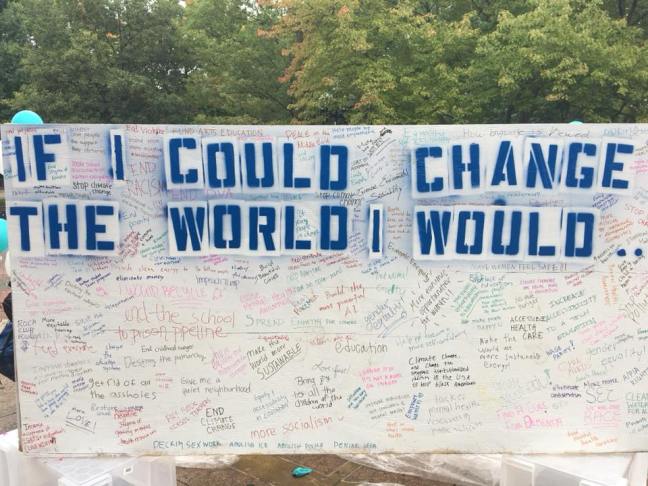
Last week, I walked through the Diag at the University and saw a large sign where students were invited to write answers to this prompt: “If I Could Change the World, I Would…” There, I saw hopes, aspirations, and heartache alike. Young people long to have substantive opportunities to impact their future for their own generation and for people of all ages. But it is so rare for us, their elders, to hand over power, leadership, and decision-making ability. And that seems to be magnified when young people come from marginalized identities and experiences of disenfranchisement.
In the midst of this, I hope we will think about what is possible: What is possible when we invite young people to lead, not only alongside us, but to actually lead the way? To actually lead us? I have built community with hundreds of students over the years and mentored a large number of people for more than a decade. And I wholeheartedly believe in reverse mentoring. I know how much I have learned, how much I have been formed and transformed through these relationships. Our city and our nation need to learn from our youth, and ultimately, be formed and transformed by their leadership.
Marginalized youth in our city know that they and their peers have experienced hardships in connection to policing — at the Blake Transit Center, in traffic stops, in having to look over their own shoulders in the most routine of situations as people unjustly view them with suspicion.
What is possible? I have spoken with Dwight Wilson from the Human Rights Commission and other members of the community who are interested in seeing the creation of a new youth council in Ann Arbor with a youth member serving on the Police Oversight Commission as a liaison to and from that council. We can trust our youth to participate and lead in this process, and we should because they are capable, they are directly-impacted, and they deserve the opportunity to shape and transform what is impacting their lives.
This sermon was preached at First Presbyterian Church in Howell, Michigan and was focused upon the story that is told in Mark 10:17-31. The sermon also references Isaiah 49:8-23. The audio recording is above and a written manuscript is below.
Once, while Jesus was teaching the people, a lawyer asked him a question: “Teacher, which commandment of the law is the greatest?” And Jesus said to him, “You shall love the Lord your God with all your heart, and with all your soul, and with all your mind. This is the greatest and first commandment. And a second is like it: You shall love your neighbor as yourself. On these two commandments hang all the law and the prophets.”
Love of God,
Love of neighbor — loving our neighbors as ourselves —
These two always go together.
We see this in the Gospel of Mark.
In fact, we see this quite a bit in the last two chapters of the Gospel of Mark — chapters 9 and 10.
Again and again, Jesus calls our attention to neighbors. Jesus calls our attention to the vulnerability of neighbors — inviting our own vulnerability. There, we find God in our midst; there, we find kinship in the midst of relationship with one another.
Perhaps you remember some of these stories from the last two chapters:
Jesus brings Peter, James, and John to a mountain by themselves, and while they’re there, something incredible happens. Jesus is transfigured before them, and they see Elijah and Moses speaking with him. Then they hear the voice of God, proclaiming that Jesus is the Beloved One to whom they should listen. They are amazed and afraid by this. It was a very sacred moment.
But then, coming down that mountain, they are immediately brought into a situation of great vulnerability. They meet the other disciples, and there is a crowd around them with some controversy. The scribes are arguing with the disciples, and when Jesus inquires about this, he learns that a father has come and presented his son, a boy who is struggling frequently with violent, convulsive seizures. Try as they might, the disciples cannot seem to heal the situation, and this is where they keep placing their focus — How do we heal this kind of situation? How do we cast it out? Jesus, puts his focus on the child himself, and in entering that vulnerability, and he brings healing.
But the disciples don’t understand.
As soon as they leave that place, they begin arguing with one another along the road about who is the greatest. When they arrive at a house in Capernaum, Jesus asks them, “What were you arguing about on the way?” and they are silent in response, knowing that they had turned their inquiry into a power play among themselves. That’s when Jesus calls their attention once more to vulnerability and love of their their most vulnerable neighbors. He places another child before them — again, a child — and he says, “Whoever welcomes one such child in my name, welcomes me, and whoever welcomes me welcomes not me but the one who sent me.”
But the disciples still don’t understand.
In response to this, John immediately says, “Teacher, we saw someone casting out demons in your name, and we tried to stop him because he was not following us.” Jesus has invited them to relinquish dominance and hierarchy — who is the greatest? —toward vulnerability and love of neighbors. But again, John is interested in the hierarchy and a clear delineation of who is in the community and who is out.
Jesus says, “Do not stop him. . . whoever is not against us is for us.” Then Jesus draws their attention once more to the child before them, telling them not to put a stumbling-block “before these little ones who believe in me.”
But the disciples still don’t understand.
They leave that place and Jesus engages the crowds in some challenging teachings. Then people begin to bring children to Jesus so that he might bless them. But the disciples speak sternly, refusing their request. Yet once more, Jesus opens himself up to the vulnerability and worth of children, some of our most vulnerable neighbors. He says, “Let the children come to me; do not stop them, for it is to such as these that the Kingdom of God belongs. Truly I tell you, whoever does not receive the Kingdom of God as a little child will never enter it.” Jesus took these children up in his arms, laid his hands on them, and blessed them.
Then we come to our passage today. This is the very next moment that follows. Will we, also disciples, get it? Or do we still not understand? Do we need Jesus to call our attention to vulnerability and our neighbors once more?
While Jesus and the disciples set out on a journey, a man ran up and knelt before him. And he asked, “Good Teacher, what must I do to inherit eternal life?” That’s a good question. Jesus places the commandments before this man. Perhaps he expected that, because he said, ‘Teacher, I have kept all these since my youth.” But then Jesus says the thing he might not have expected. The story says that Jesus loved him. Jesus loved him with these words: “You lack one thing. Go sell what you own, and give the money to the poor” — your neighbors — “and you will have treasure in heaven; then come, follow me.” When he heard this, he was shocked and went away grieving, for he had many possessions.
Jesus must have known that these possessions were a stumbling block before him and his neighbors. Maybe they kept them walled off and separated from his neighbors. Maybe they kept him in a place of believing he had more worth and value than his neighbors, or more of a right to power than his neighbors.
I wonder if Jesus was grieved by this too. He said to the disciples, “How hard it will be for those who have wealth to enter the Kingdom of God!” This can indeed be a stumbling block… love of wealth standing between us and a fuller love of God… love of wealth standing between us and a fuller love of neighbors, with neighbors, among neighbors, for neighbors. And now, Jesus calls his disciples ‘children.’ “Children, how hard it is to enter the Kingdom of God! It is easier for a camel to go through the eye of a needle than for someone who is rich to enter the Kingdom of God.”
The disciples are astounded by what Jesus says. Who knows? Maybe they are still thinking about the pathway of power and dominance. If a rich person who has kept the commandments struggles to enter the Kingdom of God, who can?
“Who then can be saved?” they asked Jesus, likely out of concern.
“For mortals it is impossible,” Jesus says, “but not for God; for God all things are possible.”
Thank goodness. Thank God.
It’s interesting that Jesus says it will be hard to enter the Kingdom of God. He doesn’t say, it will be hard for people to attain the Kingdom of God, or earn the Kingdom of God, or possess the Kingdom of God.
It will be hard to enter the Kingdom of God. That involves movement on our part from one way of being to another — to enter this realm of God, this way of God, this community of God. We are challenged to enter a reality where the vulnerable are lifted up… to the point that we are called relinquish the pathway of power and dominance… to the point that we are called to welcome the vulnerable too — our vulnerable neighbors and the vulnerable parts of ourselves.
But thank goodness. Thank God. God often brings the Kingdom to us and us to the Kingdom.
After hearing all of this, the disciples realized that they had left everything. In fact, Peter says this. “Look, we have left everything and followed you.”
And here’s where Jesus says something powerful for them, and I hope it is powerful for us. I hope it is an invitation for us.
Jesus says, “Truly I tell you, there is no one who has left house or brothers or sisters or mother or father or children or fields, for my sake and for the sake of the good news, who will not receive a hundredfold now in this age—houses, brothers and sisters, mothers and children, and fields, with persecutions—” (those sometimes, come as well)
Jesus is not talking about possessions. He is talking about entering this Kingdom — that we are invited to give up particular ways of viewing our lives and viewing our relationships. Thank goodness, thank God, we are able to enter the Kingdom of God which is always also a Kin-dom of God, a way of living and a way of relating in which our neighbors are not possessions, and our possessions are not separating us from the needs of our neighbors.
But instead, in this Kin-dom, the most vulnerable among us become our fathers and mothers and sisters and brothers. Instead, in this Kin-dom, all vulnerable children — not just our own — become children of our concern. They become our very kin — those to whom we are related and no longer separated. They are indeed are never separated from us or what we have because everything belongs to God. Therefore, all things are for the building up of God’s people, our neighbors.
We talk a great deal of stewardship in church, and when we do, we talk about how we use our wealth. How are we good stewards of this? At those times, we say that none of this belongs to us. It all belongs to God.
Do we believe that? That’s challenging. I’m challenged by it.
But when we think about stewardship, how often do we think about stewardship of our relationships, or stewardship of being neighbors with one another — not only with those who are in this sanctuary but also those beyond the sanctuary?
Do we believe that we are in kinship with those who are vulnerable? Those who experience poverty and homelessness? Those whose families are torn apart? Those who are incarcerated? Those experience violence, including violence in their homes, violence in their neighborhoods, and violence by the state? Those who are abused? Those who have disabilities? Those who have challenging diagnoses? Those who are stigmatized? Those who are kept out of view, yet human among us?
Do we believe that we are called into kinship with these vulnerable neighbors, or perhaps those vulnerable parts of ourselves that are hard to name? Can we allow people to be in kinship with those parts of ourselves?
I wonder what would happen if stewardship were about building down the church — not destroying the church, but building it down — away from power, dominance, and hierarchy toward kinship in vulnerability.
I wonder what would happen if stewardship were about building the church outward — expanding what our faith community looks like, not only about a building and membership, but a larger since of kinship and family with neighbors beyond this place.
What would that look like?
I remember this: Nothing is impossible with God. And perhaps it is God calling us into this way of life — love of God, love of neighbor — calling us, thank goodness, thank God, to enter this Kingdom, which is always a Kin-dom.
I want to take a moment to thank you personally for following my writing on Smuggling Grace. Each week, I enjoy connecting with you here. I greatly appreciate the ways you add yourselves and initiate conversations within these pieces. Thank you so much.
Twice per year, I offer an invitation for people to give a gift to support this work. Donations large and small allow me to keep writing free of charge, and that support also contributes toward the larger vision of what I am doing in Southeast Michigan as well.
If these pieces have been meaningful to you, and you are able to give, would you like to contribute? No gift is too small, and every bit is appreciated!
Quite frequently, the news feels daunting. Very often, we’re concerned that national discourse and policy are harming our loved ones and our neighbors. At times, we are frustrated personally with our friends and family members, and we’re already anticipating what the holidays might feel like this year.
All of this is true.
And without negating any of it, I find myself reflecting on a hopeful thought that was expressed last night in community.
The Michigan Nones and Dones community held an event last night called “Support in Times of Collective Stress.” We opened space for people to name stressors in their personal lives and in our larger, collective experience. We asked ourselves, which convictions, spiritual practices, and wisdom keep us grounded and centered internally? And we considered the ways that connection and community-belonging can ease our stress and move us toward collective change.
At one point, I recalled something I had read years ago, and I shared it with the group, thinking that it might illuminate the ways that stress and health can both move through relationships. Nicholas Christakis and James Fowler are social scientists who wrote a book called, Connected: The Surprising Power of Social Networks and How they Shape Our LivesIn the book, Christakis and Fowler conduct intriguing scientific research on social networks to discover how they connect us and affect us. And through a number of studies, they concluded,
On average, each person on the planet consistently affects 8,000 people every day.
Christakis and Fowler have discovered that on average, each person knows twenty people well enough to invite them to a dinner party. If those friends then know twenty people to the same degree, and then those friends know twenty people to the same degree, we are talking about 20 x 20 x 20 = 8,000 people.
We are relationally connected and deeply embedded in these relationships. Their research revealed that we affect and are affected by our friends’ friends’ friends in social and emotional contagions. Even if we don’t directly know these people three degrees away, we are consistently impacting each other every single day of our lives. That’s astonishing.
Christakis and Fowler discuss the ways that our actions, thoughts, and emotions impact others. When we feel joy, calm, stress, or anxiety, we often pass our emotions to one another in contagion. Sometimes, this happens as quickly and simply as seeing someone’s facial expression. The mirror neurons in our brains fire to make a similar facial expression, and then we feel a similar emotion too. This can happen with fear. It can also happen with a smile. These are truly contagious.
So if each of us has the ability to impact a social network as large as 8,000 people pretty unconsciously, what is possible if we consider this consciously? And what is then possible then when whole communities are acting? And beyond mere feelings (though they are important) how can can we positively affect our social network with acts of compassion, advocacy, and solidarity? What is possible when we choose wellness? What is possible when these connections move toward collective change?
After talking more about stress, personal practices, stories, and convictions, we circled back to this thought at the end. Gathered around a table as five people, we realized,
“This conversation impacts 40,000 people.”
We are facing large, looming challenges, and some people are more directly-impacted by those challenges than others. This is true and worthy of our grief and anger.
And at the same time, I hold out hope that collective change is possible. It’s always possible, and it happens through relationships.
CW: Family Systems Theory, Abuse, Trauma, National Discourse
One of the most harmful things we ever do in our collective life is designate victims as perpetrators and their abusers as the victims. It’s a terribly savvy move, and it happens in a variety of contexts, always serving to protect those who are in power.
This happens in homes and extended families when those who are abused are told they caused it (“you made me do it”). Then when they speak up or remove themselves, they are told they are harming the family. For telling the truth and disrupting the family system as it was previously functioning, the abused are then collectively treated as though they are the actual perpetrators. This is a double wound, as the same individuals carry the trauma of their abuse and the collective stigma and shaming of a family that removes support from them, instead giving it primarily to the one(s) who actually caused abuse.
This happens in schools and workplaces when people speak to the truth of bullying or serve as whistleblowers. Even at a young age, children know that they take a risk in naming bullies, as this can magnify the scope of bullying. A bullying individual can then become a bullying group exacting revenge on the “narc” who is now viewed as the perpetrator. Whistleblowers, meanwhile, name wrongdoing for a larger cause often at their own risk. In response, once the collective organization is disrupted by the truth of what has been named, they lash out at the whistleblower for the disruption itself rather holding the wrongdoers accountable or doing the hard work of changing their collective culture. Those who are harmed are viewed as the perpetrators, and power remains among those causing the harm.
This happens in religious communities when power is used abusively in the imbalance of hierarchy, then theology and historical practice are used to bolster that hierarchy as a good norm — often creating conditions where those toward the top of that hierarchy are placed above accountability altogether. Theology is also used to pressure victims never to speak up, emphasizing that victims must forgive (framing forgiveness as a simple dismissal of concern) rather than emphasizing the need for confession and accountability. At times, when victims of abuse tell the truth, the collective religious community seeks to guard itself from disruption, and once more, victims are treated with suspicion as though they are perpetrators while those who engage in harm are protected.
This is also happening culturally in our national life. Last week, Trevor Noah spoke about a pattern he sees in our politics in which false victimhood is weaponized. He spoke of the ways he sees this actively in the leadership of Donald Trump. The same pattern could be expanded toward others and this collective moment. I would like to share that video today.
It can be daunting to recognize this pattern. But when we allow ourselves to see it, we can shift and disrupt that pattern toward truth and support for those who most need it, while working toward restitution and reconciliation whenever it is possible.
We also know that in times of conflict, there is not always a clear-cut delineation of those harmed and those doing harm. But that is all the more reason that we must take harm seriously, especially abuse. Sometimes, harm comes in multiple directions, and we need to see it clearly, rather than automatically lashing out at those who are already most vulnerable. We are often complicit in bolstering the harm around us or in remaining silent. But we don’t have to be.
Family Systems Theory teaches us that individuals cannot really be understood in isolation, but rather, through the lens of relationships. We are all parts of emotional, social units, and we impact them and are being impacted by them in dynamic ways. Family Systems Theory, introduced by Murray Bowen and popularized by others, takes a look at how groups function — families, workplaces, schools, religious communities — and considers how self-differentiated people can impact the overall health of a system.
For instance, what happens when a person expresses a conviction? What happens when a person or small group of people say, “No more,” to harmful behaviors? What happens when someone tells the truth, perhaps uncovering what has been hidden? What happens when someone practices stronger, more healthy boundaries? What happens when certain people defy expectations and add health to a system, simply by choosing emotional health for themselves?
I think of an analogy that my friend Karen Wright shared with me many years ago:
It’s as if a small group of people are sitting together in a tiny fishing boat, and then someone suddenly shifts their position. That destabilizes the equilibrium. Now the people in the boat have a choice: They can pull that person back or down (and goodness knows, families, workplaces, schools, and religious communities do just that at times) or… they can shift their weight and change their positions.
One of the best things we can do for the emotional health of a community is to choose emotional health for ourselves — again, not in isolation but in relationship to the whole. Sometimes, that has a vital way of impacting the whole.
It can involve risks. Sometimes the community responds by pulling you down or by scapegoating. But this can also create new possibilities.
We can choose health. We can tell the truth. We can set boundaries. We can stop tolerating harmful behaviors. We can choose vitality.
Age is a lovely gift, as is the opportunity to connect across generations. I had that experience more than once yesterday, and I found myself grateful.
In the afternoon, I met with a trusted elder who is double my age.
I value him so much — his stories, his perspectives, and how he has lived over time. He’s a Patriarch in every sense of the word, and people use that word in connection to him, within his immediate and extended family and within an ever-expanding, assembled family of former students who number in the hundreds.
“I was wondering… would you give me –atriarch lessons?” I asked him playfully but sincerely, hoping to swap out the P for an M. In response, he laughed playfully but sincerely, and with delight.
Then, upon leaving this wonderful time together, I immediately went to campus and met with a new student who is half my age.
This time was likewise so meaningful. It was sweet to connect about the newness of campus life, give some of my insights about Ann Arbor and the University, and remember what it was like to make the transition from high school to college — a period I remember well, yet one that feels so long ago.
It was so long ago. Half my life ago.
Ian said recently, “When you started in campus ministry, we were 10% older than the students. Now we’re 100% older.” That’s true this year. It feels rich and wonderful.
And all of this leads me to say once again (truly, I think of this often) that the mid-30s feel like magic.
There is something about this time and the ability to flow between generations, receiving and giving in all directions. It’s lovely. It’s remarkably formative and generative.
As one who was born on the second day of the year, my calendar year and age-year always exist together in parallel ways. Now that we’re making the turn toward the final portion of 2018, I recognize that in three months, I’ll also move from the mid-thirties to the late thirties. When I do, nothing will shift suddenly except a number. But goodness, I think I will always treasure these years; I have never loved an age more than this.
Here’s to what’s next and all the connections that will follow.