“But why doesn’t God have arms? I just… I wish God had arms.”
That’s what I lamented as we drove through the Texas Hill Country. The scenery was lush with long, green grasses, wildflowers, a creek, and pastures with longhorn steers. But I wasn’t noticing any of that beauty.
At age 26, I sat in the back of a Volvo and felt devastated about David’s cancer. Like a slow moving storm, I was experiencing the kind of lament that hovered over anger and despair in the five stages of grief, not moving much lately, just churning and pouring it all down.
It was all anticipatory grief. David was still with us and was his typical self too — funny, endearingly irreverent, curious, committed; still voraciously reading, still reassuring and loving of me. He was, in fact, concerned lately about how much pain I was feeling in all of this. The anticipatory grief of this particular, impending loss was enormous on its own, but along with it, this seemed to pull up previous losses I had not fully grappled with before. The cumulative grief demanded to be felt.
So feeling invited to do so, I sat in the back of Ben’s Volvo and lamented. I wanted to be comforted in all of this, and God was supposed to be this cosmic force of ultimate love in the world, right? But… was God just… a neglectful parent? Another example of this gnawing absence I was feeling? I mean, what good is a God that has no arms?
Maybe in some ways, that was a silly detail to fixate upon, but fixate I did. Yet in its own way, it was an apt fixation. When grieving like that, who doesn’t want to be held? Not metaphorically — which was my point — but actually held?
The Volvo arrived at Mo Ranch, a Presbyterian Camp and Conference Center in Hunt, Texas. We were there for College Connection, a week long event that in involved play, worship, shared meals, and reflection among college students. I was there to be a volunteer leader, assisting in worship and facilitating a small group.
Though I had not met him before, the keynoter for the week was a very beloved speaker in Presbyterian circles, well known for his work in youth ministry as a pastor and now, as a seminary professor. I heard him speak throughout the week and experienced him to be engaging, deep, funny, joyful, and inviting.
For most of the conference, I put on a face in public and pushed through my own leadership commitments. But privately, I felt miserable. Why doesn’t God have arms?
I just kept lamenting that, which was of course, a symbol for everything I was feeling. Then before the last worship service, I let myself voice that aloud once more.
The keynoter had become a friend during the week, and before that last service, we sat outside the hall, waiting for it to be unlocked so we could set up the space. With time then to spare, he asked me how the week had been for me. So I told him the truth. I talked about David, how much he meant to me, and what a gift he was in my life. I talked about cancer and the devastation of impending loss. I voiced the whirlwind of my feelings, and then, I eventually said it again:
“But why doesn’t God have arms? I just… I wish God had arms.”
The keynoter heard me meaningfully. And somehow, that conversation allowed me to enter that worship space with more vulnerability. This was a healing and wholeness service after all, and I let my public, putting-on-of-a-face fade.
I had a small role in that service. We had a time of anointing one another, placing a bit of oil on the foreheads of those who requested it with prayer. I participated in that. But when I was finished, I walked to the back of the hall and just sat in a chair totally dejected.
My eyes were closed with tears falling down my cheeks, so I didn’t really see this coming. But when he was finished with his part, seeing my sadness, the keynoter came to the back with me. I didn’t see him walk there. I only… felt his arms.
He absolutely bear hugged me. And I just melted into him.
I let the sadness be there, really and truly. But then I smiled. I already knew what he was doing before he said anything aloud.
But soon after he started to embrace me, he voiced it it. With great presence, he said,
I like it. I’m intrigued by it. I’m curious how this opens different possibilities for conversation and connection.
Last week, over coffee, a young adult and I had a conversation about what it’s like to be a college student during the Trump administration. In the midst of this, I shared what it was like to be a college student during the years of the Bush administration. In the wake of 9/11 and the Iraq War, we witnessed threads of Islamophobia which have grown and contributed to this current political moment. In the wake of the same events, we saw an administration speak untruth about “weapons of mass destruction” in Iraq as justification to go to war. In the years since, we’ve had endless war, under many justifications, though I don’t suppose we often know what they are because we hardly ever talk about our ongoing wars. And lies are increasingly normalized in the current administration. These eras are different yet connected to one another.
When I started working as a campus minister, I was four years out of college myself. Last week, I did the math internally and realized that this politically engaged student was three years old when I started college. And she’s in her last year; this year’s freshmen were born the year I started college.
I’m not a Spring Chicken anymore.
I like it. I’m intrigued by it. I’m curious how this opens different possibilities for conversation and connection. And I am aware — I’ve especially noticed this the last two years — that this opens a different kind of presence for me on campus. This is not only true in politics. This is true in relationships. Students and I are beginning to see ourselves as parts of different generations. This is new. I welcome it.
I’ve written before about being a Geezer Millennial. My high school class graduated in 2000 and serves as the upper bracket of the Millennial generation. Each year, I spend time with students who are the same ages, but I increasingly get older year by year. So over time in this experience of being a campus minister, I have gotten to know people throughout the range of the Millennial years. Now, this Geezer Millennial is spending time meeting the very youngest Millennials, and we’re right on the line of where a new generation begins.
I minister in very similar ways than I did right at the beginning, just four years out of college. But also, my embodied presence on campus is different now. I like it. I’m definitely aware that I can give from this in new ways.
Last week, I was in the middle of doing mundane work tasks when I saw two Facebook comments from my 1st grade teacher. And my heart kind of soared.
Several years ago, I reconnected with her on social media, and I’m so glad for that. She is one of my most beloved teachers. As I’ve aged and time has stretched on, I’ve recognized the many ways in which she was supportive and influential. Some aspects of that support and influence have been obvious from the beginning; some have become even more clear with age.
I remember standing by the chalkboard and picking up a small violin. I wasn’t sure what I was supposed to do with that chin rest, or even that it was a chin rest, so I… just lay my entire head on it. Like it was a pillow of some sort. How do you hold this thing?
“No, like this,” she gestured, helping me hold it and look at the strings.
“I think that fits!” she said.
We were trying to figure out if this teeny violin would be the right size for me to start playing in the elementary school orchestra. She thought I had musical aptitude and decided to invite me in this direction, thinking that it would be good for me. So I started orchestra three grades early. I was now going to play this super small, stringed instrument with a bunch of 4th, 5th, and 6th graders.
It was good for me. To be honest, I never turned out to be especially apt at the violin, and I stopped playing it for good in 5th grade. But my 1st grade teacher had introduced me to music, and this wonderful direction would last much longer. She had originally invited me into orchestra because she liked my little, singing voice. I would eventually get a degree in vocal music. She initiated that direction.
Now that I’m older, I can also see that she was trying to give me an outlet for confidence, and she was seeking to give me an opportunity that was uniquely mine. While it’s definitely true that 7-year-old-me was capable of being quite a ham in the right setting (are you surprised?) at that age, I was also shy and very unsure of myself. My 1st grade teacher gave me a gift in this direction. To state it clearly, she loved me.
Ultimately, I tell this story today to speak to last week’s story. I want to ponder the gift of those Facebook comments. Most of all, I want to consider the presence of relationship over time.
Last week, my first grade teacher saw some of what we’re doing together in ministry at the University of Michigan, particularly the inclusive kind of community we’re seeking to cultivate, and she just praised it in those comments. Among other things, she called me a “good girl,” which is a remarkably 1st-grade-teacher thing to say.
When I saw that, I made a sound of glee and sat at my computer, beaming like a very old 1st grader.
I started thinking about how time is an illusion in some ways. We age, we grow, and we experience so much, but we are always at once, every age of ourselves at the same time. And this also means that the significant relationships in our lives remain present in very real and vital ways.
This means when we invest our presence toward love of another, that sticks around.
This sermon was preached at First Presbyterian Church in Troy, Michigan and was focused upon the story that is told in Matthew 8:23-27. The audio recording is above and a written manuscript is below.
The last few days, and even the last few hours, had been a whirlwind. Jesus and the disciples had connected with so many people — people whose lives existed on a large continuum of social location.
After Jesus finished teaching the Sermon on the Mount, he came down from the mountain, and an enormous crowd was following him. That’s when a leper, a social outcast, had the audacity to come and kneel before him, saying, “If you choose, you can make me clean.” And Jesus did choose, not only choosing to heal him, but also choosing to touch him — one carrying a contagious disease, one who had been cast out from connection in the community.
Then Jesus and the disciples entered Capernaum, a city in Galilee. And when they arrived, a centurion approached Jesus, a person who had been given power and authority. He was alarmed about the health of his servant at home. And Jesus merely spoke the word and healed this servant.
These two moments were extraordinary — the healing of a leper, the healing of a servant merely by speaking a word. The needs were great; the healing was great.
And then next, the need for healing came close to home. Jesus entered Peter’s house and soon learned that Peter’s mother-in-law was lying in bed with a fever. So he healed her, and then immediately, she began to serve a meal to Jesus, Peter, and the disciples. Meanwhile, all of these people from the growing crowds heard what had been happening. That very evening, many people came to Peter’s house, asking for healing. And the story says that “Jesus cast out the spirits with a word and cured all who were sick.”
Jesus and the disciples must have been amazed at it all — joyful and overwhelmed. After all, don’t we feel both joy and overwhelm in times of amazement?
This is the great whirlwind of all that had happened over the last couple of days, and this is the context of what was happening right before Jesus and his disciples got into a boat and began to travel across the Sea of Galilee.
Jesus had seen the large crowds continuing to follow them, and he said, “Let’s go to the other side.” So he got into a boat, and his disciples followed him.
I wonder what they were thinking as they began this journey… Maybe there was a sense of relief. All of this excitement had also been exhausting. Maybe there was a feeling of adventure. All of this had also been quite new, quite engaging. And now, they were traveling to the other side of these waters, and the other side would not be Galilee but Gadara, a city that was a member of the Decapolis and a center of Greek culture in the region. Who knows what they would experience there?
We don’t know what Jesus and the disciples were feeling, but they did enter that boat. They departed, away from crowds, away from excitement, away from exhaustion. Perhaps now, they were expecting smooth sailing, but of course, as we know, that’s not what happened.
The Sea of Galilee is actually pretty small. When we hear a word like ‘sea,’ we expect an expansive body of water. But the Sea of Galilee is only 13 miles long and at its greatest width, only 8.1 miles wide. This was not a large body of water. But despite its small size, the Sea of Galilee was known to produce very large waves, especially during storms.
A storm was developing. The story says that “a windstorm rose on the lake, so great that the boat was being swamped by waves.” The scene turned into chaos pretty quickly. They were on a small boat together, and all of water was entering that boat with them. Even though they were on a small body of water, they were in the middle of it with no more crowds to help them. They were there together, but with a great feeling of being alone as they tried to bail out that water. How could it be possible that they just experienced all of this vitality together just days and hours before, and now, they would conclude it all by sinking and dying in the middle of the Sea of Galilee? This must have felt surreal — how could that be true? And yet, that seemed to be right before them.
And what’s more, they had just watched Jesus do extraordinary things among their neighbors, but right now, in their chaos and panic, they looked over, and Jesus was sleeping. He was sleeping. No doubt, he was exhausted from all that had happened before, but when they saw him sleeping, they must have been terrified. Maybe they were understandably angry too.
They went and woke him up and said, “Lord, save us! We are perishing!” This seemed like the end to them. They were utterly terrified. And then Jesus says something unexpected,
“Why are you afraid, you of little faith?”
How could they not be afraid? The winds and the waves were pummeling their tiny boat. But then Jesus followed his question with action. He got up and rebuked the winds and the sea, and suddenly, there was a dead calm. He calmed that storm with his presence, and they were amazed. They were shocked. They were puzzled.
And they said to one another, “What sort of man is this, that even the winds and the sea obey him?”
And seemed as though they had gone from abject terror to awe. [1]
And while the first involved great risk and peril, the second was unsettling too. Awe can be unsettling in this way. They had feared that Jesus had abandoned him. Now they were in awe that a great presence was with them, a presence greater than they had expected… It was wonderful, and it was unsettling.
And so I wonder, what do we do with a story like this one? Is it unsettling to you and me?
It might be… because we could sit with it and think through its implications in ways that seem to say, “Jesus calms every storm. Jesus turns everything around. Jesus will save us from every peril.” We could sit with that implication, but it might unsettle us, because we know that is not always true.
We do live in a world with cancer… and war… and freak accidents… and poverty… and people who cause what seems to be infinite harm with never a consequence. We live in a world with depression… and family separations… and family estrangements… and addictions… and grief that seems larger than we can handle.
These are real, and sometimes, they seem to be pummeling our lives. Sometimes, it might even feel as though Jesus is sleeping.
But we of little faith… sometimes, just a little faith… come to discover moments, unexpected moments, when we sense that a presence greater than we have previously imagined is with us. Can you recall moments like that? I imagine we might have stories to share. And we experience moments like that, we feel awe… a sense of wonder, a sense of the sacred, mixed with perplexity, and mixed with a little bit of hope. Today, wherever we are and however we are, we are invited to rest into that, maybe even just a little bit, discovering that this presence loves us and is holding us fast.
Jesus himself will not be protected from all peril. In fact, the Gospel goes on to tell us that he loved so deeply, so broadly, so radically that the powers-that-be were threatened. He was unjustly arrested. He was unjustly murdered by the state.
It seemed as though all hope had been lost. But even here, we discover God’s presence — the presence of God found in Jesus found even on the cross, that instrument of ancient torture. We discover a God that says, “Where you suffer, I suffer. I am profoundly with you. I am profoundly for you.” And in the resurrection of Jesus, we discover a God that says, “I am calling you to new life, even here. Even in destruction, even in heartbreak, even in death.”
And here is one of the greatest mysteries of all. We ourselves are being invited to embody that kind of presence in this kind of world — this world that knows all of these things. We’re invited to step into that and perhaps invite ourselves and our neighbors to experience awe.
Years ago, when I was in seminary, I remember a classmate saying something so simple but so beautiful. In a prayer, she kept repeating a rhythm and a refrain. She said words like these, “God, may we add our care to your care. May we add our compassion to your compassion. May we add our presence to your presence.”
Maybe that is our prayer collectively today, that we might discover the presence of God as we dare to embody the presence of God in the world — not that we ourselves are God or little gods, but that our lives are truly accompanied, beckoning us to accompany other lives.
Perhaps this story unsettles us.
But perhaps, it also calls us. . .
(From here, our sermon moved toward celebration of communion)
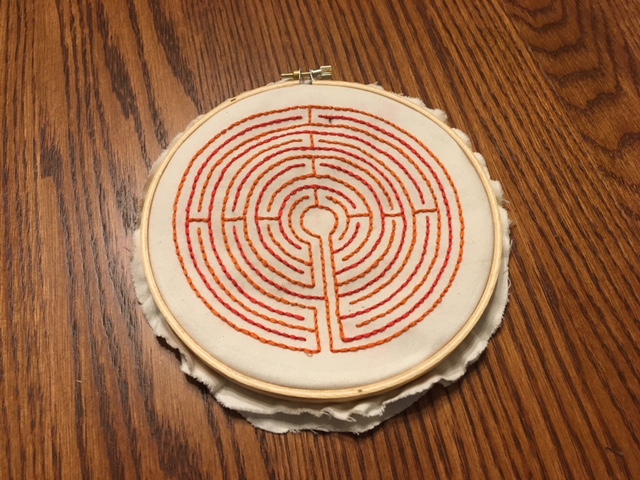
Photo: My very good friend Amanda sewed this labyrinth for me on the occasion of my ordination. It’s relaxing and fun to trace your finger toward the center.
Sometimes, we have to do the tasks we don’t particularly enjoy doing.
and
Sometimes we have to be present to aspects of life that are difficult, or unjust, particularly in community.
Both of these, though very different, take certain forms of resolve and commitment. They take resolve and commitment to be present, and they take resolve and commitment to participate in moving the larger picture toward creativity, restoration, wholeness, and vitality.
To do this, we have to keep a sense of purpose at the core of our reflection and action.
To do this, we have to keep joy at the center.
What gives you joy?
How do we bring it to the center… of our thinking? of our acting?
I’ve asked questions like these a few times lately on this blog. I think they’re important. They’re important to me now as I try some new endeavors.
It’s helpful to keep these at the center, so that when we come to the moments of
… needing to do the tasks we don’t particularly enjoy doing, and
… needing to be present to aspects of life that are difficult, or unjust, particularly in community,
we are energized for them — or at least, energized enough — because we are connected to the center of what gives us joy. We are connected to the larger picture and the why-we’re-doing-this of it all.
These give me joy:
-Hearing stories from students and young adults — large stories of formation and calling, and tiny, silly, wonderful stories from the daily-ness of life,
-Cultivating spaces where people feel a sense of belonging through connection, relationship, community, place, safety, a sense of return, and a sense of investing oneself,
-Connecting people to people in a myriad of ways — (have you met this person? do you know this group?) working on shared ideas, endeavors, and belonging in community groups; helping people feel connected to a larger sense of being rooted and related to one another (sometimes with wonderful surprise!) thinking expansively about care and connecting people toward care of one another (also sometimes with wonderful surprise!belonging is healing and life-giving!)
Follow the leads. This is my number one philosophy right now.
It’s also describes my primary rhythm of practices. I’ve done this before in other endeavors, but in this chapter, I’m being even more intentional in living this way as I try to initiate what I feel called to create.
This photo above is my raggedy-looking “leads journal.” It’s different than a bullet journal, though it does log what I’ve done and what I aspire to do. Most of all, it includes lists of discernment in which I ask myself things like, “What’s the next step with this task?” or “Who should I contact next?” or “How do I follow up on that idea someone gave me?”
I am doing this in connection to all areas of my work, including,
I believe in the Follow the Leads philosophy. First of all, it helps you think about possibilities. Second of all (though maybe this is first of all, at least in terms of priority) these possibilities are created through relationships and conversations in community. In other words, they are revealed in community.
Perhaps most of all, I just trust it.
I trust it because I’ve seen what can happen when people are committed to following “every thread of every conversation,” as Ben Johnston-Krase and Allen Brimer mention here in this video. Following a dream (including literally) Ben and Allen helped that dream become concrete as they followed the leads that were placed before them, resulting in a “church that meets on a farm and leverages all the resources of that farm to address food insecurity.” (To learn more about Farm Church, visit www.farmchurch.org.)
But also, I trust it because… what else can you do? When trying new things, certain aspects are hard. For me, funding is an ever-present challenge. At this point, if I don’t have the answers, maybe I just need to trust that a follow-the-leads strategy will reveal them.
If God and the community have placed a calling in your bones, surely there are ways to make that calling emerge concretely, and surely there are ways to make it sustainable too.
I’m not a student, but I have the jitters today. Some are anxiety-jitters, but most are excitement-jitters. We begin a new academic year at the University of Michigan today.
And I am very eager for this one!
Building community among students is pretty much my favorite thing in the whole world. In three states and in a variety locations and contexts, I’ve been doing this for ten years. Today marks the beginning of year eleven (and I’m just now realizing, the second decade — whoa).
For the last two years, sponsored by the Presbytery of Detroit, I’ve been working as a Community Chaplain. This is a rather unique role that we crafted together. While I am connected to a number of faith communities, my work is not housed solely within any one, particular church. Instead, I am commissioned to be a Chaplain within the wider community, especially among those who are not formally, religiously affiliated. This means that I meet with students from a variety of faith backgrounds or none at all. Sometimes, when they are seeking a faith community, I point them in a number of directions. Very often, we meet for coffee and talk about faith, spirituality, and what’s happening in their lives. I also meet with a variety of student groups (many are social action groups) and find ways to connect people to people, based upon their interests and skills.
I love this work.
And this year, within this larger vision, I’m starting something new as well. This year, in addition to meeting with many students one-on-one, and continuing to help out with other student communities (Canterbury House, in particular), I am also hoping to start a brand new student community.
In the spring, I was accepted into a new program of Montreat Camp and Conference Center in North Carolina. It’s called Young Adult Initiators. (Kind of a cheesy title, but it’s a good description!) This program seeks leaders who want to create new communities of young adults where they live.
In the winter, there was an application process that invited people to pitch ideas for what these new communities might look like, as well as what purposes they might serve. I pitched an idea to start an undergraduate community similar to Michigan Nones and Dones, and I was grateful to be accepted into the cohort. While some of the ideas are still to develop — I want students to co-create the vision community — this will be a discussion community where students can talk about faith, spirituality, and larger meaning over food (because shared meals are a very magical, spiritual practice for forming community!) Very likely, this community will meet at our house. We’ll probably begin with a monthly rhythm and then go from there.
Starting brand new communities…. this is also one of my very favorite things in the world. But no doubt, it’s hard work! There are challenges, and there’s a constant learning-curve. But it’s also exciting, and I know from experience, you can hardly anticipate how one thing might lead to another wonderful thing. It’s all a process.
So this week, I’m going to write about some of what I ponder when I begin new things. I’ll discuss frameworks and rhythms that I find to be helpful. I’ll also be honest about the pieces that are challenges or growing edges for me in this work.
And I would love to hear from you too. What new things are calling you? An opportunity, a practice, a mindset, a risk, a re-connection, a new question?
Whatever it is, or whomever or however, can you access it? Can you lean into it? Can you laugh in its presence? Can you rest in it? Can you marvel about it?
What is it? Can you recall it right now?
Sometimes, I find that helpful. And sometimes, we’re fortunate when joy just shows up, and rather than practicing recall, we can simply receive it.
What a gift that is.
Today I will be honest about something:
For a whole year now, I have been living and carrying three different, big stressors. Whew. And in the midst of these, a fourth keeps emerging too: Too often, I don’t sleep enough. I am writing this at 3am. (But don’t worry, writing this will help me sleep rather than take more away. I’m also going to sleep in).
In the midst of all of this, I also marvel sometimes… because side by side with these big challenges, the last twelve months have also revealed so much joy. Beautiful connections, wonderful hopes, and an ongoing sense of knowing and choosing the very forms of calling that seem to be choosing me.
What a lovely paradox that is. No need to downplay the stressors here — they’re challenging — but also… (how wonderful to say, “but also…”) they are accompanied by joy too. And I feel fortunate to know that. And sometimes, these gifts come as a wonderful surprise as well.
Here are some lovely, poetic words from Mary Oliver:
Don’t Hesitate
If you suddenly and unexpectedly feel joy, don’t hesitate. Give in to it. There are plenty of lives and whole towns destroyed or about to be. We are not wise, and not very often kind. And much can never be redeemed. Still life has some possibility left. Perhaps this is its way of fighting back, that sometimes something happened better than all the riches or power in the world. It could be anything, but very likely you notice it in the instant when love begins. Anyway, that’s often the case. Anyway, whatever it is, don’t be afraid of its plenty. Joy is not made to be a crumb. (Don’t Hesitate)
Yes!
I wonder, which ongoing stories in our lives need this posture from us?
Don’t hesitate!
(Also, don’t hesitate to go back to bed. Doing that now….)
Here’s a silly quip that has stayed with me for many years:
Remember well, and bear in mind that a jaybird’s tail sticks out behind.
It’s goofy. But the context of the quote has stayed with me the most. My surrogate Dad David used to say this to me, especially when I was anxious about something. He would often follow it by saying,
“There are some things you can always count on.”
And sometimes, he would follow it more. Referencing himself and Amy, his wife, he would add,
“There are two people in New Albany, Indiana who love you very much.”
Remember well, and bear in mind that a jaybird’s tail sticks out behind.
From time to time, I still think this phrase to myself. Sometimes, I share it with others.
I wonder, which ongoing stories in our lives need this posture from us?