Image Description: Two small purple basil plants in small, clear glass bowls are on a counter with a plastic planter container behind them.
These are my baby purple basil plants from last spring. One day, I was was sad to see them wilting inside their planter container. It was going to be time to plant them in a proper pot soon — that, I knew — but goodness, their stems were all totally wilted, lying flat over their small mounds of dirt.
So I put these small mounds of dirt into little clear bowls. Then I put some water in the bowls. These little babies sucked that water right up, and in veryshort order were springing right into growth again. It was amazing to witness how resilient they were.
And that had me reflecting…
Sometimes, you have to change the environment. When that environment has good, solid resources and care… much is possible. Sometimes, much more than we think.
Isn’t that also true when it comes to ourselves? Our neighbors? Our relationships? Our communities? Our world?
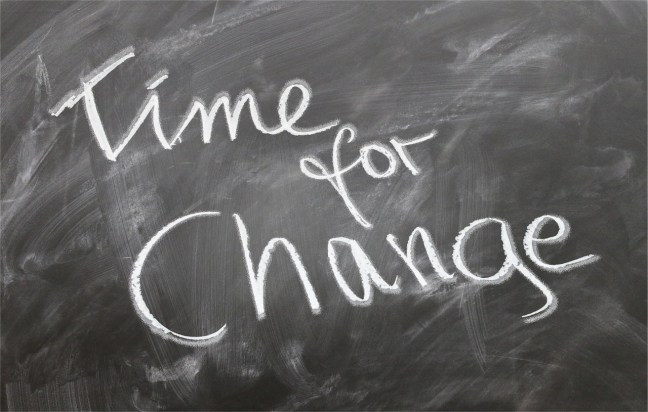
The words, “Time for Change,” written in chalk on a blackboard. Public domain.
I have always loved that huge, prolonged, build-up crescendo in the Mumford & Sons song, “Lover of the Light.”
It starts at 3:44 and builds for a whole minute until 4:43.
I hear a bit of a metaphor in this music — a musical parable, if you will.
Intriguingly, the crescendo starts after these words:
“You may not trust the promises of the change I’ll show. But I’ll be yours if you’ll be mine.”
Then we’re off.
We hear a motive. And it repeats. And it repeats. And it repeats. And it repeats.
It keeps repeating the entire time. It keeps on sounding.
And soon, other themes and chords emerge. They begin to accompany it. Then they grow and become progressively stronger. The initial theme remains, but it is no longer the sole focus. Our attention is now drawn to the collective whole.
Change.
Over the years, I’ve shared a Howard Thurman quote with many people: “Don’t ask what the world needs. Ask what makes you come alive, and go do that, because what the world needs is people who have come alive.”
Of course, I do believe we should ask what the world needs. But I also think that our aliveness — our dreams, our connections, and the callings which fuel us — can be some of the best gifts we offer our neighbors. They are ripe for collective change.
So whatever it is. . . that dream, that hope, that longing, that resource, that gift, that ability which comes so easily that you forget it’s special,
Keep doing it.
Put it out into the world and double down on it. Because it may come along and accompany someone else’s gift. And other people may come along and begin to accompany yours.
There may be obstacles (there probably will be) but that is how the best, life-giving change is made.
I love this affirmation of faith from the Uniting Church in Australia. Sometimes, I invite people to speak it aloud collectively in worship:
We are all held in the hollow of God’s hand, loved children of the universe, born from the life which flows from God, freed to the fullness of God’s creation, with all its beauty and variety.
We are all worth dying for in Christ Jesus, all called to risen life in Christ’s rising. The way of Jesus gives us footprints for our following, and our trials and longings are known in the frailty of Christ’s birth among us and the courage of Christ’s walking with us.
We are called to new things in the Spirit, in the hope that stirs in unlikely moments, the home we find in the wastelands of our wanderings, the warmth we touch in the coldness of our need, the opening of our hearts to adventures in belonging and in the gathering in of those without a home. Amen.
I love every word of this affirmation of faith. But I always feel a special burst of energy toward the end. After speaking such powerful words about love, I feel especially energized when I say, “opening our hearts to adventures in belonging. . .”
A person I know said something quite wise recently, and I am taking it to heart: Love always involves learning. If we commit ourselves to love people, that necessarily requires our lives to be shaped and changed by those very people. Loving always involves openness and willingness to being taught, so that we grow and ultimately change.
Theologian and poet Pádraig Ó Tuama says something similar: “Belonging creates and undoes us both.”
In this affirmation of faith, the fuller phrase is this: “the opening of our hearts to adventures in belonging and the gathering in of those without a home.”
To be without a home. . . This can mean many things and represent a variety of painful experiences. But it often speaks to the experience of being cast out in one way or another, either from physical homes or entire communities of belonging.
If we are to love. . . we are to learn. If we are to learn. . . we are to grow. If we are to grow. . . we are to change.
We are to commit to the “gathering in of those without a home.”
This week, U.S. Representative Alexandra Ocasio-Cortez shared her own personal, traumatic experiences as they took place during the violent storming of the U.S. Capitol on January 6. In a video on Instagram, she was vulnerable and honest. She recounted the terrorizing details of the day and referenced difficult forms of abuse she has survived in the past.
Her stories are challenging, and she revealed a great deal of strength in talking about them. She discussed the ways that trauma impacts both personal and collective experiences of safety.
I want to uplift this statement that she voiced:
“The accountability is not about revenge. It’s about creating safety. And we are not safe with people who hold positions of power who are willing to endanger the lives of others if they think it will score them a political point.”
So often, we think that accountability is about punishment. So we avoid it to protect those in power, or we dig in with revenge. Both of those pathways are different, as they don’t have the same footing when it comes to power. But in their respective ways, both can create more harm.
Accountability is about safety. And it’s necessary. None of us are safe if we keep empowering or protecting people who inflict violence. None of us are safe if we keep empowering or protecting those who are determined to condone it.
Three friends at age 16 who call themselves “The Triangle of Doom.”
I could start this piece by saying, “Get yourselves some friends you can keep for 20+ years,” and that would be fitting. But I’d actually like to say, “Get yourselves some friends you can keep for 20+ years who whenever assembled, will always place their arms in a shared, three-sided shape they like to call the Triangle of Doom.”
We ourselves are the Triangle of Doom, mind you. At least that’s what the three of us have been calling each other since we were younglings. The three of us met at age 13 when we sat together in our junior high science class to learn about about single-celled organisms, dissections, rocks, and odd, pointy substances.
Our relationships became very close during our four years of high school theatre. We had slumber parties, inside jokes, and adventures on “both sides of the river,” meaning that we traveled back and forth across the Ohio River from our Southern Indiana home to Louisville, Kentucky.
Of course, over the years, we haven’t only assembled our arms into triangles. We live in three different states, and from there, we’ve had a group text going for a long while. We talk about things that matter — relationships, families, children, jobs, politics, and what we hope for out of life. We support each other, and if any of us fell apart, we’d lend a listening ear. Heck, we’d even drive across the country to find each other.
So get yourselves some friends you can have for 20+ years who give you belly laughs so hard it hurts and who will be there, always, whenever needed.
Three friends at age 35 who call themselves “The Triangle of Doom.” We’ll all be 39 this year.
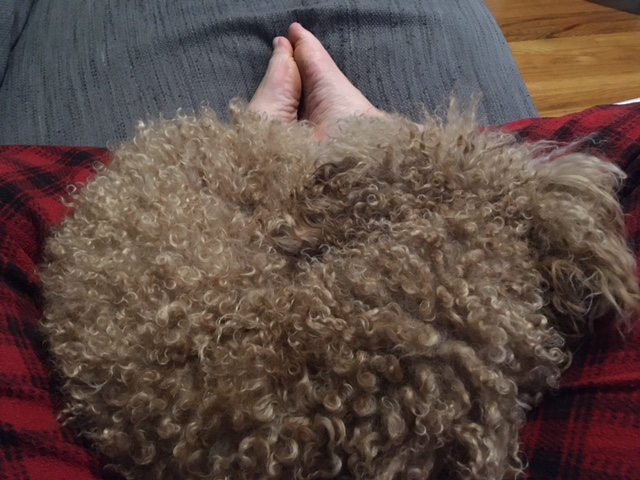
My brown, fur ball doggy friend. He’s a Golden Doodle, and he’s curled in a ball on my lap.
This weekend, I had the pleasure of doggy-sitting for a good friend of mine. This pup is truly one of the sweetest dogs I know. He is cuddly, kind-tempered, and playful. I really enjoyed having him here. He loved to play chase inside the house and in the snow; most of all, he loved moving himself right over to my lap so he could curl himself up in a little fur ball.
I grew up with a dog, but I haven’t had one in adulthood. My pup friend was nice addition for a few days. One of the things I noticed is how much he notices. He followed me around everywhere from room to room. He was deeply attuned to what I was doing, nearly at all times.
He was just totally attentive. Maybe he’d doze off, but as soon as I moved a leg on the couch, he was curious to pay attention to me again.
It makes me wonder, to what and to whom am I attuned?
Image Description: A Ben Montero cartoon, which can be found here. 4 slides: This yellow bird really loves treats! “Do we get treats?” he asks, as a newborn, as a kiddo walking into school for the first time, on the first day on the job and… well, popping out of the casket.
At the end of the month, I like to take a moment and thank people for visiting Smuggling Grace and reading my daily posts here. I appreciate that so much and the ways that people contribute their own thoughts through comments. Thank you! I’m committed to sharing my written content free of charge, and I hope that these pieces provide some hope and encouragement during challenging times. Once per month, for those who would like to support this work, I offer some opportunities to do that.
If you would like to become a monthly patron, I have a Patreon Page. Feel free to check it out. Or, if you’d like to give a one-time gift, you can do so here.
Imagine… with a small donation, you can provide the funds for a highly isolated, pandemic person to have tacos delivered joyfully to her house this weekend. Do you know how much this writer loves tacos? Or really, any kind of treats?
Thanks for reading and commenting! You are appreciated. To borrow the words from the tip jar at my local Panera Bread, “Never expected, always appreciated.”
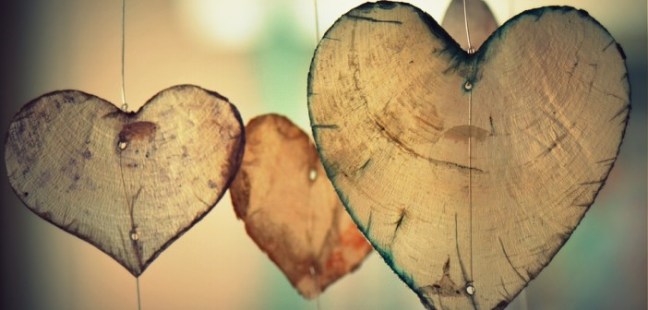
Image Description: Three hearts are carved out of wood and hanging by three wires. One is red, one is orange, and one is green.
Over the last few weeks, on three occasions, I have just happened to spot something really wonderful. While scrolling through social media, I’ve encountered three examples of connections that are very meaningful to me.
Specifically, I’ve spotted moments when my mentors have reached out intentionally to people I’ve mentored — asking how their week is going, expressing a desire to get coffee, and donating to their GoFundMe fundraiser. I’ve introduced these people to each other. They don’t live in the same places, but they are connected.
And I realize that we’re all a part of a generational structure of sorts, both by age and by mentoring. There’s a big sense of family in all of it.
Image Description: Two cupped hands meet together to form the shape of a heart. The person is wearing a sweater with blue sleeves. In the foreground at the bottom left, there are large rocks, forming a cliff. In the distance are blue water and mountains.
Every body is a worthy-of-care body.
Every body is a worthy-of-resources body.
Every body is a worthy-of-taking-up-space body.
Every body is a worthy-of-dignity body.
Every body is a worthy-of-connection body.
Every body is a worthy-of-self-expression body.
Every body is a worthy-of-advocacy body.
Every body is a worthy-of-self-determination body.
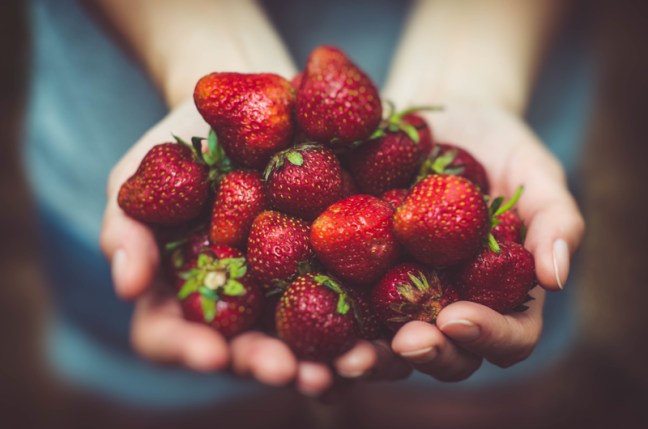
Image Description: A close-up of two hands cupped together, holding a large number of strawberries. Public domain image.
A story from Zen Buddhism:
A man was walking across a field when he saw a tiger. Fearing for his life, the man fled, but the tiger gave chase. The man reached the edge of a cliff, and just as he thought the tiger would get him, he spotted a vine growing over the edge of the cliff. Grabbing on to it, he swung himself over the edge to safety.
The tiger came to the edge and snarled at him from above. While precariously perched like this, the man saw another tiger growling at him from below. Trembling, he held on to the thin vine that was keeping him from being dinner for the tigers. What could be worse than this, he wondered.
Just then, two mice scampered out and began gnawing at the vine. As they chewed and the man pondered over his fate, he saw a juicy, red strawberry on a ledge next to him. Grasping the vine with one hand, he plucked the strawberry with the other. Ah, how sweet it tasted!
If you Google information about this story, you will quickly learn that there is debate about its meaning. Some hold the interpretation that this story is about living in the present moment and enjoying pleasure right in front of us, even in times of trial. Others, however, say that this a misunderstanding; the story is about the foolishness of getting distracted by pleasure when we have the occasion to remove ourselves from a perilous situation.
With both interpretations, we choose our life.
I will leave the interpretations to communities of Zen Buddhists, as it is their story, and they know it best.
But lately, here is something I’ve been thinking about…
There are times when loss is so great or stress is so high that we are plunged into present moment living because that feels like only way to make it — one day at a time, one moment at a time, one feeling at a time. But as we do this… we discover that present moment living is also the best way to live. It’s freeing and filling.
And
There are times when loss is so great or stress is so high that we are plunged into choosing our life in order to survive — our bodies, our in-the-moment daily needs, our rhythms, our memories, our values, our loves, and our communities. And as we do this… we often discover that there are still so many gifts in our lives. There are times when we say yes to the broad fullness of it.
With both of these, we choose our life. And that invitation is always there.







 Smuggling Grace