(Part 2): Turns Out I’ve Been in a Disabled Body This Whole Time

Invisible disability

[I found this image on Kerry Magro’s blog on a piece entitled, What I would Like People to Know About Having Autism and an Invisible Disability. Image Description: White background, black text. There is a phrase at the top which reads, “Not all disabilities look like this,” with an arrow pointing to the traditional disability symbol of someone using a wheelchair. There is a phrase below which reads, “Some look like this,” pointing to symbols of three people. Two are adults with a child in the middle holding the hands of both adults.”]

A long, empowering post:

Disability has always been a part of my life in one way or another.

If you’ve followed this blog over the last year, or if you follow me on social media, you’ll know that I have begun to focus my activism in the direction of addressing ableism, health stigma, and access to health care. At the end of last year, I wrote a post sharing that I wanted to set my intention to move in this direction in 2019. And so, I have. It’s been a wonderful experience.

Recently, I said to a loved one, “I can’t do this work and act like as though this hasn’t been a part of my life too.” Then I added, “But even more, I don’t want to do that.”

Disability has always been a part of my life in one way or another. It’s part of my story. It shaped who I became and what I care about. Turns out I’ve been in a disabled body this whole time. (And because I’m anticipating the possibility of some misconceptions rising to the surface, in a moment, I’m going to bust some myths about what that means). The truth is, until this stage of my life, I’ve never had adequate space to say something like this. Saying it now is liberating.

When I say that disability has always been a part of my life, I circle back to some the pieces I have shared here in the last twelve months — pieces that articulated how disability is a part of my story:

— This year, I began to write publicly about my childhood epilepsy. (Here and Here) That epilepsy eventually went into remission, but the experience had an enormous impact upon my upbringing and who I became as an adult. Though seizures have faded, I still have some physical vestiges of this too. As fun as it is to watch me cut a rug — and boy, can I cut a rug — don’t take me to a rave to do it: I still have a photosensitive brain.

— And yesterday, I wrote about my history of trauma and C-PTSD. (Here) Many of the hallmark symptoms of C-PTSD have faded in frequency and intensity for me over the years, and gratefully. But as I shared yesterday, that long history of trauma and the history of this whole body illness left me with a compromised nervous system. This means I have to practice certain rhythms (sleep is especially important) and take care of this with intention.

With this body, I am both particularly sensitive to stress and particularly resilient to stress. I’m remarkably skilled at navigating high stress and still functioning. (Because most of my life, I’ve had to do that. And I’m not bragging about this. This doesn’t make me a ‘Good Survivor’ or ‘better’ disabled person. I’m sad about the pressure I’ve felt to hide things and perform to certain expectations).

I don’t crumple in stress; I tend to rise to it. But it also impacts my body on a whole nervous system level. And since that system governs the body as a whole, it can lead to health challenges later. (See also this phenomenal TED Talk). That is why I am addressing this very intentionally. At this stage of my life, I’m actually choosing less stress.

That choice is pretty great.

So yes, turns out I’ve been in a disabled body this whole time. And as I said yesterday, I’m proud of who I am. Likewise, I’m proud of this body I have.

So let’s allow these misconceptions rise to the surface, so I can answer them on my own terms. Enter… the Interlocutor! (With whom I can also be a little toasty.)

“But Renee, why use such a negative word about yourself?”

The words ‘disability’ and ‘disabled’ are not negative words or bad words. Disability is a normal part of our human existence. Approximately 20% of the population lives with a disability. We tend to view such words with negative connotations because our larger culture finds a remarkable number of ways to shame and stigmatize bodies that do not meet some ‘standard’ or particular ‘norm.’ This is ableism.

People with disabilities can identify themselves and articulate their experiences in the ways they choose, and there are many ways to do that. It is irritating to many, however, when people without disabilities insist on using euphemistic language and/or tell disabled people they should not identify or talk about their experiences through the language of disability. Stop doing that, Interlocutor!

“But Renee, isn’t this… limiting yourself?”

The problem in your question, Interlocutor, is that you define disability purely through the lens of limitation alone. That, and you think I’m doing this to myself. Now, of course, disability does sometimes involve particular limitations. That is true, and by the way, that is okay.

And while we’re on that subject, let’s explore how we talk about these things. Who doesn’t have limitations particular to oneself? And who doesn’t use accommodations or assistive devices in one way or another? Glasses? Gloves? Escalators? Siri? As I recently saw on Twitter, no one talks about glasses the way people talk about wheelchairs.

“Despite being confined to glasses, she overcame.”

“She didn’t let her glasses hold her back.”

“It’s true that she had poor eyesight, but she didn’t let that limit her.”

(See how we’ve deemed certain limitations and certain assistive devices as normal and others as, well, “other-ed?” And when we say these things about wheelchairs, we are additionally providing examples of inspiration porn. <– Really, look that up. And Google more about it and the harm it does).

But beyond asking those questions and making these observations, disability is about much more than limitations. It’s about physically existing in the world in a variety of ways. It’s about particularity. It’s about identity. It’s about story. It’s about body. It’s about being part of a wider community — a larger disability community, which is pretty rad by the way, and belonging to the community as a whole, presenting particular gifts, particular needs, and particular skills. And that combination is true for any of us, by the way.

“But Renee, if you talk about yourself this way… aren’t you afraid that people will think you’re incapable?”

Again, Interlocutor, why on earth are you defining disability through the lens of incapability? Why is this always one of your first questions?

For some reason, people tend to think about disability in a binary way — as if people are totally disabled or totally not disabled. And because we stigmatize and ‘other’ people with disabled bodies, we think about folks as if they are incapable in some generalized way, and from there, deem them as less-than. (Note also, Interlocutor, the harmful cultural tendency to assign worth based on capability and certain forms/levels of productivity.)

Plus, disability isn’t a binary…

— For instance, did you know that many wheelchair users can walk or stand for a limited amount of time? But because people think about disability as a binary, wheelchair users get harassed in public all the time when they stand to reach for an item at the grocery store or walk to the back of the vehicle to pack their wheelchair away. If disability is viewed as ‘total incapability,’ these people must be fakers, right?

No, not in the slightest.

People can use mobility aids for safety, security, balance, the preservation of energy, the avoidance of fatigue, or other reasons entirely. (See also the hashtag #AmbulatoryWheelchairUsersExist, initiated by Annie Segarra, which talks about these kinds of harassment experiences. Let’s end that.)

— Many times, experiences of disability are episodic. They come and go. People should be able to talk about their experiences as they choose and/or share the need for accommodations in fluctuating ways without others viewing them as 1) utterly incapable or 2) someone who must be overreacting and feigning a disability.

— The belief that disabled people are completely incapable, and therefore, miserable and to be pitied, can have disastrous impacts for people. This is a horrible thing to consider, but do you know that the Trump administration has proposed initiating a program to monitor the social media accounts of disabled people who are receiving government services, so that if they seem too happy or are pictured doing certain activities, they can be denied assistance and potentially investigated for fraud?

The ignorance and distain for disability and can have devastating outcomes.

“But Renee, aren’t you concerned that some future employer will find this blog post someday… and make too many assumptions about you… or discriminate against you?”

Actually, yes.

But that shouldn’t be the case.

I learned earlier today that my Presbytery is promoting an upcoming event — an opportunity for people to view a film entitled, Resilience: The Biology of Stress and the Science of Hope. I’ve already seen it. It’s quite wonderful, and I might go to the event too.

And you know what? It’s about my disability.

It’s about how such a disability can take form, and also how it can be supported and aided toward greater ease, wellness, and resilience.

People from a variety of congregations may attend. They will love the film in its honesty and in its possibility. But I wonder, could I be a pastor in one of these congregations, name this disability, its story, and its particular needs… without facing negative consequences in my relationships? Without facing negative consequences to my employment?

Or…

Might it be possible for a pastor to minister as a whole person? Might it be possible for a pastor to serve precisely as herself… knowing that many others need an accompanier who has some understanding of disability, mental illness, and cultural health stigma?

Some might make assumptions about me and what they do not understand. This could include discrimination in my church circles or in other employment circles.

But… it’s not worth continuing a situation where I can’t have my story and tell my story in public. I am a disability activist. I want to write disability theology. And I have always existed in the world in a disabled body — having carried two disabilities, which despite their prevalence, face severe cultural stigmatization (1 in 26 people will have epilepsy at some point in their lives; 1 in 5 people have a mental illness).

But you know what? If  I speak about my experiences, I might be able to shift that… even just a bit.

“Oh, so is this why you’re doing this?”

Yes, now you’ve got it.

Renee Roederer

(Part 1): Today, I’m Going To Talk About My Mental Illness

beauty

[Image Description: A gray wall has street art on it. Toward the right side, there is an black outline of a hand, and within the hand, it reads ‘YOU ARE BEAUTIFUL.’ There are splotches of blue, pink, green, and yellow paint around the hand.]

CW: Mental Illness and Trauma (I don’t get specific in this post with stories of trauma, though I do talk about the physical impacts of trauma)

It’s Mental Health Month.

Today, I’m going to talk about my mental illness.  — and —
I’m going to talk about how we talk about mental illness. — and —
I’m going to talk about how I want to talk about my mental illness.

And because I want to talk about how I want to talk about my mental illness, I’m going to begin with story, identity, body, and life.

Story,
Identity,
Body,
Life,
I am a Trauma Survivor.

And within this experience, I have had C-PTSD.

Over the last few decades, people have come to understand a lot more about trauma and PTSD. This is so helpful, as this has led to more compassion, sensitivity, accommodation, and advocacy. The C is an added term for some; it stands for ‘Complex.’ This does not necessarily mean that one’s mental illness is more complex, but rather, more particular, because the trauma itself is more complex. ‘C’ or ‘Complex’ is the marker for long-lasting trauma, as opposed to short-term trauma events. (We also know that short-term trauma events can be debilitating, and these deserve our compassion).

Story,
Identity,
Body,
Life,
I am a Trauma Survivor.

And

I want you to know that I’m proud of who I am.

I survived trauma experiences that lasted multiple decades. These are stories that I am able to tell, and I feel empowered in telling them as I share them in relationship and make meaning of what I have learned. (Please also keep in mind that some do not wish to share, and sharing is not necessary for healing. Those who do wish to share should be able to do so on their own timetable and in ways of their own choosing).

I am not equated with my trauma history, but I have lived through these experiences, and I’ve integrated them into who I am and how I operate within the world.

I’m proud of who I am, and I’m proud of the life I have cultivated in response.

And

I also don’t need to tie any of this in a perfect bow.

These experiences have impacted the whole of my body.

My body has carried chronic stress over very long periods of time, and I have lived with a dysregulated nervous system for most of my life. In the midst of this, I also learned how to be remarkably resilient to stress, and I found many ways to cope with what I did not yet know to name as a dysregulated nervous system.

But all of this left an impact too.

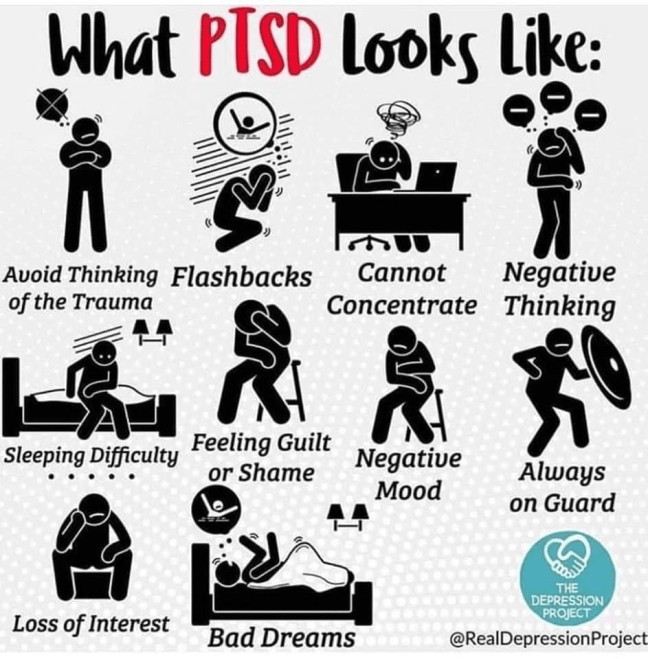
When I was in my mid-20s, several circumstances came together which created conditions for me to really feel the chronic stress I had carried for so long. My body began to act in ways that did not quite make sense to me, and frankly, that was scary. It was helpful when I had a diagnosis because I discovered that I did, in fact, absolutely make sense. I learned how physical this could be, impacting the whole body, and I had a framework to name and describe what I was experiencing, like,

emotional flashbacks,
insomnia (this was especially intense for me during that time period)
severe anxiety,
intrusive memories,
somatic illness, and
the inability to concentrate.

C-PTSD was most pronounced and most symptomatic for me during a year and a half in my mid-20s. It got much larger than I could handle, and I came very close to not finishing my class work for seminary. The vast majority of people, however, never saw signs of this. I have always been very skilled in hiding illness (See this story about that) a skill, by the way, that I do not want to celebrate, as no one should have to do this. I’ve also been pretty skilled in pushing through (likewise, no one should have to push themselves too hard). I managed to finish after all and won a significant fellowship upon commencement. Most people could not see how deeply this was impacting me.

In the summer that followed, all of these symptoms were at their strongest after they had already persisted for a long time — imagine a year without adequate sleep! —  and I bottomed out physically in ways that became remarkably dangerous to my health.

It was very challenging.
Scary too.

And
At the very same time,

My body wasn’t static.

In the years that followed, with help, I was able to move in directions that were healing. Therapy was helpful. Meditation and mindfulness were helpful. EMDR was helpful. Somatic bodywork was helpful. For two different periods of time, anti-anxiety medications were helpful. I am grateful.

And to these, I want to say two things:

1) I was privileged to have insurance that paid for these necessary forms of care. Everyone deserves this.

2) I reached a healthier plateau, but there is no marker of health or wellness that makes one “successful” or makes one’s pathway “normative.” These kinds of beliefs and larger narratives are ableist. People deserve care, inclusion, compassion, dignity, and self-determination however they exist in their bodies.

This is so important.

Again,
I don’t need to tie any of this in a perfect bow.

Some symptoms of my trauma history have faded, but I also carry impacts and have particular needs too. Flashbacks are very rare. Not non-existent, but very rare. In the midst of stress, if I’m not purposeful and intentional about it, insomnia can still become a challenge. I try to gauge that very intentionally.

I am happy. I am even joyful. I have been for a long time.
This is a gift.

And… I have a compromised nervous system. To make a comparison, some people have compromised immune systems and have to gauge their environment. I have a compromised, sensitive nervous system. In the midst of this, I maintain particular rhythms and have to avoid certain things too.

And this is okay.

In naming my mental illness —
for me, and for many, an illness of the whole body —
I do not deserve
stigma,
over-assumption,
discrimination,
shaming, or
low expectations.

Too often, this is exactly how we treat people with mental illnesses.

I am a Trauma Survivor.

My life deserves
compassion,
care, and
awe.

I am proud of who I am.

I deserve this.
And so do you.
And so does everyone.

Renee Roederer

Care Receiver

care

[Image Description: The word ‘care’ is spelled in plastic letters. The letters are set on top of a tree trunk. C (orange) — A (blue) — R (orange) — E (green). I found this image here.]

I’ve been a care giver my whole life.
I love it. I’m good at it. It brings me joy.

But these days, I’m also flipping the script.

I am choosing to think of myself as a care receiver.
And… I love it. I’m reveling it it. It’s bringing me joy.

Of course, there has been plenty of care to receive before this moment, and I have received it with gratitude. But there’s been something so wonderful in setting intention to notice all the ways that care shows up… in encouraging words… connection with people… being seen and known… laughter… hugs… food… nature…

Perhaps the difference is that I am taking it in on an even deeper level and more intentionally. It’s wonderful.

When you’ve been a care giver your whole life, you can easily come to believe that you are worthy of love and care only when you’ve earned it through care of others. (All the Enneagram 2s raise their hands). I started to move away from this mindset a long time ago, but I also did believe that on a fundamental level (and at times, an unconscious level) for a very long time.

How wonderful it is to be worthy of receiving… just because we are.

Of course, it is also absolutely true that when we receive the care offered to us, and when we receive the care around us, we often have more care to give. This is a foundational truth for care givers.

But also… we’re worth it… just because we are.

Renee Roederer

Our Announcement!

IRT Annoucement.jpg

[Image Description: This image contains photos of me and Dwight Wilson, then text about an exciting new job for both of us! For friends who use screen readers, I am placing the text of this image at the bottom of this post].

Well, I have some big news to share. ❤️

In partnership with one another and an incredible organization, Dwight Wilson and I will soon begin serving as the new Co-Directors of the Interfaith Roundtable of Washtenaw County.

I am so delighted enter this new chapter together.

The Interfaith Roundtable of Washtenaw County is an interspiritual dialogue community, inviting friendship and mutual understanding among local neighbors. Through conversation and reflection across religious and spiritual traditions, we come together to address the deep questions and concerns that impact our county and our larger world.

The Interfaith Round Table of Washtenaw County is also a community of care in which member congregations and larger circles of neighbors come together to provide support in moments of need and conviction in the shared practice of justice.

As I share this announcement, I want to express some gratitude:

— I want to thank George Lambrides and Susan King for their leadership as Co-Directors. They have founded this organization and shaped its direction so well for 25 years. We have gratitude for them and their work.

— I want to thank the Interfaith Round Table Board for this opportunity. I am so eager to partner with them in this next chapter. I am grateful for their energy and hope in these new days.

— I want to share with every single one of you my deep excitement in sharing this position with Dwight Wilson. He is a person with whom I share a great sense of kinship, connection, and vision. Over these years of knowing Dwight, I have benefited from his wisdom, his writing, his fervent sense of justice, and his gentleness. (Seriously, as the perfect example of that gentleness, he relishes in holding babies at the NICU every Monday. Follow his weekly Facebook posts about that, and you’ll see what I mean!) I am so honored to partner together and do this as a team.

To our local community members, we hope you will add your voices and your presence to the vision of the Interfaith Round Table of Washtenaw County. Let’s build on the great foundation that has been laid and move forward with reflection, energy, imagination, and love.

Here we go!

Renee Roederer

And a note about my other roles too: This is a part time position — approximately 7.5 hours per week for each of us — so my work as a Community Chaplain, along with all the things in my bio above, will also continue. Glad to add IRT to this vision! It fits so well!

Text in the image above:

“The Interfaith Round Table of Washtenaw County (IRT), now in its 25th year, is pleased to announce the hiring of new co-directors to lead the organization into its next phase of engagement with the local community.

The Rev. Renee Roederer and Dwight Wilson have been selected as co-directors and will begin their new positions mid-June.

Renee currently serves as a Community Chaplain in Washtenaw County and at the University of Michigan. She is the organizer of a new, spiritual community called “Michigan Nones and Dones” and also serves as a mentor and host of the Young Adult Interspiritual Community, a group of students and recent graduates from the University of Michigan who meet on a monthly basis to discuss faith, spirituality, and issues of shared concern. Renee is a minister in the Presbyterian Church (USA).

Dwight has been active in the IRT for the last 15 years, and active in the local Quaker community. Dwight just concluded serving 8 years an Ann Arbor Human Rights Commissioner and was recently chair of the Subcommittee on Police Oversight. He also writes historical fiction and volunteers in the Pediatric Cardiac Ward at Mott’s Children’s Hospital. Dwight also served as General Secretary of the Friends General Conference.

George Lambrides has served as the director of the IRT since its inception in 1995. Susan King served as chair and then co-director for the past 15 yers. Both will be involved in supporting this transition of leadership over the next several months. A special event to honor their years of service will be held sometime in 2020.

For more information on the Round Table’s programs and services, please go to www.irtwc.org.

Family Is Expansive


IMG_3798

[Image Description: I took this photo in Austin, Texas at Lady Bird Lake. A support pillar of a bridge reads, ‘Live a Great Story’ in black print. This print is inside a white circle, and is surrounded by colors of blue, yellow, green, and red. The pillar itself is surrounded by water, and two people are paddle boarding in the distance. Also in the distance are green, leafy trees on both sides of the water and a light blue sky with darker clouds.]

–We sat around the kitchen table, adding chairs and making space for more each time people walked through the door. We placed ourselves in a circle around two gorgeous, homemade birthday cakes, and we were there to celebrate his special day.

He made introductions of all of us to one another.

“This is ________” There was a pause. “How do we describe who we are?” he said, both of them smiling at each other, and laughing in the connection. “He’s my chosen, adult son,” he ended up saying. Then he said the same about one other person in the circle.

“This is Ian,” he said when he arrived around the circle to my husband. “I’m just meeting him for the first time, but he’s married to Renee, and she’s family, so he’s family.”

Basically, my dear friend introduced every single one of us to each other as family. And for those two hours, laughing hard, and having a serious sugar rush (Seriously, that cake was phenomenal) we were truly a family gathered around the table. And it felt like it too.


–I have a chosen parent. When I was much younger, he chose me in this way. Though I had technically reached legal adulthood (not much older), in many very real ways, he participated in raising me. He continues to be one of the most formative people in my life. I’ve discovered a lot of who I am and who I want to be in relationship with him.

When I was with him a few weeks ago, we spent some time at a sports tournament. He was standing around and talking to another person there. I walked up while they were both in conversation, so I introduced myself. I said my name and mentioned that I was visiting this weekend. That’s when the conversation partner asked,

“Are you related?”

No one has ever asked us that before.

The man was looking at me when he asked the question, and for a brief second or so, I tried to figure out how to answer. I didn’t want to just say a simple, firm “No,” but I also didn’t want to be confusing in some way.

But that’s when he jumped in and said,

“Yes. By choice. But yes! Chosen family.”

And it was lovely.


–I invited her to church with me.

This was the church I had loved but had lost, at least, for a time. I had received a recent invitation to return and participate as much as I would like, and that meant the world to me.

So I went to worship, and I brought her along with me. We sat in the pew, praying, singing, listening to the sermon, and a few times, connecting with one another through church giggles. She’s very funny. At one point, we locked arms, standing close together while singing.

Later, after the service, I went upstairs to find someone, knowing she would delight in seeing my return. And when I did, I introduced the guest I brought with me:

“This is my kindred, _______,” I said, saying her name after the word ‘kindred.’ In that moment, I didn’t simply introduce her as my friend. She is that certainly, of course. But she’s also so much more than that. She’s a member of my family.

Kindred is not an often used word. So… maybe that was an odd choice of words for an introduction… But it’s what came out. And it’s definitely accurate too. This person and I have some shared, overly specific, parallel life experiences. It’s uncanny, frankly, and on a regular basis, I marvel that we actually found each other. Kindred spirits, indeed.


–He’s an older friend, a mentor, and colleague, and he’s soon to be my work partner.

As soon as we met each other, I marveled at all we had in common. There’s plenty of life experience unique to each of us, and areas of identity and life history that are not in common (as an older, African-American man, he has taught me a lot) but we do have a similar orientation to how we’ve built community and a sense of family.

“You scoop people,” one of my youngers said this semester. “How do you do that? You choose people and then keep them for life.”

It is true that I do this, and that I aim to do this. And my older friend, mentor, colleague, and soon to be work partner does the same. Only he has done it much longer. He keeps in touch very intentionally with five hundred former students. This is amazing to me.

Once, he said this about his oldest set of former students, who are ten years younger than him:

“I’m a paternal figure for them. But we’re also friends.”

And I sat there and nodded in recognition, because I knew exactly what that was.


–A couple weeks ago, three of the most beloved people in my life each initiated conversations with me about the exact same thing, asking why I had chosen not to have children but instead build a large family by choice.

And all three of those conversations were such a delight to share.

In large part, this pathway has emerged directly from what I have received. I have received family by choice. I myself was received, chosen. (In just a mere sampling, I have written about that here, here, and here). Why not continue to expand this gift?

This was exactly what I wanted, and on a regular basis, I marvel at all the choosing and being chosen, which continues to weave through my life in a rhythm of giving and receiving in every direction. I will keep choosing that over and over again.

Renee Roederer


Preaching Collectively

circle

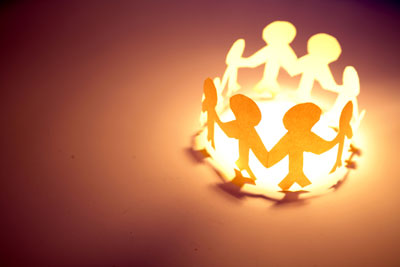
[Image Description: Eight figures of people, cut from paper, are holding hands in a circle, and a light is emerging from inside the circle. They are positioned toward the right side of the image which also has an orange background.]

I preach frequently in a variety of congregations on Sunday mornings, and I believe this wholeheartedly:

My words are part of the sermon, but the sermon is not my words. The sermon is not equated with what I say or what I have committed to paper. The sermon is a moment — a revelatory moment we all share together as we gather around a sacred text.

And recently — often, during a charge and benediction — I have found myself sharing this with people. The thoughts that emerged in our minds… the things we decided to do… the people we decided to contact… the action we decided to take… the prayer that arose… the desire that revealed itself… the calling that became a bit more clear… These are all the sermon collectively. When we lean into these, and when we act on them, we are all preaching the sermon. And we ourselves are preachers of the sermon.

I didn’t say this on this last particular Sunday. But I also didn’t have to say it. We all felt it.

After the sermon, we had a time to share joys and concerns collectively before a member of the congregation led everyone in prayer. People spoke so deeply from the heart. I’ll keep all of those details confidential, of course. But one person shared a number of serious needs in the lives of those close to her. Then she began to speak lovingly and passionately about the need to treat people struggling with mental illnesses with more compassion and tangible care. And it moved me so deeply.

She was preaching the sermon.

After the service, about ten people stayed with her, surrounding her and praying for her and the people she mentioned. It was a circle of compassion — so beautiful.

“This is church being the church,” I thought.

They were preaching the sermon.

They were certainly preaching to me because I won’t soon forget that moment. I’ll continue to remember it, take it in, and act on it.

Renee Roederer


I’m Back!

IMG_0784

[Image description: A photo of tree branches with small, light pink flowers. The photo is taken from under the branches, revealing a blue sky with light clouds above. This photo comes from Montreat Camp and Conference Center. I was there at the beginning of April to meet with my cohort from the Young Adult Initiators program.]

Hello, Friends! I’m back to my blog this week and glad for it.

I took a few weeks off from writing to focus myself in a few other directions. First, I’ve been traveling a lot since the end of February. It was a whirlwind, in fact! And it was also very lovely. Some of the trips were invitational for cohorts and speaking gigs (I like this a lot and would do more of it!) and some trips involved time with chosen family in various parts of the country. It was all a gift.

And… some other things came along in April too. I interviewed for an exciting part-time job and received the offer. So that’s a bit of a teaser, I realize, but stay tuned! We’ll have a social media announcement soon, and then I’ll share more here too.

How has this seasonal entry into the spring months been for you? I’d love to hear that. Feel free to leave a comment or send me a note at revannarbor@gmail.com.

Have a great start to your week! I’ll be writing here again throughout this week.

Renee Roederer

Inch Wide, Mile Deep

IMG_0640

[Image description: A book is on top of a brown, curved table at an angle. It’s title is Emergent Strategy: Shaping Change, Changing Worlds by adrienne maree brown. The lettering of the word ‘Emergent’ is blue, and the lettering of ‘Strategy is green. There is a salmon-colored box below these letters which reads ‘Shaping Change, Shaping Worlds’ with the name of adrienne maree brown below. In the background of the book cover, birds are flocking.]

I’ve been reading Emergent Strategy: Shaping Change, Changing Worlds by adrienne marie brown. I (and many others!) find this book to be a remarkably refreshing, empowering paradigm shift in how we understand our relationships, our connection to the earth, our activism, our organizing, and our processes for affecting change.

There is so much I could share, as this has opened up reflections for me in many directions. But today, I want to share a piece of the book that has been sitting personally with me all week.

adrienne marie brown says,

“We need each other. I love the idea of shifting from ‘mile wide inch deep’ movements to ‘inch wide mile deep’ movements that schism the existing paradigm.” (page 20)*

Inch wide, mile deep… I absolutely love that.

She is encouraging us to move away from a paradigm we might recognize very well (do you?) — that is, plunging into task-oriented work in a huge array of areas based on the urgency of the many needs around us (those needs are very real, and when we experience burnout, we might find ourselves driven more by ‘shoulds’ than feelings of relational care). In the midst of this, she encourages to move toward a paradigm that is based on relationships — going deep with them, going deep with the care of them — because that is how transformation really happens.

It’s also much more sustainable. Whether its in our employment, our vocation, our neighborhood vision, or in larger scale movement work, mile wide, inch deep rhythms… often lead to high burnout and low impact.

But inch wide, mile deep… That’s refreshing, transformative work.

And all week, I’ve found myself desiring this. To plant myself/ourselves particularly — not widely, but deeply — to be all-in on a few things, very specific inches,

trusting that those roots go deep,
trusting that those roots find nourishing soil,
trusting that those roots intertwine with other roots,

finding connection to the people planted in other inches.
(and intersecting)
(and providing collective sustenance).

Renee Roederer

*adrienne marie brown also says this about the ‘inch wide mile deep’ language:

“I first experienced this ‘inch wide mile deep language when it was used to speak about the work of the Detroit Future Youth program at Allied Media Projects. I’ve since heard it used to speak of work that prioritizes depth in community organizing, and understands that meaningful scale depends on deep transformative work, rather than surface widespread work.”


#AutismAcceptanceDay

Elegant Valentine Gradient Background

[Image description: A solid, red background.]

An invitation to visit these hashtags today on Twitter:

#ActuallyAutistic
#RedInstead
#AutismAcceptanceDay

#ActuallyAutistic people are talking about how they want to be celebrated, accepted, perceived, and included on their own terms, as opposed to the orgs that try to speak for them and in very different, often remarkably harmful directions.

This is a conversation we need to have.

Renee Roederer

These Things Happen

block

[Image description: A white, block iPhone adapter, lying flat turned slightly to the right.]

Yesterday morning, while getting in my car, I was holding the block adapter of my phone charger, and when I dropped it, it bounced off an object, did a flip, and landed in my coffee mug,

whereby I felt the realized horror of each object throughly ruining the other.

Renee Roederer