Here are photos of flowers and flowering trees from my neighborhood walk this weekend.
Enjoy.


Gorgeous!
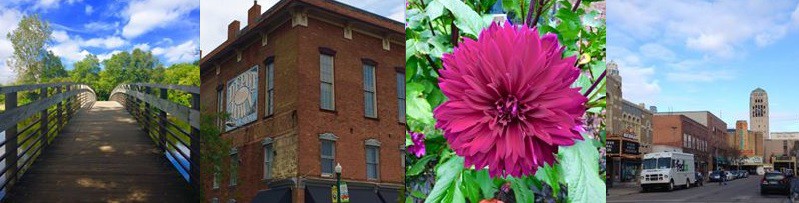
Here are photos of flowers and flowering trees from my neighborhood walk this weekend.
Enjoy.
Gorgeous!

Image Description: A person wearing a yellow and black glove is pulling weeds.
This week, I fixed the clogged sink and worked with a wonky furnace (a clogged condensate pump to be exact).
I call this sadisfaction: Sadness that something stops operating the way it should combined with deep satisfaction at having fixed it. Heck yes!
This week, I also clipped a whole bunch of weeds (those have been waiting for me for a long time) and I got my heart pumping with the exertion of a hand push lawn mower.
AND!
I reached a brand new threshold of adulthood.
Moving back in time more than a decade ago, let me first say that I remember the exact moment I felt like I was a full blown adult. No more stages of emerging adulthood, mind you, but full adulthood. It was the moment I went to buy a mattress. I remember going to a legitimate mattress store. And in a moment of arrival, I remember lying on a bunch of them to try them out. “I”m an adult!” I felt with glee.
Well, this week, I reached a whole new moment of adulthood.
“I am a mid-life adult!” I felt with glee.
Here is the milestone marker: I paid a young adult to do yard work I didn’t want to do.
(And thankfully, a young adult who loves yard work).
“Let me provide for you. To do yard work at my house. That I don’t want to do.” Every part of that feels like mid-life adulthood.
GET ON MY LAWN!
I have arrived.
In the sadisfaction, the chores, and the delegation of mid-life adulthood, I need to give a nod to Rachel Held Evans and say, I am WOMAN OF VALOR.* I am getting it done, and it deserves praise.
*I am linking above to Rev. Nadia Bolz-Weber’s gorgeous and powerful eulogy for Rachel Held Evans. I listened to this recently, and her sermon brought me to tears. I recommend reading it, or even more, listening to it, if you can. She says, “As you will discover when you read A Year of Biblical Womanhood, the best translation of eshet chayil is not ‘woman of virtue’ but actually “woman of valor,” and as Rachel teaches us, the most faithful use of Proverbs 31 is not as an unattainable standard women must reach in order to be worthy of praise, but as an example of how much in women’s lives and work is already worthy of praise.”
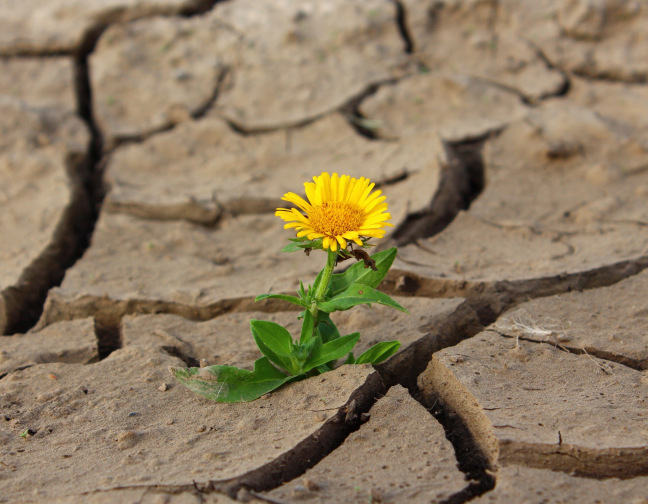
Image Description: A dandelion grows in one of many cracks in the mud.
What is your resilience story?
Have you thought about that recently? A story from your life, the life of your family, or your community? It might be helpful to bring such a story to mind – to recall those chapters and moments when we endured stress, challenge, trauma, and loss and made it through.
When we were empowered to keep going. . .
When we gained grit and resolve. . .
When we experienced renewed life, despite the pain we have known. . .
When we gained insight we cannot lose. . .
Resiliency is often totally unexpected, but it happens around us and through us. Certainly, none these forms of growth transform trauma into some kind of collective good. Far from it. But there are times when resiliency accompanies even our greatest pain and brings us through despite what we might have anticipated.
We are living in a time of collective stress and fear. As I talk with people, many are saying that they feel despair and dread. If that’s where we are, I encourage us to honor those feelings.
Alongside challenging feelings, some are facing tangible concerns and threats to their safety. We need to take these seriously and create protective strategies in our communities.
We will be even more empowered to do so if we can remember resiliency. What is your resilience story? Can you call it to mind?
In some ancient languages, the word ‘remember’ does not simply mean that we recall something from the past. It means that we make it present.
Mental health experts tell us that people tend to gain healing from stress, challenge, trauma, and loss when they can put their experiences into a personal narrative. Can we take some time today to tell our resilience stories to ourselves? Can we put their power into our bodies, minds, and spirits?
And one of the best strategies for gaining resiliency is to connect with good and trusted relationships of support and care. Have we told anyone our resilience story lately? There is great power in sharing such stories with one another.
We can consider doing that. And wherever we are and however we’re feeling, we can let these stories guide us.

[Voyager 1 pale blue dot. Image credit: NASA/JPL]
When we connect with a sense of Beyond — when we zoom out to see a larger field of view — we see ourselves in a different light. We encounter our finitude, our fragility, and our power.
In 1990, the space probe and explorer Voyager 1 was 13 years old and 3.7 billion miles away from the earth. On February 14 of that year, scientists commanded the probe to turn around and take a photo of the earth. That command resulted in this image. Astronomer Carl Sagan called it “the pale blue dot.”
He added poetic meaning and power when he added convicting words to this image. He said,
Look again at that dot. That’s here. That’s home. That’s us. On it everyone you love, everyone you know, everyone you ever heard of, every human being who ever was, lived out their lives. The aggregate of our joy and suffering, thousands of confident religions, ideologies, and economic doctrines, every hunter and forager, every hero and coward, every creator and destroyer of civilization, every king and peasant, every young couple in love, every mother and father, hopeful child, inventor and explorer, every teacher of morals, every corrupt politician, every “superstar,” every “supreme leader,” every saint and sinner in the history of our species lived there–on a mote of dust suspended in a sunbeam.
The Earth is a very small stage in a vast cosmic arena. Think of the rivers of blood spilled by all those generals and emperors so that, in glory and triumph, they could become the momentary masters of a fraction of a dot. Think of the endless cruelties visited by the inhabitants of one corner of this pixel on the scarcely distinguishable inhabitants of some other corner, how frequent their misunderstandings, how eager they are to kill one another, how fervent their hatreds.
Our posturings, our imagined self-importance, the delusion that we have some privileged position in the Universe, are challenged by this point of pale light. Our planet is a lonely speck in the great enveloping cosmic dark. In our obscurity, in all this vastness, there is no hint that help will come from elsewhere to save us from ourselves.
The Earth is the only world known so far to harbor life. There is nowhere else, at least in the near future, to which our species could migrate. Visit, yes. Settle, not yet. Like it or not, for the moment the Earth is where we make our stand.
It has been said that astronomy is a humbling and character-building experience. There is perhaps no better demonstration of the folly of human conceits than this distant image of our tiny world. To me, it underscores our responsibility to deal more kindly with one another, and to preserve and cherish the pale blue dot, the only home we’ve ever known.
-Carl Sagan, Pale Blue Dot, 1994.
Our finitude.
Our fragility.
Our power.
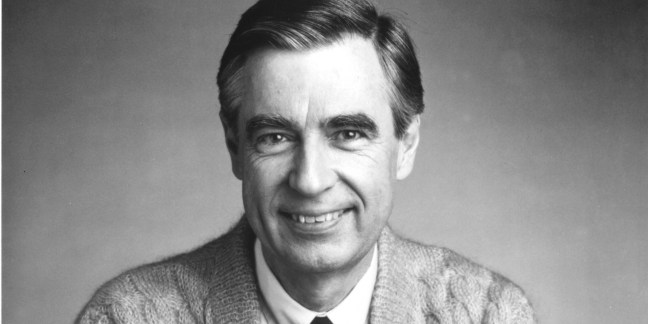
I think you all probably know that if could choose a person to be my personal patron saint or even an additional Grandpa, I would likely choose Fred Rogers. I admire him so much – not only for his tremendous work, but for his way of being in the world.
A few years ago, I ran across a testimony that demonstrated how crucial and life-saving his work truly was. It involved a continual commitment to remind vulnerable people how special and valuable they were. He changed the lives of children, including children who were abused at home. This testimony said,
“. . . he seemed to look me in the eye when he said, ‘And I like you just for being you’. In that moment, it was like he was reaching across time and space to say these words to me when I needed them most. . . I was sure I deserved every last moment of abuse, every blow, every bad name. I was sure I earned it, sure I didn’t deserve better. I knew all of these things … until that moment. If this man, who I hadn’t even met, liked me just for being me, then I couldn’t be all bad. Then maybe someone could love me, even if it wasn’t my Mom.”
I believe we need a renewed commitment to uplift the intrinsic worth and value in human beings. We need this in the wake of hatred, poverty, racism, exclusion, violence, abuse, and more. . . These forces are intense and entrenched among us. They require us to speak truth to power, so I don’t mean to be reductionistic or say that a simple declaration of worth is all that it takes. But it’s never not about that.
It’s a life-giving, foundational truth, that —
despite the pain we know,
despite the pain we cause,
despite the harsh words we hear,
despite the harsh labels we believe,
despite the forces which declare some to be ‘less than,’
despite the despair which internalizes the same,
we are loved with a Love we cannot lose.
And that Love says that we are worth it.

Image Description: The sun shines through a plane of broken glass.
Do you know this saying?
If a thing’s worth doing, it’s worth doing well.
Don’t get me wrong. I support hard work and excellence and all of that, but ultimately, I appreciate what G.K. Chesterton has to say about this. He was known for turning common sayings on their head in order to gain greater meaning from them. He started to say this instead:
If a thing’s worth doing, it’s worth doing badly.
That’s better. It may sound strange to our ears, but it’s more life-giving. Because if we think about it, it brings home this truth: If a thing is worth doing, it’s worth doing. Period. No matter the result.
– This saying bolsters people who are willing to try something innovative, even as they recognize the possibility for failure. If it turns out badly, it may be the necessary catalyst for learning. The process or the failure itself may yield insights and discoveries toward the next idea, one that would have never been conceptualized beforehand.
– This saying bolsters people who are pursuing a calling, even as they reckon with the reality that some will place roadblocks in their path. The journey toward any kind of calling takes twists and bends. At times, the these turns are remarkably unfair. At times, they are thoroughly unjust. I do not make light of this. They are harmful — not good. But the calling can emerge in spite of them.
– This saying bolsters people who are willing to tell the truth, even as they recognize it marks them for risk. Whistleblowers come to mind, in particular. There are times when we honestly cannot afford such risks. But when we can, there is life and vitality in speaking truth to power. Even if we do not shift the power entirely, those words of truth are out there in the world. They keep working. I trust that they take on a life of their own, especially as they inspire more people to come forward and speak truthfully.
It’s messy.
But if a thing’s worth doing, it’s worth doing badly.
Image Description: A white strip of paper says “Thank you…” in black, cursive ink with a pen above the ellipsis. There’s a red background.
As bizarro as Coronavirus Time™ has been with so much distance and separation, the Michigan Nones and Dones Community has met with more frequency, not less, but over Zoom.
Now that we are using this platform, we can invite people outside of Southeast Michigan to join us. With this in mind, I realize I can extend this invitation right here! Want to join our next event? ( Saturday, May 16 at 10am EDT)
Would you say that you’re spiritually curious but institutionally suspicious? Or spiritual but not religious? Or committed to a religious tradition but struggling with an organized religious community? Or someone who doesn’t want a label — just a good conversation? We’d love to have you join us.
Here’s our next event. I invite you if this intrigues you. We’ll meet over Zoom. Just RSVP, and we’ll send you the Zoom information.
Showing up: For yourself, For Others (<— Click this link to RSVP)
Event Description:
“In the challenge of this pandemic, what does it mean to show up?
For yourself?
For others?
We invite you to join the Michigan Nones and Dones community for a conversation about the unique ways we give and receive as ourselves. We’ll meet on Saturday, May 16 from 10-11:30am over Zoom. (Please RSVP, and we’ll send you the Zoom information in a personal message. You can meet us over video or over the phone.)
Who are you uniquely in the world? What spiritual gifts and callings do you have? How can you receive and give from these?
A quote from Fred Rogers (Mr. Rogers!):
“All of us, at some time or other, need help. Whether we’re giving or receiving help, each one of us has something valuable to bring to this world. That’s one of the things that connects us as neighbors–in our own way, each one of us is a giver and a receiver.”
See you on Saturday!”
We’d love to have you!

Image Description: A curvy line of tea light candles.
My motherhood always feels like wonderment.
“Where then have these come from?”
Isaiah 49:19-21
Surely your waste and your desolate places
and your devastated land—
surely now you will be too crowded for your inhabitants,
and those who swallowed you up will be far away.
The children born in the time of your bereavement
will yet say in your hearing:
‘The place is too crowded for me;
make room for me to settle.’
Then you will say in your heart,
‘Who has borne me these?
I was bereaved and barren,
exiled and put away—
so who has reared these?
I was left all alone—
where then have these come from?’
Today, I’d like to share Kim Andre Arnesen’s choral piece, “Even When He Is Silent.” The text comes from words that were discovered at Auschwitz, etched on a wall by a Jewish prisoner. This performance is by the S:t Jacobs Vokalensemble.
Text:
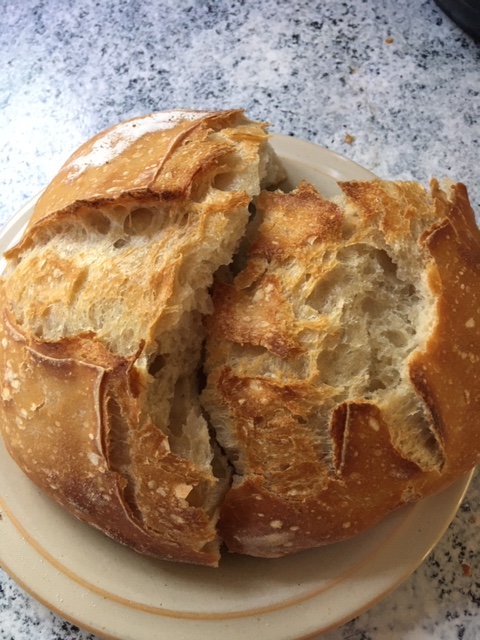
Image Description: A freshly baked loaf of sourdough bread, cut in half, on a beige color plate on a kitchen counter.
My friend L seems to have telepathic knowledge of my food cravings. He and his family are the ones who delivered homemade cookies and cream ice cream to my doorstep on Easter Sunday without any knowledge that I was specifically missing out on that exact treat. I was looking forward to it so much, but my grocery delivery was canceled that very day.
Yesterday morning, I said to myself, “I really wish I had some sourdough bread.” I thought about how delicious that sounded, and I imagined having some with butter or olive oil and spices. “I wonder how I can order some?” I wondered with curiosity.
Then in the afternoon, L sent me a message and said, “I’m baking two sourdough loaves today. Would you like one of them?”
How does he know?
You know, it’s pretty special to have unique skills for telepathic snack summoning. Move over ESP. I have TSS.
The real truth, of course, is it’s pretty special to have such wonderful friends — SWF — especially in a difficult time like this.
Thanks L and Fam.

