I think my relationship with productivity is changing.
We all have a relationship to work, work culture, and productivity. What motivates us to work? What do we enjoy about it, and what feels draining? How does our work impact our relationships? How does our sense of vocation impact our work? Do we feel free in that work, or do we feel weighed down by the demands of others? Does it seem that our work is in alignment with who we are, or not? Do we have time for rest, or do we feel as though the work never ends? Do we have the material resources we need to do the work we feel called to do, or is that a challenge in some way? How does our work affect larger communities?
In an American context, it is virtually impossible to avoid being influenced by such questions, whether they are expressed consciously or unconsciously. Above all, it is virtually impossible to avoid being influenced by the culture of American capitalism itself. The drive of this system often indicates that productivity and human worth are linked: The more you produce, the more worth and value you have as a person. But of course, this is a lie. It can even be a dangerous lie. It puts stigma on some. It may cause us to question ourselves.
In a context where all of these questions swirl around culturally, I don’t think we ever fully arrive in any particular relationship to work. We are always asking such questions. We are always being shaped by such questions.
So, in the midst of this, I think my relationship with productivity is changing. I’ve been especially productive over the last two weeks or so. (For the record, this doesn’t make me any more worthwhile than other weeks I’ve experienced.)
And here’s what I notice: I don’t feel like my productivity is about busyness. I don’t feel like I’m working in order to keep anyone’s criticism at bay. I don’t feel like the goal of my work is to conform to a great deal of others’ expectations (There is immense privilege in this statement, by the way — that is, to rejoice in directing your own work, rather than being directed by others. There’s also some limitation too. In order to do it, I have no salary support. Working on that!)
No, instead, the shift is simply this: I have been especially productive lately because I am really and truly enjoying the act of creating. I am enjoying the creation of new possibilities, and some of those other cultural influences are fading. I’ve gotten into more flow.
This isn’t an arrival point, again because all of these things are in flux. But I am enjoying this, and I am grateful for such a shift. Productivity is feeling fun and meaningful, rather than stressful or coerced. This is a gift.
What about you? How are you feeling in your relationship to work?
Sometimes, movements move in directions you don’t necessarily expect. When I traveled to Lansing yesterday to participate in the Poor People’s Campaign, I didn’t expect to witness people shutting down the Michigan State House with singing. In fact, I don’t think any of us expected that.
It just happened rather spontaneously after we had spent a bit more than an hour outside, listening to personal stories from people directly impacted by poverty and the war economy:
-The United States spends about ten times more on the military weaponry than any nation considered an ally or any nation considered a threat. This money could instead go to education, healthcare, infrastructure, and innovation.
-The branches of the armed services recruit in high schools among students who live in poverty. These young people are offered signing bonuses which seem particularly enticing because the money can aid their poor families. I support the needs of people who have made the choice to enlist, and I believe they should have care and opportunity after they leave the military. At the same time, people in poverty should not feel as though military enlistment is their only choice for a viable future. We know that across the board (not only those in poverty) veterans do not always receive the care, support, and opportunity they need. This means that some never escape poverty after all. And some veterans return with financial and emotional needs so great that they end up on the street. There is an economy profiting off of all of this. Veterans deserve our care. Young people deserve our care. This is wrong.
-When military equipment and weaponry is no longer used within the armed forces, it often moves into militarized police departments around the country. And we know that this equipment is used in physically and emotionally violent ways, especially in poor communities and particularly among Black residents and residents of color.
-There is also an economy that is profiting off of gun sales, and without having adequate checks in place, wealthy people profit by putting more weapons onto the streets and into the hands of people who will use them violently.
The Poor People’s Campaign stands against all of this.
Yesterday, we heard powerful testimonies in front of the Michigan Capitol, and then, we walked inside the building. We walked to the top balcony where we could observe the business of the Michigan House of Representatives. That’s when some people started singing spontaneously. Then, joining them, the entire balcony started singing too. This went on for a long time.
Somebody’s hurting poor people, and it’s gone on far too long, gone on far too long, gone on far too long.
Somebody’s hurting poor people, and it’s gone on far to long, and we won’t be silent anymore.
When the representatives below couldn’t silence the singing, they adjourned. Quite spontaneously, the Poor People’s Campaign shut down the Michigan House of Representatives, all in the necessity of making voices heard. This was not only true of singing itself, but in the lifting up of voices, perspectives, and needs we heard in testimony outside.
The Poor People’s Campaign is a powerful force for moral change.
Last Saturday, the Michigan Nones and Dones community had its 80th gathering.
I was grateful for it too. Since it was Memorial Day weekend, I thought we might not have enough people to move forward with the event, but in the end, we had a wonderful group around a table, sharing in conversation and eating tacos. (Sidenote: tacos equals #blessed 🙂 In fact, half of the group included people who were new to us. It was wonderful to welcome them.
Michigan Nones and Dones is a community that has been meeting in Southeast Michigan for the last two and a half years in coffee shops, restaurants, parks, and homes to talk about spirituality and make meaning together as friends. This community includes people who are religiously unaffiliated (Nones), people who have a faith tradition but have departed from traditional, institutional religious communities (Dones), and people who remain connected to faith communities to some degree but find themselves wanting to question or reform the vision of how those communities function.
We say that Michigan Nones and Dones is a community for people who are “spiritually curious but institutionally suspicious.” It’s amazing how people with many various backgrounds and perspectives can gather together under the umbrella of that description. The community includes,
-people who are agnostic and interested in spirituality and forming friendships of meaning (i.e. by this, I mean talking about life — gifts, challenges, what’s going on in the world, what really matters)
-de-affiliated Christians — folks who identify as Christian, but feel disappointed in and/or ostracized by traditional churches,
-people who are atheists who want to uplift the morality of humanism,
-people who might call themselves inter-spiritual, as they grew up with more than one faith tradition,
-people who say, “I’m secular,” or “spiritual but not religious,”
-people who are religiously unaffiliated and unsure about particular, theological beliefs, but who say, “I believe in a Higher Power of some kind,”
-people who say, “I don’t like labels. I just want to have good conversation,”
-people who are connected with traditional faith communities but frustrated with unethical behavior they see happening there, longing for a better vision,
-people who practice spiritual traditions that might fall under the New Age umbrella.
Michigan Nones and Dones is first and foremost a community, but I realize it is also an incredible platform for conversation. How rare is it to sit around a table with all of these backgrounds, find commonality of experience, and uplift different perspectives in ways that enrich all those who are gathered together? We all learn from one another.
It is a wonderful gift to get together at least twice per month to have these conversations (we meet on 2nd Tuesdays from 6:30-8pm and 4th Saturdays from 11am-12:30pm). These connections matter. These relationships matter, as people are welcomed and heard, invited to share insights, and brought into friendships they might not have made otherwise.
Of all the things I’ve ever blurted out — and quite loudly, so I’m told — this is probably the silliest one.
In 2007, I had a very dramatic skiing accident in Colorado. I fell hard and slid straight into a tree. It’s amazing that I didn’t end up with a concussion. I did, however, end up with a badly broken shoulder.
But before we got to the hospital, we didn’t know any of that. I was just being rushed down a mountain dramatically in an ambulance. I barely remember anything from that day, including that ride, so I rely on the memory of others — namely, Ben Johnston-Krase who was in the ambulance with me.
The paramedic in the ambulance was trying to keep me awake, so he kept asking me questions. I yelled all my answers in response. “On a scale of 1 to 10, Renee, how much does it hurt?” “THREE!!!!” I screamed. “A reminder that 1 is the lowest, and 10 is the highest,” he said to me. “OKAY! FIVE!!!!” (I… might downplay pain sometimes… but hey, at least I gave him what he expected — numbers).
Then he asked me another question: “So Renee, what do you do?”
“I’M A THEOLOGIAN!!!!” I blurted out at full lung capacity.
He wasn’t expecting that one at all. The paramedic looked at Ben with surprise. Then Ben kind of shrugged and nodded. “Well, yeah, that’s kind of true,” he said. I was 25 and in seminary. I liked to speak and write words about God, so I suppose that was indeed, kind of true.
Last week, I thought about this memory all over again when someone referred to me on Facebook as “a theologian.” I smiled, and all these years later, I thought, “Well, yeah, I guess that’s kind of true.”
I do like to speak and write words about God.
I do like to speak and write words about human connections in relationships.
I do like to speak and write words about our world and our callings within it.
And by the way, my definition for theologian is very broad and inclusive. When you do these things, you are also a theologian. We live this calling together. So let me blurt it out for you today: “YOU’RE A THEOLOGIAN!!!” It’s true.
An Announcement
So, in that spirit, a theologian among theologians, I want to share some news today. I think I’m going to blurt out something else entirely. I say it with excitement, trembling, and humility at once (after all, this is an attempt, and I can’t fully control the outcome, you know, like if someone will publish me…) Here it is:
I am going to write a book.
I’m a theologian, and I’m going to write a book.
Or in concert with this post so far, “I’M A THEOLOGIAN, AND I’M GOING TO WRITE A BOOK!”
Specifically,
I am going to write a theological book about kinship —
How do we understand our human relationships with one another, that we are more deeply connected than we often let ourselves imagine?
How might we open some theological frameworks for naming a reality as powerful and life-giving as Family-of-Choice? — Expanding our visions for family and close connections? Queering family? (Thanks here to our LGBTQ siblings) Lifting up awareness that scripture is abundantly full of stories where people deeply choose one another?
How might this shape a vision for Church?
And to begin to move in this direction — that is, to begin to write in this direction — I am first going to speak. I am so grateful for an opportunity this summer.
A Series
My wonderful friend and colleague, Rev. Brooke Pickrell, is going on a well-deserved Sabbatical this summer. She’s the pastor of Northside Presbyterian Church here in Ann Arbor. This congregation is so wonderful. It’s filled with people who have richly chosen one another and people who have lived with great advocacy and choice of their neighbors too.
I’m going to be leading worship there on Sunday mornings throughout the summer, and I’m going to initiate a sermon series in these same directions. There is much I want to lift up and celebrate in this congregation. And I’m hoping that the series is a great launching pad for lifting up the themes of kinship, ultimately to begin a larger writing project as well.
Here is the outline for the summer:
I. Family-of-Choice: A Theology (June)
How might we open some theological frameworks to consider and celebrate Family-of-Choice?
June 3 “I Will Go Where You Go”
Isaiah 43:18-21
Ruth 1:1-18 (Ruth and Naomi)
June 18“Ide!” – The Gift of One Another
Isaiah 49:8-23
John 19:16b-27 (Mary and John)
June 25 “I Do Choose”
Isaiah 55:1-9
Mark 1:40-45 (Jesus and the Unnamed Leper)
II. Belonging: The Kin-dom of God (July)
In part two, I uplift Kingdom of God sayings from Jesus and consider how they might speak to us about belonging. Then I invite us to explore stories about five women in the New Testament who illustrate these sayings and expand belonging in new ways.
“The Kin-dom of God is like. . .
July 1 “. . . a mustard seed”
Matthew 13:31-32
Luke 1:26-56 (Mary and the Magnificat)
July 8 “. . . yeast that a woman took and mixed”
Matthew 13:33
Luke 7:36-50 (The Woman at Simon’s House)
July 15 “. . . treasure hidden in a field”
Matthew 13:44
Matthew 15:21-28 (The Syrophoenician Woman)
July 22 “. . . a merchant in search of pearls”
Matthew 13:44-45
John 4:1-42 (The Samaritan Woman)
July 29 “. . .the master of a household who brings out of his treasure what is new and what is old”
Matthew 13:51-53
John 20:1-18 (Mary Magdalene and the Resurrection)
III. The Household: Church as Kinship (August)
The early Church was often called ‘the household.’ How might these themes of kinship impact our vision for Church?
August 5 “Once you were not a people, but now you are God’s people”
1 Peter 2:1-10
Acts 10:1-48 (Peter and Cornelius)
August 12 “You have become very dear to us”
1 Thessalonians 2:1-8
1 Timothy 1:1-2, 12-19a; 2: 14-16 (Paul and Timothy)
IV. The Fullness of Belonging
What if we allowed ourselves — really and truly — to recognize that we are deeply chosen for a life full of expansive belonging and calling?
September 2 “That you may comprehend the breadth and length, and height, and depth”
Ephesians 3:14-21
Luke 5:1-11 (Jesus and the Calling of the Disciples)
If you are a blog subscriber or perhaps a personal friend reading this post, and you’d like weekly recordings/manuscripts of these sermons, feel free to email me at revannarbor@gmail.com. I won’t be publishing them here directly, but I am pleased to send them out.
Earlier this week, I had a meaningful experience participating in the Poor People’s Campaign. Perhaps you’ve heard about this?
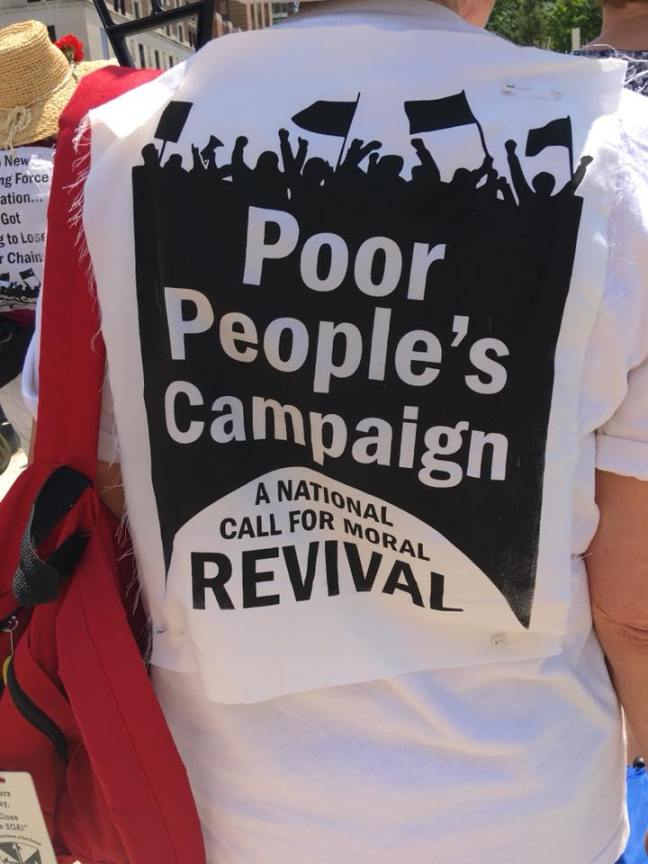
The Poor People’s Campaign is a revival of a movement launched by the Rev. Martin Luther King Jr. in 1968. In the wake of his assassination, however, the campaign did not move forward. Now, fifty years later, the Poor People’s Campaign is being revived and reconfigured for this era. Its formal title is, the Poor People’s Campaign: A National Call for Moral Revival, as it seeks to address the wrongs of
-systemic racism,
-systemic poverty,
-the war economy, and
-ecological devastation.
Right now, the Poor People’s Campaign is taking place in 30 states in an effort to change the moral narrative, leading ultimately to care of neighbors and tangible policies to address and further dismantle these entrenched realities. The Poor People’s Campaign has crafted 40 days of direct action from May 15-June 23. People are traveling to state capitals; holding rallies that lift up the voices, perspectives, and humanity of people who are directly impacted by immoral policies; and engaging in direct action through civil disobedience. People are visibly placing their bodies in public to advocate for neighbors, and some are willfully risking arrest.
Voices of Directly Impacted People
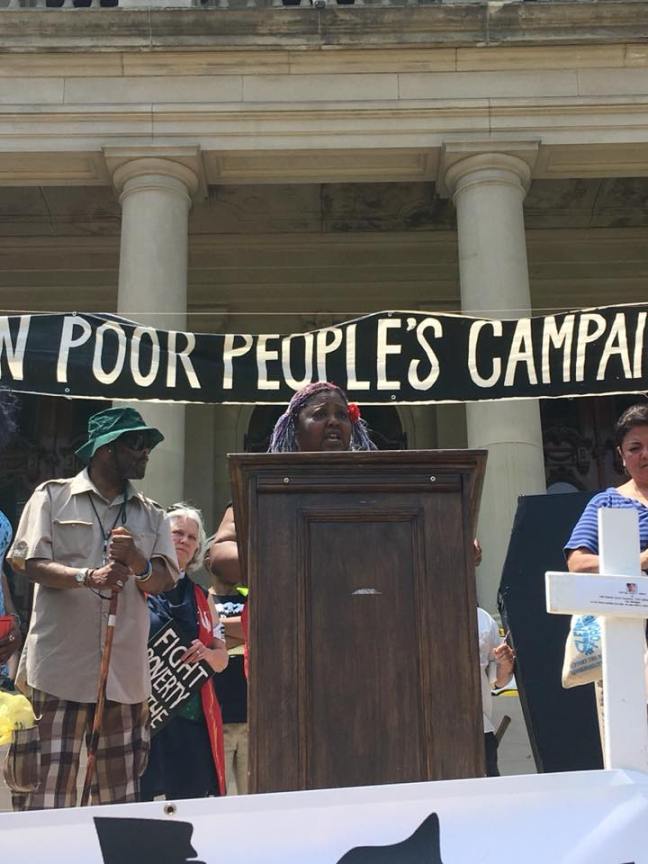
On Monday, I drove with some friends to Lansing, and I had the gift of participating in this movement. We started with a rally in a park. Many clergy were there, and we stood behind people who are directly impacted by systemic racism, mass incarceration, the removal of DACA protections, and risk of deportation. These individuals lifted up their voices and told their stories.
When organizers invited clergy forward to stand behind these powerful speakers, I was very moved to look to my left and see the Rev. Edward Pinkney next to me. A long time organizer in Benton Harbor, Michigan, Rev. Pinkney was targeted unjustly and falsely accused of altering dates on a recall petition for Benton Harbor’s mayor, James Hightower. The recall was prompted by the mayor’s continued support for tax evasion by the Whirlpool Corporation, which is headquartered in Benton Harbor.
With the smallest amount of evidence, and perhaps even more alarming — the use in court of Rev. Pinkney’s activism as evidence itself (i.e. making an argument that he would be the type of person to do this through his political perspectives alone) — Rev. Pinkney was sentenced to ten years in prison. This drew the attention of organizations like the ACLU, concerned that Rev. Pinkney had been targeted as a political prisoner. He was moved around to several prisons in Michigan, and at one point, confined in a cell that had black mold. While all of this was unjust to him personally, Rev. Pinkney spent several years lifting up the abuses and indignities faced by all prisoners in Michigan. I am pleased to say that his case was formally overturned at the beginning of this month. It was so meaningful to see Rev. Pinkney present at the Poor People’s Campaign, continuing to lift up his voice for the needs of many who are harmed within Michigan’s prisons.
Direct Action and Civil Disobedience
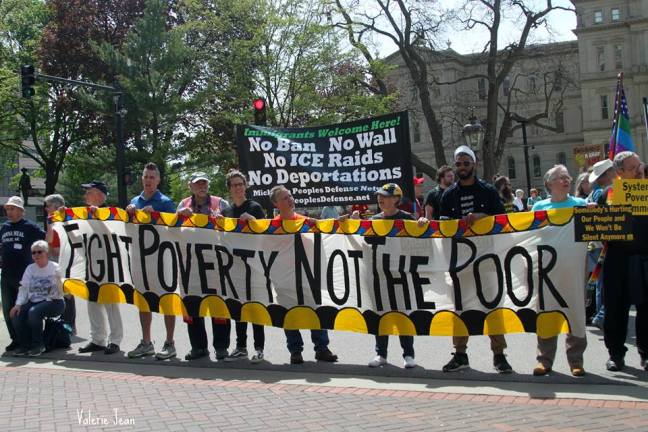
After we had the rally in the park, we marched collectively to the Constitution Hall, a location where many state offices are held. For hours, many marched in a circle in front of the building, articulating a different moral narrative and calling attention to injustices. This took place while some chose civil disobedience and blocked the entrance of the building. They wanted to call attention to these needs by risking arrest.
Eventually, that’s what happened. Some were arrested by the Lansing Police and the Michigan State Police. When people were walked in handcuffs by police to their vehicles, the larger crowd of participants formed an aisle and stood on either side to applaud loudly, giving thanks and adding encouragement to those who chose to be arrested. I noticed that many of the arrested participants were older women. Later, I learned that some of them were Roman Catholic nuns.
Getting Involved
Joining with others in 30 states, we will do it all again next Tuesday, May 29, this time calling attention to the militarism, the war economy, and gun violence. You are invited to get involved too wherever you are.
Those who are doing civil disobedience have all gone to mandatory training. They know before they arrive what they are choosing to do. If you feel called to that vision, training events are still happening. But you can also do direct action in support by attending the rallies and/or marching to where the civil disobedience is happening. All tactics for the Poor People’s Campaign are purposefully non-violent. When you show up with your presence, you will learn, and you will bring visibility to these necessary concerns in our nation.
Ian and I were sitting at the dinner table a few nights ago, when we had this conversation:
Renee: During the years of the Obama Presidency, I think lots of people in this country became more racist. Beyond unconscious bias, I mean. They consciously became more racist.
Ian: But folks have always been like that.
Renee: Oh, for sure.
It’s clear that the Obama Presidency brought people out of the woodwork who were emboldened when they had a President to “Other” in that way. And the Trump Presidency brought even more people out of the woodwork who are emboldened in their racism.
But I guess I mean this: During the years of the Obama Presidency, White Christian America began to feel as though they were tangibly losing influence, so —
Ian: — Why not then become more Christian?
Ian anticipated what I was going to say, which was that White Christian America doubled down on protecting its whiteness. But if Christians were worried about losing influence, why not become more Christian? In word? In deed? In message? In collective action?
I should say that by “White Christian America” I mean something specific. This is the terminology of Robert P. Jones and the Public Religion Research Institute. In his book The End of White Christian America, Jones argues that changing demographics are impacting the nation in these areas:
1) racial ethnicity in the United States (population trends indicate that by approximately 2045, those deemed as ‘white’ will no longer be a majority of the U.S. population)
and
2) religious disaffiliation (approximately 22.8% of Americans are no longer formally affiliated with any particular religious organization)
These have paired to raise anxieties among white Christians and their leaders.
Jones argues that in the wake of losing cultural and political influence, White Christian America began to assert its whiteness further and work tangibly to protect it.
Ian’s question has some grief in it. Worried about losing influence. . . ?
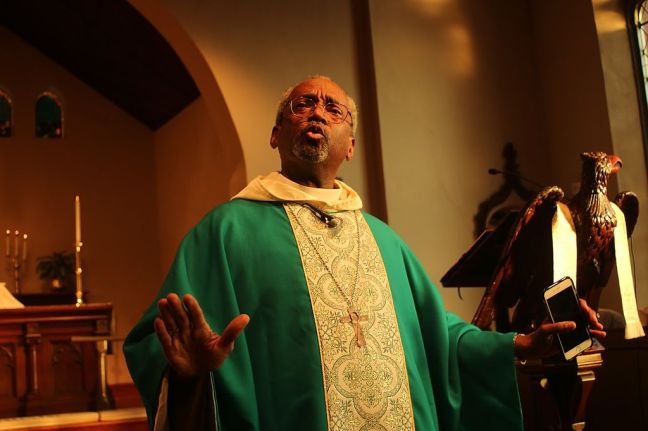
I don’t think it’s a stretch to say that it’s rather rare for a sermon to get passed around the way Bishop Curry’s has over these last few days.
After Michael Curry, Presiding Bishop of the Episcopal Church, preached the homily at the Royal Wedding on Saturday, his sermon has been shared all over social media. It has made its way into articles for a large number of magazines (also shared on social media), and it has been featured in a lot of prime time news slots — temporarily, I might add, displacing the person who seems to dominate television around the clock.
Bishop Curry preached about the power of love — not just the love between a couple, but the calling to love our neighbors — and he invited those listening to imagine a world where humanity had learned to harness the power of love. It was hopeful and inviting. It was empowering.
I love that Bishop Curry’s sermon brought together massive amounts of people who are not typically a community – that is, the 3,000 or so who were present and the many millions who were watching on television. At the very same time, he dared to be remarkably subversive. Both of these were so moving.
Fred Rogers used to say, “I’m so convinced that the space between the television set and the viewer is holy ground. And what we put on the television can, by the Holy Spirit, be translated into what this person needs to hear and see. . .” I think a sense of holy ground was created as 29.2 million people watched and felt a sense of connection with one another. People were moved. Lots of folks who are not overtly religious shared this sermon and spoke to the power of it.
And make no mistake, this sermon was subversive as well. Throughout the sermon, Bishop Curry represented and referenced Black liberation theology as he was in a space historically associated with colonialism, white supremacy, and subjugation. He quoted the Rev. Martin Luther King Jr., and he referenced the influence of enslaved people in the United States. The sermon was powerful for all these reasons too.
So if you haven’t seen it yet, and you’re so inclined, here is a video of the sermon, and here is a transcript. I hope you find it moving too.
This sermon was preached at First Presbyterian Church in Saline, Michigan and was focused upon the story that is told in Acts 2:1-21. The audio recording is above and a written manuscript is below.
I hear that word weaving its way throughout this entire story. It’s a word that is big, expansive, and at times, remarkably surprising.
All.
It’s right there at the beginning, in the very first sentence of the story: When the day of Pentecost had come, they were all together in one place. The disciples of Jesus were all in a house together. The twelve disciples were there, likely with other men, women, and children who called themselves disciples too. We don’t know exactly what they were doing when the great, surprising moment of the Spirit came, but we do know that they were together in community. We do know they were all in one place.
They had been doing this together for a while in a season of waiting. Now surely, they couldn’t have anticipated the full power of this moment in all its details, and most likely, they wouldn’t have necessarily expected it to happen that very day. They couldn’t have anticipated this in its entirety, but they were waiting purposefully.
After Jesus died and showed himself unexpectedly raised to new life, he spoke to his disciples, saying, “Thus it is written, that the Messiah is to suffer and to rise from the dead on the third day, and that repentance and forgiveness of sins is to be proclaimed in his name to all nations, beginning from Jerusalem. You are my witnesses of these things. And see, I am sending upon you what my Father promised; so stay here in the city until you have been clothed with power from on high.”
So when the day of Pentecost had come, they were all together in one place. They were waiting purposefully for the promises of God. But in any given moment, could they have anticipated that the time was right upon them? I bet they were just as stunned as anyone else was that day.
Suddenly from heaven there came a sound like the rush of a violent wind, and it filled the entire house where they were sitting.
I’m sure they were startled.
Divided tongues, as of fire, appeared among them, and a tongue rested on each of them.
What strange, wonderful details.
And that’s when we hear the word again. . .
All of them were filled with the Holy Spirit and began to speak in other languages, as the Spirit gave them ability.
Could they have possibly anticipated this holy moment and what it would be like?
Could they have possibly known how deeply empowered they would become without a moment’s notice?
When the Holy Spirit suddenly entered that room, God empowered them to become witnesses to proclaim this great message of love, liberation, forgiveness, and renewal for the people.
They spoke good news about all these things, and initially, all those who heard them were stunned. Pentecost was an ancient, annual festival of the Jews. People from many different nations were present during this holy moment. They were Jews who lived in other places. They came to Jerusalem from every nation to celebrate this great festival of the harvest.
When the people heard all this sound and these words of love, liberation, forgiveness, and renewal they were shocked. They said, “Are not all these who are speaking Galileans? So how is it that all of us – all of us, wherever we have come from – are hearing these words in our own languages?” They were stunned by this. The story says, All were amazed and perplexed, saying to one another, ‘What does this mean?’
So often, when we enter our own celebration of Pentecost and remember this holy moment, we think of this story as a miracle of tongues. Certainly it was, for in this story, the disciples were speaking languages previously unknown to them. But Eric Law, an Episcopalian priest and author, frames this moment in another way. He says that this Pentecost moment was a miracle of the ear.[2] Suddenly, people divided by language, national origin, and cultural upbringing were connected, and all were able to understand one another.
This is a miracle of God, bringing people together so that this message of good news may be known.
This is what they understood:
Peter, standing with the eleven, raised his voice and said to all of them, People of Judea and all who live in Jerusalem, let this be known to you, and listen to what I say. (And I love this next part). These people are not drunk as you suppose. It’s only 9 in the morning! No, this is what was spoken by the prophet Joel.
And listen as the word all weaves its way through Peter’s speech.
In the last days it will be, God declares, that I will pour out my Spirit upon all flesh, and your sons and your daughters shall prophesy, and your young men shall see visions, and your old men shall dream dreams. Even upon my slaves, both men and women, in those days I will pour out my Spirit; and they shall prophesy.
And Peter closes by saying,
Then everyone who calls on the name of the Lord shall be saved.
All who call on the name of the Lord, leaning in the direction of this vision,
shall know love, liberation, forgiveness, and renewal.
That’s what happens in this moment of Pentecost.
Beyond the portion of the text we read today, Peter continues in his speech. He talks about the life, death, and resurrection of Jesus. He talks about love, liberation, forgiveness, and renewal. Peter shares all of this with the people, for God is providing all of these for the people.
And after they heard all of this, the story continues, saying that they were cut to the heart. They said to Peter and the other apostles, “What should we do?” Peter invites them to repent — which means to change one’s mindset — be baptized, and receive the Holy Spirit.
And they do. The story goes on to say,
Those who welcomed his message were baptized, and that day, about three thousand persons were added.
So this day of Pentecost –
the day we are living together –
I keep thinking about this word All
and the power that is within it.
I marvel at the power and the beauty of the large, expansive vision of God. All.
I marvel at the power and the beauty present
when we are all gathered together,
not simply living a mundane moment,
not simply living one of 52 Sundays on the calendar,
but being present this day and waiting upon God.
All.
I marvel at the power and beauty that takes place
when all are empowered, including those beyond our sanctuary,
perhaps to do things that have seemed impossible. All.
I marvel when all are able to understand each other,
especially in this world where see so many divisions —
our genders,
our races and ethnicities,
our class structures,
our political divisions,
our expressions of culture,
our expressions of church culture. . .
What a miracle it is when we are all able to understand one another and our neighbors, and recognize that the Spirit of God can be found in and among all of these human lives.
I marvel at this word: All.
And it makes me wonder. . .
When we are gathered together — when all of us are in one place — do we expect very much from that experience?
Do we think that anything transformative is possible? Or do we see this gathering as just another run-of-the-mill routine in our lives?
Do I expect very much? Or do I assume that yes, I’m going to be guest preacher, and step into another pulpit, and speak for a while. Go home. . . have lunch. . . and continue in a run-of-the-mill day? Sometimes, I think that way.
Or might we expect that God will show up and expand our vision, our thinking, our understanding of ourselves, and indeed the whole world?
Might it be possible that the love, liberation, forgiveness, and renewal of God might be present, on display, and transformative in ways that are surprising and uplifting? Might that presence of the Spirit help us expand the ways we view our neighbors and understand how we are called to love — breaking open all those ways in which we limit our understandings of who we are and who our neighbors are, ways that we sometimes reduce ourselves or our neighbors?
My goodness, do we think that the Spirit could change us? Even today? Even this very hour? Do we?
I wonder. . .
Yesterday — you might have heard about this — the world had a Royal Wedding. Lots of people in the world, depending on where they live, woke up early or stayed up late to watch this wedding take place live.
And during the wedding, Michael Curry, the Presiding Bishop of the Episcopalian Church in the United States, preached the homily. Maybe you heard about this too, because all day long, I saw social media feeds on Facebook and Twitter filled with his presence, as people shared his words and praised the moment. How often these days do we sermons shared so broadly on social media?
In his sermon, Bishop Curry did some things that were unexpected. And who can know all the ways the Spirit might have unexpectedly impacted human hearts in that moment, in his words, and in the particular thoughts and unfolding callings of people around the world? Because millions upon millions of people were watching, all gathered in one place.
Bishop Curry brought the influence of Black liberation theology into the Royal Family, quoting Martin Luther King Jr. and uplifting the witness of American slaves. And Bishop Curry talked universally about the power of love, inviting us into its power. “There is power in love,” he said again and again.
He spoke about fire, and all that has been possible — health, migration, science, medicine, technology — because humanity has harnessed the power of fire. He asked us, What might be possible if humanity began to harness the power of love?
Yes, what might be possible? What unexpected, transformative good news might be possible — for our neighbors, for ourselves, for the whole world? What love? What liberation? What forgiveness? What renewal?
And friends, how can we be a part of it?
Isn’t that one of the questions that is before us today on Pentecost — a day so surprising and wonderful? How can we be a part of this?
So let’s close in the same way we began,
with that opening sentence of the scripture made present to us now:
When the day of Pentecost had come, the people of First Presbyterian Church of Saline were all together in one place.