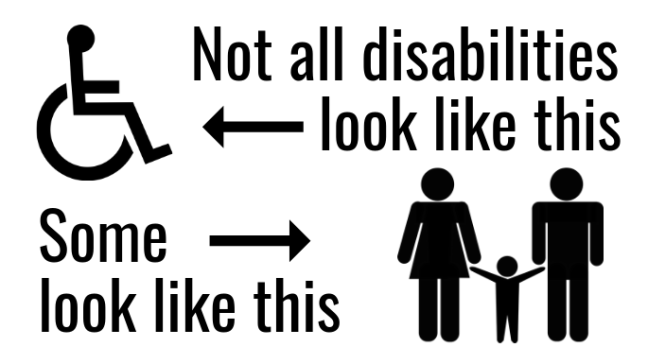
[I found this image on Kerry Magro’s blog on a piece entitled, What I would Like People to Know About Having Autism and an Invisible Disability. Image Description: White background, black text. There is a phrase at the top which reads, “Not all disabilities look like this,” with an arrow pointing to the traditional disability symbol of someone using a wheelchair. There is a phrase below which reads, “Some look like this,” pointing to symbols of three people. Two are adults with a child in the middle holding the hands of both adults.”]
A long, empowering post:
Disability has always been a part of my life in one way or another.
If you’ve followed this blog over the last year, or if you follow me on social media, you’ll know that I have begun to focus my activism in the direction of addressing ableism, health stigma, and access to health care. At the end of last year, I wrote a post sharing that I wanted to set my intention to move in this direction in 2019. And so, I have. It’s been a wonderful experience.
Recently, I said to a loved one, “I can’t do this work and act like as though this hasn’t been a part of my life too.” Then I added, “But even more, I don’t want to do that.”
Disability has always been a part of my life in one way or another. It’s part of my story. It shaped who I became and what I care about. Turns out I’ve been in a disabled body this whole time. (And because I’m anticipating the possibility of some misconceptions rising to the surface, in a moment, I’m going to bust some myths about what that means). The truth is, until this stage of my life, I’ve never had adequate space to say something like this. Saying it now is liberating.
When I say that disability has always been a part of my life, I circle back to some the pieces I have shared here in the last twelve months — pieces that articulated how disability is a part of my story:
— This year, I began to write publicly about my childhood epilepsy. (Here and Here) That epilepsy eventually went into remission, but the experience had an enormous impact upon my upbringing and who I became as an adult. Though seizures have faded, I still have some physical vestiges of this too. As fun as it is to watch me cut a rug — and boy, can I cut a rug — don’t take me to a rave to do it: I still have a photosensitive brain.
— And yesterday, I wrote about my history of trauma and C-PTSD. (Here) Many of the hallmark symptoms of C-PTSD have faded in frequency and intensity for me over the years, and gratefully. But as I shared yesterday, that long history of trauma and the history of this whole body illness left me with a compromised nervous system. This means I have to practice certain rhythms (sleep is especially important) and take care of this with intention.
With this body, I am both particularly sensitive to stress and particularly resilient to stress. I’m remarkably skilled at navigating high stress and still functioning. (Because most of my life, I’ve had to do that. And I’m not bragging about this. This doesn’t make me a ‘Good Survivor’ or ‘better’ disabled person. I’m sad about the pressure I’ve felt to hide things and perform to certain expectations).
I don’t crumple in stress; I tend to rise to it. But it also impacts my body on a whole nervous system level. And since that system governs the body as a whole, it can lead to health challenges later. (See also this phenomenal TED Talk). That is why I am addressing this very intentionally. At this stage of my life, I’m actually choosing less stress.
That choice is pretty great.
So yes, turns out I’ve been in a disabled body this whole time. And as I said yesterday, I’m proud of who I am. Likewise, I’m proud of this body I have.
So let’s allow these misconceptions rise to the surface, so I can answer them on my own terms. Enter… the Interlocutor! (With whom I can also be a little toasty.)
“But Renee, why use such a negative word about yourself?”
The words ‘disability’ and ‘disabled’ are not negative words or bad words. Disability is a normal part of our human existence. Approximately 20% of the population lives with a disability. We tend to view such words with negative connotations because our larger culture finds a remarkable number of ways to shame and stigmatize bodies that do not meet some ‘standard’ or particular ‘norm.’ This is ableism.
People with disabilities can identify themselves and articulate their experiences in the ways they choose, and there are many ways to do that. It is irritating to many, however, when people without disabilities insist on using euphemistic language and/or tell disabled people they should not identify or talk about their experiences through the language of disability. Stop doing that, Interlocutor!
“But Renee, isn’t this… limiting yourself?”
The problem in your question, Interlocutor, is that you define disability purely through the lens of limitation alone. That, and you think I’m doing this to myself. Now, of course, disability does sometimes involve particular limitations. That is true, and by the way, that is okay.
And while we’re on that subject, let’s explore how we talk about these things. Who doesn’t have limitations particular to oneself? And who doesn’t use accommodations or assistive devices in one way or another? Glasses? Gloves? Escalators? Siri? As I recently saw on Twitter, no one talks about glasses the way people talk about wheelchairs.
“Despite being confined to glasses, she overcame.”
“She didn’t let her glasses hold her back.”
“It’s true that she had poor eyesight, but she didn’t let that limit her.”
(See how we’ve deemed certain limitations and certain assistive devices as normal and others as, well, “other-ed?” And when we say these things about wheelchairs, we are additionally providing examples of inspiration porn. <– Really, look that up. And Google more about it and the harm it does).
But beyond asking those questions and making these observations, disability is about much more than limitations. It’s about physically existing in the world in a variety of ways. It’s about particularity. It’s about identity. It’s about story. It’s about body. It’s about being part of a wider community — a larger disability community, which is pretty rad by the way, and belonging to the community as a whole, presenting particular gifts, particular needs, and particular skills. And that combination is true for any of us, by the way.
“But Renee, if you talk about yourself this way… aren’t you afraid that people will think you’re incapable?”
Again, Interlocutor, why on earth are you defining disability through the lens of incapability? Why is this always one of your first questions?
For some reason, people tend to think about disability in a binary way — as if people are totally disabled or totally not disabled. And because we stigmatize and ‘other’ people with disabled bodies, we think about folks as if they are incapable in some generalized way, and from there, deem them as less-than. (Note also, Interlocutor, the harmful cultural tendency to assign worth based on capability and certain forms/levels of productivity.)
Plus, disability isn’t a binary…
— For instance, did you know that many wheelchair users can walk or stand for a limited amount of time? But because people think about disability as a binary, wheelchair users get harassed in public all the time when they stand to reach for an item at the grocery store or walk to the back of the vehicle to pack their wheelchair away. If disability is viewed as ‘total incapability,’ these people must be fakers, right?
No, not in the slightest.
People can use mobility aids for safety, security, balance, the preservation of energy, the avoidance of fatigue, or other reasons entirely. (See also the hashtag #AmbulatoryWheelchairUsersExist, initiated by Annie Segarra, which talks about these kinds of harassment experiences. Let’s end that.)
— Many times, experiences of disability are episodic. They come and go. People should be able to talk about their experiences as they choose and/or share the need for accommodations in fluctuating ways without others viewing them as 1) utterly incapable or 2) someone who must be overreacting and feigning a disability.
— The belief that disabled people are completely incapable, and therefore, miserable and to be pitied, can have disastrous impacts for people. This is a horrible thing to consider, but do you know that the Trump administration has proposed initiating a program to monitor the social media accounts of disabled people who are receiving government services, so that if they seem too happy or are pictured doing certain activities, they can be denied assistance and potentially investigated for fraud?
The ignorance and distain for disability and can have devastating outcomes.
“But Renee, aren’t you concerned that some future employer will find this blog post someday… and make too many assumptions about you… or discriminate against you?”
Actually, yes.
But that shouldn’t be the case.
I learned earlier today that my Presbytery is promoting an upcoming event — an opportunity for people to view a film entitled, Resilience: The Biology of Stress and the Science of Hope. I’ve already seen it. It’s quite wonderful, and I might go to the event too.
And you know what? It’s about my disability.
It’s about how such a disability can take form, and also how it can be supported and aided toward greater ease, wellness, and resilience.
People from a variety of congregations may attend. They will love the film in its honesty and in its possibility. But I wonder, could I be a pastor in one of these congregations, name this disability, its story, and its particular needs… without facing negative consequences in my relationships? Without facing negative consequences to my employment?
Or…
Might it be possible for a pastor to minister as a whole person? Might it be possible for a pastor to serve precisely as herself… knowing that many others need an accompanier who has some understanding of disability, mental illness, and cultural health stigma?
Some might make assumptions about me and what they do not understand. This could include discrimination in my church circles or in other employment circles.
But… it’s not worth continuing a situation where I can’t have my story and tell my story in public. I am a disability activist. I want to write disability theology. And I have always existed in the world in a disabled body — having carried two disabilities, which despite their prevalence, face severe cultural stigmatization (1 in 26 people will have epilepsy at some point in their lives; 1 in 5 people have a mental illness).
But you know what? If I speak about my experiences, I might be able to shift that… even just a bit.
“Oh, so is this why you’re doing this?”
Yes, now you’ve got it.
–Renee Roederer