You Can Be That Grandmother

shoe1

[The Old Woman Who Lived in a Show, image from Artisan Landscape]

“What if you think of it this way?” she said.

Sometimes, we can shift a situation simply by reframing it.

Years ago, a friend of mine was feeling sad, frustrated, and angry. Then, as we sometimes do, she began to turn those feelings inward, feeling sad, frustrated, and angry with herself for having such feelings in the first place. In the midst of that, she had a conversation with someone pretty wise. That person said,

“Imagine you’re a grandmother, and you have so very many grandchildren. In fact, you have more grandchildren than you can count, and maybe they’re running around all over the place. It probably feels pretty disorienting. Frustrated though you are, you’re a loving grandmother, so rather than lashing out at all these grandchildren, you approach them one at a time, and you try to figure out why each one is acting up. These grandchildren are your feelings. Maybe they have some things to tell you. What if you approach them one by one and ask them they need?

“Maybe you say, ‘Honey, you can’t run around like this, and you can’t hit your sister feeling over the head. But come here. Can you tell me why you’re frustrated? Can you tell me why you’re feeling so sad? I’m listening to you.’

“Then listen to yourself. Really listen. Mirror back what you hear. ‘Oh, I hear that you’re scared. Yeah, that can feel scary.’ Then say, ‘I’m here.’ And give these grandchildren what they need — love, reassurance, and confidence that you’re going to be present and that you’ll protect them.”

This was a wise reframing.

Sometimes, we especially need to remember that we are in relationship with ourselves. Entering that recognition more deeply, we can have important insights and grow. None of us is uniform or monolithic. We have parts, and sometimes, some parts of ourselves need to be heard by other parts. We can have internal dialogue. No need for shame spirals. We can hear ourselves with loving intention.

So if it’s helpful, I offer this reframing: You too can be that grandmother.

–Renee Roederer

The Guesthouse

This being human is a guest house.
Every morning a new arrival.

A joy, a depression, a meanness,
some momentary awareness comes
as an unexpected visitor.

Welcome and entertain them all!
Even if they are a crowd of sorrows,
who violently sweep your house
empty of its furniture,
still, treat each guest honorably.
He may be clearing you out
for some new delight.

The dark thought, the shame, the malice.
meet them at the door laughing and invite them in.

Be grateful for whatever comes.
because each has been sent
as a guide from beyond.

— Jellaludin Rumi,
translation by Coleman Barks

“By Just Your Being You”

img_8347

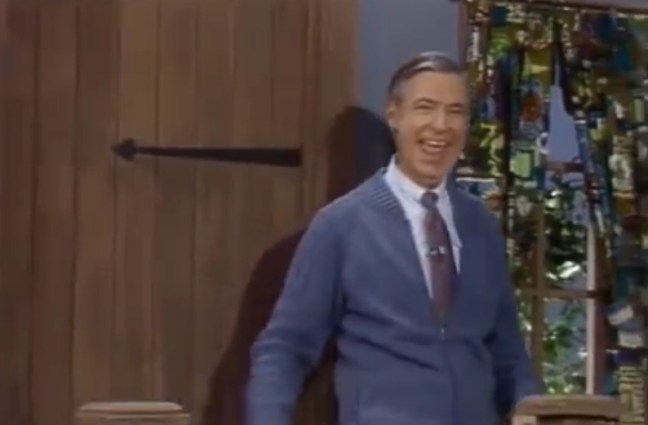
Fred Rogers closed every episode of Mr. Roger’s Neighborhood with the same statement:

You make each day a special day. You know how, by just your being you. There’s only one person in this whole world like you.

He said this daily with emphasis and intention. Occasionally, he said it with playfulness. He always meant it, and young children across the United States internalized this message inside themselves. They came to believe it. Very likely, many came to memorize it, and in anticipation, they said it along with him, either aloud or inside their own minds.

You make each day a special day. You know how, by just your being you. There’s only one person in this whole world like you.

This was a litany of sorts. A daily recitation.

We might also call it liturgy.

Liturgy literally means, “Work of the people” — sacred words voiced, shared, and enacted. Perhaps in these days, we need to voice, share, and enact the convictions behind this daily statement.

You make each day a special day. You know how, by just your being you. There’s only one person in this whole world like you.

And maybe part of our work as a people is to internalize these words inside ourselves as well.

After all, I notice one intriguing word in this daily liturgy. It’s the word your. Fred Rogers could have easily said, “You make each day special. You know how, by just being you.” But instead, he added the word your. “You know how, by just your being you.” His phrasing is actually a bit more clunky than it has to be.

But it’s also important. We are invited to know our specialness, worth, and value as ours. We are encouraged to be in relationship with ourselves — “being you” — knowing that even in our days of doubt, we are worth loving. We can live in conversation with this reality, recognizing when we are living in alignment with its values and when we have temporarily acted outside of them. We can always return.

And this isn’t ego, a way of setting ourselves against others or above others. It is a reality we live in relationship with others. So we hear and speak it again in relationship:

You make each day a special day. You know how, by just your being you. There’s only one person in this whole world like you.

And we come to make it ours.

–Renee Roederer

Kinship: Idou

heart

Of all the narratives in the Bible, I find myself frequently returning to a story that is only three verses long:

But standing by the cross of Jesus were his mother, and his mother’s sister, Mary the wife of Clopas, and Mary Magdalene.  When Jesus saw his mother, and the disciple whom he loved standing near, he said to his mother, “Woman, behold, your son!” Then he said to the disciple, “Behold, your mother!” And from that hour the disciple took her to his own home. (John 19:25-27)

Many years ago, I heard this passage during a Good Friday service, and for some reason in that particular moment, this vignette from the cross completely convicted and invigorated me. It is a reminder that the words of scripture can always become more than mere words on a page. Read in community, they can take on life in very particular ways – we might even say Incarnational ways, as they become infused with meaning.

That’s what happened to me that night. In that moment, I encountered this story of Jesus giving his Disciple and his Mother in Kinship to one another, and suddenly, I began to recall all the people to whom I had been given. Over and over again, this had been true. Particular people with names and faces. . . particular experiences and stories. . . particular affections and expressions of belonging. . . particular ways of building relational language and naming the beauty of our connections.

Over and over again. . .

And since that night, this has continued to happen over and over again. . .

This is sheer gift. We are given to one another — not in a possessive sense, but in giftedness itself. At times, this might come as a surprise. Like the original story, these connections can be born in times of suffering, In such moments, we add comfort and commitment to one another. At other times, they can be born of joy. We discover we have connections deeper than we previously imagined.

And we can marvel about this.

In fact, that’s what happens in this narrative. Jesus gives his Disciple and his Mother toward commitment, but he also gives them toward marveling.

Idou.
That’s the word.

Behold.

See each other and marvel.

Idou.
That’s the Greek word of the original text.

Idou.
Behold!
See
with
depth, and
meaning, and
wonderment.

Behold, you belong to one another.
Mother and Son,
You and Me,
All of Us.

We too have been given to one another for this kind of commitment and this kind of wonder.

Idou.

What if we take some moments, in person or even in our imagination, to allow ourselves to see this giftedness once more, entering an invitation anew to behold and see one another — truly, in the giftedness that is present, real, and alive?

Idou.
Marvel.

–Renee Roederer

This post is part of a series this week. Feel free to check out the other pieces too:

Kinship: Open Wide the Circle
Kinship: The Myriad of Entry Points
Kinship: “We share the same soul”
Kinship: Our Language for Family is Too Limited


Kinship: Our Language for Family is Too Limited

language

My cousin Cody is one of my very best friends. Recently, he told a work colleague that he and I end up texting or calling each other almost every day, and this person was authentically surprised that two cousins would be so close.

Then last week, in a conversation with someone, I accidentally called Cody my brother. I admit it kind of surprised me. It’s not like I mixed him up with another brother. I’m an only child and have never had siblings. Perhaps unconsciously within me, there was a desire to use a word that would more adequately signal the reality of how close we are. ‘Cousin’ is factual, but in that moment, it wouldn’t have signaled that. Cody very much feels like the brother I never had.

But in addition to these particular moments, Cody and I have had a lot of conversations lately about the ways that family language can be limiting. Specifically, in addition to our families of birth, how do we come to talk about people who have become family to us? What language do we use to adequately express those relationships? ‘Friend’ may be factual, but so often, it falls short completely. How do we talk about these beloved people in ways that aren’t confusing or limiting, while adequately signalling how these relationships function in our lives?

As an example, how do we talk about the myriad of ways we build our families? Cody and I were recently talking about parenting and family formation, and he said to me, “So there’s birth, there’s adoption, and there’s. . . what you do. What do you call that, Renee?”

“EXACTLY!” is all I could exclaim. What is it that I do. . .? Or more accurately, what is it that I have experienced and continue to co-create alongside others? What do I call that? For instance, over the last decade, I have come into relationship with about twenty young adults with whom I have made lifetime commitments. We have become family to one another. These relationships haven’t displaced our families of birth, but they have richly added to them. How do we talk about this when the language of connection often falls short? How do we all talk about the variety of pathways toward family formation, when our culture tends to create some sort of hierarchy of who gets to be ‘real family,’ and who doesn’t?

The limitation of language can lead to real challenges too. I can tell you this first-hand: Alongside my family of birth, for whom I give thanks, I have additionally had parents who aren’t literally my parents, siblings who aren’t literally my siblings, and children who aren’t literally my children. And when these relationships have had needs — specifically, when I have needed to signal to the broader community that these relationships have needs, or that I have needs in connection to theirs — the limitation of language has become a serious challenge. For instance, what happens when these kinds of loved ones go through a crisis? Or a serious illness? What happens when one of these loved ones dies?

Often, an unconscious cultural hierarchy comes into play. People don’t always naturally respond in ways that are adequate to the connection. Somehow, words like “Mom,” “Dad,” “Brother,” “Sister,” “Son,” and “Daughter” serve to mark significance publicly, and people know what to do with these. But when language falls short for other kinds of familial relationships, people downplay their significance, usually unintentionally.

I have experienced this, including 9 years ago, when I lost a parent-who-wasn’t-literally-my-parent to cancer. There was a lot of work involved in helping people to understand my grief. Sometimes, I just wanted to be able to voice a familial marker. That’s all it would have taken to help people understand.

So all of this is to say. . . I think we need deeper and richer language for family. For Kinship. It’s less about specific terms and more about expanding our language to make space for what’s real in our lives. I long for a language rich enough to adequately describe my Family-of-Choice — a language that is particular enough and a language that is expansive and inclusive enough.

I don’t know how to do this exactly, but I find myself wanting to do some serious writing about Kinship in these ways. I’m certainly not alone in these experiences. And if lots of us have these experiences, why not have a better language to match them?

–Renee Roederer

This post is a part of a series this week. Feel free to check out the other pieces as well:

Kinship: Open Wide the Circle
Kinship: The Myriad of Entry Points
Kinship: “We share one soul”

Kinship: “We share the same soul”

Jia and Zuri say they are twins. In fact, they tell everyone. They are four years old and go to the same preschool. They are remarkably close and sometimes assert their unique relationship by choosing to wear matching clothes.

Jia is white, and Zuri is black.

When folks ask them what makes people twins, the girls say, “Similarities.” They talk about how they are more than just sisters — certainly more than best friends. Their birthdays are close together, and they are the same height. They like the same things.

Recently, at a birthday party, another child told them they can’t be twins because of their different skin colors. Jia began to cry, but then, she responded with this statement: “We’re twins because we share the same soul.”

This is so beautiful.

It may also feel precarious. It is easy to wonder how society might deny these girls their connection, and worse, over time, treat them differently based on race.

But they demonstrate a deep connection that sustains them. They assert a vision for that connection with familial language. Why do we insist that things must be literally true, when they are in fact truer than true?

This is Kinship.

These two share one soul. I wonder what we could learn from them.

–Renee Roederer

This post is part of a series this week. Feel free to check out the other pieces as well:

Kinship: Open Wide the Circle
Kinship: The Myriad of Entry Points
Kinship: Our Language for Family is Too Limited

Kinship: The Myriad of Entry Points

words with friends

So I love, love, love this story: He’s 22. She’s 81. Their Friendship is Melting Hearts.

This article from The New York Times tells the story of Spencer Sleyton and Rosalind Guttmann. There is a nearly 60 year age gap between them, but they became friends while playing the game Words with Friends on their phones. Spencer is a rapper and producer from East Harlem; Rosalind lives in Palm Beach, Florida.

The article starts with this really great line. Spencer Sleyton and his friends were sitting around one day naming their best friends. “When it was his turn, he said: ‘My best friend is an 81-year-old white woman who lives in a retirement community in Florida.'”

That was a bit of an exaggeration — maybe not best friends — but they had authentically become quite close. They were assigned to each other via the randomized game player process on Words with Friends, and then they played over 300 games. Throughout these games, they began to use the chat feature to connect, and then they shared wisdom from their lives.

Recently, Spencer Sleyton flew to Palm Beach to meet Rosalind Guttmann for the first time. Such a special experience. Two people who could have easily been strangers now have a special bond.

This is Kinship.

And it’s a reminder that just about any occasion or medium can make this possible. In this case, even a Words with Friends app!

I find myself reflecting on this in my own life and in the lives of people I hold dear. I think about how many simple occasions became entry points to build such life-giving and formative bonds. Many times, I could not have foreseen where they would go.

One common entry point in my relationships seems to be coffee shops. 🙂 I think about how many meaningful relationships started with getting coffee somewhere. I can look back on various locations and think about them with names attached. This is where I met _______. Here’s where I met ________. Now, these are the kinds of people I cannot imagine not knowing.

There have been other launching points: Returned emails; sitting next to someone at a meeting, then realizing commonalities; Facebook chats, including with people I’ve not met in person; being introduced via shared friendships; showing up for a Meetup Group event.

It always starts somewhere. It can start just about anywhere.

So what new occasions might open doors for Kinship, maybe even soon? We can look for these. We can cultivate these.

–Renee Roederer

This post is part of a series this week. Feel free to check out the other pieces too:

Kinship: Open Wide the Circle
Kinship: “We share the same soul”
Kinship: Our Language for Family is Too Limited

Kinship: Open Wide the Circle

The Youth Advisory Board is changing things. Hearts. Minds. Connections. Empowerment. Policy Statements.

Yesterday, I had the opportunity to go to the Open House of the Michigan Juvenile Youth Advisory Board. This community effort is led by youth who have experienced incarceration in Washtenaw County, Michigan. Along with some students from Eastern Michigan University and the University of Michigan, these youth are working to create changes that are more just and compassionate before, during, and after incarceration.

Most recently, the Youth Advisory Board worked hard to encourage the Washtenaw County Commissioners to create a statement in support of raising the age of adult convictions from 17 to 18. The County Commissioners passed this unanimously.

The Youth Advisory Board is the first to lead a Michigan county toward such a statement. Since this policy shift is not actual until it happens on the state level, they are now encouraging other youth to make changes in counties across the state.

It was really moving to see these youth come into leadership in a sense of their own empowerment. They are also a great encouragement for one another. Though I can imagine some aspects, I can barely grasp what it is like to be young and incarcerated, then what it is like to try to make a life beyond that experience. Each person has a story. Each person remembers what it is like to be cast aside and placed outside the circle of belonging. Collectively, the Youth Advisory Board now writes letters to people in jails and prisons who are in the midst of such experiences.

These things are also true for incarcerated people where I live in Washtenaw County:

– It costs $15 to have a 1 to 10 minute phone call. This greatly affects families and their abilities to connect.

– When people are released from jail, they either have to take the bus home during the daytime or ask someone to pick them up at midnight.

– Washtenaw County Jail only allows visitation to happen in video form. There is no physical visitation.

– Sometimes, people linger in jail with only a $100-250 bail. But people could be reunited with families if they had the ability to pay. (See and consider giving to this Bail, Legal, and Support Fund in Washtenaw County).

I suspect, in many cases, our dismissal and exclusion of people who are poor, leads to all of these outcomes, thus compounding the separation, exclusion, stigma, and impoverishment.

Mother Theresa says, “If there is no peace, it is because we have forgotten we belong to each other.”

Belonging. Connection. Flesh of flesh and bone of bone. Spirit of spirit.

Kinship.

No daylight to separate us.

Only kinship. Inching ourselves closer to creating a community of kinship such that God might recognize it. Soon we imagine, with God, this circle of compassion. Then we imagine no one standing outside of that circle, moving ourselves closer to the margins so that the margins themselves will be erased. We stand there with those whose dignity has been denied. We locate ourselves with the poor and the powerless and the voiceless. At the edges, we join the easily despised and the readily left out. We stand with the demonized so that the demonizing will stop. We situate ourselves right next to the disposable so that the day will come when we stop throwing people away.

– Father Greg Boyle, Tattoos on the Heart

This post is part of a series this week. Feel free to check out the other pieces too:

Kinship: The Myriad of Entry Points
Kinship: “We share the same soul”
Kinship: Our Language for Family is Too Limited

“The Cup of Salvation!”

world_communion_sunday

If you’re a part of a liturgical church community, or perhaps if you were raised in one, you may know that when people come forward to receive the communion meal together, servers will often say particular phrases while they offer the bread and the cup:

“This is Christ’s body, broken for you.”
“This is Christ’s body, given for you.”
“The Bread of Life.”
“Receive what you are, the Body of Christ.”

“This is Christ’s blood, shed for you.”
“This is the life of Christ, given for you.”
“This is the Cup of the Covenant.”
“This is the Cup of Salvation.”

I prefer some of these to others, but they are examples of what you might hear.

Many years ago, I was living in Austin, Texas, and often, I would share this meal together with college students. I was just one year out of undergrad myself, and the oldest students in this community became some of the closest friends of my life. They still are. Today, I’m remembering a wonderful moment when we shared this meal together.

Two of my friends were servers, and as people came forward, they continued to say these phrases:

“This is the Bread of Life.”
“This is the Cup of Salvation.”

They said them very quietly, kind of reverently.

But then one of them turned to the other and said, “Why do we always whisper it?” I was nearby so I heard this, and it made me smile. After asking that question, they started staying these things much more loudly — with declaration, with confidence!

“The Cup of Salvation!” They didn’t yell it or make a joke of it. They just said it with confidence. Except it did make us smile because it was so out of the ordinary. We got what they were doing. It was wonderful.

So, a word like salvation. . .

Salvation may seem like Christiany jargon. And given how some Christians are behaving and asserting faith publicly against others these days, we may bristle at a term like salvation. Too often, that word has been used to assert who is “in” and who is “out.”

But one of its primary meanings is healing — simply and wonderfully, healing. Like salve. How wonderful it is to imagine people saying with confidence,

“This is the cup of healing!”
“Healing is possible!”
“This healing is for you!”
“This healing is for us!”
“This healing connects us to each other and the larger world!”
“This healing calls us to be healers!”

This is one more reason that this Eucharist meal — again, Eucharist means, Good Gift — is a prelude to all our meals and all our connecting. It sends us outward to live this way all over the place.

With confidence!

Good gifts.

Eucharist.

Every day,
Every moment,
Every meal,
Every relationship.

This post is a part of a series this week. Feel free to check out the other pieces too:

Abundant Bread Crumbs
Small, Enormous Kindnesses
The Time He Held Up the M&Ms
Solidarity Eating

Solidarity Eating

These days, I’m on a Cancer Solidarity Diet, eating and drinking some of the same things as a loved one who is going through cancer treatments. In the midst of this, some who know me well will find this rather shocking: I have temporarily given up coffee.

Move over, daily rounds of multiple cups of Joe.
Enter lots of green tea.

These eating patterns involve a combination of 1) choosing alkaline foods over acidic foods (coffee is really acidic) and 2) anti-angiogensis foods. That’s a big word to describe a process of reducing the growth of blood vessels in our bodies, as these can allow some challenging things to grow along with them.

In other words, in both categories, lots and lots of fruits and vegetables, lentils, and green tea. If you know a loved one who has cancer, or if you want to learn some eating habits to reduce the risk of cancer, I cannot recommend this video enough:

And all of this has brought up a recognition in my mind that when we eat, we are always connected to others, perhaps in ways we’ve yet to ponder.

Yes, we may enjoy the same foods in a moment of connection, or we may even make food choices in solidarity. But beyond these, think about how many people are involved in the making of even one food item. . .

Who planted this? Who tended to this? Who watered this? Who harvested this? Who brought this to a grocery store? Which employees stocked it and checked it out? Which restaurant workers made this into a meal on a plate?

Who gets paid in this process and how? Who has access to this food? Who doesn’t, and why? Whose land is used in this way, and whose land has been occupied?

When we sit down to eat, we are always connected in one way or another. So I wonder what kind of communion could be created if we pondered these connections more intentionally?

Perhaps somewhere within this awareness, we also find,

Good gifts.

Eucharist.

Every day,
Every moment,
Every meal,
Every relationship.

This post is a part of a series this week. Feel free to check out the other pieces too:

Abundant Bread Crumbs
Small, Enormous Kindnesses
The Time He Held Up the M&Ms
“The Cup of Salvation!”

The Time He Held Up the M&Ms

More than a decade ago, I entered a worship space a bit early. I joined some people from my community in in assembling sack lunches. Together, we made sandwiches and placed them in bags with some fruit and just a bit of candy. Then we put the bags on and under the Communion Table. That night, we were going to engage a practice we decided to call “Communion Table Extended.” During our service, we shared the Eucharist meal together, and afterwards, we walked around in the neighborhood to share those bags of food with anyone who might enjoy them — mainly, neighbors experiencing homelessness and hungry college students.

As I think of that night so many years ago, a particular image comes to mind. I think of my mentor who celebrated communion with us that night. After saying a prayer, breaking the bread, and pouring the cup — all part of what is typical and sacred — he voiced some words that are also both typical and sacred: “These are the gifts of God for the people of God.”

But instead of lifting up the bread and the cup as is usual, in this moment of practicing Communion Table Extended, he lifted up the bread and a bag of M&Ms.

Bread. And M&Ms. “These are the gifts of God for the people of God.” And they were.

This meal of bread and cup… So many people have taught me how sacred this is. But I also thank this mentor of mine, both in this moment and many other moments, for teaching me how ordinary it is – that is, how God’s grace and incarnation are found among us in ordinary, everyday, relational experiences.

In fact, this sacred meal is intended to be a prelude for many meals and connections. In these too, we can be surprised at how God’s grace and incarnation are found among us through ordinary, everyday, relational experiences.

The image of holding up those M&Ms has stayed with me all those years.

It is another reminder of

Good gifts.

Eucharist.

Every day,
Every moment,
Every meal,
Every relationship.

–Renee Roederer

This post is a part of a series this week. Feel free to check out the other pieces too:

Abundant Bread Crumbs
Small, Enormous Kindnesses
Solidarity Eating
“The Cup of Salvation!”