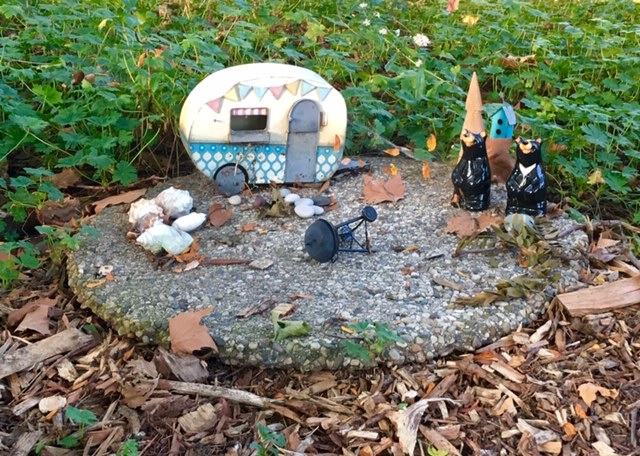
[Image Description: A mini tableau camping scene with a camper, an overturned grill, and bears!]
On Sunday, while driving in my car, I listened to an episode of the podcast Hidden Brain called You 2.0: Rebel With a Cause. The episode was about people who find themselves breaking rules that need to be broken. This includes people who live with a sense of openness. It allows for shifts in thinking and the cultivation of new possibilities in living and in problem solving. For a portion of the episode, they talked about the concept of Beginner’s Mind.
Beginner’s Mind, or Shoshin, comes from Zen Buddhism. The Zen monk and teacher Shunryu Suzuki says, “In the beginner’s mind there are many possibilities, but in the expert’s there are few.” When we approach life with a sense of newness, we can learn, grow, and view more possibilities.
Last night, I experienced this in a small but refreshing way. I stepped outside of the house and walked outside around the block, something I’ve done more times than I can count. But this time, I walked the block counter-clockwise instead of my typical clockwise. It wasn’t the first time I had done so, but I hadn’t walked in this direction in a very long time.
And I noticed so many different details in the neighborhood!
My favorite previously unnoticed detail was an adorable, mini tableau camping scene outside of a neighbor’s house.
There’s a lot to notice. We just need to begin again. There are a lot of possibilities.
Image Description: Renee and Suzanne have their heads together for a selfie, each holding a brown cup of coffee to their lips.
Two Tuesdays ago, my dear friend Suzanne died.
Suzanne had multiple myeloma for nine years, and throughout her diagnosis, if there was ever an example of someone who lived fully and abundantly, it was her. Even now, that is ever on display through the sheer number of people who have traveled to Michigan or made their presence known on social media to give testimony about her role in their lives.
Suzanne was also my primary partner in forming the vision for the Michigan Nones and Dones Community. She was present at that magical first meeting in January 2016 which launched the community into being. Always the extrovert, in the years to come, Suzanne was wonderful at welcoming new people and inviting others. It just came so naturally to her.
I will miss her deeply, and I will think of her so often.
Her illness progressed rapidly in her last six months of life. At the beginning of that time, she was in Chicago for a month, seeking to be in a medical trial. Her doctors could not get her platelets into the parameters for the study, and sadly, she had to return home. While she was there, however, so many people traveled to Chicago to care for her. And when she came home and had another stint in the University of Michigan Hospital, she was able to go home to her apartment because doctors trusted the large number of loving people in Suzanne’s life to be with her 24/7 around the clock. We did that collectively. We used a care app to coordinate it.
Suzanne cultivated this kind of love around her. She was not only an example of one who loves abundantly; she provided an abundant example of how to receive love and care. We are all deserving of this, and Suzanne was such a tremendous model of it.
Suzanne made the decision to receive hospice care on a Friday. I saw her the next day, and I’m so glad for it. I didn’t expect that she would die four days later. In that window of time — Friday through Tuesday — all of Suzanne’s people participated in something beautiful. On the care app, we all told Suzanne what we promise.
I promise…
Suzanne’s large, abundant community told her how they would remember her. Memories, foods, inside jokes… They also filled in those words — I promise… — by sharing the ways they would put her legacy and impact into action for the rest of their lives.
And I thought, “Oh, what a gift…” How wonderful it is to have the occasion to speak such promises to a beloved person. Suzanne was so deserving of hearing those things.
I find myself reflecting on how often those words go unsaid. Perhaps I can make an additional promise to Suzanne by saying those kinds of words to others too.
Image Description: A cardinal is perched on a stump with trees and snow in the background. Public Domain.
Last week, I spent some time in the waiting room for a doctor’s visit… like a lot of time. Waiting. Usually, it doesn’t take this long — something my doctor also confirmed once he was able to see me.
For a while, I just sat in silence. I brought a book, but I think I just needed a bit of time to decompress and think of very little. The truth is, I had had a lot on my mind over the last few days. All of that was still there, of course, so I sat there while silence accompanied my still emerging thoughts. That and daytime television.
Then a man approached my side of the room, and he sat directly to my left. He had a walker. I soon realized the walker was for his wife who came immediately behind him. She moved to sit directly to my right, so before she sat, I asked,
“Would you like this seat?” wondering if they’d rather sit directly next to each other.
“Oh no, honey, this is just fine.”
Suddenly, I was sandwiched between Bob and Sue, two older adults, who were much better at accompanying me than the silence. For the next twenty minutes, I honestly felt wonderfully grandparented, as they delighted in talking with me. Bob told me his creative strategy to get telemarketers to stop calling. Sue told me that she knows one of my neighbors. They both shared why they keep choosing this medical clinic. They inquired about me. I felt so enjoyed, and I enjoyed them too.
At one point, while flipping through magazines, Sue saw a picture of a cardinal and said, “Aren’t they so pretty?”
“Yes, I love them,” I said, thinking about the ones who fly into my yard and how they’re my university mascot as well.
“You know, I’ve never seen a baby cardinal. I wonder what they look like.”
“I’ll look it up,” I said, pulling out my phone.
They chuckled at the marvel of it, that we could look that up on a phone. “These young people know how to do it,” Bob said. I smiled, enjoying being relationally young, though I’m just a couple years shy of forty.
“Oh, here it is. Look at that!” I said. It turns out that baby cardinals are pretty cute. We passed my phone around to see.
A few minutes later, a medical assistant spoke their names, and Bob and Sue were called to the back before I was. When they stood up to shuffle to their visit, I felt different.
There are many ways that kindness and delight can show up, surprisingly, even in times of stress. We just have to show up to it. Or sometimes… let it just find us.
*I changed the names of this wonderful couple. I will remember them by their real names for a long time.
Image Description: A very long, brown table with brown chairs with red table settings. The table is located in a room with white, cinderblock walls and a large number of windows. Florescent lights are hanging above the table.
This sermon was preached at Northside Presbyterian Church in Ann Arbor, Michigan and was focused upon the story told in Luke 14:1-14. An audio recording is above and a written manuscript is below.
Well, one thing is for sure: Jesus is no Emily Post.
Throughout the gospels, I marvel sometimes at how frank Jesus can be — how he can upend the social order by sharing new ways of being, new ways of interacting.
So here he is, seeming to give advice about how to host a dinner party while he’s at a dinner party. He looks over at the host and says these things in front of the guests. I wonder if that was uncomfortable.
Of course, no one was engaging Jesus as an advice columnist. Instead, when our passage begins today, we hear this opening statement: “On one occasion when Jesus was going to the house of one of the leaders of the Pharisees to eat a meal on the Sabbath, they were watching him closely.” This seems to set the scene in some way.
Jesus was often watched closely by the powerful and marginalized alike. Sometimes, people sought to entrap him and catch him in his words. And many times, among the powerful and among the marginalized, people looked to him to speak words of wisdom and speak in empowering ways. People were drawn to him, and people resisted him. In both cases, Jesus was watched.
Jesus was being watched on his way to this dinner party, and as he was going there, Jesus saw a man with dropsy. And he asked a question to those who were watching him. “Is it lawful to cure people on the Sabbath or not?” That was his question.
Now I have to admit that I get very uncomfortable with the thought that Jesus just spotted this man with an illness and began to use him as a test case in a way on the spot. After he asked that question — “Is it lawful to cure people on the Sabbath or not?” — it seems that there was an interesting silence, both from the man with dropsy and those who were watching.
In the midst of this silence, Jesus then heals the man and answers his question with a different question. “If one of you has a child or an ox that falls into a well, will you not immediately pull it out on a Sabbath day?” There was more silence. They could not reply to this.
Of course, the answer was obvious. Of course, they would do that — when it is their child in trouble, when it is their child separated and alone, when it is their ox in trouble, when it is their ox separate and alone… the answer seems to be different.
And so Jesus uplifts the intrinsic worth of neighbors — those who are experiencing trouble and those who continue to be separated off because of the ways that people structure society. Jesus uplifts this human worth and belonging, privileging these things more than legality. And that is something that is certainly relevant for these days we are living.
Jesus arrives at the dinner party, and the texts says that he notices things. He notices how the guests are seated and speaks a parable. “For all those who exalt themselves will be humbled, and those who humble themselves will be exalted,” he concludes.
Then this is the moment when he turns to the host and says, “When you give a luncheon or a dinner, don’t invite your friends, or your brothers, or your relatives, or your rich neighbors in case they may invite you in return, and you will be repaid.” I sort of wonder what this might have felt like when Jesus moved from a parable toward being this direct.
When he says, “Don’t invite your friends, or your brothers, or your relatives, or your rich neighbors,” I almost imagine that he could have gestured toward specific people because there were likely friends with names, and the host’s brothers with names, relatives with names, and rich neighbors with names, sitting right there.
“But when you give a banquet, invite the poor, and the crippled, and the lame, and the blind, for they cannot repay you,” at least not in the kinds of ways that were expected here. These dinner parties had certain social expectations attached. Sometimes this could involve climbing up a social ladder, or even a quid pro quo of sorts.
Again, Jesus is uplifting the intrinsic worth of neighbors. He uplifts the poor and people with disabilities who were so often separated off and excluded from community-belonging, resources, and care.
People were ready to react harshly against Jesus for healing on the Sabbath. They were willing to uplift that above the worth of their neighbor with dropsy, a person who blended into the social fabric of not being noticed, or perhaps noticed in a way that normalized being disposed of. Jesus is talking about something different. Jesus is talking about upending all of that because in the Kingdom of God, community-belonging is expansive enough for everyone to have that wonderful experience of having their worth mirrored to them, along with having the resources they need, along with receiving the care and connection they need. We all need this.
And of course, it brings us to asking, who is excluded in this way right now? Who tends to go unnoticed? Or perhaps noticed but separated and disposed of in ways that have become normalized?
I listened to a couple of lectionary podcasts this week that I really love, and I gained a lot of insight from those, but when it got to this question of who is excluded, I thought it was frustrating that in both podcasts, people right named a lot of marginalized people but didn’t actually name people with disabilities, even though disability is a major framework for this passage. And it’s relevant now too. Houses of worship have a formal exemption in complying with the Americans With Disabilities Act, and because of that, we have all sorts of churches and houses of worship that completely inaccessible to disabled people — folks who deserve belonging, community care, and opportunities to participate and lead just like everyone else.
And from here, we can expand more. Who is it that we tend to separate off? It wouldn’t be hard to name those who are houseless; those who are gay, lesbian, bisexual, transgender, and queer; those who are incarcerated and those who are formally incarcerated; those who are immigrants; those who have no legal status according to that framework, and yet those who belong to the household of God; and those who don’t know where their next meal is coming from.
Jesus is upending all of these things and creating a different vision where belonging is not about transaction, or climbing some sort of social ladder, or a quid pro quo, but really about truly giving and receiving because we belong to one another, and our vision is expansive, where everyone can have what they need and everyone can contribute.
This is a different vision. It is the vision of the Kingdom of God where kinship expands, where all is held in and through a loving God who has created us and invites us to co-create each other, forming each other and caring for each other. This vision can be central to our lives. It changes everything.
And with this vision in mind, I want to close with some words from Aric Clark, a Presbyterian minister who lives in Portland, Oregon. He’s also the Co-Moderator of the Presbyterian Peace Fellowship.
He says,
“For a moment, imagine everything you possess turned into cash and set in a pile near a street. Everything in your bank account(s), any equity you have in a home, any value in your cars or other goods, any investments or retirement accounts. Everything. Stacked up in hundred dollar bills by the sidewalk.
“Now imagine you are asked to go take a nap and leave that pile, however modest or large, unguarded. I know I couldn’t do it. My mind wouldn’t stop worrying about that pile. It could rain. The wind could blow. Someone could take it.
“This is what it means that where your treasure is, there your heart will be also. We are helplessly drawn into the orbit of our possessions by the gravity of our preoccupation with securing our future. When Jesus tells us to sell our goods and give it to the poor it is in order that our heart might be with the poor, that our center of gravity might be moved into alignment with God’s trajectory for the world.
“Don’t mistake this as only a moral curative for greed. Even more important is the way it liberates us from fear. Can you feel how heavy that fear for your security is? Our society demands we be useful and productive. Tells us we’re on our own. If we don’t make our own living somehow everyone will just watch us starve. Watch us drown in our own futility. It’s happening everyday. There’s enough food. There are enough houses. But people are hungry and houseless all around us. To make sure that won’t be us or our children we hoard and we arm ourselves to protect our hoards and it’s exhausting and terrifying. We’re all EXHAUSTED and TERRIFIED, can you feel it?
“What if I told you that you don’t have to feel that way? That your future was never yours to secure. That there’s enough for you and me and everyone else. Enough for those families in cages at our border. Enough for the thousands sleeping on our streets each night. Enough for everyone. And you don’t have to fight for it or protect it.
“In fact, if you give up securing your future and instead give your energy and concern to your neighbors, and to the land you live on, if you work to ensure they have enough and the land can regenerate, you may discover that these things, community and land, are purses that don’t diminish, immune to thieves and rust and moths. If the houseless and the refugees are alright in your community then you will be alright. If the wildlife and the watershed are healthy in your area then you will be healthy. If the widows and the orphans in your village aren’t lonely, then you won’t be lonely.
“Can you set down your fear with me? Can you let go of your goods and trust your community and the providence of God to secure your future? Can we make each other and this land we live in our treasure, our heart? Can we imagine being that free?”
What if Northside Presbyterian Church were that free? What if we were that free?
Image Description: Ricardo Semler is giving a Ted Talk. He’s wearing a pink, button-up shirt, and a brown blazer. He’s holding some notes, looking up, and his right hand is gesturing.
Ricardo Semler, CEO and majority owner of Semco Partners, is known for implementing creative reforms in the areas of workplace culture and education. He also has an intriguing personal practice:
For years, Ricardo Semler has declared Mondays and Thursdays to be his “Terminal Days.”
These two days of the week are dedicated to prioritizing what he would be doing if he were to learn that he has a terminal diagnosis. The decision to label 28.5% of the week “Terminal Days” might seem rather grim to many of us. In fact, he says that his wife does not like the term. But without question, his personal commitment to this practice has been life-giving.
He says, “On Mondays and Thursdays, I learn how to die. I call them my terminal days. . . one day I could be sitting in front of a doctor who looks at my exams and says, ‘Ricardo, things don’t look very good. You have six months or a year to live.’ And you start thinking about what you would do with this time. And you say, ‘I’m going to spend more time with the kids. I’m going to visit these places. I’m going to go up and down mountains and places, and I’m going to do the things I didn’t do when I had the time.
“But of course, we know these are very bittersweet memories we’re going to have. It’s going to be very difficult to do. You spend a good part of the time crying, probably. So I said, I’m going to do something else. Every Monday and Thursday, I’m going to use my terminal days. And I will do, during those days, whatever it is I was going to do if I received that piece of news.”
One of the things I admire about Ricardo Semler, which you will notice also if you watch the TED Talk above, is that he has spent his life working to reform systems – including the workplace culture of his own company – so that others have the freedom to prioritize their lives in similar ways.
We don’t all have the privilege or opportunity to step away from work two additional days each week, and we can’t all afford to travel the globe. But all of this makes me wonder, what can we do? What is in the realm of possibility, and which choices are ours to make?
Most importantly,
What do we want our lives to mean?
What do we want to prioritize?
What can we do with our time, so that we’re prioritizing these things now, rather than waiting for some event to wake us up to them?
Image Description: A person is standing at the edge of the ocean and looking outward. This person’s back is to the viewer. There are mountains in the background.
Wealth is not synonymous with worth.
Likewise,
Productivity is not synonymous with worth.
Productivity has never been the full measure of our lives, nor what it means to be human. But I think it’s quite possible to internalize the opposite.
Our culture conveys that productivity is the highest good, yet if we chase after it — I don’t merely mean working well in a meaningful way, but if we chase after it– we are rarely satisfied.
When it becomes the totality of our time or our self-understanding, we soon find that it is chasing us. In this mindset, no matter how much time we put into our labor, it is never enough.
It’s easy to internalize cultural beliefs around productivity. Yet truly, productivity is not synonymous with worth.
We do not need to reach a certain benchmark to be worthy of love, care, and belonging. We do not need an enormous salary to convey that we matter.
Yet as human beings, we need wholeness and fullness. Sometimes, this means that we need different experiences — rest, renewal, rejuvenation. Sometimes, this means that we need different parts of our brain to be active — the creative, the playful, the intuitive. These add to our own lives, and they also add to our communities.
I could make a parallel post to yesterday’s piece about having needs.
A great deal of cultural messaging says,
“Don’t speak up.”
“Keep that idea to yourself.” (or let me appropriate it…)
“Stay small.”
“Who are you to be in the room? Who are you to lead?”
These messages are sent especially to those with marginalized identities.
But shouldn’t we be suspicious? So frequently, aren’t the cultural forces and systems of greed, along with their benefactors, the loudest messengers in these directions?
But shouldn’t we be suspicious? So frequently, aren’t the cultural forces and systems of greed, along with their benefactors, the loudest messengers in these directions?
“Growing up with the message that ‘you’re not supposed to need other people’ is going to require a ton of shame to maintain — since it’s going against millions of years of human evolution in a species with a nervous system built exactly FOR: safety, connection, and relationship.”
Image from @notesfromyourtherapist on Instagram.
Image Description: The quote above is written on a sheet of white paper with black writing.
Image Description: Paper cut outs of people are standing in a line and holding hands. The image has different shades of orange with light shining through at the top.
We need care.
We all need nourishment, rest, play, connection, love, relaxation, personal growth, and the meeting of daily needs. These take time and intention.
These days, we hear a lot about self-care, but we need community-care too. I follow the lead here of BIPOC and disability justice activists who remind us that our relationships are intended to be interdependent, and that we can practice care toward one another, meeting each other’s needs with love, consent, respect, and empowerment.
When it comes to cultivating care for ourselves, both in our practices toward ourselves and in our making requests from others… some of us were socialized to feel as though care for ourselves is somehow selfish… that it is self-centered or that the prioritizing of time for our care somehow ‘takes’ from others.
Of course, when we seek to live toward an interdependent vision for our relationships, care for ourselves creates more vitality, resilience, and energy for our loved ones and the community as a whole. It aids more than ourselves alone.
But still, even if we know that, and even if we believe that, that old socialization can run deep.
So here’s a question I find myself thinking about…
When we cultivate care for ourselves, in our practices toward ourselves and in our asking for needs to be met by others,
what if we also thought about it as “selves-care”?
Does this framing help?
After all,
Don’t we find that we are meeting needs of our younger selves?
Don’t we find that we are creating more vitality for our future selves?
Doesn’t care do that for ourselves? Reach backward and forward?
Selves-Care: Loving and aiding our past and future selves. Loving and aiding our relationships and wider community. Is this helpful?
Image Description: A school lunch with a chicken salad sandwich, carrots, a pear, and a red and white carton of low-fat milk.
A public school district in Pennsylvania recently threatened parents with the possibility sending their children into foster care if they did not pay their school lunch debt. In the wake of this, multiple people have offered to pay the debt on behalf of all the families, but the school district has refused those offers.
Sometimes, greed isn’t about money. Sometimes, it’s about power, domination, and intimidation: