Have you ever found yourself wanting to articulate something that’s not quite complete. . . but in process? That’s how I feel about the topic I want to explore this week. If you’ve been following with me for a while, you can probably sense my inklings on this. I talk here and there about my desire for a “Horizontal Church.” What do I mean by that? Well, that’s in process, including in my own thinking, but I mean a community that is more participatory, more empowering of the collective body, and more shared in its leadership. I mean a church (likely, building-less) that views itself as community-alongside-a-community, always with neighbors and justice in mind. I mean a community that finds God and the sacred in everyday experience. These thoughts are all in process.
I’ll be doing some writing on this all week. But today, I want to begin with a re-post that can lay some groundwork. Does the shift from vertical to horizontal resonate with you?
Transcendent Horizon
Earlier this month, my husband and I spent a weekend in Petoskey, Michigan. This small town is located alongside Lake Michigan, and each night, if it’s not too cloudy, people can watch the sunset right over the lake. The view is stunning. Sometimes I forget how miraculous this is. . . The sun sets without fail every evening, yet no two views are the same.
The first night we were there, we saw a sunset unlike anything I’ve ever seen before. Just above the water, along the horizon, there was a thick, fiery band of light. No grand swirls in the sky; just one bright, luminous band.
A jetty was in front of us as well, and it contained a walkway toward a lighthouse. As we watched the evening light in the sky, two individuals came into view. One was walking toward the lighthouse, and the other was walking away from it. Though they did not know each other, their silhouettes met within this light of the horizon. It was gorgeous, and no photo did it justice.
Beautifully, it reminded me of a metaphor that Diana Butler Bass uses for God.
She says that throughout most of our human history, we have practiced a vertical spirituality. In our minds — and especially, in our unconscious minds — we tend to think of God as literally ‘up.’ God is up there. . . somewhere. Some of this thought is connected to Christian scriptures, but it’s also a vestige of having believed in a literal, three-tiered universe. God is up, far away in heaven. We are here. And below us lies some kind of netherworld.
Diana Butler Bass writes that for most of our history, religious institutions have functioned a bit like an elevator within that consciousness. They work to bring us closer to that distant God, who is up there. . . somewhere. In response, she says, we have built vertical hierarchies, and Church architecture often mirrors our vertical spirituality too.
Bass believes that we are experiencing a major shift these days. I also sense it. Do you? More and more, people are longing for a horizontal spirituality, a sense that God is with us in our everyday experiences.
. . .God with us on the ground. . . . God with us in our everyday lives. . . . God with us in the midst of suffering. . . . God with us in horizontal relationships,
connecting us in friendship and community,
connecting our world in justice and equity.
God with us. This conviction brings us back to the language of incarnation.
I recently heard Diana Butler Bass talking about these thoughts on a podcast. The hosts asked her if she might provide a particular image or metaphor to think God in a horizontal framework. I loved what she said.
She said, “Yes, actually, the horizon itself.” She mentioned that some have expressed concern that she’s de-emphasized the transcendence of God in her arguments — that is, God as holy, mighty, and mysterious. She said that the image of the horizon gives a different view of transcendence.
No matter how much we approach the horizon, it’s always before us, still a mystery. Yet it’s always with us on our plane.
I love it.
God with us.
Mysterious, yet incarnational,
an ever-present Horizon on our plane.
This sermon was preached at First Presbyterian Church in Howell, Michigan and is based on John 2:13-25. A recording is above, and the written text is below.
John 2:13-25
The Passover of the Jews was near, and Jesus went up to Jerusalem. In the temple he found people selling cattle, sheep, and doves, and the money changers seated at their tables. Making a whip of cords, he drove all of them out of the temple, both the sheep and the cattle. He also poured out the coins of the money changers and overturned their tables. He told those who were selling the doves, “Take these things out of here! Stop making my Father’s house a marketplace!” His disciples remembered that it was written, “Zeal for your house will consume me.” The Jews then said to him, “What sign can you show us for doing this?” Jesus answered them, “Destroy this temple, and in three days I will raise it up.” The Jews then said, “This temple has been under construction for forty-six years, and will you raise it up in three days?” But he was speaking of the temple of his body. After he was raised from the dead, his disciples remembered that he had said this; and they believed the scripture and the word that Jesus had spoken.
When he was in Jerusalem during the Passover festival, many believed in his name because they saw the signs that he was doing. But Jesus on his part would not entrust himself to them, because he knew all people and needed no one to testify about anyone; for he himself knew what was in everyone.
When I was a very young kid — maybe about 4 years old — I used to sit on the floor of my family’s living room and watch Sesame Street. Did any of you grow up watching Sesame Street? Maybe some of our kids do now. Well, decades ago, when I was one of those kiddos, Sesame Street often featured a particular song. I bet some of you know it. Sesame Street would show four objects. Three of them would be the same — identical, in fact — but one would be different.
Maybe you remember that song?
One of these things is not like the others, One of these things doesn’t belong, Can you tell which thing is not like the others, by the time we finish our song?
That song seems to apply this morning as we approach this story of Jesus entering the temple and driving out money changers. Now, of course, in an obvious sense, the scene is hardly comparable to Sesame Street. After all, Sesame Street involves adorable muppets who are learning and demonstrating how to get along. This scene, meanwhile, involves a mini stampede of animals and furious human beings who are driven out forcefully by an angry Jesus.
So what am I getting at here?
In one sense, the song does apply. Because this account of Jesus in the temple is the odd one out. Matthew, Mark, and Luke, the first three gospels, tell it in a particular way, but this version in John is different. One of these things is not like the others, and this version is that thing.
Matthew, Mark, and Luke tell the story of Jesus’ entry into the temple as part of the Holy Week narrative, toward the end of their gospels. Jesus rides into Jerusalem on a donkey, accompanied with loud shouts of Hosannas from the crowd. Soon after, he enters the temple and drives out the money changers.
But that’s not what happens here.
Notice the chapter number of this story. John, chapter 2, verses 13-25. This narrative is not embedded in the larger Holy Week story. In fact, this is a different Passover altogether. All of this takes place right at the beginning of John’s gospel. I wonder why that might be. . .?
Now every version of this story is forceful, no doubt. Jesus is angry about what he encounters in the temple. But admittedly, this version is more violent. In the other stories, Jesus overturns the tables and says, “Is it not written, ‘My house shall be called a house of prayer for all the nations, but you have made it a den of robbers.” In this account, Jesus does more than overturn tables. He pours out the coins of the money changers and drives people out with a whip of cords. “Take these things out of here!” he says. “Stop making my Father’s house a marketplace!”
In Matthew, Mark, and Luke, it is pretty clear that Jesus was angry about money changers and the ways they were extorting the people at the time. Here in John, Jesus decries the temple becoming a marketplace, but John also puts focus on a particular statement that the others do not include. John says, “His disciples remembered that it was written, ‘Zeal for your house will consume me.’” And John quotes Jesus as saying, “Destroy this temple, and in three days I will raise it up.” Some of the people around him begin to mock him, saying, “This temple has been under construction for forty-six years, and will you raise it up in three days?” “But he was speaking of the temple of his body,” John says. These statements are unique to this version of the narrative.
One of these is not like the others.
I wonder how this narrative might speak to us in a particular way today.
Every Gospel writer was writing to an audience, and John was no exception. He was writing to a particular community, likely even, a particular church. And it appears that this church community had a shared song, though a song of greater depth and wonder than any song from Sesame Street. Do you remember the very first words of the Gospel according John? It’s possible that they come from an ancient, church hymn. Do you remember this beautiful text?
In the beginning was the Word, and the Word was with God, And the Word was God.
And that opening text goes on to say,
The Word became flesh and lived among us, and we have seen his glory, the glory of a Father’s only son, full of grace and truth.
The Word — Jesus — is embodied. Wonder of wonders. . . God is embodied in Jesus. With us. Together, we can say that Jesus is a dwelling place of God.
“Destroy this temple, and in three days I will raise it up.” Some of the people around him began to mock him, saying, “This temple has been under construction for forty-six years, and will you raise it up in three days?” “But he was speaking of the temple of his body.”
Jesus is the dwelling place of God.
And not only that. God has been found to be among us. Wonder of wonders. . . we too are embodied, and God chooses to be present among us.
I like the translation that Eugene Peterson gives in The Message:
The Word became flesh and blood, and moved into the neighborhood. We saw the glory with our own eyes, the one-of-a-kind glory, like Father, like Son, Generous inside and out, true from start to finish.
The Word became flesh and blood, and moved into the neighborhood. With us. With human lives. With neighbors! Isn’t that what the neighborhood means? Jesus is the dwelling place of God, and our neighborhoods and our neighbors are the dwelling place of Jesus.
So is it any surprise really that John might place this story where he does, at the beginning?
Jesus loved the temple. He was an observant Jew, and it is important to remember tht. John says, “Zeal for your house will consume me.” But there was never a moment when Jesus walled himself off inside those walls. Jesus moved into the neighborhood and placed his focus on neighbors. He practiced love for the neighbors. . .
. . . uplifting the dignity of the poor and offering them bread,
. . . healing the ones who were cast out by society, in their bodies, in their relationships,
. . . defending those who were scapegoated and threatened with violence,
. . . welcoming the vulnerable, including children, and widows, and those especially marked by others as ‘sinners.’
Jesus is the dwelling place of God, and he chooses to dwell among the neighbors. This story — this odd-one-out version of the story — is a prelude for the Gospel itself. It moves toward the neighborhood.
Every Gospel writer writes to an audience, and John is no exception. We can’t know if he had others in mind. Perhaps he would have never imagined that these words would reach us today so distanced in culture and time. But how might they speak to us, particularly? How might they speak to First Presbyterian Church of Howell?
We know this much: We have never had a calling to wall ourselves off inside the walls of this church building. Sure, we value this building, and we care for it. But friends, hear this: These walls and this sanctuary have never been the Church. We are the Church — we. . . you and me. . . an embodied community. . . we are the Church.
And if we are going to follow Jesus, this dwelling place of God, this person of grace and truth, we must follow him into the neighborhood. We must place our focus on neighbors. We must practice love for the neighbors.
Do our neighbors experience us in this way? We hope so. But we can also be honest. So often, our neighbors see Christians doing everything we can to bolster the former institutional grandeur – of our buildings, our finances, our image, you name it. . . So often our neighbors see Christians working to bolster these institutional aspects of our collective life as we experience decline.
But why are we experiencing decline? It may not be just one thing, but perhaps our neighbors no longer believe that Christians love neighbors. Perhaps they see the Church at large trying to build itself — its buildings, its influence, maybe even its political power at the expense of protecting the lives of the vulnerable and scapegoated, rather than loving people where they are, loving people as the neighbors of Jesus, the neighbors of God.
So how might we remember our calling again? How might we hear it in a new way?
I don’t think it starts with anything abstract. I think it starts with the neighbors we know. I think it starts with the neighbors we know about. I think it involves an invitation to value those neighbors and learn from them.
It doesn’t start with anything abstract. It starts with God, but even God — the God we ponder with ideas, and big words, and theology; the God who in many ways is beyond our imagination — even God, this God, is not abstract. Because God has become enfleshed. Jesus is the dwelling place of God, and Jesus dwells among the neighbors.
So let’s start there, and let’s see what kind of story might unfold. Let’s see what kind of Gospel might unfold. Like this passage before us today, this invitation might also be a preview to what is to come — Gospel, a renewed vision, a renewed calling, and friends, a renewed following of Jesus, the dwelling place of God.
This week, I had the pleasure to attend a workshop led by John Vest at the Next Church national gathering. It was entitled, An Introduction to Cultivated Ministry: Bearing Fruit through Theology, Accountability, Learning, and Storytelling.
This workshop is connected to an ongoing project and movement within Next Church, considering how we might shift our framework for assessing the visions and directions of ministry and community life together.
The Cultivated Ministry project began when some creative leaders gathered to talk about the ways that we support (or struggle to support) new ministry initiatives. Here are some of the themes that emerged. In this conversation. . .
One of these leaders compared the process to the Hunger Games and said, “You come up with a good — even proven — ministry, and everyone is excited about it. When you ask for help in paying for it, there are three larger churches and a couple of grant programs to go to and these creative ministries end up fighting each other to our own death to get any final resources.”
Touché. I know what this is like personally.
Soon after, a pastor of a large congregation with a multi-million-dollar budget said, “What I hear you asking for is a blank check, and we simply can’t give that to you. In a season where we have many resources, but are facing budget cuts of our own and laying off staff, we have to justify every dollar we spend.”
Another leader spoke up and said, “Our presbytery has money to fund new ventures but we expect them to be growing numerically and financially sustainable within five years.”
“What if we’re working in a community that is financially incapable of being self-sustaining?” someone chimed up.
All of these quotes directly come from the new Cultivated Ministry booklet (it’s a really good resource!) and are a summary of themes that often come up when discussing ways to support and finance new ministry initiatives.
The challenge is often this: The typical metrics for evaluating and supporting ministries are inadequate, and they have not been replaced with new ones. That is what Cultivating Ministry seeks to do.
Let me say more. . .
When it comes to existing churches and new ministry initiatives alike, we often evaluate effectiveness through membership counts, financial totals, and worship attendance. But these are not always good measuring tools, nor are they often what are most fruitful in the life of a shared vision.
In the workshop at Next Church, John Vest shared that we place the expectations of these traditional metrics upon new initiatives and new communities (including whether or not we will fund them) when many of our existing churches cannot meet the expectations of those very same metrics.
The Cultivated Ministry project seeks to provide different metrics. They are. . .
Theology
Mutual Accountability
Learning
Storytelling
Theology – In this workshop, John Vest said, “We often know the the what and the how of what we’re doing, but we don’t always know the why. If you don’t have a theological reason for what you’re doing, come up with one, or do something else.” The shared convictions of our theology can inform and enrich our directions. We are invited into spiritual imagination together.
Mutual Accountability – Likewise, we are invited into a teamwork approach of mutual support and accountability. Notice the word mutual. So often, we consider ‘accountability’ to flow in only one direction, with one group or entity holding sole evaluation power. But we need to be partners. Ministry leaders need to tell the story of what they are doing, and larger communities need to ask how they can best come alongside these new initiatives. The Cultivated Ministry booklet says, “Mutual accountability is a continuous cycle of inviting participation, developing clarity, acting, reflecting, evaluating, and acting again.”
Learning – Discernment is always a crucial element in the Cultivating Ministry process. As a part of discernment, we can ask vital questions to help us consider our impact. If we are not reflecting, learning, and growing regularly, we can get into a rut of merely counting outputs. Outputs are not the same as impact. I think this statement is especially important when it comes to assessment: “The key to making this paradigm shift is understanding that learning is the primary goal of assessment. In a learning-driven approach to assessment, we shift from history to vision, from outputs to impact, from reality to in-breaking possibility. We assess what we have done, not as justification for continued practice, but as the springboard to future innovation.”
Storytelling – Stories help us understand where we came from and where we’re going. Likewise, stories help us make meaning. Stories help connect us and bring us together for shared belonging and shared work. “When we make Cultivated Ministry a priority, it becomes clear that not only do we need ways of gathering information about the effectiveness of our ministry, we must also learn to use that information to tell stories that matter — stories of impact and stories of transformation. Without these stories, we can collect all the quantitative data we want, but it won’t lead to the deep cultural and organizational adaptations we need to fulfill our mission in rapidly changing contexts.
We can change our metrics. We can become better partners. We can do ministry with more intention. We can do ministry with better support.
The Cultivated Ministry project can help with all of these.
During the opening worship service of the Next Church national gathering, someone voiced a phrase right before our time of collective confession. I am going to remember it for a long time. It’s simple, but ultimately, such a reframing.
The leader said,
“We are held in a love we are not required to deserve.”
Oh, that’s so good. So good! Not just as a phrase but an orientation. Suddenly, when pondering love, forgiveness, belonging, or a myriad of other things, all those questions about deserve-dness (are we deserving? are we not?) are just completely off the table.
Because this is a love we are not even required to deserve.
I love that. I will use it in worship. I will say it to myself and others.
Not of one experience, but multiple experiences — from different chapters of my life; some prolonged, some swift and sudden in ways that utterly knocked the breath out of me.
Yes, I am a trauma survivor.
And I will say something else quite clearly. In fact, if you lean in a little, you will hear these words with a tremendous amount of strength.
I am not ashamed of who I am.
You might even hear a tinge of joy.
I am not ashamed of who I am!
You will definitely hear some power. And perhaps, willful snark. Today, these words are posted on a blog, but when I say them in any context, or even simply think them, I assure you, they resound in multiple directions. After all, when you are a trauma survivor, the world likes to tell you should bear shame simply because you are carrying the story of what you experienced. But I refuse to bear shame. I refuse.
Power and snark — hear it!
I am not ashamed of who I am.
Yesterday, I attended a workshop on trauma and confession at the Next Church national gathering. It was led masterfully by McKenna Lewellen. She studies trauma and places it in conversation with theology, worship practice, congregational care, and neighborhood care.
McKenna Lewellen shared that so often in Presbyterian worship (my tradition) we speak Prayers of Confession from the perspective of those who have wounded our neighbors. This is vital, of course. We need to own our complicity.
But we do not often hear prayers that voice the perspectives of neighbors who have been wounded. She says that confession involves “speaking the truth about our lives.” We are leaving something out if we never make space to hear the voices and perspectives of those harmed. By the way, this might include us too. Confession can also name the ways we bear burdens of having been sinned against.
My suspicion is this:
In church cultures, we are often willing to pray about the ways we cause harm generally, but we are not always willing to hear specific stories of harm. We don’t want to grapple with them. We want to silence people and stories because these might impact us, or even change us. We might have to acknowledge our privilege. We might have to experience disruption in our comfort and routine. We might have to acknowledge that we choose to protect and insulate people in power — individuals and entire groups — often at abusive costs, because that power structure benefits us in some way.
Trauma survivors often bear shame, not only because trauma is isolating in itself, but because entire systems work to ensure, both consciously and unconsciously, that folks bear their experiences alone. As we discussed in this workshop yesterday, systems and the communities behind them (family systems, workplace systems, church systems, national systems, etc.) often compound the pain of trauma by treating the wounded as though they are themselves perpetrators, simply because they bear a story and are now a ‘threat’ to the truth coming out. This can happen with individuals or entire communities experiencing oppression (racism and white supremacy are essential to this conversation). This is, in a word, scapegoating.
Confession involves “telling the truth about our lives.” With the right kind of care, intention, and support, always mindful to be led by the voices and agency of those harmed, we can make space for this in our communities, including in our worshiping communities. We can even make space in our actual experiences of worship.
And speaking of worship, I notice that the word Confession is actually used in two ways in my faith tradition. It is both an opportunity to pray about sin and wrongdoing, and an opportunity to say what we believe.
This week, I’m in Baltimore for the national gathering of Next Church. Next Church is a conference and a movement within the Presbyterian Church (U.S.A.) that seeks to ponder and act upon new visions for Church and collective life. As a part of this movement, we ponder innovation, community-building, and concerns of justice in our nation and world. Who are we, and who are we called to become?
Over the next few days, I’ll share some of what I’m learning here. But for now, if you’d like to learn more about all of this, come visit this page.
And wherever you are, and whatever you’re pondering today, I hope that you are stretched and encouraged, just as we are!
I’ve written about this before, but it’s on my mind again this week, so I thought I’d share it once more. I love a particular quote from Frederick Buechner.
This quote has been voiced during milestone events in my life and the lives of people I love. I first heard it when a loved one spoke it aloud to frame my ordination service (that was so meaningful). I have voiced it when I’ve officiated weddings. I wrote it at the beginning of someone’s commencement letter.
There’s something special about this because the quote has become communitied. Ordination services, and weddings, and commencements. . . A whole bunch of people in my wider community know this quote and hold it dear. Here it is:
In the entire history of the universe, let alone in your own history, there has never been another day just like today, and there will never be another just like it again. Today is the point to which all your yesterdays have been leading since the hour of your birth. It is the point from which all your tomorrows will proceed until the hour of your death. If you were aware of how precious today is, you could hardly live through it. Unless you are aware of how precious it is, you can hardly be said to be living at all.
Yes, this is great for milestone days.
But also. . . Frederick Buechner didn’t write this about milestone days. His point is that every day — every single today — is this unique. Every day is a hinge moment. Every day is precious.
So every day this week, I’ve said this quote aloud first thing in the morning. I’ve invited this to frame my days. It doesn’t mean that every day is easy. I’ve actually waded through some challenges this week. It just means that every day is particular. Every day has value. Every day can teach us.
On Monday, I was a powerhouse of productivity. I worked through my entire to-do list. But not only that. Each time I finished an activity, I asked, “What should be the next step?” and from that question, I made a new list. Then, I finished that entire second list too. I had lots of energy, resulting in a plethora of check marks on paper.
Then, on Tuesday, I did no work at all. I still had energy, but it was a different kind of energy. I woke up thinking I was going to follow the same trajectory. But every time I sat down to begin, I just couldn’t get going. At first, I was frustrated. I have things that need to be done, and it certainly feels good to move through them. But then, I realized I needed a different kind of space. I needed to let go of a narrative that says, “Productivity is always better.”
Over the last few months, our wider family has experienced unexpected diagnoses and losses. It’s been a lot. On Tuesday, I just needed to tend to some space for that. It wasn’t all sad, actually. It was mostly connective. I felt a lot of love yesterday as I connected with loved ones — about these things, about other meaningful things.
Sometimes, we need to let go of a particular narrative and make space for one that is more foundational to who we are or what we need.
And boy, “Productivity is always better,” can really get in our way, can’t it? That’s a narrative we’ve often internalized. We live in a capitalist culture that tells our our worth lies in what we can produce. Whether we ourselves are Protestants or not, we live in a culture that has been influenced by the Protestant work ethic. I additionally live in a university town where imposter syndrome dynamics are nearly always at work.
“Who are you, and what do you do?”
That’s a question we might ask aloud. But within this narrative lie other questions, often asked of ourselves:
How much time do you work?
How busy are you, and how is that a badge of worth?
How much did you accomplish today?
How does my work compare to yours?
How does my organization compare to others?
Productivity can be fun, especially when it’s connected to what’s most meaningful in our lives. But “Productivity is always better”? Yeah, I have gratitude that we can kick that to the curb.
During this season, I’ve been thinking a great deal about gratitude and living more fully in the present moment.
I have found this to be true:
Gratitude helps us
hold lightly, and
hold deeply.
These two things at once.
Perhaps it sounds a bit cheesy to pair those words together, a mantra of sorts, but I have found such a paradox to be true.
The practice of gratitude helps us hold experiences lightly, because we recognize that all things are constantly changing. Gratitude doesn’t seek to control people, situations, or outcomes. Instead, we can receive from all of these as they change.
The practice of gratitude helps us hold experiences deeply, because we recognize their value and are fully present. Gratitude connects us deeply with our daily lives and most especially, people. Gratitude strengthens connections and bonds.
I wonder what’s possible if we practice gratitude more intentionally?
I participated in leading worship at Northside Presbyterian Church yesterday, a congregation that always has an extended period of time for children in the midst of their worship service. It’s called Children’s Storytime, and it’s typically interactive in some way. Yesterday, this ended up being true in a playful way, and it impacted the service over all. That’s because Northside Presbyterian Church met a new friend — one, particular stinkbug.
While sitting on the floor with the kids, I asked them if they noticed anything different about the sanctuary. They did. The chairs were facing a different direction, and the color purple was displayed in a few places. I was wearing a purple stole myself, and I asked the kids if they wanted to each put it on. “We’re all ministers,” I said.
Then I asked the kids if they knew why some of these things had changed. “It’s Lent!” I answered. I went on to talk about seasons. I asked about the seasons we typically have outside, and then I shared that the church has seasons too.
“You know, on may way here, I saw that some of the snow has melted, and I could see the grass. Have you ever had winters — or maybe certain parts of the winter — where the snow is so big that you don’t see grass for a long time?”
“Yeah,” they said.
“Sometimes, it can feel like we won’t ever see the grass again. But we will. It’s always there. You know, a lot changes inside our church sanctuary with church seasons, but one thing is always the same. We just find ways different ways of saying it. It’s that God loves us, all the time, no matter what. And we’re invited to love each other, all the time, no matter what.”
And that’s when a five year old said,
“Hey, guess what? There’s a stinkbug!”
Sure enough, there was a stinkbug crawling up the leg of the chair next to us.
“Should we tell this stinkbug that God loves stinkbugs? All the time?” I asked.
“I’m gonna tell him that it’s Lent!” the five year old said.
“Great!”
“IT’S LENT!” he said enthusiastically, though it was more of a loud whisper than a yell.
Ah, a chance to practice proclamation playfully! We’re all ministers after all.
After this time together, the kids went downstairs, and service took a serious turn as we addressed last week’s gun violence. But, believe it or not, we weren’t finished with the spontaneity of this particular stinkbug.
Whenever we prepare to receive an offering, in addition to giving resources in the moment, I always invite people to meditate on how they feel called to offer themselves this week in a sense of calling. I said something like that before we passed the plates. Then the music started.
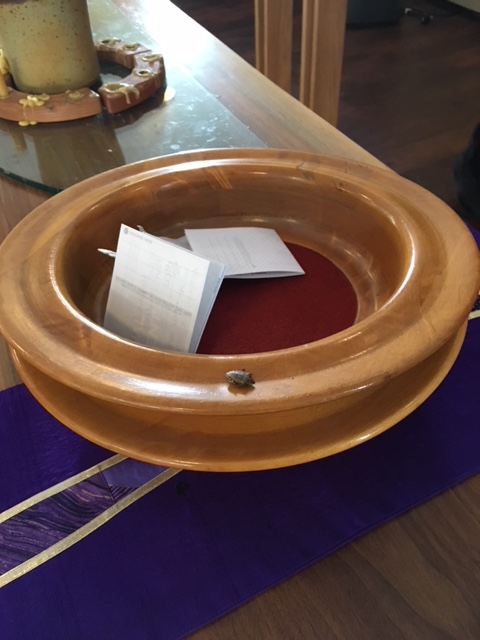
After the offering was received, we all sang the Doxology, and I prayed in front of the person who held the offering plates. As soon as that was finished though, she then turned around and said to everyone. “I have to tell you this. The stinkbug is in the offering plate.”
Sure enough, the stinkbug was in there, crawling through the money, becoming an offering.
Then, as the service was ending, I gave a benediction while the stinkbug was walked around the rim of the offering plate. These are the kinds of experiences you can never plan. I’m so grateful for spontaneity! I’m so grateful that proclamation can start with play.